
Recent from talks
Type 89 grenade discharger
Knowledge base stats:
Talk channels stats:
Members stats:
Type 89 grenade discharger
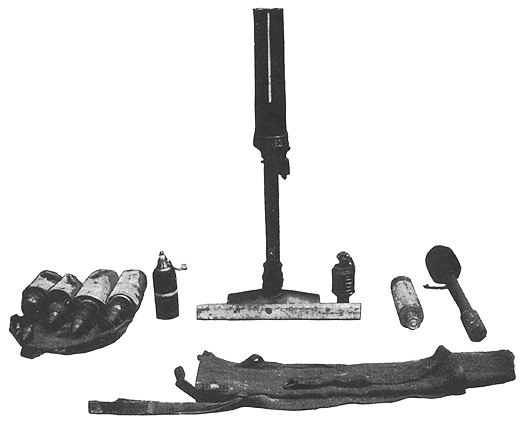
The Type 89 grenade discharger (八九式重擲弾筒, Hachikyū-shiki jū-tekidantō), inaccurately and colloquially known as a knee mortar by Allied forces, is a Japanese grenade launcher or light mortar that was widely used in the Pacific Theater of World War II.
The Japanese Army, noting that grenades were short-ranged weapons, began efforts to optimize these weapons for close-in infantry fighting.
After studying employment of grenades and mortars on the battlefield, the Japanese Army developed hand grenades, rifle grenades, and grenade and mortar shell dischargers (small mortars) suited to warfare in typical short-range combat environments such as urban, trench, and jungle warfare.
As part of this effort, by 1932, the Japanese Army had adopted a set of fragmentation grenades with almost universal adaptability.
The Type 91 fragmentation grenade could be thrown by hand, fired from a spigot-type launcher, or used in a mortar-like grenade discharger, the Type 89.
The Type 89 heavy grenade discharger was adopted in 1929, but production did not begin until 1932. It differs from the earlier Type 10 grenade discharger in that it has a longer rifled barrel.
The Type 89 could fire two types of high explosive grenades or shells: the Type 91 grenade, which was a normal infantry fragmentation grenade adapted to the Type 89 discharger, and the 0.91 kg (~2 lb) Type 89 50 mm shell, which was an impact-detonated shell with considerably more explosive power.
Like its predecessor, the Type 10 grenade launcher, the Type 89 grenade launcher was also used as a signal flare device.
Hub AI
Type 89 grenade discharger AI simulator
(@Type 89 grenade discharger_simulator)
Type 89 grenade discharger
The Type 89 grenade discharger (八九式重擲弾筒, Hachikyū-shiki jū-tekidantō), inaccurately and colloquially known as a knee mortar by Allied forces, is a Japanese grenade launcher or light mortar that was widely used in the Pacific Theater of World War II.
The Japanese Army, noting that grenades were short-ranged weapons, began efforts to optimize these weapons for close-in infantry fighting.
After studying employment of grenades and mortars on the battlefield, the Japanese Army developed hand grenades, rifle grenades, and grenade and mortar shell dischargers (small mortars) suited to warfare in typical short-range combat environments such as urban, trench, and jungle warfare.
As part of this effort, by 1932, the Japanese Army had adopted a set of fragmentation grenades with almost universal adaptability.
The Type 91 fragmentation grenade could be thrown by hand, fired from a spigot-type launcher, or used in a mortar-like grenade discharger, the Type 89.
The Type 89 heavy grenade discharger was adopted in 1929, but production did not begin until 1932. It differs from the earlier Type 10 grenade discharger in that it has a longer rifled barrel.
The Type 89 could fire two types of high explosive grenades or shells: the Type 91 grenade, which was a normal infantry fragmentation grenade adapted to the Type 89 discharger, and the 0.91 kg (~2 lb) Type 89 50 mm shell, which was an impact-detonated shell with considerably more explosive power.
Like its predecessor, the Type 10 grenade launcher, the Type 89 grenade launcher was also used as a signal flare device.
Recent media