Hubbry Logo
Type 91 grenadeType 91 grenadeMain
Open search
Type 91 grenade
Community hub
Type 91 grenade
logo
8 pages, 0 posts
0 subscribers
Be the first to start a discussion here.
Type 91 grenade
Type 91 grenade
from Wikipedia

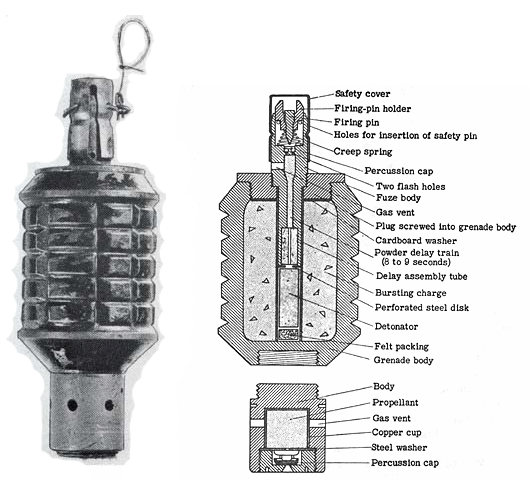
The Type 91 hand grenade (九一式手榴弾, Kyūichi-shiki Teryūdan) was an improved version of the Type 10 fragmentation hand grenade/rifle grenade of the Imperial Japanese Army.

Key Information

History

[edit]

The Japanese Army, noting that grenades were short-ranged weapons, began efforts to optimize these weapons for close-in infantry fighting. The first hand-thrown fragmentation grenade was the Type 10.

Soon after introduction of the Type 10 grenade to front line combat troops, a number of issues arose. When hand-thrown, instability and inaccuracy of the fuse mechanism made the Type 10 almost as much of a menace to the thrower as to the recipient. Furthermore, the weapon was regarded as undersized, and lacked desired lethality.

The Japanese Army continued to experiment with rifle and hand-thrown grenades between the wars and would adopt a family of fragmentation grenades with almost universal adaptability.

However, the Type 91, as well as other Japanese hand grenades suffered from faults in manufacturing and production of the fuse, grenade body, and explosive compound, resulting in inconsistent detonation, variable fuse burning times, and incomplete or variable fragmentation of the grenade body. During the war, these manufacturing issues remained unresolved.[1]

Aftermath

[edit]

Although superseded as a hand-thrown weapon by the Type 97 by the start of World War II it was still used by units in the Second Sino-Japanese War and by reserve forces, as well as the Japanese Navy's Special Naval Landing Forces.[2]

Design

[edit]

Introduced in 1931, the Type 91 fragmentation grenade could be thrown by hand, fired from a cup-type grenade launcher (the Type 100), discharged by a lightweight mortar-like projector (the Type 89, or knee mortar),[3] or fitted with finned tail-assembly and fired from a spigot-type rifle grenade launcher.

The design of the Type 91 grenade was almost identical to the earlier Type 10.

The main difference was the Type 91's domed top as opposed to the Type 10's serrated top. As with the Type 10, a threaded socket in the bottom of the body allowed for the attachment of an auxiliary propellant canister for use in a Type 89 grenade discharger.

The fuse was a percussion-activated delay type, initiated by pulling out a safety pin and striking the top of the cap.

The grenade incorporated a 7–8 second delay before detonation. This feature was incorporated as part of the Type 91's other uses as a rifle grenade or as a shell fired from the Type 89 grenade discharger, as the long delay enabled longer time-in-flight to distant targets.[4]

When used as a rifle grenade the fuse activated automatically, as the plunger was pushed in against a weak creep spring by the force of the launch. Additionally, the Type 91 could be used as a booby trap by removing the safety pin and setting under a floorboard or chair.[5]

Accessories

[edit]

The Japanese military used spigot-type grenade launchers.

These grenade launchers were used by Japanese Naval Landing Forces to launch an anti-tank (hollow-charge) finned grenade. They were also used to propel Type 91 hand grenades fitted with tail-fin assemblies.

These grenades had wood-bulleted launching cartridges stored in their tail-fin assemblies. The cartridges are fired from the rifle and the wooden bullets are trapped by the tail-fin assemblies launching and arming the grenade. These launchers are not numbered, and production figures are not available and examples of spigot grenade launchers are rarely encountered.

Type 89

[edit]

The Type 89 discharger was introduced in 1939, the Type 91 fragmentation grenade was fitted with a propellant base and time fuse. It did not explode upon contact, but was designed to ignite its fuse while in flight.

A weak creep spring inside the grenade firing mechanism allowed the firing pin to be thrown back upon launching, igniting a time fuse with a 7-8 second delay. Using this system, the Type 91 grenades could be launched through jungle cover or through small openings without the danger of premature detonation in the event the grenade struck an object on its way to the target.[6]

Although the Type 89 could be fired by a single person, it was typically operated with a crew of three, enabling it to reach a rate of fire of about 25 rounds per minute.[7]

Type 100

[edit]

The Type 100 grenade discharger was introduced in 1939 as a grenade discharger on Arisaka rifles for Type 91 and Type 99 hand grenades.

The launcher is somewhat unusual in that rather than using the more common cup designs it is a gas trap system, meaning that it incorporates a barrel extension which taps off excess propellent gases to launch the grenade from a cup offset from the barrel.

This has the advantage that standard rifle cartridges could be used along with the standard hand-grenades which simplified logistics, at the expense of increased weight and decreased efficiency.

Variants

[edit]

As a hand-thrown grenade, the 7-8 second delay of the Type 91 proved too long in actual combat, enabling the enemy to pick up and throw the grenade back. To resolve this, the Type 97 fragmentation grenade was adopted for hand-thrown use.

In addition to a four-second delay, the Type 97 had no provisions for attaching a propellant base for firing by grenade projector. These changes prevented accidental usage in the latter roles while simplifying production.

When the Type 97 with its shortened delay came into production and was being delivered to front line combat units, the Japanese Army continued to use the older Type 91 grenades as hand-thrown weapons, in addition to rifle and grenade projector use.

Many of the Type 91 grenades were modified by shortening the fuse to a four to five second delay, drilling out the base, and welding small extensions on the body, so that it could not fit into the Type 10 or Type 89 grenade discharger, and painting the bottom white.

The resulting modified Type 91 was visually almost identical to the Type 97 except for its white base.[8]

Combat record

[edit]

The Type 91 (modified) was issued as a standard hand grenade to Japanese infantrymen in the Second Sino-Japanese War and throughout the various campaigns of World War II.[9]

Users

[edit]

References

[edit]
[edit]

Notes

[edit]
Revisions and contributorsEdit on WikipediaRead on Wikipedia
from Grokipedia
The Type 91 grenade was a fragmentation hand developed by the in 1931 as an improvement over the earlier Type 10 grenade, featuring a versatile design that allowed it to be thrown by hand, launched from a using the Type 100 grenade cup discharger, or fired from the Type 89 50 mm discharger (commonly known as the "knee mortar"). It consisted of a cylindrical, serrated cast-iron body weighing approximately 530 grams, filled with 65 grams of TNT explosive, and equipped with a distinctive two-stage arming mechanism: a was first removed, followed by striking a on a hard surface (such as a or tree) to initiate the 7- to 8-second delay fuse, which produced a characteristic metallic "ping" sound often recognized by Allied troops as a warning to take cover. This design made the Type 91 a standard-issue weapon for Japanese throughout , seeing widespread use by both and from 1932 until 1945 in conflicts including the Second Sino-Japanese War and the Pacific Theater. Production of the Type 91 began in 1932 and continued in large quantities by Japanese state factories, with over a million units manufactured by the war's end, though quality issues arose later due to material shortages, leading to some unreliable fuses if stored improperly. In 1937, it was partially supplemented for hand-thrown roles by the Type 97 grenade, which featured a shorter 4- to 5-second delay and a friction igniter for simpler arming, but the Type 91 remained in service across all its multi-role configurations due to its adaptability and existing stockpiles. Despite its innovative versatility, the grenade's fragmentation pattern produced relatively small and less lethal shards compared to Allied equivalents like the U.S. Mk 2, limiting its effectiveness in open combat, though it proved dangerous in close-quarters jungle fighting and booby-trap applications. Post-war, captured Type 91 grenades were repurposed by Chinese and North Korean forces during the First Indochina War and Korean War.

History

Development

The Type 91 grenade originated as an enhanced iteration of the fragmentation hand and , introduced by the in 1921, which had demonstrated shortcomings in fragmentation effectiveness and operational reliability during early field evaluations. To remedy these issues, development commenced in 1931 under the oversight of the 's Technical Arsenal (ordnance department), aiming to produce a more robust and adaptable explosive device suitable for diverse infantry applications. The design process emphasized versatility, enabling the grenade to function not only as a hand-thrown but also when launched from via adapters or from the (a light mortar-like device), thereby standardizing equipment across infantry units and enhancing tactical flexibility in close-quarters and scenarios. Initial testing focused on improving safety mechanisms, such as a percussion-activated delay initiated by striking the fuze head against a hard surface after removing the , with inertia activation for launched use, and optimizing the cast-iron body for better shrapnel distribution, addressing the Type 10's inconsistent performance. Following successful trials, the grenade was officially adopted and entered production in 1932, designated "Type 91" to reflect the corresponding year in the Japanese imperial calendar (year 2591). This multi-role capability was rationalized as a means to equip with a single ordnance item capable of multiple delivery methods, reducing logistical burdens and promoting unit versatility in evolving combat doctrines.

Production

The Type 91 grenade was manufactured at state s during the 1930s and 1940s. Markings on the grenade body and typically indicated production dates using the Showa , such as Showa 12 (corresponding to 1937) or Showa 16.12 (), along with arsenal symbols like circular stamps for inspection or origin. Production volumes for the Type 91 are estimated at approximately 998,791 units between 1932 and 1936, based on aggregated data from arsenal records, with output peaking in the late and early as demand surged for infantry weapons ahead of and during ; total production exceeded one million units by the war's end, though comprehensive figures remain unavailable due to the destruction or loss of wartime documentation. Manufacturing processes were plagued by inherent quality issues, including inconsistent fuze timing from the standard 7-second delay element, which proved unreliable for hand-thrown applications and often resulted in duds or premature detonations. The cast iron body, externally serrated into 50 segments to promote fragmentation, frequently yielded poor and irregular shrapnel patterns due to material inconsistencies and casting variations. Assembly errors, such as loose fuze seating or incomplete explosive packing of the 65 grams of powdered TNT filling, further contributed to high dud rates. Wartime efforts to address these defects involved substituting scarcer materials with alternatives amid resource shortages, such as lower-grade explosives or simplified components, but such measures largely failed to resolve the persistent reliability problems.

Design

Specifications

The Type 91 grenade, a versatile fragmentation device employed by the , featured a compact design optimized for hand-throwing, rifle projection, or mortar discharge. Its specifications emphasized reliability in multi-role applications while prioritizing fragmentation lethality through a serrated body construction. Key parameters included a total weight of 530 grams, enabling effective throwing distances up to 30-40 meters by trained soldiers. The grenade's body consisted of with external serrations forming 50 grooves to promote uniform fragmentation upon detonation, enhancing its anti-personnel effectiveness. This material choice provided durability for projection while containing 65 grams of TNT as the high-explosive filling, sufficient to generate lethal fragments. Dimensions measured approximately 95 in length and 50 in diameter, with the cylindrical form facilitating attachment to . The standard fuze incorporated a delay mechanism of 7-8 seconds, allowing safe arming and projection before ; this timing was calibrated for the grenade's primary roles beyond mere hand use. The fragmentation pattern produced relatively small shards with limited compared to Allied equivalents.
SpecificationValueNotes/Source
Overall Weight530 gramsTotal loaded weight.
Explosive Filling65 grams TNTPowdered trinitrotoluene for burst effect.
Body MaterialSerrated with 50 grooves for fragmentation.
Length~95 mmApproximate body excluding attachments.
Diameter~50 mmCylindrical body profile.
Fuze Delay7-8 secondsStandard time fuze for activation.
Effective Casualty RadiusN/ASmall fragments limited in open terrain.

Components

The Type 91 grenade features a body designed for fragmentation, consisting of a domed head with serrations on the exterior surface to enhance shrapnel production upon detonation. The body measures approximately 95 mm in length and 50 mm in diameter, and includes a threaded socket at the base for modular attachments. This construction allows the grenade to serve as a for the filling while providing structural integrity for various launch methods. The assembly is a percussion-type mechanism integrated into the top of the , comprising a , primer, delay element, and booster charge. The is housed in an adjustable holder that can be screwed to control its depth, with initiation occurring via impact setback that strikes a , igniting a powder-based delay train of 7 to 8 seconds before reaching the booster and main charge. A perforated disk separates components within the fuze well, and the assembly includes a creep spring and cardboard washer to manage during handling. Safety features include a pull-ring pin that secures a two-pronged arming over the , preventing accidental activation until deliberately removed, along with a protective or metal cover over the striker mechanism. The design requires an intentional arming motion—pulling the pin and releasing the —followed by striking the cap on a hard surface to initiate the delay sequence for hand-thrown use, while handles arming in launched modes. Markings on the body, such as symbols and production dates, are stamped for identification and quality control. For versatility, the base threaded socket accommodates attachments like a removable propellant increment container for mortar firing, which includes a perforated metal tube holding black powder charges adjustable via incremental sleeves, or a finned tailboom assembly for rifle launching to stabilize flight. These attachments screw directly into the socket, allowing reconfiguration without altering the core grenade. Internally, the grenade contains a fragmentation matrix formed by the serrated casing, surrounding a central cavity filled with 65 grams of flaked TNT , positioned for optimal . A booster charge adjacent to the fuze well ensures reliable propagation of the wave to the main filling, with a cup and additional separators maintaining component isolation during storage and transport.

Variants

Type 97

The Type 97 hand grenade was introduced by the in 1937 as a dedicated fragmentation grenade for hand-throwing, specifically designed to rectify the Type 91's excessively long delay time that made it less suitable for close-quarters assaults. Developed by the Army Technical Bureau, it became the primary successor for frontline troops seeking a more responsive weapon in combat scenarios. The key modification in the Type 97 was its revised , which reduced the delay to approximately 4-5 seconds compared to the Type 91's 7-8 seconds, allowing for quicker after release. It retained core design elements from the Type 91, including a body with a serrated, pineapple-like surface for fragmentation and a filling of TNT , ensuring similar lethality and reliability in shrapnel dispersal. However, to focus exclusively on hand use, the Type 97 omitted the threaded socket at the base for attaching propellant charges, eliminating compatibility with launchers or dischargers. Production of the Type 97 overlapped with that of the Type 91 throughout , with the newer model gradually supplanting the older one to become the standard-issue fragmentation grenade for Japanese Army and Navy Marine forces by the late . Carried universally by frontline , it remained in widespread service until Japan's surrender in 1945, underscoring its role as a staple of Imperial Japanese armament.

Modified Type 91

The Modified Type 91 grenade represented an unofficial wartime adaptation of the original Type 91 design, aimed at improving its suitability for hand throwing during . These transitional changes involved retrofitting existing grenades with a shorter delay , typically reducing the ignition time from the original 7-8 seconds to 4-5 seconds to make it more practical for infantry use. To achieve this, the threaded base was drilled out to accommodate the new , the cavity was painted white for visibility and to indicate the modification, and small welds were added to the rim to prevent reattachment of mortar or adapters, thereby disabling multi-role capabilities. Lacking any official designation, these conversions served as a stopgap solution amid delays in introducing the purpose-built Type 97 hand grenade, utilizing surplus Type 91 stock from earlier production runs. The modifications were not part of a new manufacturing line but rather rework efforts on pre-existing grenades, reflecting resource pressures during the late transition period. Identification of Modified Type 91 grenades relies on distinct features such as the white-painted base cavity and the absence of functional threaded sockets due to drilling and welds, distinguishing them from standard Type 91 variants equipped for mortar or launch. Production of these adapted grenades remained limited, primarily involving conversions of available inventory rather than mass output, and they were allocated mainly to reserve units and facing supply shortages.

Operational Use

Hand Thrown

The Type 91 was armed for hand throwing by first ensuring the was threaded into the inertia weight, a step typically completed upon issuance using a provided to secure it in place. To initiate the throw, the user grasped the firmly with the lever held against the body, withdrew the double brass , and then struck the cap sharply against a hard surface, such as a or rock, to drive the into the primer and ignite the black powder delay train. This percussion-initiated process was essential, as the did not arm automatically upon release like many contemporary designs; confirmation of ignition, often marked by visible smoke from the base escape hole, preceded the actual throw to minimize mishandling. The grenade's effective throwing range was limited to approximately 30 to 40 meters, constrained by its 530-gram weight and the lengthy 7- to 8-second delay, which exposed the thrower to potential enemy counteraction during flight and detonation. This delay, while suitable for launched applications, rendered the Type 91 suboptimal for standard hand-thrown assaults, as the time allowed adversaries to seek cover, retrieve, or even return the device. Despite these drawbacks, it served a tactical role in close-quarters suppression within trenches or bunkers, where short-range accuracy was less critical, and as a by removing the and concealing it under objects like floorboards for delayed activation upon disturbance. Safety risks associated with hand-thrown use included failures to arm if the strike on the cap was insufficiently forceful, leaving the inert and wasting ammunition, as well as premature from faulty fuzes that could shorten the delay to under 5 seconds, endangering the user during the throw. The emission of black smoke from the fuze during the delay also compromised concealment in stealth operations, and overall fuze unreliability contributed to inconsistent performance in combat. To mitigate risks, instructions emphasized immediate throwing post-strike and reinsertion of the bent if the action was aborted.

Rifle Launched

The Type 91 grenade was adapted for rifle launching by attaching a finned tailboom to its base socket, which provided aerodynamic stabilization during flight. This modification replaced the standard propellant charge used in other configurations and allowed the grenade to be compatible with the Type 100 cup discharger, a muzzle-mounted device secured to the barrel of rifles chambered in 6.5mm or 7.7mm. To fire the grenade, the operator would first remove the safety pin and load the modified Type 91 into the cup discharger with the tailboom extending rearward. The rifle was then elevated to approximately a 45-degree angle for optimal trajectory, and a blank cartridge was chambered and fired, propelling the grenade to an effective range of 100 to 150 meters. The launch inertia from the propellant gases activated the fuze mechanism, initiating the delay sequence for detonation upon impact or after the preset time. This rifle-launched configuration offered significant advantages over hand-throwing, including greatly extended range that enabled suppression of anti-personnel targets or light cover from a safer distance. The overall weight of the , including the tailboom, influenced the ballistic but allowed for accurate delivery within the specified range when properly aimed.

Mortar Fired

The Type 91 grenade was adapted for mortar use by inserting a propellant increment consisting of a charge, typically flakes contained in a cup within a threaded base socket, which provided propulsion when fired from the . This adaptation leveraged the grenade's existing threaded base socket, allowing the propellant container—approximately 1.5 inches long and 1.02 inches in diameter—to screw directly into it for secure attachment. The primary launcher for this mode was the Type 89 50mm knee mortar, a lightweight, portable grenade discharger designed for squads, weighing about 10.25 pounds (4.7 kg) and capable of being carried and operated by a single or small team. Introduced in , the Type 89 featured a rifled barrel for and a base plate for ground support, enabling high-angle while remaining maneuverable in close terrain. In the firing process, the safety pin was removed from the grenade's fuze, the propellant-equipped Type 91 was dropped base-first into the discharger's muzzle, and a lanyard or trigger mechanism struck the percussion cap primer in the propellant base to ignite the charge, propelling the grenade upward at a 45-degree angle or adjusted elevation. The discharger's range knob allowed precise adjustment, with the Type 91 achieving effective ranges of 50 to 170 meters, depending on the propellant charge and elevation settings. This drop-and-fire method provided rapid deployment, with rates up to 25 rounds per minute for a trained crew. The activated inertially upon launch, with the setback force from propulsion recocking the and releasing the to ignite a delay train, resulting in a 7- to 8-second time delay before , which was well-suited for arcing trajectories over obstacles. This inertial mechanism ensured reliable arming without manual intervention beyond pin removal, enhancing during squad-level operations.

Combat History

World War II

The Type 91 grenade served as a primary fragmentation weapon for the and from its introduction in 1932 through the end of in 1945. Although partially supplanted by the Type 97 for hand-thrown roles by the late , the Type 91 remained in heavy use due to its versatility as a , projectile, or mortar round, particularly in resource-strapped units. It was prominently deployed in the Second Sino-Japanese War from 1937 to 1945, where Japanese infantry relied on it for close-quarters engagements against Chinese forces. In the Pacific theater, the grenade featured in major island campaigns, including the Battle of Guadalcanal in 1942, where Japanese soldiers hurled Type 91s at U.S. Marines during defensive stands and counterattacks; the in 1945, supporting entrenched positions; and the , amid desperate last stands. These conflicts highlighted its role in supplementing rifles and bayonets in infantry assaults and fortifications. Combat performance was marred by significant reliability issues, including notoriously unreliable fuses in pre-war stockpiles that often caused premature detonation or failure to explode, contributing to high rates. The initial 7-8 second delay element exacerbated this, allowing Allied troops—such as U.S. Marines—to retrieve and hurl back live or grenades, fostering a "dangerous to both sides" reputation; examples include instances on and where unexploded Type 91s were repurposed against Japanese positions. Tactically, it was frequently employed in banzai charges and defensive bunkers to disrupt enemy advances at short range, often alongside the more specialized Type 97 for hand use.

Postwar Conflicts

In the (1946-1954), fighters employed captured Type 91 grenades against French colonial forces, leveraging leftover Japanese munitions from occupations. The grenade's versatility as a hand-thrown or launched projectile proved useful in guerrilla tactics, though reliability issues persisted from its original design. During the (1950-1953), North Korean and Chinese People's Volunteer Army troops utilized Type 91 grenades in improvised roles, often as hand-thrown anti-personnel weapons drawn from captured or surplus stocks. These were deployed in close-quarters assaults and defensive positions, reflecting the scarcity of modern explosives early in the conflict. Postwar production and refurbishment of the Type 91 in remained limited, with reliance primarily on existing WWII-era inventories rather than new manufacturing. By the mid-1950s, the grenade was phased out due to technological obsolescence and the adoption of improved Soviet and domestic designs by communist forces. The legacy of Type 91 grenades includes ongoing hazards from WWII stockpiles in Pacific islands such as and the , where live examples continue to pose risks during construction and land use. In , Japanese wartime explosives, including grenades, have been unearthed in regions like Province, contributing to persistent clearance efforts.

References

Add your contribution
Related Hubs
User Avatar
No comments yet.