
Recent from talks
Type 97 sniper rifle
Knowledge base stats:
Talk channels stats:
Members stats:
Type 97 sniper rifle
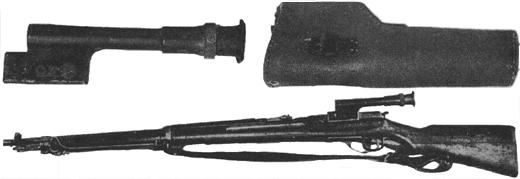
The Type 97 sniper rifle (九七式狙撃銃, Kyū-nana-shiki sogekijū) is a Japanese bolt-action rifle, based on the Type 38 rifle adopted in 1937, following Japanese combat experience in Manchuria. Although the Japanese planned on replacing it with the Type 99 sniper rifle, which had superior range and penetration, the Type 97 remained in service until the end of the World War II.
According to Ness, the Japanese were relatively late in the development of purpose-built sniper rifles. During the 1920s, trials with small numbers of Type 38 rifles fitted with scopes were conducted, but the Japanese apparently showed no interest.
In 1935, following combat experience in Manchuria, the Imperial Japanese Army conducted trials under the leadership of Colonel Tatsumi Namio to develop a new dedicated sniper rifle for the IJA. About 700 modified Type 38 rifles were made in Kokura Arsenal for trials; testing at the Futsu Proving Ground showed a 10% increase in accuracy at a range of 300 metres (330 yd) and 30% at 600 metres (660 yd) in comparison to the standard Type 38 infantry rifle. The new rifle was adopted for IJA service as the Type 97 sniper rifle in 1937.
The Type 97 was basically a slightly modified Type 38 rifle with a slightly longer bent down bolt handle (to avoid hitting the scope when open) and mountings for a telescopic sight.
The scopes have a fixed focus and a 2.5x magnification power with a 10° field of view. The scopes were zeroed at the factory and are not adjustable (each one set for a specific rifle and marked with the rifle's serial number), requiring the sniper to use reticule marks to compensate for range and drift. Offsetting the scope mounting to the left allowed the Type 97 to be loaded with single rounds or 5-round stripper clips, but also made the rifle somewhat awkward to aim. According to US Army manuals, the scope weighted 0.50 kilograms (1.1 lb).
Most rifles were fitted with a folding monopod, but with the deterioration of Japanese manufacturing capabilities as the war progressed, late production rifles no longer had monopods.
The Type 97 retains the internal five round internal box magazine chambered for the semi-rimmed 6.5×50mm Arisaka round and the leaf-type back sight graduated from 500 metres (550 yd) to 2,600 metres (2,800 yd) from the Type 38. The 6.5 mm round gives a light recoil, while the unusually long barrel (which allows more of the propellant to be burnt while the projectile is still on the barrel) gives little muzzle flash, which made counter-sniping difficult.
The Type 97 was manufactured at the Nagoya Arsenal and Kokura Arsenal, with approximately 14,500 produced at the Nagoya Arsenal, and 8,000 at the Kokura Arsenal according to Soto and Allan, while Walter gives a total of 8,000−9,000 Kokura-made rifles in 1938−1939 and about 14,500 Nagoya-made rifles in 1938−1943.
Hub AI
Type 97 sniper rifle AI simulator
(@Type 97 sniper rifle_simulator)
Type 97 sniper rifle
The Type 97 sniper rifle (九七式狙撃銃, Kyū-nana-shiki sogekijū) is a Japanese bolt-action rifle, based on the Type 38 rifle adopted in 1937, following Japanese combat experience in Manchuria. Although the Japanese planned on replacing it with the Type 99 sniper rifle, which had superior range and penetration, the Type 97 remained in service until the end of the World War II.
According to Ness, the Japanese were relatively late in the development of purpose-built sniper rifles. During the 1920s, trials with small numbers of Type 38 rifles fitted with scopes were conducted, but the Japanese apparently showed no interest.
In 1935, following combat experience in Manchuria, the Imperial Japanese Army conducted trials under the leadership of Colonel Tatsumi Namio to develop a new dedicated sniper rifle for the IJA. About 700 modified Type 38 rifles were made in Kokura Arsenal for trials; testing at the Futsu Proving Ground showed a 10% increase in accuracy at a range of 300 metres (330 yd) and 30% at 600 metres (660 yd) in comparison to the standard Type 38 infantry rifle. The new rifle was adopted for IJA service as the Type 97 sniper rifle in 1937.
The Type 97 was basically a slightly modified Type 38 rifle with a slightly longer bent down bolt handle (to avoid hitting the scope when open) and mountings for a telescopic sight.
The scopes have a fixed focus and a 2.5x magnification power with a 10° field of view. The scopes were zeroed at the factory and are not adjustable (each one set for a specific rifle and marked with the rifle's serial number), requiring the sniper to use reticule marks to compensate for range and drift. Offsetting the scope mounting to the left allowed the Type 97 to be loaded with single rounds or 5-round stripper clips, but also made the rifle somewhat awkward to aim. According to US Army manuals, the scope weighted 0.50 kilograms (1.1 lb).
Most rifles were fitted with a folding monopod, but with the deterioration of Japanese manufacturing capabilities as the war progressed, late production rifles no longer had monopods.
The Type 97 retains the internal five round internal box magazine chambered for the semi-rimmed 6.5×50mm Arisaka round and the leaf-type back sight graduated from 500 metres (550 yd) to 2,600 metres (2,800 yd) from the Type 38. The 6.5 mm round gives a light recoil, while the unusually long barrel (which allows more of the propellant to be burnt while the projectile is still on the barrel) gives little muzzle flash, which made counter-sniping difficult.
The Type 97 was manufactured at the Nagoya Arsenal and Kokura Arsenal, with approximately 14,500 produced at the Nagoya Arsenal, and 8,000 at the Kokura Arsenal according to Soto and Allan, while Walter gives a total of 8,000−9,000 Kokura-made rifles in 1938−1939 and about 14,500 Nagoya-made rifles in 1938−1943.
Recent media