
Recent from talks
USS Advance (1862)
Knowledge base stats:
Talk channels stats:
Members stats:
USS Advance (1862)
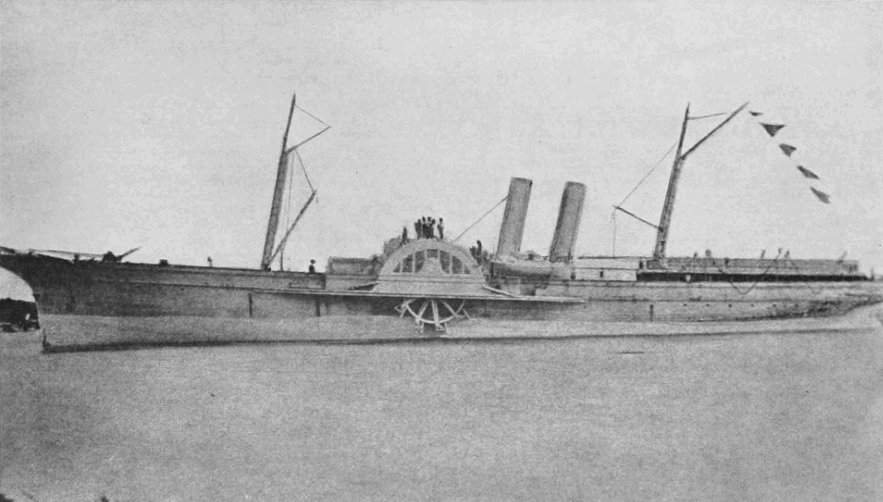
USS Advance, the second United States Navy ship to be so named, was later known as USS Frolic, and was originally the blockade runner Advance captured by the Union Navy during the latter part of the American Civil War. She was purchased by the Union Navy and outfitted as a gunboat and assigned to the blockade of the waterways of the Confederate States of America. She also served as dispatch ship and supply vessel when military action eventually slowed.
Lord Clyde, named for Scottish military officer Colin Campbell, 1st Baron Clyde, was built for the packet service between Ireland and Scotland operated by the Dublin & Glasgow Sailing and Steam Packet Company. She was launched at Greenock, Scotland, by Caird & Co. as Yard No.97 on 3 July 1862. Lord Clyde was an iron-hulled vessel with a length of 237.5 ft (72.4 m), a beam of 26.1 ft (8.0 m), a depth of 14.8 ft (4.5 m) and a draft of 11.0 ft (3.4 m). She measured 778 GRT and 457 NRT and was powered by a 2-cylinder oscillating side-lever steam engine of 350 nhp, also made by Caird, driving two side paddle wheels. On completion she conducted sea trials on 18 September 1862 and sailed from Greenock five days later for Kingstown, Dublin to commence her regular service with Glasgow.
During the American Civil War, a growing shortage of supplies for the manufacture of uniforms for North Carolina troops in 1862 prompted incoming governor Zebulon B. Vance to propose that the state purchase its own blockade runner. With the assistance of British businessman Alexander Collie, Lord Clyde was purchased by the state of North Carolina and on 28 June 1863 she successfully ran the Union blockade into Wilmington. At Wilmington the ship was changed to local registry and renamed Advance (some sources state A. D. Vance in honor of the Governor).
Three months later, a half share in Advance was sold to the firm of Power, Low & Co. in order to raise funds towards purchasing additional ships. She successfully passed through the blockade between the Cape Fear River and Nassau or Bermuda some seventeen times between June 1863 and September 1864, under the command of Lt. John J. Guthrie, CSN.
Advance was commanded by Capt. Tom Crossan when captured by USS Santiago de Cuba on 10 September 1864 when she attempted to put to sea from Wilmington, North Carolina. Gov. Vance attributed her capture to use of low grade North Carolina bituminous coal and denounced Confederate Secretary of the Navy Stephen Mallory for giving the stockpile of smokeless anthracite to CSS Tallahassee (a raiding cruiser) so that none was left for Advance to run out of Wilmington safely. Writing on 3 January 1865, Vance complained:
Why a State struggling for the common good, to clothe and provide for its troops in the public service, should meet with no more favor than a blockade gambler passes my comprehension.
Advance was condemned by the New York prize court, and she was purchased by the Navy that same month; then commissioned at the New York Navy Yard on 28 October 1864, Lt. Comdr. John H. Upshur in command.
Advance departed New York City on 30 October; arrived off Wilmington, North Carolina, on 14 November; and joined the North Atlantic Blockading Squadron. In addition to her reversed role—catching blockade runners as opposed to being one—she participated in the two expeditions against Fort Fisher, located on Confederate (Federal) Point at the mouth of the Cape Fear River.
Hub AI
USS Advance (1862) AI simulator
(@USS Advance (1862)_simulator)
USS Advance (1862)
USS Advance, the second United States Navy ship to be so named, was later known as USS Frolic, and was originally the blockade runner Advance captured by the Union Navy during the latter part of the American Civil War. She was purchased by the Union Navy and outfitted as a gunboat and assigned to the blockade of the waterways of the Confederate States of America. She also served as dispatch ship and supply vessel when military action eventually slowed.
Lord Clyde, named for Scottish military officer Colin Campbell, 1st Baron Clyde, was built for the packet service between Ireland and Scotland operated by the Dublin & Glasgow Sailing and Steam Packet Company. She was launched at Greenock, Scotland, by Caird & Co. as Yard No.97 on 3 July 1862. Lord Clyde was an iron-hulled vessel with a length of 237.5 ft (72.4 m), a beam of 26.1 ft (8.0 m), a depth of 14.8 ft (4.5 m) and a draft of 11.0 ft (3.4 m). She measured 778 GRT and 457 NRT and was powered by a 2-cylinder oscillating side-lever steam engine of 350 nhp, also made by Caird, driving two side paddle wheels. On completion she conducted sea trials on 18 September 1862 and sailed from Greenock five days later for Kingstown, Dublin to commence her regular service with Glasgow.
During the American Civil War, a growing shortage of supplies for the manufacture of uniforms for North Carolina troops in 1862 prompted incoming governor Zebulon B. Vance to propose that the state purchase its own blockade runner. With the assistance of British businessman Alexander Collie, Lord Clyde was purchased by the state of North Carolina and on 28 June 1863 she successfully ran the Union blockade into Wilmington. At Wilmington the ship was changed to local registry and renamed Advance (some sources state A. D. Vance in honor of the Governor).
Three months later, a half share in Advance was sold to the firm of Power, Low & Co. in order to raise funds towards purchasing additional ships. She successfully passed through the blockade between the Cape Fear River and Nassau or Bermuda some seventeen times between June 1863 and September 1864, under the command of Lt. John J. Guthrie, CSN.
Advance was commanded by Capt. Tom Crossan when captured by USS Santiago de Cuba on 10 September 1864 when she attempted to put to sea from Wilmington, North Carolina. Gov. Vance attributed her capture to use of low grade North Carolina bituminous coal and denounced Confederate Secretary of the Navy Stephen Mallory for giving the stockpile of smokeless anthracite to CSS Tallahassee (a raiding cruiser) so that none was left for Advance to run out of Wilmington safely. Writing on 3 January 1865, Vance complained:
Why a State struggling for the common good, to clothe and provide for its troops in the public service, should meet with no more favor than a blockade gambler passes my comprehension.
Advance was condemned by the New York prize court, and she was purchased by the Navy that same month; then commissioned at the New York Navy Yard on 28 October 1864, Lt. Comdr. John H. Upshur in command.
Advance departed New York City on 30 October; arrived off Wilmington, North Carolina, on 14 November; and joined the North Atlantic Blockading Squadron. In addition to her reversed role—catching blockade runners as opposed to being one—she participated in the two expeditions against Fort Fisher, located on Confederate (Federal) Point at the mouth of the Cape Fear River.
Recent media