Hubbry Logo
Blockade runnerBlockade runnerMain
Open search
Blockade runner
Community hub
Blockade runner
logo
8 pages, 0 posts
0 subscribers
Be the first to start a discussion here.
Contribute something
Blockade runner
Blockade runner
from Wikipedia
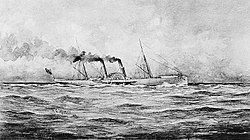
Blockade runner USS Banshee, 1863

A blockade runner is a merchant vessel used for evading a naval blockade of a port or strait. It is usually light and fast, using stealth and speed rather than confronting the blockaders in order to break the blockade. Blockade runners usually transport cargo, for example bringing food or arms to a blockaded city. They have also carried mail in an attempt to communicate with the outside world.

Blockade runners are often the fastest ships available, and come lightly armed and armored. Their operations are quite risky since blockading fleets would not hesitate to fire on them. However, the potential profits (economically or militarily) from a successful blockade run are tremendous, so blockade-runners typically had excellent crews. Although having modus operandi similar to that of smugglers, blockade-runners are often operated by states' navies as part of the regular fleet; states having operated them include the Confederate States of America during the American Civil War, and Germany during the World Wars.

In history

[edit]

Ancient Greece, Peloponnesian War

[edit]

There were numerous blockades and attempts at blockade running during the Peloponnesian War. With his fleet blockaded, Leon of Salamis dispatched blockade runners to seek reinforcements from Athens.

Ancient Rome, Punic Wars

[edit]

During the Punic Wars, the Carthaginian Empire attempted to evade Roman navy blockades of its ports and strongholds. At one point, blockade runners brought in the only food reaching the city of Carthage.[1][2]

Middle age

[edit]

During the 14th century, while Queen Margaret I of Denmark's forces were besieging Stockholm, the blockade runners who came to be known as the Victual Brotherhood engaged in war at sea and shipped provisions to keep the city supplied.

American Revolutionary War

[edit]

Blockade runners in the American Revolution eluded the British naval blockades in order to supply resources to the army. French naval aid was vital.

American Civil War

[edit]
A Confederate blockade runner at anchor at St. George's, Bermuda

During the American Civil War, blockade running became a major enterprise for the Confederacy due to the Union blockade as part of the Anaconda Plan to cut off the Confederacy's overseas trade. Twelve major ports and approximately 3,500 miles of coastline along the Confederacy were patrolled by roughly 500 Union Navy ships.[citation needed]

The United Kingdom played a major role in Confederate blockade running. British merchants had conducted significant amounts of trade with the South prior to the war, and were suffering from the Lancashire Cotton Famine. The British Empire also controlled many of the neutral ports in the Caribbean, most notably the Bahamas and Bermuda. In concert with Confederate interests, British investors ordered the construction of steamships that were longer, narrower and considerably faster than most of the conventional steamers guarding the American coastline, thus enabling them to outmaneuver and outrun blockaders. Among the more notable was the CSS Advance that completed more than 20 successful runs through the Union blockade before being captured.[3]

These vessels brought badly needed supplies, especially firearms, and Confederate mail. The blockade played a major role in the Union's victory over the Confederate states, though historians have estimated the supplies brought by blockade runners to the Confederacy lengthened the duration of the war by up to two years.[4][5] By the end of the American Civil War, Union warships had captured more than 1,100 blockade runners and had destroyed or run aground another 355.[6][7]

Cretan Revolt (1866–1869)

[edit]

Greek blockade runners supplied the Christians during the Cretan revolt (1866–1869). Names of the ships include: Arkadion (named after the Arkadi Monastery, sunk by the Ottoman sloop-of-war Izzedin in August 1867);[8] Hydra; Panhellenion; and Enosis (Unification), which was detained in Syros by Hobart Pasha in December 1868, just about the time the rebellion collapsed.

Prohibition era

[edit]

World War I

[edit]

During World War I the Central Powers, most notably Germany, were blockaded by the Entente Powers. In particular the North Sea blockade made it nearly impossible for surface ships to leave Germany for the then neutral United States and other locations.

The blockade was run with cargo submarines, also called merchant submarines, Deutschland and Bremen, which reached the then neutral United States.[9]

The Marie successfully ran the British North Sea blockade and docked, heavily damaged, in Batavia, Dutch East Indies (now called Jakarta) on May 13, 1916.[10]

In 1917 Germany tried unsuccessfully to supply their forces in Africa by sending Zeppelin LZ104.

World War II

[edit]

Axis blockade runners

[edit]
German Blockade Runner Badge

On the outbreak of war, the Royal Navy imposed a naval blockade of Germany. The fall of France provided the German occupying forces with access to the French Atlantic coast and between 1940 and 1942, many blockade running trips succeeded in delivering cargoes of critical war supplies - especially crude rubber - through the port of Bordeaux; a trade that increased with the entry of Japan into the war in December 1941. Allied attempts to disrupt these operations initially had only a limited effect; as in Operation Frankton. From 1943 improved Allied air superiority over the Bay of Biscay rendered blockade running by surface ships effectively impossible. By some counts, during the war Germans sent 32 (surface) blockade runners to Japan, only 16 of them reaching their destination. Later in the war, most of the trade between Germany and Japan was by cargo submarine.[11]

Italian ships, interned in Spain after Italy entered the war in June 1940, crossed the Bay of Biscay to Bordeaux and some of them, such as Fidelitas and Eugenio C, dashed through the English Channel bound for Germany and Norway.[12][13]

To transfer technology to Imperial Japan, on 25 March 1945 Nazi Germany dispatched a submarine, U-234, to sail to Japan. Germany surrendered before it arrived. The Japanese submarine I-8 completed a similar mission.

The German ship Ramses was in China when the war started. On Nov. 23, 1942, she attempted to sail from Batavia (now Jakarta), to Bordeaux with a cargo of rubber. The hope was that maintaining a sharp 24-hour lookout they could evade the Allied blockade.[14] HMAS Adelaide (1918) caught and sank her.

A small number of planes succeeded in flying between the Axis-controlled Europe and the Japanese-controlled parts of Asia. The first known flight was by an Italian Savoia-Marchetti SM.75 Marsupiale, which flew in July 1942, according to various sources, either from Zaporozhye to Baotou or from Rhodes Island to Rangoon.[11] Later, German Junkers Ju 290-A aircraft prepared for (or, according to some sources, completed) similar flights.[11]

Allied blockade runners

[edit]

During World War II, trade between Sweden (which remained neutral throughout the war) and Britain was severely curtailed by the German blockade of the Skagerrak straits between Norway and the northern tip of Denmark. In order to import vital materiel from Sweden, such as ball bearings for the British aircraft industry, five Motor Gun Boats, such as the Gay Viking, were converted into blockade runners, using winter darkness and high speed to penetrate the German maritime blockade. Larger Norwegian ships succeeded in escaping through the blockade to Britain in Operation Rubble but later attempts failed.

Modern era

[edit]

In modern times, tracking equipment such as radar, sonar, and reconnaissance satellites make evading a total blockade by a world power nearly impossible.[citation needed] Drug smugglers and groups like the Tamil Tigers are able to run blockades due to the partial nature of the blockade, or because the navy imposing the blockade is weak and under-equipped. Reminiscent of earlier German attempts, drug smugglers have used semi-submersibles (narco-submarines) in their smuggling operations.

See also

[edit]

References

[edit]

Bibliography

[edit]
Revisions and contributorsEdit on WikipediaRead on Wikipedia
from Grokipedia

A blockade runner is a swift, low-profile merchant vessel optimized for evading naval blockades during wartime, relying on speed, stealth, and shallow draft to through restricted waters. These ships were prominently utilized in the (1861–1865), where Confederate operators employed them to import arms, ammunition, and medical supplies into Southern ports while exporting to neutral territories such as , Nassau, and , thereby circumventing the Union Navy's coastal blockade proclaimed by President in April 1861.
Typically constructed as side-wheel or screw steamers of 400 to 600 tons, blockade runners featured elongated hulls—often six to nine times their beam—painted in dull lead-gray for nocturnal , telescopic smokestacks to reduce , feathering paddles or propellers for quiet operation, and fuels like smokeless coal to minimize detection. Speeds of 9 to 13 knots enabled daring nighttime dashes, guided by expert pilots navigating via soundings and landmarks over routes spanning 500 to 600 miles. Despite high risks and rewards—crews earning thousands in per voyage—their operations sustained Confederate and , with estimates indicating two-thirds of early attempts succeeding and individual ships like the R. E. Lee completing 21 runs carrying thousands of bales valued at millions. However, as Union forces expanded and tightened the , capturing over 1,100 runners and sinking or destroying hundreds more, the flow of goods dwindled, contributing to the Confederacy's eventual resource exhaustion by 1865.

Definition and Characteristics

Core Definition


A is a vessel, typically a ship, employed to evade a naval of a , , or coastline by transporting such as munitions, supplies, or commodities to or from the blockaded area. These operations aim to sustain besieged forces or economies against the blockading power's efforts to isolate and starve them of resources through maritime interdiction. Unlike warships designed for , blockade runners prioritize evasion over confrontation, relying on superior speed and stealth to minimize detection and risks.
Blockade runners are generally constructed as lightweight, fast-steaming vessels with low freeboard, shallow drafts, and minimal to reduce and enhance maneuverability in shallow or confined waters. In the , common designs included side-wheel steamers of 400 to 600 tons, elongated hulls with sharp bows, and engines optimized for bursts of high speed, often exceeding 10 knots to outpace pursuers. These features enabled runners to approach blockaded harbors at night, using local knowledge of channels and pilotage to navigate past patrols. Cargo capacity was limited to prioritize speed, with high-value, compact goods like arms or preferred for profitability. The practice is inherently commercial and opportunistic, frequently undertaken by private owners or firms under government sanction, such as letters of marque, to generate profit amid wartime scarcity. Success depended on factors including enforcement stringency, weather conditions, and intelligence on patrol patterns, with runners often staging from neutral ports like or Nassau for . Historical efficacy varied; during the (1861–1865), approximately 8,000 successful runs supplied the Confederacy despite Union naval efforts, though losses mounted as blockades tightened. Blockade running exemplifies asymmetric maritime strategy, where smaller, agile assets challenge superior naval forces through guile and velocity rather than direct battle.

Physical and Operational Features

Blockade runners were engineered for speed, maneuverability, and low visibility to penetrate naval . During the , typical vessels were side-wheel steamers displacing 400 to 600 tons, with elongated hulls featuring a length-to-beam of 6 to 7 for hydrodynamic efficiency. These ships incorporated raised and poop decks, amidships engines, and low-placed boilers to reduce silhouette height, often complemented by short, thin smokestacks that could to minimize detection. Hulls were narrow and sharp, painted in neutral grays or whites, and fitted with shallow drafts—typically 8 to 10 feet loaded—to navigate coastal shallows and river mouths avoided by deeper-draft Union blockaders. Propulsion relied on steam engines yielding speeds of 12 to 15 knots under power and 8 to 9 knots under auxiliary , prioritizing burst acceleration over sustained cruising to outrun pursuers. Cargo holds were optimized for high-value, low-bulk items: outbound shipments of , , or generated profits funding inbound arms, , medicines, and , with voyages structured for round-trip cycles via neutral ports like Nassau or . Armament was minimal—small arms or light pivoted guns—to avoid alerting patrols, emphasizing evasion over combat. Operationally, crews numbered 20 to 50, often British sailors enticed by profit shares exceeding 200% per successful run, under captains skilled in coastal piloting and night navigation. Runs occurred predominantly at night or in , hugging shorelines to exploit shallow waters, with vessels burning smokeless Welsh and dousing lights to enhance stealth. Success rates hovered around 70-80% for Confederate ports like Wilmington or Charleston, though losses mounted as Union patrols intensified, capturing or sinking over 1,000 runners by 1865. In , German blockade runners adapted similar principles but on larger scales, such as converted men achieving 16-23 knots with diesel and enhanced for transatlantic evasion of Allied convoys.

Tactics and Methods

Evasion Techniques

Blockade runners primarily relied on stealth over raw speed to penetrate naval cordons, as superior alone often proved insufficient against layered patrols. Vessels were designed with low freeboard, narrow hulls approximately nine times their beam, and painted in dull lead-gray hues to blend with and shore at , minimizing visual detection from afar. Telescopic smokestacks could be lowered nearly to deck level, while short masts and feathering paddle wheels reduced silhouettes and operational noise; anthracite coal fueled engines to produce smokeless exhaust, further concealing approach. Nocturnal operations formed the core of evasion strategy, with runs timed for moonless nights and high tides to exploit darkness and navigable channels. Captains extinguished all lights, covered hatches to eliminate glow, and hugged coastlines within 10-12 miles of shore, leveraging land contours for and surf sounds to drown engine racket. Pilots navigated treacherous shoals using hand leads for soundings, avoiding reliance on visual cues. In the , such tactics enabled ships like the R. E. Lee to complete 21 successful transits between December 1862 and November 1863. If detection occurred, runners employed deceptive maneuvers and contingency actions. Flares or rockets might be fired seaward to divert pursuing blockaders toward false leads, while feigned signals of surrender could lure closers before sudden acceleration. Weather played a pivotal role: heavy seas disrupted enemy gunnery, as seen when the steamer Lilian evaded the U.S.S. Shenandoah amid rough conditions. Imminent capture prompted intentional grounding on beaches, where Confederate shore batteries provided cover for cargo salvage or vessel recovery, as with the Kate in July 1863. For bursts of speed, crews occasionally ignited turpentine-soaked cotton bales, propelling ships to 13 knots temporarily. In later conflicts, such as German runs to occupied territories, evasion incorporated and circuitous neutral routes to dodge Allied patrols, though success rates declined with improved technologies like . These methods underscored a causal reliance on environmental obscurity and vessel inconspicuousness rather than confrontation, prioritizing penetration probability over firepower.

Technological Adaptations Over Time

Blockade runners initially employed sailing vessels such as schooners and brigs, modified for enhanced speed through reduced rigging and streamlined hulls to facilitate evasion in wind-dependent conditions during early 19th-century conflicts. By the (1861-1865), steam propulsion became dominant, supplanting sail-dominated fleets; steamers outnumbered sailing vessels 73 to 55 by 1863, offering reliable high speeds of 12-21 knots via engines like oscillating cylinders or side-lever mechanisms driving paddle wheels or screws. This shift enabled consistent performance for short, intense dashes, with screw propellers preferred for quieter operation compared to noisier paddle wheels. Design features emphasized stealth and maneuverability, including shallow drafts of 8-10 feet for navigating coastal inlets, extreme length-to-beam ratios (up to 11:1) for hydrodynamic , and low freeboards to lower profiles against horizons. Retractable funnels and masts, as on vessels like the Kate, allowed temporary reduction of smoke and during blockader approaches, while feathering paddle buckets improved . Hull construction advanced from to iron (e.g., Wild Dayrell, 215 feet long) and steel (e.g., ), enhancing durability without sacrificing speed. Camouflage paint schemes represented a primary for visual evasion, with Civil War runners adopting dull leaden gray, light lead, or white coatings to merge with night seas, surf, or sandbars—features not evident in pre-steam eras. These neutral tones, combined with extinguished lights and tarpaulin-covered hatches for silence, supported nocturnal runs, achieving speeds of 9-13 knots . No fundamental innovations arose; runners adapted extant maritime technologies, prioritizing speed and inconspicuousness over armament. In , surface blockade runners yielded to Allied air and naval superiority by 1943, prompting adaptation of diesel-electric submarines for transoceanic cargo hauls of 80-300 tons, including strategic materials like and components. These conversions, such as German U-183 or Italian UIT-24, exploited submerged stealth for year-round operations across routes like to , extending voyage times to 2-3 months while integrating combat tasks en route. Post-1945 instances involved further refinements like high-speed motor vessels or for sanctions evasion, but core principles of propulsion reliability, low detectability, and rapid transit persisted.

Historical Instances

Ancient and Classical Periods

During the (264–241 BC), the Romans imposed a naval blockade on the Carthaginian stronghold of Lilybaeum (modern , ) starting in 250 BC, aiming to starve the garrison into submission after failed assaults. The blockade involved a fleet of warships patrolling the harbor entrance to intercept supplies, but Carthaginian forces countered with light, maneuverable quinqueremes crewed by skilled pilots who exploited gaps in the Roman lines, weather conditions, and superior sailing tactics to deliver provisions, reinforcements, and evacuate non-combatants. These vessels, often operating under cover of night or bold daylight runs, sustained the defenders for nearly a decade despite Roman efforts to tighten the cordon, including the construction of a -equipped boom and harbor barriers. A prominent figure in these operations was the Rhodian, a Carthaginian captain renowned for his audacious evasions, as chronicled by the historian . In one instance around 249 BC, successfully navigated his ship through the Roman fleet in broad daylight, delivering critical supplies and earning acclaim for repeating such feats multiple times, including a fifth run that highlighted for its daring execution against vigilant blockaders. These blockade-running missions not only prolonged the siege but demonstrated early adaptations in ship design and for evasion, relying on speed, shallow draft, and intimate knowledge of local waters rather than armament. Prior to the , naval blockades in the world, such as the Spartan of following the in 405 BC during the , proved more effective with limited recorded evasion attempts, owing to the oar-powered triremes' vulnerabilities to close-quarters interception and the absence of specialized fast merchant vessels. Roman and Carthaginian experiences at Lilybaeum marked an evolution toward systematic blockade running, influencing later Mediterranean naval strategies, though success remained contingent on numerical superiority of pursuers and environmental factors like winds and currents.

Medieval and Early Modern Periods

During the Siege of Acre (1189–1191) in the Third Crusade, Christian naval forces under imposed a on the port to isolate the Ayyubid , but Muslim vessels repeatedly breached it to deliver critical supplies and troops. In late 1190, Saladin's successfully ran the with twenty-five shiploads of reinforcements and provisions, sustaining the defenders amid the prolonged contest. Such efforts involved fast galleys exploiting gaps in the crusader line, though the contributed to eventual starvation and surrender of the city in July 1191 after Richard I's arrival tightened enforcement. These incidents represent early examples of blockade-breaking operations, albeit and integrated with broader fleet actions rather than specialized merchant evasion. In the , naval blockades became more systematic amid and colonial expansion, prompting organized attempts to run them for military resupply and commerce. The Dutch Revolt (1568–1648) featured reciprocal blockades, with the United Provinces imposing a tight naval cordon on Spanish-held Flemish ports like in 1584–1585 to cripple Habsburg logistics, though smuggling persisted via shallow-draft vessels navigating inland waterways and coastal shallows. Spanish forces countered by attempting to pierce Dutch blockades; in the (October 1639), a Spanish under Antonio de Oquendo, escorting transports with 10,000 troops and silver bullion, sought to relieve the garrison but was intercepted and decimated by Maarten Tromp's fleet while sheltering in the Downs anchorage off , resulting in the loss of over 40 Spanish ships and marking a pivotal blow to Iberian . By the , blockade running supported revolutionary causes against imperial navies, as seen in the American War of Independence (1775–1783), where Britain's undeclared commercial blockade of rebel colonies from to Savannah aimed to sever trade and supplies. American merchants and privateers, often small s or brigs from neutral ports, evaded patrols to import arms, powder, and salt from and the , with documented successes like the Liberty clearing Philadelphia's blockade in August 1775 to deliver mail and goods to Europe. Figures such as operated as effective runners, transporting munitions and provisions through foggy nights and storm cover, sustaining Continental forces despite the Royal Navy's deployment of up to 32 warships at peak enforcement. These operations underscored the economic incentives, with runners profiting from scarcity premiums, though captures by British cruisers claimed many vessels as prizes.

19th Century Conflicts

Blockade running featured in several 19th-century conflicts, but reached its peak during the American Civil War (1861–1865), where privately operated vessels evaded the Union Navy's blockade of Confederate ports to deliver essential supplies. The Union blockade, declared by President Abraham Lincoln on April 19, 1861, sought to isolate the Confederacy economically by sealing approximately 3,500 miles of coastline from the Potomac River to the Rio Grande. Initial efforts involved fewer than 100 ships, but by war's end, the Union deployed over 600 vessels, capturing or destroying hundreds of runners. Confederate blockade runners, often purpose-built steamers of 400–600 tons with shallow drafts, low profiles, and speeds up to 13–19 knots, used smokeless anthracite coal and grey paint for stealth. They typically departed from neutral ports like Nassau or , navigating at night during high tides and moonless phases, relying on coastal landmarks and signal lights for entry into harbors such as , or . Cargoes inbound included munitions, medicine, and machinery, while outbound shipments consisted primarily of , , and , yielding profits of 500–1,000% on successful voyages. Approximately 66 vessels made regular runs, with successes estimated at two-thirds early in the , though overall attempts numbered 2,500–2,900, many failing as the tightened. Notable examples include the R. E. Lee, a Clyde-built steamer that completed 21 successful runs between December 1862 and November 1863 before capture, and the Banshee, which operated multiple trips from Liverpool to Confederate ports. In 1863, 199 runners reached Confederate ports; this rose to 244 in 1864, but declined sharply after the Union capture of Fort Fisher on January 15, 1865, which closed Wilmington, the last major entry point. Despite these efforts, blockade running supplied only a fraction of Confederate needs, prolonging but not preventing economic collapse. Earlier in the century, during the (1812–1815), British naval blockades of American ports prompted merchant ships to attempt evasion through stealthy runs, particularly along the Atlantic coast, to sustain trade amid restricted commerce. In the (1803–1815), Napoleon's and British counter-blockades spurred smuggling vessels to bypass European coastal restrictions, though these operations relied more on small craft than specialized runners. These instances prefigured the more organized, high-stakes efforts of the Civil War but involved fewer dedicated vessels and less technological adaptation.

World Wars and Interwar Period

During World War I, the Allied naval blockade of Germany, primarily enforced by the Royal Navy, restricted access to seaborne imports and exports, rendering organized surface blockade running exceedingly difficult. The strategy employed a distant blockade patrolling the North Sea and exits from the Baltic, intercepting neutral vessels suspected of carrying contraband to German ports via Scandinavian or Dutch intermediaries. Few dedicated blockade runner operations succeeded, as British dominance in surface warfare precluded effective evasion tactics, compelling Germany to rely instead on unrestricted submarine warfare for economic disruption rather than supply importation. The from 1919 to 1939 saw no significant instances of blockade running, owing to the absence of large-scale naval blockades amid relative and the League of Nations' limited enforcement mechanisms, such as against aggressors like in 1935, which lacked robust maritime interdiction. In , Germany initiated blockade running operations in 1941 to procure strategic materials like rubber, , and medicinal fats from and neutral territories, utilizing swift, low-profile merchant vessels dispatched from Far Eastern or Iberian ports under the oversight of the German Naval High Command. Routes typically circumvented Allied patrols by transiting the and around the , with voyages lasting months amid threats from cruisers, submarines, and aircraft. Dozens of attempts occurred through 1944, but Allied countermeasures proved formidable; for instance, in the 1943–1944 season, initial runners such as Osorno and Alsterufer partially succeeded, though subsequent efforts faced heightened interception. Faced with mounting losses of surface ships, Germany adapted by employing U-boats for sporadic cargo transport and, in spring 1943, converting seven Italian submarines into dedicated blockade runners capable of carrying up to 700 tons of goods across extended ranges. These underwater operations aimed to exploit gaps in Allied surveillance but yielded mixed results, with several submarines lost to depth charges or mines. Allied forces, leveraging intelligence and aerial patrols, neutralized key threats, sinking five German runners in the South Atlantic within days in January 1944. While some cargoes reached Germany—supplying roughly 10–20% of critical imports in peak years—the endeavors ultimately failed to offset the blockade's strangling effect on the Axis economy, highlighting the primacy of naval supremacy in denying maritime access.

Post-1945 and Contemporary Examples

In the post-World War II period, overt naval blockades in declared wars have been rare, supplanted by enforced through and monitoring rather than sustained blockades, leading blockade running to manifest primarily as covert maritime sanctions evasion. has employed extensive ship-to-ship (STS) transfers to circumvent resolutions prohibiting its coal exports and capping refined petroleum imports, with UN panels documenting 89 illicit coal transfers in the first half of 2019 alone, often involving vessels disabling automatic identification systems (AIS), flag-hopping, and transfers in near . The U.S. government seized the North Korean-flagged tanker Wise Honest in April 2019 for transporting coal in violation of sanctions, highlighting how uses front companies and disguised vessels to sustain revenue estimated at hundreds of millions annually from such activities. These operations rely on small, agile tankers and bulk carriers, echoing historical runners' emphasis on speed and stealth, though modern and sanctions advisories have increased interception risks. Iran has developed a parallel "shadow fleet" of approximately 300-400 tankers to evade U.S. sanctions on its oil exports, imposed since to curb funding for nuclear and programs, employing tactics such as AIS spoofing, STS transfers in the and , and transfers to non-sanctioned vessels for delivery primarily to , which receives over 90% of Iran's illicit oil. In October 2025, the U.S. targeted networks including UAE-based entities facilitating (LPG) smuggling, sanctioning vessels that obfuscate origins through ship-to-ship operations and fake documentation, enabling Iran to export roughly 1.5 million barrels per day despite restrictions. These runners often comprise aging supertankers acquired via opaque ownership structures, incurring higher operational costs from uninsured voyages and evasion maneuvers but generating billions in revenue, as verified by shipping from firms tracking darkened voyages. Russia's response to Western sanctions following its 2022 invasion of exemplifies contemporary large-scale blockade running analogs, with a shadow fleet exceeding 600 tankers evading the oil price cap by transporting crude above the $60-per-barrel limit through STS transfers, AIS deactivation, and use of flags of convenience from non-Western states. By October 2025, the had sanctioned 117 such vessels in its 14th package, targeting operators contributing to Russia's , while U.S. and actions added over 200 designations, yet the fleet's expansion—now including LNG carriers—has sustained oil revenues near pre-war levels, albeit at elevated shipping costs estimated at $10-15 billion annually due to uninsured hulls and detours. These operations, concentrated in Baltic, , and Pacific routes, demonstrate how state-backed entities procure and repurpose older vessels, mirroring historical adaptations but amplified by global commodity demands from sanction-indifferent buyers like and . Attempts to challenge humanitarian blockades have also invoked blockade-running tactics, as seen in multiple Gaza Freedom Flotillas since seeking to breach Israel's naval , imposed in 2007 to arms to following its takeover of the territory. The flotilla, involving six vessels carrying aid and activists, culminated in an Israeli interception of the Mavi Marmara, where commandos boarded amid resistance, resulting in nine deaths; a subsequent UN affirmed the 's legality for security purposes under while criticizing excessive force. More recent efforts, such as the October 2025 flotilla with ships like the Madleen, have faced interceptions or technical halts, underscoring the challenges of small-craft evasion against advanced naval patrols, though one vessel reportedly entered Gaza waters briefly before diversion. These incidents highlight tensions between humanitarian intent and enforcement of blockades deemed essential for preventing militant rearmament, with success rates near zero for sustained penetration.

Strategic and Economic Impacts

Military Effectiveness

Blockade runners demonstrated varying degrees of military effectiveness across historical conflicts, primarily by delivering critical supplies such as munitions, medicine, and raw materials to besieged forces, thereby extending operational capabilities despite naval interdiction efforts. In the , Confederate blockade runners achieved success rates of over 80% for completed voyages, enabling the importation of arms and ammunition that armed a significant portion of Southern troops. These operations, often originating from ports like Nassau and , supplied an estimated half of the Confederacy's military imports, including and , which compensated for limited domestic production and prolonged resistance against Union advances. However, effectiveness waned as the Union Navy grew to over 600 vessels by 1865, increasing capture rates to around 15-20% in later years and limiting total throughput to a fraction of pre-war trade volumes. In , Axis blockade runners, particularly German efforts to link with , proved far less effective due to intensified Allied patrols and air surveillance. Between 1941 and 1944, only a handful of surface vessels successfully transited, delivering strategic materials like rubber and , but most were intercepted, with losses exceeding 90% of attempted runs. Submarine-based alternatives supplemented these, completing a few deliveries of high-value items such as mercury and optical instruments, yet the overall volume was negligible compared to the logistical demands of , failing to materially alter frontline outcomes. Historically, the military value of blockade running hinged on the asymmetry between runner speed and blockade enforcement capacity; shallow-draft, high-speed vessels evaded early s effectively but became obsolete against maturing naval technologies like and convoys. While tactically enabling sporadic resupply—such as sustaining Confederate armies through —the strategy rarely shifted strategic balances, as demonstrated by the Confederacy's eventual collapse despite runner imports and the ' resource shortages persisting amid failed transits. Empirical assessments indicate that blockade runners amplified defender resilience by 10-20% in supply terms during initial phases but could not offset superior industrial output or blockade intensification over prolonged engagements.

Economic Ramifications and Profiteering

Blockade running imposed significant economic strains on besieged entities by necessitating high-risk, high-cost operations that distorted trade patterns and fueled inflation. While intended to sustain war efforts through imports of essential goods like arms and medicine, runners often prioritized high-value, low-volume cargoes such as luxury items, exacerbating shortages of necessities and contributing to price spirals within blockaded regions. In the , the reduced Confederate cotton exports by approximately 95%, from pre-war levels of around 10 million bales annually to a fraction thereof, severely curtailing foreign exchange and industrial inputs for the North's mills while forcing the South into economic isolation. Despite this, blockade runners facilitated imports valued at an estimated $100 million in goods over the war, though this represented only a small portion of pre-war trade volumes and came at the expense of inflated domestic costs due to speculative pricing. Profiteering emerged as a core driver of blockade running operations, with entrepreneurs and ship owners reaping extraordinary returns from the arbitrage between blockade premiums and black-market demand. A successful round trip could yield profits of £30,000 or more in the mid-1860s, enabling owners to recoup vessel costs after just two voyages and absorb losses from captures, as the average runner completed four to five trips before interception. By 1863, operators shifted toward smuggling luxury goods like wines, silks, and jewelry, which fetched markups of 500-1000% in Confederate ports, over necessities that aligned more closely with military needs but offered lower margins. This speculative enterprise, centered in neutral hubs like Bermuda's St. George's Harbour and Nassau, involved British and Southern firms in a well-organized network that funneled wealth to a narrow class of investors, while broader economic attrition from the blockade eroded Confederate fiscal stability through hyperinflation and currency devaluation. In , analogous dynamics played out on a larger scale, though traditional running was supplanted by and neutral trade loopholes; Allied blockades slashed German imports by over 80% from 1939 peaks, collapsing inflows and precipitating industrial contraction, with limited runner efforts via occupied ports yielding negligible offsets. For , U.S. and surface blockades eviscerated merchant tonnage, reducing imports to critical levels by 1944 and hastening without significant from runners due to pervasive Allied dominance. These cases underscore how running, while temporarily alleviating shortages, entrenched economic inefficiencies and rewarded risk-takers at the expense of equitable resource distribution, often prolonging conflicts by enabling partial circumvention of strategic strangulation.

International Law on Blockades and Runners

International law governing naval blockades originates from customary rules that evolved through diplomatic conferences, including the 1856 , which stipulated that blockades, to be binding upon neutral states, must be effective—that is, maintained by a force sufficient to render entry to or departure from the blockaded coast dangerous. This effectiveness requirement, a cornerstone of blockade validity, prevents mere paper declarations without credible enforcement, as mere intent or token presence does not suffice; the assessment remains a factual determination based on the blockading force's capacity to deter or intercept violators. The 1909 London Declaration concerning the Laws of Naval War further codified blockade procedures, requiring that a blockade not extend beyond enemy ports and coasts, be notified to neutral powers via direct governmental communication or neutral consuls at blockaded ports, and allow neutral vessels actual notice through warnings if previously uninformed. Article 11 of the Declaration emphasized presumptive knowledge for vessels that had sailed from blockaded areas or received warnings, enabling capture of those attempting breach despite awareness. Although the London Declaration was not ratified by all major powers and thus did not enter into force as a treaty, its provisions on blockades reflect and influenced applicable in armed conflicts at sea. Modern restatements, such as the 1994 San Remo Manual on Applicable to Armed Conflicts at Sea—drafted by international legal experts as a non-binding guide to customary rules—require that a be formally declared and notified to all belligerents and neutral states, specifying its commencement, duration, location, extent, ports and coasts covered, and enforcement methods. prohibits blockades enforced in ways causing excessive civilian harm disproportionate to military advantage or with the sole intent to starve the population into submission, denying essentials like food and medical supplies without allowing humanitarian passage. Enforcement may involve stationed forces, patrols, or mines, but must remain impartial, applying equally to all vessels regardless of flag. Blockade runners—vessels seeking to evade a valid by entering or exiting prohibited areas—face capture as s under these rules, with warships authorized to exercise the right of visit, for suspected breaches. Neutral runners with presumptive or actual knowledge of the blockade lose protections against capture, and their cargoes may be if or destined for the blockaded enemy; occurs in prize courts to determine and transfer title. Such captures must respect proportionality and distinction principles under , avoiding unnecessary force, though the act of running itself constitutes a violation justifying to maintain blockade integrity. In practice, ineffective enforcement undermines the blockade's , potentially rendering captures unlawful and exposing captors to restitution claims.

Moral and Strategic Debates

Blockade runners have sparked strategic debates regarding their capacity to undermine naval blockades and sustain belligerent economies during prolonged conflicts. In the American Civil War (1861–1865), runners achieved penetration rates exceeding 80 percent in many operations, particularly along the Carolina coast where success approached 90 percent early in the war, enabling the importation of munitions, salt, and medical supplies critical to Confederate logistics. However, Union naval superiority eventually reduced these rates, with over 1,500 runners captured or destroyed by war's end, limiting total imports to levels insufficient for decisive military advantage despite delivering an estimated hundreds of thousands of rifles. Proponents of runners' strategic value argue they extended Southern resistance by funding the war through cotton exports and averting immediate collapse, while critics contend blockades inflicted attrition that runners merely delayed, contributing to Confederate defeat via resource denial. In World War II, German blockade runners linking Europe to Japan via surface ships and later U-boats transported strategic materials like rubber and tungsten, but Allied interdiction—sinking most surface runners by 1944—rendered them marginally effective, with cargoes representing a fraction of pre-war imports and failing to offset broader economic strangulation. Debates persist on whether such operations justified resource allocation; some analyses highlight psychological boosts to isolated Axis partners, yet empirical data show blockades curtailed imports of key commodities by significant margins, underscoring runners' limitations against overwhelming naval dominance. Moral debates focus on the ethics of private commerce aiding warring parties, often pitting free trade principles against war prolongation. During the Civil War, Confederate regulations mandated that half of inbound cargoes consist of military goods, framing running as patriotic necessity, yet widespread profiteering—yields reaching 200–400 percent—drew criticism for exacerbating domestic speculation and inequality, with some Southern observers decrying it as disloyal opportunism akin to smuggling. Neutral actors, including British firms building and crewing many runners, faced accusations of abetting rebellion, though international custom permitted such trade absent formal neutrality violations, raising questions of complicity in extended bloodshed estimated at additional thousands of casualties from sustained fighting. Broader ethical scrutiny questions runners' role in economic warfare's civilian toll. Blockades inherently pressure noncombatants through , and runners' delivery of arms alongside necessities arguably intensified conflicts without altering outcomes, prompting arguments that they morally equivocated legitimate resistance with mercenary prolongation of futile struggles. In contexts like WWII, Axis runners prioritizing war materials over amplified debates on whether private evasion of blockades excused indirect support for , though legal precedents affirmed belligerents' rights to without deeming runners inherently illicit. These tensions reflect causal realities: runners exploited naval gaps for profit and survival but rarely inverted strategic imbalances, inviting retrospective judgments on their net contribution to human cost versus preservation of .

References

Add your contribution
Related Hubs
Contribute something
User Avatar
No comments yet.