
Recent from talks
USS Philadelphia (1776)
Knowledge base stats:
Talk channels stats:
Members stats:
USS Philadelphia (1776)
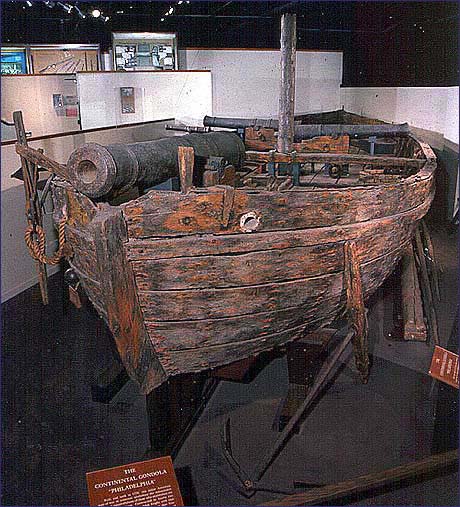
USS Philadelphia was a 3-gun gundalow of the Continental Navy. She was constructed from July–August 1776 for service during the American Revolutionary War. Manned by Continental Army soldiers, she was part of a fleet under the command of General Benedict Arnold that fought against the British Royal Navy in the Battle of Valcour Island on Lake Champlain. Philadelphia was sunk during the battle on 11 October 1776.
In 1935, amateur military marine archaeologist Lorenzo Hagglund located her remains standing upright at the bottom of Lake Champlain. The wreck was raised to the surface and salvaged. In 1961 she was bequeathed to the Smithsonian Institution. Philadelphia and associated artifacts are now part of the permanent collection of the National Museum of American History, in Washington, D.C., where curator Philip K. Lundeberg was responsible for arranging her initial display. The vessel is listed on the National Register of Historic Places and is a National Historic Landmark.
The American Revolutionary War, which began in April 1775 with the Battles of Lexington and Concord, widened in September 1775 when the Continental Army embarked on an invasion of the British Province of Quebec. The province was viewed by the Second Continental Congress as a potential avenue for British forces to attack and divide the rebellious colonies and was lightly defended. The invasion reached a peak on 31 December 1775, when the Battle of Quebec ended in disaster for the Americans. In the spring of 1776, 10,000 British and German troops arrived in Quebec, and General Guy Carleton, the provincial governor, drove the Continental Army out of Quebec and back to Fort Ticonderoga.
Carleton then launched his own offensive intended to reach the Hudson River, whose navigable length begins south of Lake Champlain and extends down to New York City. Control of the upper Hudson would enable the British to link their forces in Quebec with those in New York, recently captured in the New York campaign by Major General William Howe. This strategy would separate the American colonies of New England from those farther south and potentially quash the rebellion.
Following the American retreat from Quebec, the only ships on the lake were those of a small fleet of lightly armed ships that Benedict Arnold had assembled following the capture of Fort Ticonderoga in May 1775. This fleet, even if it had been in British hands, was too small to transport the large British army to Fort Ticonderoga.
During their retreat from Quebec, the Americans carefully took or destroyed all ships on Lake Champlain that might prove useful to the British. When Arnold and his troops, making up the rear guard of the army, abandoned Fort Saint-Jean, they burned or sank all the boats that they could not use and set fire to the sawmill and the fort. These actions effectively denied the British any hope of immediately moving onto the lake.
The two sides set about building fleets: the British at Saint-Jean and the Americans at the other end of the lake in Skenesborough (present-day Whitehall, New York). While planning Quebec's general defenses in 1775, General Carleton had anticipated the problem of transportation on Lake Champlain, and had requested the provisioning of prefabricated ships from Europe. Because of this planning, the British were able to assemble a fleet that significantly overpowered that of the Americans. In total, the British fleet (25 armed vessels) had more firepower than the Americans' 15 vessels, with more than 80 guns outweighing the 74 smaller American guns.
The American shipbuilding effort at Skenesborough was overseen by Hermanus Schuyler (possibly a relation of Major General Philip Schuyler), and the outfitting was managed by military engineer Jeduthan Baldwin. Schuyler began work in April to produce boats larger and more suitable for combat than the small shallow-draft boats known as bateaux that were used for transport on the lake. The process eventually came to involve General Benedict Arnold, who was an experienced ship's captain, and David Waterbury, a Connecticut militia leader with maritime experience. Major General Horatio Gates, in charge of the overall defense of the lake, eventually asked Arnold to take more responsibility in the shipbuilding effort because "I am intirely uninform'd as to Marine Affairs."
Hub AI
USS Philadelphia (1776) AI simulator
(@USS Philadelphia (1776)_simulator)
USS Philadelphia (1776)
USS Philadelphia was a 3-gun gundalow of the Continental Navy. She was constructed from July–August 1776 for service during the American Revolutionary War. Manned by Continental Army soldiers, she was part of a fleet under the command of General Benedict Arnold that fought against the British Royal Navy in the Battle of Valcour Island on Lake Champlain. Philadelphia was sunk during the battle on 11 October 1776.
In 1935, amateur military marine archaeologist Lorenzo Hagglund located her remains standing upright at the bottom of Lake Champlain. The wreck was raised to the surface and salvaged. In 1961 she was bequeathed to the Smithsonian Institution. Philadelphia and associated artifacts are now part of the permanent collection of the National Museum of American History, in Washington, D.C., where curator Philip K. Lundeberg was responsible for arranging her initial display. The vessel is listed on the National Register of Historic Places and is a National Historic Landmark.
The American Revolutionary War, which began in April 1775 with the Battles of Lexington and Concord, widened in September 1775 when the Continental Army embarked on an invasion of the British Province of Quebec. The province was viewed by the Second Continental Congress as a potential avenue for British forces to attack and divide the rebellious colonies and was lightly defended. The invasion reached a peak on 31 December 1775, when the Battle of Quebec ended in disaster for the Americans. In the spring of 1776, 10,000 British and German troops arrived in Quebec, and General Guy Carleton, the provincial governor, drove the Continental Army out of Quebec and back to Fort Ticonderoga.
Carleton then launched his own offensive intended to reach the Hudson River, whose navigable length begins south of Lake Champlain and extends down to New York City. Control of the upper Hudson would enable the British to link their forces in Quebec with those in New York, recently captured in the New York campaign by Major General William Howe. This strategy would separate the American colonies of New England from those farther south and potentially quash the rebellion.
Following the American retreat from Quebec, the only ships on the lake were those of a small fleet of lightly armed ships that Benedict Arnold had assembled following the capture of Fort Ticonderoga in May 1775. This fleet, even if it had been in British hands, was too small to transport the large British army to Fort Ticonderoga.
During their retreat from Quebec, the Americans carefully took or destroyed all ships on Lake Champlain that might prove useful to the British. When Arnold and his troops, making up the rear guard of the army, abandoned Fort Saint-Jean, they burned or sank all the boats that they could not use and set fire to the sawmill and the fort. These actions effectively denied the British any hope of immediately moving onto the lake.
The two sides set about building fleets: the British at Saint-Jean and the Americans at the other end of the lake in Skenesborough (present-day Whitehall, New York). While planning Quebec's general defenses in 1775, General Carleton had anticipated the problem of transportation on Lake Champlain, and had requested the provisioning of prefabricated ships from Europe. Because of this planning, the British were able to assemble a fleet that significantly overpowered that of the Americans. In total, the British fleet (25 armed vessels) had more firepower than the Americans' 15 vessels, with more than 80 guns outweighing the 74 smaller American guns.
The American shipbuilding effort at Skenesborough was overseen by Hermanus Schuyler (possibly a relation of Major General Philip Schuyler), and the outfitting was managed by military engineer Jeduthan Baldwin. Schuyler began work in April to produce boats larger and more suitable for combat than the small shallow-draft boats known as bateaux that were used for transport on the lake. The process eventually came to involve General Benedict Arnold, who was an experienced ship's captain, and David Waterbury, a Connecticut militia leader with maritime experience. Major General Horatio Gates, in charge of the overall defense of the lake, eventually asked Arnold to take more responsibility in the shipbuilding effort because "I am intirely uninform'd as to Marine Affairs."
Recent media