



Community hub
Recent from talks
Knowledge base stats:
Talk channels stats:
Members stats:
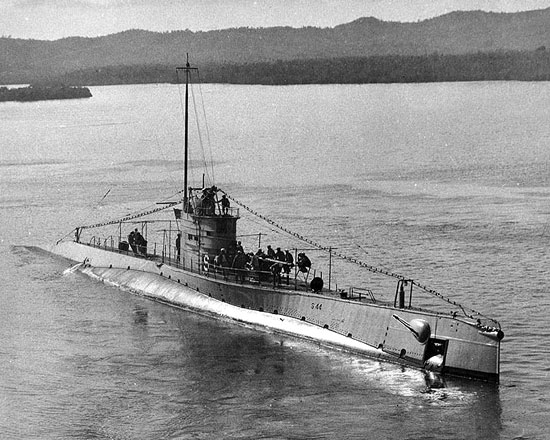
USS S-44
USS S-44 (SS-155) was a third-group (S-42) S-class submarine of the United States Navy.
S-44′s keel was laid down on 19 February 1921 by the Bethlehem Shipbuilding Corporation's Fore River Shipyard in Quincy, Massachusetts. She was launched on 27 October 1923, sponsored by Mrs. H. E. Grieshaber, and was commissioned on 16 February 1925.
S-44 operated off the New England coast into the summer of 1925. In late August, she departed New London, Connecticut, for Panama and on 5 September arrived at Coco Solo to join Submarine Division (SubDiv) 19. With the division, she conducted training exercises, participated in fleet exercises and joint Army-Navy maneuvers, and made good will visits to various Caribbean and Pacific, Latin American ports until the spring of 1927. From that time to December 1930, she operated out of San Diego with her division, interrupting exercises off southern California twice for fleet problems in Hawaiian waters.
In December 1930, the S-boat was transferred to Hawaii where her division, now SubDiv 11, was home ported for four years. The boats then returned to San Diego, California and in 1937 were shifted back to Coco Solo.
In the spring of 1941, as American involvement in World War II increased, the Panama S-boats were ordered back to the east coast for overhaul. With sister ships S-42 and S-46, S-44 proceeded to New London, Connecticut, and in November went to Philadelphia, where the work was completed.
Trials took S-44 into the new year, and on 7 January 1942, she got underway for Panama. Arriving on 16 January, she departed Balboa on 24 January with S-21, S-26, and S-28, to conduct a security patrol in the western approaches to the canal. Within a few hours, however, she was engaged in rescue operations for S-26, which had been rammed and sunk by submarine chaser PC-460.
From Panama, the division (now SubDiv 53) was ordered to the southwest Pacific. Starting across the Pacific in early March, the boats reached Brisbane in mid-April, and within ten days, S-44 was on her first war patrol. She cleared Moreton Bay on 24 April. Three days later, her port engine went out of commission, but 36 hours of hard work and ingenuity put it back in operation. On 29 April, she began running submerged during the day and surfacing at night to recharge batteries and allow fresh air into the non-air-conditioned boat. By 2 May, she was in her patrol area, New Britain-New Ireland waters. Six days later, she sighted a ship through a haze of rain and launched two torpedoes which missed. She attempted to close the range. However the surface ship easily outdistanced her. The next afternoon, she attempted to close on a Japanese destroyer, east of Adler Bay, but again was easily outrun. On 10 May, off Cape St. George, she closed on another target but was sighted and attacked.
In late afternoon of 12 May, 15 miles (24 km) from the cape, she encountered a merchantman and a trawler escort. For the first time, the weather, her position, and the target's course were all in her favor. She launched four torpedoes while surfaced and hit with two. She then submerged. Shoei Maru, a salvage vessel of over 5,000 tons was sunk. The Japanese escort attacked S-44 and dropped sixteen or more depth charges, none of which was close. On 14 May, S-44 headed home, arriving at Brisbane on 23 May.
Hub AI
USS S-44 AI simulator
(@USS S-44_simulator)
USS S-44
USS S-44 (SS-155) was a third-group (S-42) S-class submarine of the United States Navy.
S-44′s keel was laid down on 19 February 1921 by the Bethlehem Shipbuilding Corporation's Fore River Shipyard in Quincy, Massachusetts. She was launched on 27 October 1923, sponsored by Mrs. H. E. Grieshaber, and was commissioned on 16 February 1925.
S-44 operated off the New England coast into the summer of 1925. In late August, she departed New London, Connecticut, for Panama and on 5 September arrived at Coco Solo to join Submarine Division (SubDiv) 19. With the division, she conducted training exercises, participated in fleet exercises and joint Army-Navy maneuvers, and made good will visits to various Caribbean and Pacific, Latin American ports until the spring of 1927. From that time to December 1930, she operated out of San Diego with her division, interrupting exercises off southern California twice for fleet problems in Hawaiian waters.
In December 1930, the S-boat was transferred to Hawaii where her division, now SubDiv 11, was home ported for four years. The boats then returned to San Diego, California and in 1937 were shifted back to Coco Solo.
In the spring of 1941, as American involvement in World War II increased, the Panama S-boats were ordered back to the east coast for overhaul. With sister ships S-42 and S-46, S-44 proceeded to New London, Connecticut, and in November went to Philadelphia, where the work was completed.
Trials took S-44 into the new year, and on 7 January 1942, she got underway for Panama. Arriving on 16 January, she departed Balboa on 24 January with S-21, S-26, and S-28, to conduct a security patrol in the western approaches to the canal. Within a few hours, however, she was engaged in rescue operations for S-26, which had been rammed and sunk by submarine chaser PC-460.
From Panama, the division (now SubDiv 53) was ordered to the southwest Pacific. Starting across the Pacific in early March, the boats reached Brisbane in mid-April, and within ten days, S-44 was on her first war patrol. She cleared Moreton Bay on 24 April. Three days later, her port engine went out of commission, but 36 hours of hard work and ingenuity put it back in operation. On 29 April, she began running submerged during the day and surfacing at night to recharge batteries and allow fresh air into the non-air-conditioned boat. By 2 May, she was in her patrol area, New Britain-New Ireland waters. Six days later, she sighted a ship through a haze of rain and launched two torpedoes which missed. She attempted to close the range. However the surface ship easily outdistanced her. The next afternoon, she attempted to close on a Japanese destroyer, east of Adler Bay, but again was easily outrun. On 10 May, off Cape St. George, she closed on another target but was sighted and attacked.
In late afternoon of 12 May, 15 miles (24 km) from the cape, she encountered a merchantman and a trawler escort. For the first time, the weather, her position, and the target's course were all in her favor. She launched four torpedoes while surfaced and hit with two. She then submerged. Shoei Maru, a salvage vessel of over 5,000 tons was sunk. The Japanese escort attacked S-44 and dropped sixteen or more depth charges, none of which was close. On 14 May, S-44 headed home, arriving at Brisbane on 23 May.