


Community hub
Recent from talks
Contribute something to knowledge base
Content stats: 0 posts, 0 articles, 1 media, 0 notes
Members stats: 0 subscribers, 0 contributors, 0 moderators, 0 supporters
Subscribers
Supporters
Contributors
Moderators
Hub AI
USS S-6 AI simulator
(@USS S-6_simulator)
Hub AI
USS S-6 AI simulator
(@USS S-6_simulator)
USS S-6
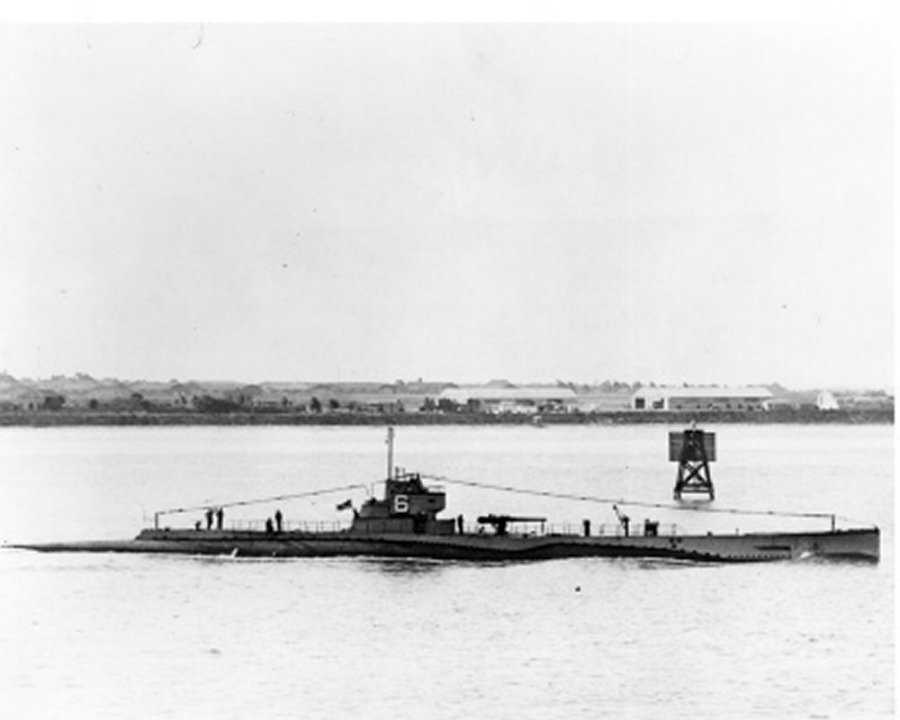
USS S-6 (SS-111), also known as "Submarine No. 111", was an S-3-class, also referred to as a "Government"-type, submarine of the United States Navy.
The "Government"-type had a length of 231 feet (70.4 m) overall, a beam of 21 ft 10 in (6.7 m), and a mean draft of 13 ft 1 in (4.0 m). They displaced 875 long tons (889 t) on the surface and 1,088 long tons (1,105 t) submerged. All S-class submarines had a crew of 4 officers and 34 enlisted men, when first commissioned. They had a diving depth of 200 ft (61.0 m).
For surface running, the S-3-class were powered by two 700-brake-horsepower (522 kW) NELSECO diesel engines, each driving one propeller shaft. When submerged each propeller was driven by a 600-horsepower (447 kW) Westinghouse Electric Corporation electric motor. They could reach 15 knots (28 km/h; 17 mph) on the surface and 11 kn (20 km/h; 13 mph) underwater.
The boats were armed with four 21-inch (533 mm) torpedo tubes in the bow. They carried eight reloads, for a total of twelve torpedoes. The S-3-class submarines were also armed with a single 4 in (100 mm)/50 caliber deck gun.
S-6's keel was laid down on 29 January 1918, by the Portsmouth Naval Shipyard, in Kittery, Maine. She was launched on 23 December 1919, sponsored by Miss Eleanor Westcott, and commissioned on 17 May 1920.
When the US Navy adopted its hull classification system on 17 July 1920, she received the hull number SS-111.
Following trials and outfitting, S-6 departed New London, Connecticut, on 18 November 1920, and joined other S-boats of Submarine Divisions 12 and 18 (SubDivs 12 and 18), for what was to be, at that time, the longest cruise for American submarines on record. The trip, begun with a rendezvous off Portsmouth, New Hampshire, took them through the Panama Canal, to Pearl Harbor, and then to Cavite, Luzon, Philippine Islands. Submarines which had previously served in the Asiatic Fleet, the Plunger-class, had been carried over tied to the decks of colliers.
The two submarine divisions operated from Cavite, over the next three years, from 1 December 1921–29 October 1924. During that time, they frequently visited the Chinese ports at Shanghai, Yantai, Qinhuangdao, Qingdao, Amoy, and Wusong.
USS S-6
USS S-6 (SS-111), also known as "Submarine No. 111", was an S-3-class, also referred to as a "Government"-type, submarine of the United States Navy.
The "Government"-type had a length of 231 feet (70.4 m) overall, a beam of 21 ft 10 in (6.7 m), and a mean draft of 13 ft 1 in (4.0 m). They displaced 875 long tons (889 t) on the surface and 1,088 long tons (1,105 t) submerged. All S-class submarines had a crew of 4 officers and 34 enlisted men, when first commissioned. They had a diving depth of 200 ft (61.0 m).
For surface running, the S-3-class were powered by two 700-brake-horsepower (522 kW) NELSECO diesel engines, each driving one propeller shaft. When submerged each propeller was driven by a 600-horsepower (447 kW) Westinghouse Electric Corporation electric motor. They could reach 15 knots (28 km/h; 17 mph) on the surface and 11 kn (20 km/h; 13 mph) underwater.
The boats were armed with four 21-inch (533 mm) torpedo tubes in the bow. They carried eight reloads, for a total of twelve torpedoes. The S-3-class submarines were also armed with a single 4 in (100 mm)/50 caliber deck gun.
S-6's keel was laid down on 29 January 1918, by the Portsmouth Naval Shipyard, in Kittery, Maine. She was launched on 23 December 1919, sponsored by Miss Eleanor Westcott, and commissioned on 17 May 1920.
When the US Navy adopted its hull classification system on 17 July 1920, she received the hull number SS-111.
Following trials and outfitting, S-6 departed New London, Connecticut, on 18 November 1920, and joined other S-boats of Submarine Divisions 12 and 18 (SubDivs 12 and 18), for what was to be, at that time, the longest cruise for American submarines on record. The trip, begun with a rendezvous off Portsmouth, New Hampshire, took them through the Panama Canal, to Pearl Harbor, and then to Cavite, Luzon, Philippine Islands. Submarines which had previously served in the Asiatic Fleet, the Plunger-class, had been carried over tied to the decks of colliers.
The two submarine divisions operated from Cavite, over the next three years, from 1 December 1921–29 October 1924. During that time, they frequently visited the Chinese ports at Shanghai, Yantai, Qinhuangdao, Qingdao, Amoy, and Wusong.
Recent media
Recent media