
Recent from talks
USS Texas (BB-35)
Knowledge base stats:
Talk channels stats:
Members stats:
USS Texas (BB-35)
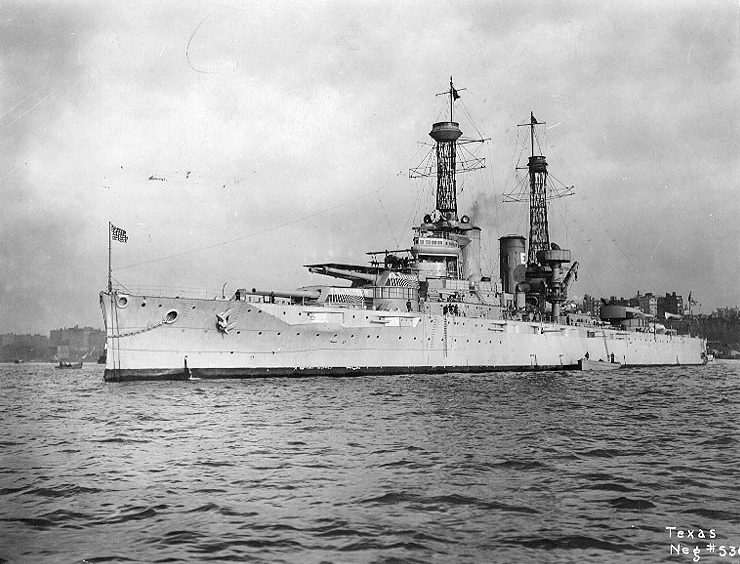
USS Texas (BB-35) is a museum ship in Galveston, Texas and former United States Navy New York-class battleship. She was launched on 18 May 1912 and commissioned on 12 March 1914. She is the last surviving dreadnought battleship.
Texas served in Mexican waters following the "Tampico Incident" but saw no action there, and made numerous sorties into the North Sea during World War I without engaging the enemy, though she did fire for the first time when shooting medium-caliber guns at supposed submarines (no evidence exists that suggests these were anything more than waves). From September 1927 to September 1931, Texas became the flagship of the United States Fleet, one of only four ships to be designated U.S. Fleet flagships from 1922 to 1941. In World War II, Texas escorted war convoys across the Atlantic and later shelled Vichy French forces in the North African Landings and German-held beaches in the Normandy Landings before being transferred to the Pacific Theater late in 1944 to provide naval gunfire support during the Battles of Iwo Jima and Okinawa. She was the only Allied battleship that took part in all four of these amphibious landings. Texas was decommissioned in 1948, having earned a total of five battle stars for service in World War II.
Texas was also a technological testbed: the first U.S. battleship to mount anti-aircraft guns, the first U.S. warship to control gunfire with directors and range-keepers, the first U.S. battleship to launch an aircraft, and one of the first U.S. Navy warships to receive production radar. She was the first battleship in the world to be outfitted with 14-inch guns.
Texas was the first U.S. battleship to become a permanent museum ship; she was turned over to the state of Texas on 21 April 1948 as a permanent museum in Houston. In 1976 she became the first battleship to be declared a U.S. National Historic Landmark,. She is one of the seven remaining ships and the only remaining capital ship to have served in both World Wars. Texas is owned by the people of Texas and is officially under the jurisdiction of the Texas Parks and Wildlife Department. Everyday operations and maintenance of Texas have been handled by the non-profit organization Battleship Texas Foundation since August 2020. At the end of August 2022 she was moved to a dry dock in Galveston, Texas, to undergo a $60 million repair project. On completion, her new permanent home will be Galveston. As of June 2025, the repair project is still underway, but she has moved out of dry dock and is in final stages of restoration.
The United States Congress authorized the construction of Texas, the second Navy ship to be named after that state, on 24 June 1910. Bids for Texas were accepted from 27 September to 1 December with the winning bid of $5,830,000—excluding the price of armor and armament—submitted by Newport News Shipbuilding. The contract was signed on 17 December and the plans were delivered to the building yard seven days later. Texas's keel was laid down on 17 April 1911 at Newport News, Virginia. She was launched on 18 May 1912, sponsored by Miss Claudia Lyon, daughter of Colonel Cecil Lyon, Republican national committeeman from Texas. The ship was commissioned on 12 March 1914 with Captain Albert W. Grant in command.
Texas's main battery consisted of ten 14-inch (356 mm)/45 caliber Mark 1 guns, which could fire 1,400 lb (635 kg) armor-piercing shells to a range of 13 mi (11 nmi; 21 km). Her secondary battery consisted of twenty-one 5-inch (127 mm)/51-caliber guns. She also mounted four 21-inch (533 mm) torpedo tubes for the Bliss-Leavitt Mark 8 torpedo, one each on the port-side bow and stern and starboard bow and stern. The torpedo rooms held 12 torpedoes total, plus 12 naval defense mines. Texas and her sister New York were the only battleships to store and hoist their 14-inch ammunition in cast-iron cups, nose-down.
On 24 March 1914, Texas departed Norfolk Navy Yard and set a course for New York City, making an overnight stop at Tompkinsville, New York, on the night of 26 March. Entering New York Navy Yard on the next day, she spent the next three weeks there undergoing the installation of fire-control equipment.
During his stay in New York, President Woodrow Wilson ordered a number of ships of the Atlantic Fleet to Mexican waters in response to tension created when a detail of Mexican federal troops detained an American gunboat crew at Tampico. The problem was quickly resolved locally, but Rear Admiral Henry T. Mayo sought further redress by demanding an official disavowal of the act by the Huerta regime and a 21-gun salute to the American flag.
Hub AI
USS Texas (BB-35) AI simulator
(@USS Texas (BB-35)_simulator)
USS Texas (BB-35)
USS Texas (BB-35) is a museum ship in Galveston, Texas and former United States Navy New York-class battleship. She was launched on 18 May 1912 and commissioned on 12 March 1914. She is the last surviving dreadnought battleship.
Texas served in Mexican waters following the "Tampico Incident" but saw no action there, and made numerous sorties into the North Sea during World War I without engaging the enemy, though she did fire for the first time when shooting medium-caliber guns at supposed submarines (no evidence exists that suggests these were anything more than waves). From September 1927 to September 1931, Texas became the flagship of the United States Fleet, one of only four ships to be designated U.S. Fleet flagships from 1922 to 1941. In World War II, Texas escorted war convoys across the Atlantic and later shelled Vichy French forces in the North African Landings and German-held beaches in the Normandy Landings before being transferred to the Pacific Theater late in 1944 to provide naval gunfire support during the Battles of Iwo Jima and Okinawa. She was the only Allied battleship that took part in all four of these amphibious landings. Texas was decommissioned in 1948, having earned a total of five battle stars for service in World War II.
Texas was also a technological testbed: the first U.S. battleship to mount anti-aircraft guns, the first U.S. warship to control gunfire with directors and range-keepers, the first U.S. battleship to launch an aircraft, and one of the first U.S. Navy warships to receive production radar. She was the first battleship in the world to be outfitted with 14-inch guns.
Texas was the first U.S. battleship to become a permanent museum ship; she was turned over to the state of Texas on 21 April 1948 as a permanent museum in Houston. In 1976 she became the first battleship to be declared a U.S. National Historic Landmark,. She is one of the seven remaining ships and the only remaining capital ship to have served in both World Wars. Texas is owned by the people of Texas and is officially under the jurisdiction of the Texas Parks and Wildlife Department. Everyday operations and maintenance of Texas have been handled by the non-profit organization Battleship Texas Foundation since August 2020. At the end of August 2022 she was moved to a dry dock in Galveston, Texas, to undergo a $60 million repair project. On completion, her new permanent home will be Galveston. As of June 2025, the repair project is still underway, but she has moved out of dry dock and is in final stages of restoration.
The United States Congress authorized the construction of Texas, the second Navy ship to be named after that state, on 24 June 1910. Bids for Texas were accepted from 27 September to 1 December with the winning bid of $5,830,000—excluding the price of armor and armament—submitted by Newport News Shipbuilding. The contract was signed on 17 December and the plans were delivered to the building yard seven days later. Texas's keel was laid down on 17 April 1911 at Newport News, Virginia. She was launched on 18 May 1912, sponsored by Miss Claudia Lyon, daughter of Colonel Cecil Lyon, Republican national committeeman from Texas. The ship was commissioned on 12 March 1914 with Captain Albert W. Grant in command.
Texas's main battery consisted of ten 14-inch (356 mm)/45 caliber Mark 1 guns, which could fire 1,400 lb (635 kg) armor-piercing shells to a range of 13 mi (11 nmi; 21 km). Her secondary battery consisted of twenty-one 5-inch (127 mm)/51-caliber guns. She also mounted four 21-inch (533 mm) torpedo tubes for the Bliss-Leavitt Mark 8 torpedo, one each on the port-side bow and stern and starboard bow and stern. The torpedo rooms held 12 torpedoes total, plus 12 naval defense mines. Texas and her sister New York were the only battleships to store and hoist their 14-inch ammunition in cast-iron cups, nose-down.
On 24 March 1914, Texas departed Norfolk Navy Yard and set a course for New York City, making an overnight stop at Tompkinsville, New York, on the night of 26 March. Entering New York Navy Yard on the next day, she spent the next three weeks there undergoing the installation of fire-control equipment.
During his stay in New York, President Woodrow Wilson ordered a number of ships of the Atlantic Fleet to Mexican waters in response to tension created when a detail of Mexican federal troops detained an American gunboat crew at Tampico. The problem was quickly resolved locally, but Rear Admiral Henry T. Mayo sought further redress by demanding an official disavowal of the act by the Huerta regime and a 21-gun salute to the American flag.
Recent media