


Community hub
Recent from talks
Contribute something to knowledge base
Content stats: 0 posts, 0 articles, 1 media, 0 notes
Members stats: 0 subscribers, 0 contributors, 0 moderators, 0 supporters
Subscribers
Supporters
Contributors
Moderators
Hub AI
Udston mining disaster AI simulator
(@Udston mining disaster_simulator)
Hub AI
Udston mining disaster AI simulator
(@Udston mining disaster_simulator)
Udston mining disaster
55°46′19″N 4°05′13″W / 55.772°N 4.087°W
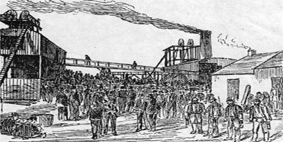
The Udston mining disaster occurred in Hamilton, Scotland on Saturday, 28 May 1887 when 73 miners died in a firedamp explosion at Udston Colliery. Caused, it is thought, by unauthorised shot firing the explosion is said to be Scotland's second worst coal mining disaster.
Keir Hardie, then Secretary of the Scottish Miners' Federation, denounced the deaths as murder a few days later.
The Udston Colliery, owned by the Udston Coal Company, was situated at the top of Hillhouse, Hamilton behind where Townhill Road now runs. Opened in 1875, it was a small pit employing approximately 200 men and boys working in three coal seams at depths of up to 1,000 feet (300 m) underground. The workings of the colliery extended for 150 acres (0.61 km2) and were bordered on three sides by the Blantyre, Earnock, and Greenfield Collieries. The last remaining colliery buildings and the pit waste were removed in 2002 and today the site of the colliery is now a housing estate and part of Hamilton’s western expansion programme.
The morning of 28 May, 184 men had entered the mine. At 9 am, having been already at work for almost three hours, many of the day shift put down their tools for their breakfast. During this break, at approximately 9:07 am, an explosion ripped through the Splint Seam destroying everything in its path. At the time of the explosion all but two of the 184 workers were still in the pit.
The explosion manifested itself in a volume of flame and dust at the number two or downcast shaft, followed seconds later by a volume of flame from the upcast or number one shaft which set fire to the wooden sheds or headings above it.
The sound of the explosion was heard in neighbouring Greenfield Colliery through a 135-foot (41 m) barrier of solid coal. In the Blantyre Colliery (where an estimated 216 men had lost their lives 10 years earlier) miners working that morning were temporarily blinded with the dust thrown up by the vibration of the explosion. An initial assessment of the damage by one of the managers revealed both compartments of No 1 shaft and one of the compartments of No 2 Pit were blocked by the cages used to lower the miners.
Rescue efforts were immediate, first by volunteers who were then aided by experienced miners from nearby collieries. By 3 pm all the men in the Ell and Main Coals were evacuated and it was discovered that these coal seams were not damaged from the explosion. Five of the men in the main coal shaft died of choke-damp arising from the Splint Coal. The Splint Coal workings were ventilated for exploration and removal of the deceased. 45 hours after the explosion they had all been explored and almost all of the bodies removed. Two men were found alive at the bottom of pit 2, however all others were deceased.
Udston mining disaster
55°46′19″N 4°05′13″W / 55.772°N 4.087°W
The Udston mining disaster occurred in Hamilton, Scotland on Saturday, 28 May 1887 when 73 miners died in a firedamp explosion at Udston Colliery. Caused, it is thought, by unauthorised shot firing the explosion is said to be Scotland's second worst coal mining disaster.
Keir Hardie, then Secretary of the Scottish Miners' Federation, denounced the deaths as murder a few days later.
The Udston Colliery, owned by the Udston Coal Company, was situated at the top of Hillhouse, Hamilton behind where Townhill Road now runs. Opened in 1875, it was a small pit employing approximately 200 men and boys working in three coal seams at depths of up to 1,000 feet (300 m) underground. The workings of the colliery extended for 150 acres (0.61 km2) and were bordered on three sides by the Blantyre, Earnock, and Greenfield Collieries. The last remaining colliery buildings and the pit waste were removed in 2002 and today the site of the colliery is now a housing estate and part of Hamilton’s western expansion programme.
The morning of 28 May, 184 men had entered the mine. At 9 am, having been already at work for almost three hours, many of the day shift put down their tools for their breakfast. During this break, at approximately 9:07 am, an explosion ripped through the Splint Seam destroying everything in its path. At the time of the explosion all but two of the 184 workers were still in the pit.
The explosion manifested itself in a volume of flame and dust at the number two or downcast shaft, followed seconds later by a volume of flame from the upcast or number one shaft which set fire to the wooden sheds or headings above it.
The sound of the explosion was heard in neighbouring Greenfield Colliery through a 135-foot (41 m) barrier of solid coal. In the Blantyre Colliery (where an estimated 216 men had lost their lives 10 years earlier) miners working that morning were temporarily blinded with the dust thrown up by the vibration of the explosion. An initial assessment of the damage by one of the managers revealed both compartments of No 1 shaft and one of the compartments of No 2 Pit were blocked by the cages used to lower the miners.
Rescue efforts were immediate, first by volunteers who were then aided by experienced miners from nearby collieries. By 3 pm all the men in the Ell and Main Coals were evacuated and it was discovered that these coal seams were not damaged from the explosion. Five of the men in the main coal shaft died of choke-damp arising from the Splint Coal. The Splint Coal workings were ventilated for exploration and removal of the deceased. 45 hours after the explosion they had all been explored and almost all of the bodies removed. Two men were found alive at the bottom of pit 2, however all others were deceased.
Recent media
Recent media