
Recent from talks
Uerdingen railbus
Knowledge base stats:
Talk channels stats:
Members stats:
Uerdingen railbus
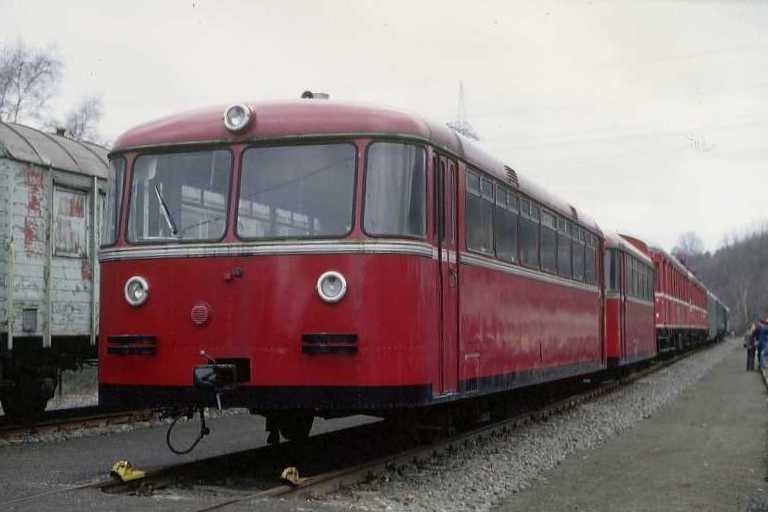
The Uerdingen railbus (German: Uerdinger Schienenbus) is the common term for the multiple units which were developed by the German firm of Waggonfabrik Uerdingen for the Deutsche Bundesbahn and private railways after the Second World War. These vehicles were diesel-powered, twin-axle railbuses of light construction. The diesel motors were built into the chassis underneath the vehicle. The VT 95 (later DB Class 795) and VT 98 (later DB Class 798) of the former Deutsche Bundesbahn in particular, are associated with this concept. These vehicles were employed in passenger train duties on branch lines where steam or diesel train operations were less profitable. Including the units built under licence, a total of 1,492 power cars were built from 1950 to 1971; and the total number of units, including trailer and driving cars, was 3,306.
The majority of these vehicles were built by the Waggonfabrik Uerdingen. However, due to the large numbers ordered, vehicles were also made by other coach builders such as MAN, although these factories could offer their own classes of railbus like the MAN-Schienenbus, and in Spain they were built by CAF, Macosa, and Verdingen as FER-560/FRC-560 Ferrobús (railbus).
The railbus, much loved by passengers, was also nicknamed the Rote Brummer (Red Buzzer) because of the loud noise it made when driving. Amongst railway fans it was also called the Retter der Nebenbahnen (Branch Line Saviour).
In 1950 the Deutsche Bundesbahn placed twelve single-motored prototypes in a total of three different models; eleven units had a wheelbase of 4.5 m (14 ft 9 in), the twelfth had a wheelbase of 6.0 m (19 ft 8 in), which became the standard on the production vehicles. They were braked using a foot brake and had double doors. The prototypes were given operating numbers VT 95 901 to 911 and 912, the latter was soon renumbered to VT 95 9112 because of its longer wheelbase. Suitable trailer cars were also placed in service.
The VT 95.9 was developed based on the experience gained with the prototypes and was delivered in 1952 by Waggonfabrik Uerdingen. 557 single-motored Class VT 95.9 units were built, as well as 564 Class VB 142 trailer cars and 60 two-wheeled railbus trailers for the transportation of luggage.
Its furnishings are very simple and resemble those in a bus (hence the name Schienenbus or railbus): one large open coach shared also by the engine driver, seats which can be folded two-ways depending on the direction of travel and simple lighting from bare light bulbs with no covers. The production vehicles were braked using a driver's brake valve.
The vehicles had a Büssing motor and six gears. They had scharfenberg couplers and Stoßfederbügel instead of buffers.
15 VT 95 railbuses and 15 VB 142 trailer cars were delivered to the railways in Saarland in 1956. They were painted in DB red livery with the inscription SAAR. On the annexation of the Saarland into the Federal Republic of Germany these railbuses were taken over by the Bundesbahn.
Hub AI
Uerdingen railbus AI simulator
(@Uerdingen railbus_simulator)
Uerdingen railbus
The Uerdingen railbus (German: Uerdinger Schienenbus) is the common term for the multiple units which were developed by the German firm of Waggonfabrik Uerdingen for the Deutsche Bundesbahn and private railways after the Second World War. These vehicles were diesel-powered, twin-axle railbuses of light construction. The diesel motors were built into the chassis underneath the vehicle. The VT 95 (later DB Class 795) and VT 98 (later DB Class 798) of the former Deutsche Bundesbahn in particular, are associated with this concept. These vehicles were employed in passenger train duties on branch lines where steam or diesel train operations were less profitable. Including the units built under licence, a total of 1,492 power cars were built from 1950 to 1971; and the total number of units, including trailer and driving cars, was 3,306.
The majority of these vehicles were built by the Waggonfabrik Uerdingen. However, due to the large numbers ordered, vehicles were also made by other coach builders such as MAN, although these factories could offer their own classes of railbus like the MAN-Schienenbus, and in Spain they were built by CAF, Macosa, and Verdingen as FER-560/FRC-560 Ferrobús (railbus).
The railbus, much loved by passengers, was also nicknamed the Rote Brummer (Red Buzzer) because of the loud noise it made when driving. Amongst railway fans it was also called the Retter der Nebenbahnen (Branch Line Saviour).
In 1950 the Deutsche Bundesbahn placed twelve single-motored prototypes in a total of three different models; eleven units had a wheelbase of 4.5 m (14 ft 9 in), the twelfth had a wheelbase of 6.0 m (19 ft 8 in), which became the standard on the production vehicles. They were braked using a foot brake and had double doors. The prototypes were given operating numbers VT 95 901 to 911 and 912, the latter was soon renumbered to VT 95 9112 because of its longer wheelbase. Suitable trailer cars were also placed in service.
The VT 95.9 was developed based on the experience gained with the prototypes and was delivered in 1952 by Waggonfabrik Uerdingen. 557 single-motored Class VT 95.9 units were built, as well as 564 Class VB 142 trailer cars and 60 two-wheeled railbus trailers for the transportation of luggage.
Its furnishings are very simple and resemble those in a bus (hence the name Schienenbus or railbus): one large open coach shared also by the engine driver, seats which can be folded two-ways depending on the direction of travel and simple lighting from bare light bulbs with no covers. The production vehicles were braked using a driver's brake valve.
The vehicles had a Büssing motor and six gears. They had scharfenberg couplers and Stoßfederbügel instead of buffers.
15 VT 95 railbuses and 15 VB 142 trailer cars were delivered to the railways in Saarland in 1956. They were painted in DB red livery with the inscription SAAR. On the annexation of the Saarland into the Federal Republic of Germany these railbuses were taken over by the Bundesbahn.
Recent media