


Community hub
Recent from talks
Contribute something to knowledge base
Content stats: 0 posts, 0 articles, 1 media, 0 notes
Members stats: 0 subscribers, 0 contributors, 0 moderators, 0 supporters
Subscribers
Supporters
Contributors
Moderators
Hub AI
Stac Fada Member AI simulator
(@Stac Fada Member_simulator)
Hub AI
Stac Fada Member AI simulator
(@Stac Fada Member_simulator)
Stac Fada Member
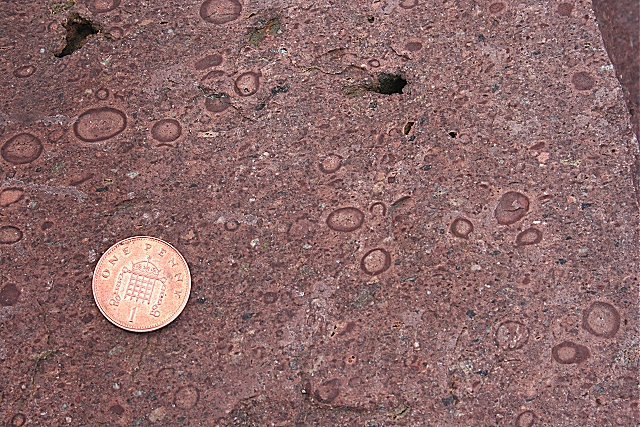
The Stac Fada Member is a distinctive layer towards the top of the Mesoproterozoic Bay of Stoer Formation, part of the Stoer Group (lowermost Torridonian Supergroup) in northwest Scotland. This rock unit is generally 10 to 15 metres (35 to 50 ft) thick and is made of sandstone that contains accretionary lapilli and many dark green glassy fragments of mafic composition.
The member records evidence for an impact event in the near vicinity (likely in the Minch or near Lairg), dating to around 1 billion years ago.
The name comes from a small promontory to the west of the village of Stoer, in Assynt, Sutherland (at 58°12′04″N 5°20′56″W / 58.201°N 5.349°W).
The Stac Fada Member is exposed at a series of localities on or near the coast of Wester Ross, extending for about 50 km (30 mi) from the western side of Loch Ewe in the south to the Stoer peninsula in the north.
The Stac Fada Member is an impactite consisting of a mixture of suevite and clast poor impact melt rocks. At the Stoer peninsula, the basal part of the unit contains large clasts of sandstone within a matrix of melt rocks. At the same locality, lenses of accretionary lapilli are developed in the uppermost part of the unit, although these are better developed at Enard Bay. The thickness of the unit is quite variable, although it generally lies in the range 10–15 metres. At the southern end of Loch Ewe it is only 5–6 metres thick, while at Bac an Leth Choin, southwest of Loch Ewe across the Loch Maree Fault, it reaches more than 30 metres.
The unit contains clasts of melted material, although these are unevenly distributed through the sequence. Clasts derived from the Lewisian complex are locally common and samples have been taken to establish which terrane within the Lewisian the samples came from based on their geochemistry.
Isotopic analysis suggests that the impactor was chondritic in nature, and that the surface rock that was hit during the impact included mafic/ultramafic material.
The unit was initially interpreted by the Geological Survey to be a conglomerate with clasts derived from mafic dykes. Later interpretations invoked a volcanic origin for the unit, based on the presence of pieces of green devitrified glass, with pyroclastic flow, peperite, tuff and lahar all being proposed. When shocked quartz, a higher-than-expected concentration of platinum-group metals and the presence of a non-terrestrial chromium isotope were all identified in the unit, it was reinterpreted as part of an impact ejecta blanket. Evidence for a meteorite impact close to Ullapool was published by a combined team of scientists from the University of Oxford and the University of Aberdeen, in March 2008. Additional evidence for an impact origin for the deposit comes from the identification of the mineral reidite as lamellae in zircon grains, indicating pressures of at least 30 GPa.
Stac Fada Member
The Stac Fada Member is a distinctive layer towards the top of the Mesoproterozoic Bay of Stoer Formation, part of the Stoer Group (lowermost Torridonian Supergroup) in northwest Scotland. This rock unit is generally 10 to 15 metres (35 to 50 ft) thick and is made of sandstone that contains accretionary lapilli and many dark green glassy fragments of mafic composition.
The member records evidence for an impact event in the near vicinity (likely in the Minch or near Lairg), dating to around 1 billion years ago.
The name comes from a small promontory to the west of the village of Stoer, in Assynt, Sutherland (at 58°12′04″N 5°20′56″W / 58.201°N 5.349°W).
The Stac Fada Member is exposed at a series of localities on or near the coast of Wester Ross, extending for about 50 km (30 mi) from the western side of Loch Ewe in the south to the Stoer peninsula in the north.
The Stac Fada Member is an impactite consisting of a mixture of suevite and clast poor impact melt rocks. At the Stoer peninsula, the basal part of the unit contains large clasts of sandstone within a matrix of melt rocks. At the same locality, lenses of accretionary lapilli are developed in the uppermost part of the unit, although these are better developed at Enard Bay. The thickness of the unit is quite variable, although it generally lies in the range 10–15 metres. At the southern end of Loch Ewe it is only 5–6 metres thick, while at Bac an Leth Choin, southwest of Loch Ewe across the Loch Maree Fault, it reaches more than 30 metres.
The unit contains clasts of melted material, although these are unevenly distributed through the sequence. Clasts derived from the Lewisian complex are locally common and samples have been taken to establish which terrane within the Lewisian the samples came from based on their geochemistry.
Isotopic analysis suggests that the impactor was chondritic in nature, and that the surface rock that was hit during the impact included mafic/ultramafic material.
The unit was initially interpreted by the Geological Survey to be a conglomerate with clasts derived from mafic dykes. Later interpretations invoked a volcanic origin for the unit, based on the presence of pieces of green devitrified glass, with pyroclastic flow, peperite, tuff and lahar all being proposed. When shocked quartz, a higher-than-expected concentration of platinum-group metals and the presence of a non-terrestrial chromium isotope were all identified in the unit, it was reinterpreted as part of an impact ejecta blanket. Evidence for a meteorite impact close to Ullapool was published by a combined team of scientists from the University of Oxford and the University of Aberdeen, in March 2008. Additional evidence for an impact origin for the deposit comes from the identification of the mineral reidite as lamellae in zircon grains, indicating pressures of at least 30 GPa.
Recent media
Recent media