
Recent from talks
Assynt
Knowledge base stats:
Talk channels stats:
Members stats:
Assynt
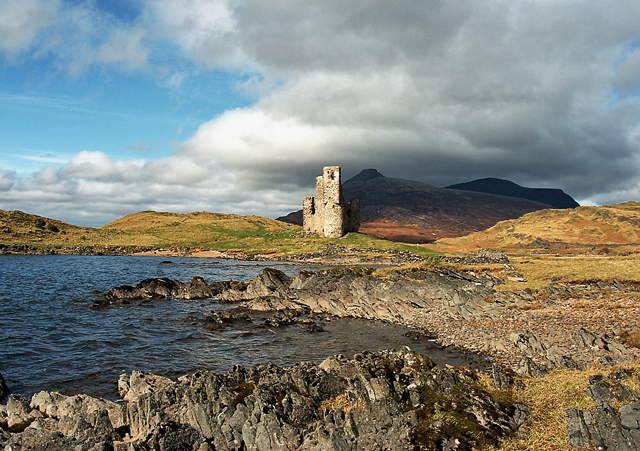
Assynt (Scottish Gaelic: Asainn [ˈas̪ɪɲ] or Asainte [ˈas̪ɪɲtʲə]) is a sparsely populated area in the south-west of Sutherland, lying north of Ullapool on the west coast of Scotland. Assynt is known for its landscape and its remarkable mountains, which have led to the area, along with neighbouring Coigach, being designated as the Assynt-Coigach National Scenic Area, one of 40 such areas in Scotland.
The western part of Assynt has many distinctively shaped mountains, including Quinag, Canisp, Suilven and Ben More Assynt, that rise steeply from the surrounding "cnoc and lochan" scenery. These can often appear higher than their actual height would indicate due to their steep sides and the contrast with the moorland from which they rise. Many of the most distinctive peaks such as Suilven were formed during the last Ice Age, when they were left exposed above the ice sheet as nunataks, and they now remain as inselbergs of highly eroded Torridonian sandstone sitting on a bedrock of much older Lewisian gneiss. The Moine Thrust runs through the area, and is most visible at Knockan Crag National Nature Reserve, which includes a visitor centre interpreting the geological features of the landscape. In the east of Assynt lies a region of limestone scenery surrounding Ben More Assynt. This part of Assynt hosts the longest cave in Scotland, Uamh an Claonaite, which lies five miles (eight kilometres) south of Inchnadamph. The geological importance of Assynt is reflected in its inclusion in the North West Highlands Geopark.
The name Assynt may derive from an Old Norse word meaning 'ridge end'. There is also a tradition that the name comes from a fight between the two brothers Unt and Ass-Unt, (meaning Man of Peace and Man of Discord). The latter having won the tussle gave his name to the parish. It is celebrated in the poetry of Norman MacCaig.
For many years Assynt was regarded as a district or province of Scotland in its own right, and was later established as a civil parish. With the introduction of counties it became part of the county of Sutherland. Parishes were abolished for administrative purposes in 1930, and counties were replaced by a system of regional and district councils in 1975, however the boundaries of both were retained for statistical purposes (e.g. census figures and land registration) as well for ceremonial purposes such as lieutenancy. The regions and districts were replaced by unitary councils in 1996, and Assynt now forms a community within Highland council area.
As is typical for the Scottish highlands, the Assynt area is divided into a number of large estates, which are in a mix of private, charitable and community ownership. The Assynt Estate, which includes Ben More Assynt and the lands around Lochinver, remains in the hands of the Vestey family, who also formerly owned the North Assynt Estate (see below).
The Quinag estate belongs to the John Muir Trust, a charity that seeks to conserve wild land and wild places.
The Little Assynt Estate, which comprises two of the old townships of Assynt, Little Assynt and Loch Beannach is now owned by Culag Community Woodland Trust, a local trust that seeks to provide employment and training and improvements in well-being for local people, as well as encouraging education about the area's natural environment.
In 1989, the northwest portion of the Assynt estate was renamed the North Lochinver Estate and put on the market by its owners, the Vestey family. This area consisted almost entirely of crofting land, with 13 crofting townships being set up during the Highland Clearances. The purpose of the sale was to raise money for the owners to buy more hill ground suitable for deer stalking. The estate was purchased by Scandinavian Property Services Limited. Three years later, the company went into liquidation. The North Lochinver Estate was divided into seven lots and put up for sale. The sale was handled by an Edinburgh based estate agent, John Clegg and Co. The proposed break-up of the estate was a cause of concern for the crofters as the boundaries of the lots cut across grazing land, creating the possibility of some crofters having to deal with more than one landlord. The crofters also believed that some of the portions would be directly administered by the owners, rather than a professional factor.
Hub AI
Assynt AI simulator
(@Assynt_simulator)
Assynt
Assynt (Scottish Gaelic: Asainn [ˈas̪ɪɲ] or Asainte [ˈas̪ɪɲtʲə]) is a sparsely populated area in the south-west of Sutherland, lying north of Ullapool on the west coast of Scotland. Assynt is known for its landscape and its remarkable mountains, which have led to the area, along with neighbouring Coigach, being designated as the Assynt-Coigach National Scenic Area, one of 40 such areas in Scotland.
The western part of Assynt has many distinctively shaped mountains, including Quinag, Canisp, Suilven and Ben More Assynt, that rise steeply from the surrounding "cnoc and lochan" scenery. These can often appear higher than their actual height would indicate due to their steep sides and the contrast with the moorland from which they rise. Many of the most distinctive peaks such as Suilven were formed during the last Ice Age, when they were left exposed above the ice sheet as nunataks, and they now remain as inselbergs of highly eroded Torridonian sandstone sitting on a bedrock of much older Lewisian gneiss. The Moine Thrust runs through the area, and is most visible at Knockan Crag National Nature Reserve, which includes a visitor centre interpreting the geological features of the landscape. In the east of Assynt lies a region of limestone scenery surrounding Ben More Assynt. This part of Assynt hosts the longest cave in Scotland, Uamh an Claonaite, which lies five miles (eight kilometres) south of Inchnadamph. The geological importance of Assynt is reflected in its inclusion in the North West Highlands Geopark.
The name Assynt may derive from an Old Norse word meaning 'ridge end'. There is also a tradition that the name comes from a fight between the two brothers Unt and Ass-Unt, (meaning Man of Peace and Man of Discord). The latter having won the tussle gave his name to the parish. It is celebrated in the poetry of Norman MacCaig.
For many years Assynt was regarded as a district or province of Scotland in its own right, and was later established as a civil parish. With the introduction of counties it became part of the county of Sutherland. Parishes were abolished for administrative purposes in 1930, and counties were replaced by a system of regional and district councils in 1975, however the boundaries of both were retained for statistical purposes (e.g. census figures and land registration) as well for ceremonial purposes such as lieutenancy. The regions and districts were replaced by unitary councils in 1996, and Assynt now forms a community within Highland council area.
As is typical for the Scottish highlands, the Assynt area is divided into a number of large estates, which are in a mix of private, charitable and community ownership. The Assynt Estate, which includes Ben More Assynt and the lands around Lochinver, remains in the hands of the Vestey family, who also formerly owned the North Assynt Estate (see below).
The Quinag estate belongs to the John Muir Trust, a charity that seeks to conserve wild land and wild places.
The Little Assynt Estate, which comprises two of the old townships of Assynt, Little Assynt and Loch Beannach is now owned by Culag Community Woodland Trust, a local trust that seeks to provide employment and training and improvements in well-being for local people, as well as encouraging education about the area's natural environment.
In 1989, the northwest portion of the Assynt estate was renamed the North Lochinver Estate and put on the market by its owners, the Vestey family. This area consisted almost entirely of crofting land, with 13 crofting townships being set up during the Highland Clearances. The purpose of the sale was to raise money for the owners to buy more hill ground suitable for deer stalking. The estate was purchased by Scandinavian Property Services Limited. Three years later, the company went into liquidation. The North Lochinver Estate was divided into seven lots and put up for sale. The sale was handled by an Edinburgh based estate agent, John Clegg and Co. The proposed break-up of the estate was a cause of concern for the crofters as the boundaries of the lots cut across grazing land, creating the possibility of some crofters having to deal with more than one landlord. The crofters also believed that some of the portions would be directly administered by the owners, rather than a professional factor.
Recent media