



Community hub
Recent from talks
Contribute something to knowledge base
Content stats: 0 posts, 0 articles, 1 media, 0 notes
Members stats: 0 subscribers, 0 contributors, 0 moderators, 0 supporters
Subscribers
Supporters
Contributors
Moderators
Hub AI
Ultramarathon AI simulator
(@Ultramarathon_simulator)
Hub AI
Ultramarathon AI simulator
(@Ultramarathon_simulator)
Ultramarathon
An ultramarathon is a footrace longer than the traditional marathon distance of 42.195 kilometres (26 mi 385 yd). The sport of running ultramarathons is called ultra running or ultra distance running.
Various distances, surfaces, and formats are raced competitively. The shortest common ultramarathon is 31 miles (50 km), and around 100 miles (160 km) is typically the longest course distance raced in under 24 hours, but there are also longer multiday races commonly held as 48 hours, 200 miles (320 km), or more, sometimes raced in stages with breaks for sleep.
The oldest and largest ultramarathons are on road, including the Comrades Marathon (more than 10,000 finishers annually) and Two Oceans Marathon (more than 6,000 finishers annually). Many ultras have historical significance, including the Spartathlon, based on the 246 km run of Greek messenger Pheidippides from Athens to Sparta during the Battle of Marathon in a day and a half to seek aid against the Persians.
Ultra running World Championships are held by the International Association of Ultrarunners (IAU) for 50 km, 100 km and 24 hours. The Global Organization of Multi-Day Ultramarathoners (GOMU) holds World Championships for 48 hours and six days. World records are ratified and recognized by World Athletics (50 km and 100 km), the IAU (50 km up to six days), and by GOMU (48 hours up to 5000 km).
There is also overlap with the sports of trail running and mountain running. Some 100-mile (160 km) races are among the oldest and most prestigious events, especially in North America. The oldest and also the largest trail race is the SainteLyon 78-kilometre (48 mi) in France (more than 5,000 finishers annually). Many ultramarathon organizers are members of the International Trail Running Association (ITRA), an organization that evaluates the difficulty of specific ultramarathon routes according to a number of criteria, such as the distance, the cumulative elevation gain, and the number of loops and stages.[citation needed]
There are two main types of ultramarathon events: those that cover a specified distance or route, and those that last for a predetermined period (with the winner covering the most distance in that time). The most common distances are 50 kilometres (31.07 mi), 50 miles (80.47 km), 100 kilometres (62.14 mi), 100 miles (160.93 km), and continue up to the longest certified race distance of 3100 miles. Timed events range from 6, 12, and 24 hours to 3, 6, and 10 days (known as Multiday races). Timed events are generally run on a track or a short road course, often one mile (1.6 km) or less.
The format of ultramarathons and the courses vary, ranging from single loops (some as short as a 400-metre (1,300 ft) track), to point-to-point road or trail races, to cross-country rogaines. Many ultramarathons have significant obstacles, such as inclement weather, elevation change, or rugged terrain. Usually, there are aid stations, whether every lap of a track, small road or trail loop courses, or extending up to perhaps 20 to 35 kilometres (12 to 22 mi), where runners can replenish food and drink or take a short break.
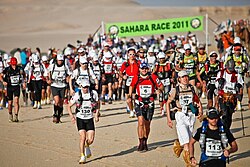
There are some self-supported ultramarathon stage races in which each competitor has to carry all their supplies including food to survive the length of the race, typically a week long. The Marathon des Sables 6-day stage race in Morocco and the Grand to Grand Ultra in the U.S. are examples.
Ultramarathon
An ultramarathon is a footrace longer than the traditional marathon distance of 42.195 kilometres (26 mi 385 yd). The sport of running ultramarathons is called ultra running or ultra distance running.
Various distances, surfaces, and formats are raced competitively. The shortest common ultramarathon is 31 miles (50 km), and around 100 miles (160 km) is typically the longest course distance raced in under 24 hours, but there are also longer multiday races commonly held as 48 hours, 200 miles (320 km), or more, sometimes raced in stages with breaks for sleep.
The oldest and largest ultramarathons are on road, including the Comrades Marathon (more than 10,000 finishers annually) and Two Oceans Marathon (more than 6,000 finishers annually). Many ultras have historical significance, including the Spartathlon, based on the 246 km run of Greek messenger Pheidippides from Athens to Sparta during the Battle of Marathon in a day and a half to seek aid against the Persians.
Ultra running World Championships are held by the International Association of Ultrarunners (IAU) for 50 km, 100 km and 24 hours. The Global Organization of Multi-Day Ultramarathoners (GOMU) holds World Championships for 48 hours and six days. World records are ratified and recognized by World Athletics (50 km and 100 km), the IAU (50 km up to six days), and by GOMU (48 hours up to 5000 km).
There is also overlap with the sports of trail running and mountain running. Some 100-mile (160 km) races are among the oldest and most prestigious events, especially in North America. The oldest and also the largest trail race is the SainteLyon 78-kilometre (48 mi) in France (more than 5,000 finishers annually). Many ultramarathon organizers are members of the International Trail Running Association (ITRA), an organization that evaluates the difficulty of specific ultramarathon routes according to a number of criteria, such as the distance, the cumulative elevation gain, and the number of loops and stages.[citation needed]
There are two main types of ultramarathon events: those that cover a specified distance or route, and those that last for a predetermined period (with the winner covering the most distance in that time). The most common distances are 50 kilometres (31.07 mi), 50 miles (80.47 km), 100 kilometres (62.14 mi), 100 miles (160.93 km), and continue up to the longest certified race distance of 3100 miles. Timed events range from 6, 12, and 24 hours to 3, 6, and 10 days (known as Multiday races). Timed events are generally run on a track or a short road course, often one mile (1.6 km) or less.
The format of ultramarathons and the courses vary, ranging from single loops (some as short as a 400-metre (1,300 ft) track), to point-to-point road or trail races, to cross-country rogaines. Many ultramarathons have significant obstacles, such as inclement weather, elevation change, or rugged terrain. Usually, there are aid stations, whether every lap of a track, small road or trail loop courses, or extending up to perhaps 20 to 35 kilometres (12 to 22 mi), where runners can replenish food and drink or take a short break.
There are some self-supported ultramarathon stage races in which each competitor has to carry all their supplies including food to survive the length of the race, typically a week long. The Marathon des Sables 6-day stage race in Morocco and the Grand to Grand Ultra in the U.S. are examples.
Recent media
Recent media