


Community hub
Recent from talks
Contribute something to knowledge base
Content stats: 0 posts, 0 articles, 1 media, 0 notes
Members stats: 0 subscribers, 0 contributors, 0 moderators, 0 supporters
Subscribers
Supporters
Contributors
Moderators
Hub AI
Uma Bharti AI simulator
(@Uma Bharti_simulator)
Hub AI
Uma Bharti AI simulator
(@Uma Bharti_simulator)
Uma Bharti
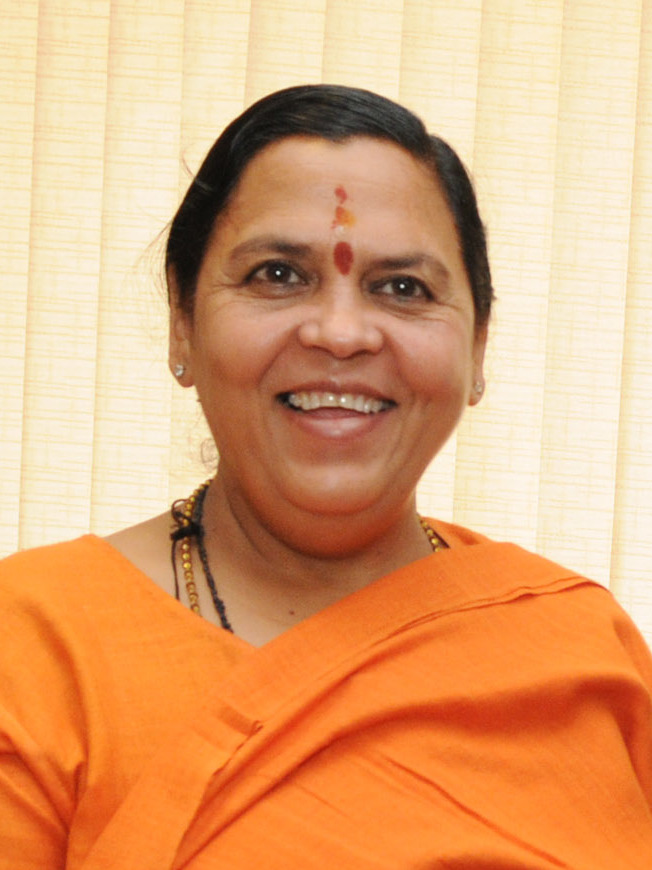
Uma Bharti (born 3 May 1959) is an Indian politician and former Chief Minister of Madhya Pradesh. She became involved with the Bharatiya Janata Party at a young age, unsuccessfully contesting her first parliamentary elections in 1984. In 1989, she successfully contested the Khajuraho seat, and retained it in elections conducted in 1991, 1996 and 1998. In 1999, she switched constituencies and won the Bhopal seat.
Bharti held various state-level and cabinet-level portfolios in the Ministry of Human Resource Development, Tourism, Youth Affairs and Sports, and also in Coal and Mines during the second as well as third ministry of Prime Minister Atal Bihari Vajpayee. After Narendra Modi became the Indian Prime Minister in 2014, she was appointed the Minister for Water Resources, River Development and Ganga Rejuvenation, and held this office until September 2017.
Bharti was among the leaders in the Ram Janmabhoomi movement of the 1980s and 1990s, organised by the Vishva Hindu Parishad. She was present at the demolition of the Babri Masjid, and was later acquitted by a special CBI court in relation to charges filed against her in the incident.
In the 2003 State Assembly polls, she led the BJP to a sweeping win in the Madhya Pradesh Legislative Assembly. She defeated her Indian National Congress (INC) opponent from the Malehra seat by a 25 per cent margin. She resigned from the post of Chief Minister in August 2004, when an arrest warrant was issued against her regarding the 1994 Hubli riot case. After a falling-out with the BJP, she established her own political party for a while before returning to the fold and being elected as a Member of the Legislative Assembly in the state of Uttar Pradesh. She was subsequently re-elected to the Lok Sabha, the lower house of the Parliament of India.
She is occasionally addressed by the Hindu honorific Sādhvī, a respectful Sanskrit title for a female renunciant.
Uma Bharti was born on 3 May 1959 in Dunda, Tikamgarh District in the state of Madhya Pradesh to a family of peasants, belonging to the Lodhi caste. She attended school up until the sixth standard. As a child, she displayed considerable interest in religious texts like the Bhagvad Gita which led to her being seen as a "spiritual" child. She began to give religious discourses while still a child, which brought her into contact with Rajmata Vijayaraje Scindia, who would later become her political mentor. She describes herself in her youth as a "religious missionary".
With the support of Vijaya Raje Scindia, Bharti became involved with the BJP in Madhya Pradesh while still in her twenties. In 1984, she contested Lok Sabha elections for the first time, but lost from Khajuraho (Lok Sabha constituency) as the INC saw a surge in support following the assassination of Indira Gandhi. In 1989, she won from Khajuraho Lok Sabha constituency, and retained the seat in the elections of 1991, 1996, and 1998. She was elected to Lok Sabha from Bhopal in 1999, and from Jhansi in 2014. She did not contest Lok Sabha elections in 2019.
Bharti rose to national prominence when she became one of the major faces of the Ram Janmabhoomi movement, alongside L. K. Advani and others. Her fiery speeches are credited for helping the movement achieve its momentum. In December 1992, she was one of several prominent Sangh Parivar figures present at a rally in Ayodhya that developed into a riot, culminating in the demolition of the Babri Mosque. Bharti was indicted for inciting a mob to violence by the Liberhan Commission that probed the incident. Bharti has denied that she incited the mob but says she does not regret it and that she is willing to take "moral responsibility" for the demolition. She acknowledges that the BJP reaped massive political benefits from the incident. In April 2017, the Supreme Court of India reinstated a criminal conspiracy case against Bharti and other BJP leaders.
Uma Bharti
Uma Bharti (born 3 May 1959) is an Indian politician and former Chief Minister of Madhya Pradesh. She became involved with the Bharatiya Janata Party at a young age, unsuccessfully contesting her first parliamentary elections in 1984. In 1989, she successfully contested the Khajuraho seat, and retained it in elections conducted in 1991, 1996 and 1998. In 1999, she switched constituencies and won the Bhopal seat.
Bharti held various state-level and cabinet-level portfolios in the Ministry of Human Resource Development, Tourism, Youth Affairs and Sports, and also in Coal and Mines during the second as well as third ministry of Prime Minister Atal Bihari Vajpayee. After Narendra Modi became the Indian Prime Minister in 2014, she was appointed the Minister for Water Resources, River Development and Ganga Rejuvenation, and held this office until September 2017.
Bharti was among the leaders in the Ram Janmabhoomi movement of the 1980s and 1990s, organised by the Vishva Hindu Parishad. She was present at the demolition of the Babri Masjid, and was later acquitted by a special CBI court in relation to charges filed against her in the incident.
In the 2003 State Assembly polls, she led the BJP to a sweeping win in the Madhya Pradesh Legislative Assembly. She defeated her Indian National Congress (INC) opponent from the Malehra seat by a 25 per cent margin. She resigned from the post of Chief Minister in August 2004, when an arrest warrant was issued against her regarding the 1994 Hubli riot case. After a falling-out with the BJP, she established her own political party for a while before returning to the fold and being elected as a Member of the Legislative Assembly in the state of Uttar Pradesh. She was subsequently re-elected to the Lok Sabha, the lower house of the Parliament of India.
She is occasionally addressed by the Hindu honorific Sādhvī, a respectful Sanskrit title for a female renunciant.
Uma Bharti was born on 3 May 1959 in Dunda, Tikamgarh District in the state of Madhya Pradesh to a family of peasants, belonging to the Lodhi caste. She attended school up until the sixth standard. As a child, she displayed considerable interest in religious texts like the Bhagvad Gita which led to her being seen as a "spiritual" child. She began to give religious discourses while still a child, which brought her into contact with Rajmata Vijayaraje Scindia, who would later become her political mentor. She describes herself in her youth as a "religious missionary".
With the support of Vijaya Raje Scindia, Bharti became involved with the BJP in Madhya Pradesh while still in her twenties. In 1984, she contested Lok Sabha elections for the first time, but lost from Khajuraho (Lok Sabha constituency) as the INC saw a surge in support following the assassination of Indira Gandhi. In 1989, she won from Khajuraho Lok Sabha constituency, and retained the seat in the elections of 1991, 1996, and 1998. She was elected to Lok Sabha from Bhopal in 1999, and from Jhansi in 2014. She did not contest Lok Sabha elections in 2019.
Bharti rose to national prominence when she became one of the major faces of the Ram Janmabhoomi movement, alongside L. K. Advani and others. Her fiery speeches are credited for helping the movement achieve its momentum. In December 1992, she was one of several prominent Sangh Parivar figures present at a rally in Ayodhya that developed into a riot, culminating in the demolition of the Babri Mosque. Bharti was indicted for inciting a mob to violence by the Liberhan Commission that probed the incident. Bharti has denied that she incited the mob but says she does not regret it and that she is willing to take "moral responsibility" for the demolition. She acknowledges that the BJP reaped massive political benefits from the incident. In April 2017, the Supreme Court of India reinstated a criminal conspiracy case against Bharti and other BJP leaders.
Recent media
Recent media