
Recent from talks
Uniformly bounded representation
Knowledge base stats:
Talk channels stats:
Members stats:
Uniformly bounded representation
In mathematics, a uniformly bounded representation of a locally compact group on a Hilbert space is a homomorphism into the bounded invertible operators which is continuous for the strong operator topology, and such that is finite. In 1947 Béla Szőkefalvi-Nagy established that any uniformly bounded representation of the integers or the real numbers is unitarizable, i.e. conjugate by an invertible operator to a unitary representation. For the integers this gives a criterion for an invertible operator to be similar to a unitary operator: the operator norms of all the positive and negative powers must be uniformly bounded. The result on unitarizability of uniformly bounded representations was extended in 1950 by Dixmier, Day and Nakamura-Takeda to all locally compact amenable groups, following essentially the method of proof of Sz-Nagy. The result is known to fail for non-amenable groups such as SL(2,R) and the free group on two generators. Dixmier (1950) conjectured that a locally compact group is amenable if and only if every uniformly bounded representation is unitarizable.


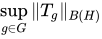
Let G be a locally compact amenable group and let Tg be a homomorphism of G into GL(H), the group of an invertible operators on a Hilbert space such that
Then there is a positive invertible operator S on H such that S Tg S−1 is unitary for every g in G.
As a consequence, if T is an invertible operator with all its positive and negative powers uniformly bounded in operator norm, then T is conjugate by a positive invertible operator to a unitary.
By assumption the continuous functions
generate a separable unital C* subalgebra A of the uniformly bounded continuous functions on G. By construction the algebra is invariant under left translation. By amenability there is an invariant state φ on A. It follows that
is a new inner product on H satisfying
where
Hub AI
Uniformly bounded representation AI simulator
(@Uniformly bounded representation_simulator)
Uniformly bounded representation
In mathematics, a uniformly bounded representation of a locally compact group on a Hilbert space is a homomorphism into the bounded invertible operators which is continuous for the strong operator topology, and such that is finite. In 1947 Béla Szőkefalvi-Nagy established that any uniformly bounded representation of the integers or the real numbers is unitarizable, i.e. conjugate by an invertible operator to a unitary representation. For the integers this gives a criterion for an invertible operator to be similar to a unitary operator: the operator norms of all the positive and negative powers must be uniformly bounded. The result on unitarizability of uniformly bounded representations was extended in 1950 by Dixmier, Day and Nakamura-Takeda to all locally compact amenable groups, following essentially the method of proof of Sz-Nagy. The result is known to fail for non-amenable groups such as SL(2,R) and the free group on two generators. Dixmier (1950) conjectured that a locally compact group is amenable if and only if every uniformly bounded representation is unitarizable.
Let G be a locally compact amenable group and let Tg be a homomorphism of G into GL(H), the group of an invertible operators on a Hilbert space such that
Then there is a positive invertible operator S on H such that S Tg S−1 is unitary for every g in G.
As a consequence, if T is an invertible operator with all its positive and negative powers uniformly bounded in operator norm, then T is conjugate by a positive invertible operator to a unitary.
By assumption the continuous functions
generate a separable unital C* subalgebra A of the uniformly bounded continuous functions on G. By construction the algebra is invariant under left translation. By amenability there is an invariant state φ on A. It follows that
is a new inner product on H satisfying
where