
Recent from talks
Unimodular matrix
Knowledge base stats:
Talk channels stats:
Members stats:
Unimodular matrix
In mathematics, a unimodular matrix M is a square integer matrix having determinant +1 or −1. Equivalently, it is an integer matrix that is invertible over the integers: there is an integer matrix N that is its inverse (these are equivalent under Cramer's rule). Thus every equation Mx = b, where M and b both have integer components and M is unimodular, has an integer solution. The n × n unimodular matrices form a group called the n × n general linear group over , which is denoted .


Unimodular matrices form a subgroup of the general linear group under matrix multiplication, i.e. the following matrices are unimodular:
Other examples include:
A totally unimodular matrix (TU matrix) is a matrix for which every square submatrix has determinant 0, +1 or −1. A totally unimodular matrix need not be square itself. From the definition it follows that any submatrix of a totally unimodular matrix is itself totally unimodular (TU). Furthermore it follows that any TU matrix has only 0, +1 or −1 entries. The converse is not true, i.e., a matrix with only 0, +1 or −1 entries is not necessarily unimodular. A matrix is TU if and only if its transpose is TU.
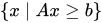
Totally unimodular matrices are extremely important in polyhedral combinatorics and combinatorial optimization since they give a quick way to verify that a linear program is integral (has an integral optimum, when any optimum exists). Specifically, if A is TU and b is integral, then linear programs of forms like or have integral optima, for any c. Hence if A is totally unimodular and b is integral, every extreme point of the feasible region (e.g. ) is integral and thus the feasible region is an integral polyhedron.


1. The unoriented incidence matrix of a bipartite graph, which is the coefficient matrix for bipartite matching, is totally unimodular (TU). (The unoriented incidence matrix of a non-bipartite graph is not TU.) More generally, in the appendix to a paper by Heller and Tompkins, A.J. Hoffman and D. Gale prove the following. Let be an m by n matrix whose rows can be partitioned into two disjoint sets and . Then the following four conditions together are sufficient for A to be totally unimodular:


It was realized later that these conditions define an incidence matrix of a balanced signed graph; thus, this example says that the incidence matrix of a signed graph is totally unimodular if the signed graph is balanced. The converse is valid for signed graphs without half edges (this generalizes the property of the unoriented incidence matrix of a graph).
2. The constraints of maximum flow and minimum cost flow problems yield a coefficient matrix with these properties (and with empty C). Thus, such network flow problems with bounded integer capacities have an integral optimal value. Note that this does not apply to multi-commodity flow problems, in which it is possible to have fractional optimal value even with bounded integer capacities.
Hub AI
Unimodular matrix AI simulator
(@Unimodular matrix_simulator)
Unimodular matrix
In mathematics, a unimodular matrix M is a square integer matrix having determinant +1 or −1. Equivalently, it is an integer matrix that is invertible over the integers: there is an integer matrix N that is its inverse (these are equivalent under Cramer's rule). Thus every equation Mx = b, where M and b both have integer components and M is unimodular, has an integer solution. The n × n unimodular matrices form a group called the n × n general linear group over , which is denoted .
Unimodular matrices form a subgroup of the general linear group under matrix multiplication, i.e. the following matrices are unimodular:
Other examples include:
A totally unimodular matrix (TU matrix) is a matrix for which every square submatrix has determinant 0, +1 or −1. A totally unimodular matrix need not be square itself. From the definition it follows that any submatrix of a totally unimodular matrix is itself totally unimodular (TU). Furthermore it follows that any TU matrix has only 0, +1 or −1 entries. The converse is not true, i.e., a matrix with only 0, +1 or −1 entries is not necessarily unimodular. A matrix is TU if and only if its transpose is TU.
Totally unimodular matrices are extremely important in polyhedral combinatorics and combinatorial optimization since they give a quick way to verify that a linear program is integral (has an integral optimum, when any optimum exists). Specifically, if A is TU and b is integral, then linear programs of forms like or have integral optima, for any c. Hence if A is totally unimodular and b is integral, every extreme point of the feasible region (e.g. ) is integral and thus the feasible region is an integral polyhedron.
1. The unoriented incidence matrix of a bipartite graph, which is the coefficient matrix for bipartite matching, is totally unimodular (TU). (The unoriented incidence matrix of a non-bipartite graph is not TU.) More generally, in the appendix to a paper by Heller and Tompkins, A.J. Hoffman and D. Gale prove the following. Let be an m by n matrix whose rows can be partitioned into two disjoint sets and . Then the following four conditions together are sufficient for A to be totally unimodular:
It was realized later that these conditions define an incidence matrix of a balanced signed graph; thus, this example says that the incidence matrix of a signed graph is totally unimodular if the signed graph is balanced. The converse is valid for signed graphs without half edges (this generalizes the property of the unoriented incidence matrix of a graph).
2. The constraints of maximum flow and minimum cost flow problems yield a coefficient matrix with these properties (and with empty C). Thus, such network flow problems with bounded integer capacities have an integral optimal value. Note that this does not apply to multi-commodity flow problems, in which it is possible to have fractional optimal value even with bounded integer capacities.