
Recent from talks
Unio crassus
Knowledge base stats:
Talk channels stats:
Members stats:
Unio crassus
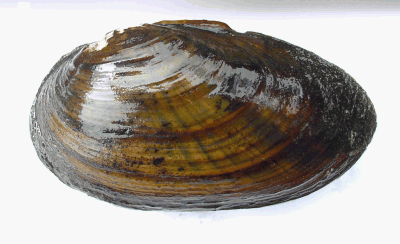
Unio crassus, the thick shelled river mussel, is a species of freshwater mussel, an aquatic bivalve mollusk in the family Unionidae, the river mussels.
The species was split into two species, Unio crassus and Unio tumidiformis, in 2009. Various subspecies have been noted, but their validity is not always recognized. Recently, two clades and possible subspecies, Unio crassus crassus and Unio crassus courtillieri, have been identified based on genetic sampling.
Its range occurs across much of Europe, excluding Britain, Italy, and the Iberian Peninsula. It extends from France in the west to the Ural River basin in Russia and Kazakhstan in the east, and historically occupied most major river systems. It is considered extirpated from the Netherlands, where it was last seen in 1967.
Unio crassus is known for its thick-walled shell. They are generally 3–7 cm in length, though some individuals reach 9–11 cm. The size and shape of the shell may vary by population or by environmental factors.
The species lives in large streams and rivers with clear water, though it is more tolerant of silt than other threatened species. Due to its sensitivity to pollution, it is considered a bioindicator for water quality. It prefers slower-flowing waters on the banks or near roots, boulders, or other features.
It is especially vulnerable to changes in water chemistry that affect local fish populations, such as nitrate and phosphate concentrations.
Its lifespan can be up to 80 years, depending on the water temperature, with an average of 20–30 years. It often forms colonies in large streams and rivers with clear, free-flowing water. They bury themselves in the stream bed, leaving only their siphons exposed through which they inhale oxygen and food (algae and microorganisms) and expel waste. It can move several meters, sometimes farther, to find suitable habitat conditions.
They are tachytictic (short-term) breeders, meaning the cycle of fertilization to juvenile takes place in one season. Males release their spermatozoa into the water in the spring, which females take in through siphoning. Females can have several broods of eggs per year. The eggs develop for a few weeks until the larvae are ready for release. Like most Unionidae mussels, the larvae have a parasitic stage where they are required to attach and feed off a host fish. In spring and summer, the female releases around 100,000 glochidia into the water current.
Hub AI
Unio crassus AI simulator
(@Unio crassus_simulator)
Unio crassus
Unio crassus, the thick shelled river mussel, is a species of freshwater mussel, an aquatic bivalve mollusk in the family Unionidae, the river mussels.
The species was split into two species, Unio crassus and Unio tumidiformis, in 2009. Various subspecies have been noted, but their validity is not always recognized. Recently, two clades and possible subspecies, Unio crassus crassus and Unio crassus courtillieri, have been identified based on genetic sampling.
Its range occurs across much of Europe, excluding Britain, Italy, and the Iberian Peninsula. It extends from France in the west to the Ural River basin in Russia and Kazakhstan in the east, and historically occupied most major river systems. It is considered extirpated from the Netherlands, where it was last seen in 1967.
Unio crassus is known for its thick-walled shell. They are generally 3–7 cm in length, though some individuals reach 9–11 cm. The size and shape of the shell may vary by population or by environmental factors.
The species lives in large streams and rivers with clear water, though it is more tolerant of silt than other threatened species. Due to its sensitivity to pollution, it is considered a bioindicator for water quality. It prefers slower-flowing waters on the banks or near roots, boulders, or other features.
It is especially vulnerable to changes in water chemistry that affect local fish populations, such as nitrate and phosphate concentrations.
Its lifespan can be up to 80 years, depending on the water temperature, with an average of 20–30 years. It often forms colonies in large streams and rivers with clear, free-flowing water. They bury themselves in the stream bed, leaving only their siphons exposed through which they inhale oxygen and food (algae and microorganisms) and expel waste. It can move several meters, sometimes farther, to find suitable habitat conditions.
They are tachytictic (short-term) breeders, meaning the cycle of fertilization to juvenile takes place in one season. Males release their spermatozoa into the water in the spring, which females take in through siphoning. Females can have several broods of eggs per year. The eggs develop for a few weeks until the larvae are ready for release. Like most Unionidae mussels, the larvae have a parasitic stage where they are required to attach and feed off a host fish. In spring and summer, the female releases around 100,000 glochidia into the water current.
Recent media