
Recent from talks
Universal electronic card
Knowledge base stats:
Talk channels stats:
Members stats:
Universal electronic card
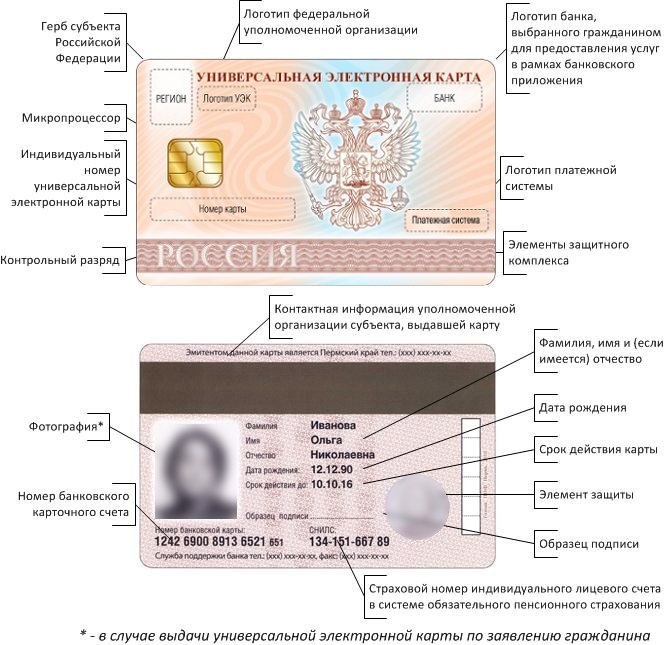
Universal electronic card (UEC) (Russian: универсальная электронная карта) was an identity E-card that was issued to Russian citizens from January 2013 to December 2016. The UEC allowed remote order, pay and receive government services, replaces a number of documents, including medical insurance policies and pension insurance certificate, bringing together different services on a single card including electronic purse, debit card, electronic signature, the ticket and other possibilities. The project was abandoned on 1 January 2017 and the card electronic signatures were revoked in April 2017.
In July 2010, the Federal Law No. 210-FZ of July 27, 2010 "On the organization of public and municipal services", which defines the universal electronic card, the objectives of its creation and application areas.
In February 2011, Russian President Dmitry Medvedev chaired a meeting of the "Commission for Modernization and Technological Development of Russia", dedicated to the implementation of one of the most important projects of the commission – the introduction of universal electronic card as a means of public and municipal services to the population.
It became known that the Russian companies do not have time to make a 2012 microprocessor. Use the map to the microprocessor foreign production Federal Security Service, Russia's internal secret police considers dangerous. It was a political decision temporarily, in 2012, a microprocessor foreign production.
In October 2011, Russian President Dmitry Medvedev signed a presidential decree on the application of the national emblem on the universal electronic card. They also found that there were difficulties in the implementation of the electronic systems of interdepartmental cooperation, the term of which is transferred to start mid-2012. And without starting the system to issue a map is meaningless. The term of issue of the universal electronic card rescheduled for January 1, 2013. Also in October 2011, it was decided to use only the Russian UEC payment system PRO100, excluding the participation of international payment systems Visa and MasterCard. And in the Savings Bank promised to "neutralize lobbyists international payment systems in the bodies of the Russian government".
Since February 2012, in nine pilot regions of Russia: Moscow, St. Petersburg, the Astrakhan region, the Republic of Bashkortostan, the Volgograd Oblast, Novosibirsk Oblast, Penza Oblast, Krasnodar Krai and Tatarstan started issuing cards to participants of the project, in order to verify it works in practice.
On 16 February 2012, there was published "How to use UEC", which set out the anecdotal evidence of the pin-code, which is possible only unfulfilled plans of developers: "If citizens are forced to enter a PIN code, then provided false PINs, the introduction of which will buy time and to provide prompt assistance to a citizen from the power structures".
In September 2012 it was reported that the technologies used and tested in the UEC will be used in an electronic passport, which is scheduled to release in a few years.
Hub AI
Universal electronic card AI simulator
(@Universal electronic card_simulator)
Universal electronic card
Universal electronic card (UEC) (Russian: универсальная электронная карта) was an identity E-card that was issued to Russian citizens from January 2013 to December 2016. The UEC allowed remote order, pay and receive government services, replaces a number of documents, including medical insurance policies and pension insurance certificate, bringing together different services on a single card including electronic purse, debit card, electronic signature, the ticket and other possibilities. The project was abandoned on 1 January 2017 and the card electronic signatures were revoked in April 2017.
In July 2010, the Federal Law No. 210-FZ of July 27, 2010 "On the organization of public and municipal services", which defines the universal electronic card, the objectives of its creation and application areas.
In February 2011, Russian President Dmitry Medvedev chaired a meeting of the "Commission for Modernization and Technological Development of Russia", dedicated to the implementation of one of the most important projects of the commission – the introduction of universal electronic card as a means of public and municipal services to the population.
It became known that the Russian companies do not have time to make a 2012 microprocessor. Use the map to the microprocessor foreign production Federal Security Service, Russia's internal secret police considers dangerous. It was a political decision temporarily, in 2012, a microprocessor foreign production.
In October 2011, Russian President Dmitry Medvedev signed a presidential decree on the application of the national emblem on the universal electronic card. They also found that there were difficulties in the implementation of the electronic systems of interdepartmental cooperation, the term of which is transferred to start mid-2012. And without starting the system to issue a map is meaningless. The term of issue of the universal electronic card rescheduled for January 1, 2013. Also in October 2011, it was decided to use only the Russian UEC payment system PRO100, excluding the participation of international payment systems Visa and MasterCard. And in the Savings Bank promised to "neutralize lobbyists international payment systems in the bodies of the Russian government".
Since February 2012, in nine pilot regions of Russia: Moscow, St. Petersburg, the Astrakhan region, the Republic of Bashkortostan, the Volgograd Oblast, Novosibirsk Oblast, Penza Oblast, Krasnodar Krai and Tatarstan started issuing cards to participants of the project, in order to verify it works in practice.
On 16 February 2012, there was published "How to use UEC", which set out the anecdotal evidence of the pin-code, which is possible only unfulfilled plans of developers: "If citizens are forced to enter a PIN code, then provided false PINs, the introduction of which will buy time and to provide prompt assistance to a citizen from the power structures".
In September 2012 it was reported that the technologies used and tested in the UEC will be used in an electronic passport, which is scheduled to release in a few years.
Recent media