


Community hub
Recent from talks
Contribute something
Nothing was collected or created yet.
President of Russia
View on Wikipedia
| President of the Russian Federation | |
|---|---|
| Президент Российской Федерации | |
 Presidential emblem | |
 | |
_cropped_and_edited.jpg) | |
| Presidential Administration of Russia | |
| Style | Mr President (informal) Comrade Supreme Commander (military) His Excellency[1] (diplomatic) |
| Type | Head of state Supreme commander-in-chief |
| Member of | |
| Residence |
|
| Seat | Kremlin Senate |
| Appointer | Direct popular vote |
| Term length | Six years, renewable once |
| Constituting instrument | Constitution of Russia (1993) |
| Precursor | President of the Soviet Union |
| Formation | |
| First holder | Boris Yeltsin |
| Deputy | Prime Minister |
| Salary | 8,900,000₽ or US$120,000 per annum est.[4] |
| Website | президент.рф (in Russian) eng.kremlin.ru (in English) |
The president of Russia[a], officially the president of the Russian Federation[b], is the executive head of state of Russia. The president is the chair of the Federal State Council and the supreme commander-in-chief of the Russian Armed Forces. It is the highest office in Russia.
The modern incarnation of the office emerged from the president of the Russian Soviet Federative Socialist Republic (RSFSR). In 1991, Boris Yeltsin was elected president of the RSFSR, becoming the first non-Communist Party member to be elected into a major Soviet political role. He played a crucial role in the dissolution of the Soviet Union which saw the transformation of the RSFSR into the Russian Federation. Following a series of scandals and doubts about his leadership, violence erupted across Moscow in the 1993 Russian constitutional crisis. As a result, a new constitution was implemented and the 1993 Russian Constitution remains in force today. The constitution establishes Russia as a semi-presidential system which separates the president of Russia from the government of Russia which exercises executive power.[5]
In all cases where the president of the Russian Federation is unable to fulfill their duties, those duties shall be temporarily delegated to the prime minister of Russia, who becomes acting president of Russia.[6]
The powers of the presidency include: execution of federal law, appointing federal ministers, and members of the judiciary, and negotiating treaties with foreign powers. The president also has the power to grant federal pardons and reprieves, and to convene and adjourn the Federal Assembly under extraordinary circumstances. The president also appoints the prime minister, who directs domestic policy of the Russian Federation alongside the president.
The president is elected directly through a popular vote to a six-year term. Previously, the Constitution established a term limit for the presidency restricting the officeholder to serve no more than two consecutive terms. However, this limitation has since been overhauled in large part due to the constitutional amendments that were ratified in 2020. One of the amendments passed reset the terms of both Vladimir Putin and Dmitry Medvedev, allowing either to serve as president for a full two terms regardless of their previous terms. In all, three individuals have served four presidencies spanning six full terms. In May 2012, Vladimir Putin became the fourth president; he was re-elected in March 2018 and in March 2024 for two consecutive six-year terms.
History
[edit]After the fall of monarchy in 1917, the All-Russian Constituent Assembly, elected later that year, planned on establishing a democratic presidential or semi-presidential federal republic, proclaiming the Russian Democratic Federal Republic (RDFR) in January 1918. The president of the RDFR would have been the head of state, elected for a one-year term by a majority vote in parliament involving the deputies of both chambers.[7] Due to the dissolution of the assembly by the Bolsheviks and establishment of their one-party dictatorship, no person was ever elected to this office.
Boris Yeltsin came to power with a wave of high expectations not long before the Soviet Union's collapse. In May 1990, he was elected as chairman of the Supreme Soviet (parliament) of the Russian Soviet Federative Socialist Republic (SFSR) – the highest state office – and thus became the head of state. As a result of the creation of the post of President of the Soviet Union, the Union republics also began to introduce the post of President. To do this, a referendum was held in the Russian SFSR, in which 71% of voters voted for the creation of the post of President, elected in direct elections. On 12 June 1991 Yeltsin was elected president of the Russian SFSR with 57% of the vote, becoming the first popularly elected president.[8] However, Yeltsin never recovered his popularity after a series of economic and political crises in Russia in the 1990s. The Yeltsin era was marked by widespread corruption, economic collapse, and enormous political and social problems.[8] By the time he left office, Yeltsin had an approval rating of two percent by some estimates.[8]
Throughout his presidential terms and into his second term as the prime minister, Vladimir Putin has enjoyed high approval ratings amongst the Russian public. During his eight years in office, the Russian economy bounced back from crisis, seeing the country's GDP increase sixfold (72% in PPP),[9] poverty cut more than half[10] and average monthly salaries increase from $80 to $640, or by 150% in real rates.[11] At the same time, his conduct in office has been questioned by domestic dissenters, as well as foreign governments and human rights organizations, for his handling of internal conflicts in Chechnya and Dagestan, his record on internal human rights and freedoms, his relations with former Soviet republics, and his relations with the so-called oligarchs: Russian businessmen with a high degree of power and influence within both the Russian government and economy. This was seen by the Kremlin as a series of anti-Russian propaganda attacks orchestrated by western opponents and exiled oligarchs.[12]
Medvedev was appointed as first deputy prime minister on 14 November 2005. Formerly Vladimir Putin's chief of staff, he was also the chairman of Gazprom's board of directors, a post he had held, for the second time, since 2000. On 10 December 2007, he was informally endorsed as a candidate for the forthcoming presidential elections by the most prominent Russian political party, United Russia, and officially endorsed on 17 December 2007. Medvedev's candidacy was supported by outgoing president Vladimir Putin and pro-presidential parties.[13] As technocrat and political appointee, Medvedev – Putin's former chief of staff and one-time rival to Sergey Ivanov – had never held elective office before 2009. Medvedev chose Putin as his prime minister; in 2012, Putin ran for the presidency, won, and appointed Medvedev as prime minister.
Selection process
[edit]Eligibility
[edit]A presidential candidate must be a citizen of the Russian Federation who is at least 35 years old, has permanently resided in Russia for at least 25 years and does not have and has never previously had foreign citizenship or a foreign residence permit.[14] Following constitutional amendments in 2020, the requirement of permanent residence in Russia increased from 10 years to 25 years and a new requirement preventing a presidential candidate from ever having foreign citizenship or a foreign residence permit was introduced.[15][16][17]
The Russian constitution limits the number of terms a president can serve to two terms. Previously, the constitution only limited the president to two consecutive terms, allowing a former president to seek re-election after sitting out one complete term.[18] However, following constitutional changes in 2020, this was changed to two terms overall, allowing the incumbent president and former presidents to serve two more terms.[19]
Election
[edit]The election of the president is mainly regulated by the Presidential Election Law (PEL) and the Basic Guarantees of Electoral Rights (BGL).[20] The Federation Council calls the presidential elections.[21] If it does not call a presidential election that is due, the Central Election Commission will call the presidential election.[22] The election day is the second Sunday of the month and the presidential electoral constituency is the territory of the Russian Federation as a whole. Each faction in the State Duma, the lower house of the Russian parliament has the right to nominate a candidate for the presidential elections. The minimum number of signatures for a presidential candidate fielded by a political party with no parliamentary representation is 100,000, down from 2 million before amendments to the law.[citation needed]
Terms were extended from four to six years in 2008, during Dmitry Medvedev's administration.[23] The president is elected in a two-round system every six years, with a two consecutive term limitation.[24] If no candidate wins by an absolute majority in the first round, a second election round is held between two candidates with the most votes.[24] The last presidential election was in 2024, and the next is in 2030.[25]
Inauguration
[edit] |
|---|


The inauguration of the president of Russia is conducted six years after the previous inauguration (since 2000, on 7 May). If the president is chosen in an early election, they are scheduled to take the oath thirty days after the announcement of the results.
Before executing the powers of the office, a president is constitutionally required to take the presidential oath:[26]
I swear in exercising the powers of the President of the Russian Federation to respect and safeguard the rights and freedoms of man and citizen, to observe and protect the Constitution of the Russian Federation, to protect the sovereignty and independence, security and integrity of the State, to faithfully serve the people.
Vacancy or disability
[edit]Vacancies in the office of president may arise under several possible circumstances: death, resignation and removal from office. In all cases when the president is unable to perform their duties, their powers are temporarily transferred to the prime minister until the new president takes office.
Insignia
[edit]After the oath of office has been taken by the elected president, these following insignia are handed over to the president. These devices are used to display the rank of their office and are used on special occasions.
Chain of office
[edit]
The first insignia that is issued is the chain of office with an emblem. The central emblem is the red cross of the Order "For Merit to the Fatherland", with arms in equal size, charged with the Russian coat of arms. On the reverse of the cross, the words "Benefit, Honor and Glory" appear in the form of a circle. A golden wreath is used to connect the cross with the rest of the chain. There are 17 "links" in the emblem, with nine consisting of the Russian coat of arms. The other eight consist of a rosette, also bearing the motto "Benefit, Honor and Glory." At the inauguration of Vladimir Putin, the emblem was placed on a red pillow, positioned on the left side of the podium. According to the Presidential website, the emblem is placed inside the Kremlin and is used only on certain occasions.
Standard (flag)
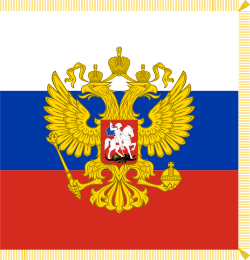
[edit]The standard is a square version of the Russian flag, charged in the center with the Russian coat of arms. Golden fringe is added to the standard. Copies of the standard are used inside their office, at the Kremlin, other state agencies, and while the president is traveling in a vehicle inside Russia. A 2:3 ratio version of the flag is used when the President is at sea. This is the most used symbol to denote the presence of the Russian President.
Special copy of the Constitution
[edit]The President also has a special copy of the Russian Constitution that is used during the inauguration. This copy has a hard, red cover with gold lettering. An image of the Russian coat of arms appears in silver. The special copy is kept in the Presidential Library.
Legal basis of the insignia
[edit]These insignia and the procedure were established by the presidential decree 1138 from 5 August 1996,[27] and modified by decree 832 from 6 May 2000.[28] In the new decree the special copy of the Constitution was removed as the third symbol of the Russian Presidency; the other two symbols remained intact because they were and are regulated by separate decrees. Nonetheless, the special copy of the Constitution still exists and serves for inauguration purposes only without being officially presented as a symbol of the Russian Presidency.
Presidential Fanfare
[edit]The Presidential Fanfare is a composition played exclusively for the President of Russia, when they enter a place or an event.
Powers and duties
[edit]_-_09.jpeg)
Guarantor of the Constitution
[edit]As the guarantor of the Constitution and the entire system of constitutional law, the president ensures that the constitutions, laws and regulations of the constituent territories of the Russian Federation be in full compliance with the country's Constitution and federal laws.
Nominations
[edit]The president is highly active in appointing top officials in the country. They nominate candidates for official state positions, who must ultimately be appointed based on parliamentary vote. The president submits nominations to the Federation Council, the upper house of the parliament, for judges of the Constitutional Court and the Supreme Court, as well as for prosecutor general of Russia. A proposal to relieve the prosecutor general of their duties must also be submitted to the Federation Council. The president submits to the State Duma, the lower house of parliament, nominations for appointment to the office of the chairperson of the Central Bank, and likewise submits to the State Duma any proposal to relieve the chairperson of the Central Bank of their duties.[29]
Legislation
[edit]Under the procedure stipulated by the Constitution, the president exercises their right to submit draft legislation, as well as the right to sign bills into law or to veto them.
The president has the right to suspend laws and regulations issued by executive bodies of Russia's constituent territories if such laws and regulations contravene the Constitution, federal laws or international obligations of the Russian Federation, or violate human and civil rights and liberties, pending the resolution of the issue in an appropriate court.
The president can issue by-laws by decree, so long as such decrees are not in contradiction with existing laws (both local and federal), Russia's international agreements or the Russian Constitution.
The president is further empowered to grant federal pardons and reprieves, and to convene and adjourn either or both houses of the Federal Assembly under extraordinary circumstances.
Other powers of the president in the sphere of legal activities and in their interaction with the parliament include calling elections to the State Duma, dissolving the State Duma in certain cases, and calling a referendum.
Domestic policy
[edit]Under the Constitution, the president is not empowered to determine the full range of short-, middle-, and long-term objectives and targets of domestic policy, but only its basic guidelines. In practice, they determine it with the prime minister and the government of the federation. They are to be implemented both by the president themself and by the government of Russia within the bounds of their authority. The president's fundamental positions on domestic policy issues are expressed in their written decisions regarding draft federal constitutional laws and draft federal laws, as well as their letters explaining the reasons for rejecting draft federal laws.
Within the bounds of the authority granted to the head of state by the Constitution and other laws, the president also shapes the basic domestic policy guidelines by issuing legal regulations and through organizational and regulatory activity, such as issuing decrees and executive orders. Each year the president is required to make an Address to the Federal Assembly regarding the situation in the country and the internal and foreign policy of the state.
Foreign policy
[edit]
The president is invested with extensive rights to implement the state's foreign policy. The president determines Russia's position in international affairs, along with the prime minister and the government of the federation, and represents the state in international relations, conducts negotiations and signs ratification documents. The president appoints and recalls diplomatic representatives of Russia to foreign states and international organizations. These appointments are preceded by consultations with the respective committees or commissions of the two houses of the Federal Assembly. The president signs international treaties.
Commander-in-chief
[edit]
The president of Russia bears ultimate authority over the Russian Armed Forces as "Supreme Commander-in-Chief", a role established by Article 87 of the Constitution. In this capacity, the president issues military directives, makes defence policy and appoints the High Command of the Armed Forces.[30][31][32][33]
Furthermore, several articles of the Defence Statute enable the president to order a general or partial mobilization of the military, announce martial law, oversee the war industry and make regulations.[33][34][35]
A 2020 military doctrine governs the use of Russian nuclear arms; it allows the president to launch atomic weapons in response to WMD or ballistic missile strikes, attacks that threaten the integrity of the nuclear arsenal, and attacks that may jeopardise the country as a whole.[36]
Ceremonial duties
[edit]An important ceremonial role of the president is awarding state awards. State Awards of the Russian Federation are the highest form of official recognition given to individuals for service to the nation in the fields of defense, state-building, economics, science, culture, art, education, health care, public safety, rights advocacy and charity. The state awards of the Russian Federation include the title of Hero of the Russian Federation, Hero of Labour of the Russian Federation as well as orders, medals, emblems and honorary titles. New state honors and awards can be established by the president, who also presents these honors to the recipients in an official ceremony. A Commission for State Honors, which works on a voluntary basis, helps the president to objectively assess potential recipients.
Residences
[edit]

The primary working president's residence is the Senate building (also known as 1st building) in the Moscow Kremlin complex.[37] Also the president can use the Grand Kremlin Palace (used for official ceremonies and meetings). Previously, the president also could use the so-called 14th Administrative Corpus Building (the reserve residence), but in 2016, it was demolished.[37]
Since 2000, the current home residence of the president is Novo-Ogaryovo (Russian: Ново-Огарёво). It was planned that it would remain at the disposal of Vladimir Putin after his term ended, as Gorki-9 (Russian: Горки-9) (also called Barvikha (Russian: Барвиха), but actually near it) had remained at the disposal of Boris Yeltsin after his retirement.
Also, the president has several vacation residences outside of Moscow.[38]
- Rus' State Residence (Zavidovo), Tver Oblast
- Congress Palace or Constantine Palace complex (Russian: Дворец конгрессов, Константиновский дворец), Strelna, Saint Petersburg, reconstructed for 300th Saint Petersburg anniversary
- Bocharov Ruchey (Russian: Боча́ров Руче́й, lit. Bocharov creek), Sochi
- Shuyskaya Chupa (Russian: Шу́йская Чупа́) at a distance of 25 km from Petrozavodsk, Karelia
- Dolgiye Borody (Russian: Долгие Бороды) (also known as Uzhin Russian: Ужи́н) at a distance of 20 km from Valday, Novgorod Oblast
- Volzhskiy Utyos sanatorium (Russian: Во́лжский утёс, lit. Cliff-upon-Volga) on Kuybyshev Reservoir shore
- Tantal tourist centre (Russian: Танта́л, lit. Tantalum) on Volga bank, at a distance of 25 km from Saratov
- Sosny (Russian: Со́сны, lit. pines) on Yenisei bank, near Krasnoyarsk.[39]
- Angarskie hutora (Russian: Анга́рские хутора́, lit. Steadings of Angarsk) at a distance of 47 km from Irkutsk
- Maly istok (Russian: Ма́лый исто́к, lit. The small headspring) inside Ekaterineburg forestry
Political affiliation
[edit]None of the Russian presidents to date have ever been a member of a political party while in office. In 2012, commenting on stepping down from the post of United Russia party leader, Vladimir Putin said "The constitution doesn't forbid the president to be a member of any party, but in the spirit of how our political life has evolved, a president is first and foremost a consolidating figure for all the political forces of the country, for all citizens".[40]
Transport
[edit]National transport services for the Russian president and the presidential state car are provided by the Special Purpose Garage (SPG).[41] The SPG is a unit within the Federal Protective Service.
- Limousines

Aurus Senat – the official Russian presidential executive car - Aurus Senat – main car
- Mercedes-Benz S600 Pullman Guard
- Escort cars
- Mercedes-Benz (including G-Class)
- Chevrolet
- Honorary escort (motorcycles)


Air transport services for the president are provided by the airline company Rossiya Airlines.[42]
- Airplanes for long-distance travel
- Ilyushin Il-96-300PU (long-range) – main aircraft
- Ilyushin Il-62M (long-range)
- Dassault Falcon 900 (long-range)
- Tupolev Tu-154 (medium-range)
- Yakovlev Yak-40 (short-range)
- Tupolev Tu-214PU
- Helicopters
The presidential aircraft uses the same colour scheme as standard Rossiya aircraft, except for the use of the Russian coat of arms or the presidential standard on the empennage instead of the flag of Russia.
In the spring of 2013 a helipad was constructed in the Moscow Kremlin. According to the chief of the Kremlin Property Agency construction of a helicopter pad for the president cost 200 million rubles (about $6.4 mln). The helipad is located in the Kremlin's Tainitsky Garden close to exterior walls.[43]
Post-presidency
[edit]
On 16 August 1995, President Boris Yeltsin signed a decree "On some social guarantees of persons holding public positions of the Russian Federation and the position of federal public servants." 15 June 1999 went to President Yeltsin's decree on amendments and additions to the previous decree. On 11 November 1999 Prime Minister Vladimir Putin signed a decree on the implementation of the amended decree of 15 June 1999.
On 31 December 1999, the day of the resignation of Boris Yeltsin, the president issued a decree "On guarantees of the Russian Federation President, stop exercising their powers, and their family," and the eponymous federal law was adopted by 25 January 2001.
This law establishes the legal, social and other guarantees of the Russian Federation's president, stops the execution of its powers in connection with the expiration of their term of office or in advance in the event of their resignation or permanent incapacity for health reasons to exercise the powers belonging to them and their family:
- President of Russia, ceased to carry out its mandate, regardless of age, is entitled to a monthly lifetime pay of 75% of the monthly remuneration of the President of Russia.
- In the case of the President's death their family members are entitled to a monthly allowance in the amount equal to six times the minimum old-age pension, established by the federal law on the day of their death.
- President of Russia, ceased to carry out its mandate, has immunity. They can not be held criminally or administratively liable for acts committed by them during the execution of the President's powers, as well as arrested, detained, interrogated and subjected to a personal search, if these actions are carried out in the course of proceedings relating to the execution of their powers as president.
Beginning in 1999, all living former presidents were granted a pension, an office, and a staff. The pension has increased numerous times. Retired presidents receive a pension based on the salary of the government. All former presidents, their spouses, and their children until age 16 are protected by the Federal Protective Service until the president's death. A spouse who remarries or divorced from president is no longer eligible for Federal Protective Service protection.
In 2020, the Constitution was amended to grant the former president immunity (except if they were removed from office by impeachment). This immunity may be lifted in the same manner as the impeachment procedure. Also, in accordance with the amendments, former presidents (except if they were removed from office by impeachment) were granted the right to become senators for life.[19]

In May 2008, the Federal law №68, "On centers of historical heritage of presidents of the Russian Federation ceased to carry out its powers", was adopted.[44] According to this law, the objectives of the centers are the study and public presentation of historical heritage of presidents of Russia as an integral part of the modern history of Russia, the development of democratic institutions and the rule of law. The centers will be built for each former president of Russia. The first such center dedicated to Boris Yeltsin was opened in 2015 in Yekaterinburg. In the future the creation of presidential centers for Vladimir Putin and Dmitry Medvedev is also planned.[45]
List of presidents
[edit]| No. | Portrait | Name (Birth–Death) |
Term | Political party | Election | ||
|---|---|---|---|---|---|---|---|
| Took office | Left office | Duration | |||||
| 1 | Boris Yeltsin (1931–2007) | 10 July 1991 | 31 December 1999 | 8 years, 174 days | Independent | 1991 1996 | |
| – | Vladimir Putin (born 1952) Acting | 31 December 1999 | 7 May 2000 | 128 days | Unity | – | |
| 2 | Vladimir Putin (born 1952) | 7 May 2000 | 7 May 2008 | 8 years, 0 days | Independent | 2000 2004 | |
| 3 | Dmitry Medvedev (born 1965) | 7 May 2008 | 7 May 2012 | 4 years, 0 days | United Russia | 2008 | |
| 4 | Vladimir Putin (born 1952) | 7 May 2012 | Incumbent | 13 years, 181 days | Independent | 2012 2018 2024 | |
.jpg)
.jpg)
.jpg)
.jpg)
_(cropped)_2.png)
Timeline
[edit]
List of presidential administrations
[edit]See also
[edit]- List of presidents of Russia
- List of Russian presidential candidates
- List of heads of state of Russia
- Lifespan timeline of presidents of Russia
- First Lady of Russia
- Prime Minister of Russia
- President of the Soviet Union
- General Secretary of the Communist Party of the Soviet Union
- Russian presidential administration
Notes
[edit]References
[edit]- ^ United Nations Heads of State Heads of Government Ministers for Foreign Affairs Protocol and Liaison Service
- ^ RSFSR Law "On President of the Russian SFSR
- ^ RSFSR Law on amendments to the Constitution of the RSFSR
- ^ "Here are the salaries of 13 major world leaders". Business Insider. Archived from the original on 30 September 2018. Retrieved 8 February 2020.
- ^ I.E. Kozlova and O. E. Kutafin, Konstitutsionnoe Pravo Rossii (Constitutional Law of Russia) (4th ed, 2006) p. 383
- ^ "Конституция Российской Федерации". Eng.constitution.kremlin.ru. Archived from the original on 10 May 2013. Retrieved 3 March 2014.
- ^ (in Russian) THE POLITICAL SYSTEM OF RUSSIA IN PROGRAMS OF WHITE MOVEMENT AND WHITE EMIGRATION[permanent dead link] Bukhvostovoj D.V.
- ^ a b c "Transcripts of 'Insight' on CNN". CNN. 7 October 2002. Archived from the original on 7 November 2017. Retrieved 17 July 2007.
- ^ GDP of Russia from 1992 to 2007 Archived 7 November 2020 at the Wayback Machine International Monetary Fund Retrieved on 12 May 2008
- ^ Fedyukin, Igor (4 May 2008). "Putin's Eight Years". Kommersant. Archived from the original on 4 March 2016. Retrieved 4 May 2008.
- ^ Putin visions new development plans for Russia China View Retrieved on 8 May 2008
- ^ Sergey Morozov, "Putin's Diplomacy: Russian Judo on World Tatami". – Saint Petersburg, publishing house "Krylov", 2008. – 288 pp. ISBN 978-5-9717-0630-4. Chapter "Dracula, Rotten Meat and Dr. Evil", p. 130: "... in the Kremlin they thought that Russia has become a subject of a series of political propaganda attacks orchestrated by the West and exiled oligarchs.", p. 139, Dmitry Peskov: "Things we observe in the British media relate more to a usual human hysteria rather than to journalism... President regards this calmly, understanding at the same time that this has nothing to do with journalism and analytics."
- ^ Putin sees Medvedev as successor Archived 12 December 2007 at the Wayback Machine BBC News
- ^ The Constitution of the Russian Federation: A Contextual Analysis, Henderson, Jane
- ^ "What changes will be in the Constitution of the Russian Federation?". duma.gov.ru. 12 March 2020. Archived from the original on 11 May 2021. Retrieved 6 April 2021.
- ^ "Putin signs law that could keep him in Kremlin until 2036". Reuters. 5 April 2021. Archived from the original on 6 April 2021. Retrieved 6 April 2021.
- ^ "Constitutional and political change in Russia" (PDF). europarl.europa.eu. Archived (PDF) from the original on 17 February 2022. Retrieved 6 April 2021.
- ^ "Chapter 4. The President of the Russian Federation | The Constitution of the Russian Federation". www.constitution.ru. Archived from the original on 12 December 2007. Retrieved 22 July 2017.
- ^ a b Закон РФ о поправке к Конституции РФ от 14.03.2020 N 1-ФКЗ "О совершенствовании регулирования отдельных вопросов организации и функционирования публичной власти" [Law of the Russian Federation on the amendment to the Constitution of the Russian Federation of March 14, 2020 N 1-FKZ "On improving the regulation of certain issues of the organization and functioning of public authorities] (8.3, 8.3.1) (in Russian). 14 March 2020. "Статья 1 / КонсультантПлюс". Archived from the original on 3 January 2021. Retrieved 3 July 2020.
{{cite web}}: CS1 maint: bot: original URL status unknown (link) - ^ Gueorguieva, Vassia; Simon, Rita James (2009). Voting and Elections the World Over. Global Perspectives on Social Issues Series. Lexington Books. p. 79. ISBN 978-0-7391-3090-2.
- ^ Constitution of Russia article 102:1
- ^ Kozlova and O. E. Kutafin, Konstitutsionnoe Pravo Rossii (Constitutional Law of Russia) (4th ed, 2006) p. 373.
- ^ Sefanov, Mike (22 December 2008). "Russian presidential term extended to 6 years". CNN. Archived from the original on 2 April 2015. Retrieved 2 March 2015.
- ^ a b Gueorguieva & Simon 2009, p. 79.
- ^ Herszenhorn, David M. (5 March 2012). "Observers Detail Flaws in Russian Election". The New York Times. Archived from the original on 5 March 2012. Retrieved 5 March 2012.
- ^ "Chapter 4. The President of the Russian Federation". The Constitution of the Russian Federation. Archived from the original on 12 December 2007. Retrieved 24 March 2018.
- ^ Coбpaниe зaкoнoдaтeльcтвa Рoccийcкoй Фeдepaции 1996, №33, ar. 3976
- ^ Coбpaниe зaкoнoдaтeльcтвa Рoccийcкoй Фeдepaции 2000, №19, ar. 2068
- ^ "Authority and Duties of the President". Archive.kremlin.ru. Archived from the original on 10 February 2014. Retrieved 3 March 2014.
- ^ "Commander-in-Chief of the Armed Forces". President of Russia. Archived from the original on 3 December 2022. Retrieved 3 December 2022.
- ^ Osborn, Andrew; Antonov, Dmitry (22 February 2022). "Putin orders troops to Ukraine after recognizing breakaway regions". Reuters. Archived from the original on 21 February 2022. Retrieved 3 December 2022.
- ^ Talmazan, Yuliya; Alex; Smith, er; Smith, Allan (22 February 2022). "Putin orders troops to eastern Ukraine after formally recognizing breakaway regions". www.nbcnews.com. Archived from the original on 3 December 2022. Retrieved 3 December 2022.
- ^ a b Maynes, Charles; Hayda, Julian (19 October 2022). "Putin orders martial law in occupied Ukrainian areas as Kyiv's forces gain ground". NPR. Archived from the original on 3 December 2022. Retrieved 3 December 2022.
- ^ "Putin orders partial military call-up, sparking protests". AP NEWS. 21 September 2022. Archived from the original on 3 December 2022. Retrieved 3 December 2022.
- ^ "Putin mobilises reservists to fight in Ukraine". BBC News. 21 September 2022. Archived from the original on 13 December 2022. Retrieved 3 December 2022.
- ^ "Factbox: The chain of command for potential Russian nuclear strikes". Reuters. 2 March 2022. Archived from the original on 3 December 2022. Retrieved 3 December 2022.
- ^ a b The Presidential Residences Archived 28 August 2009 at the Wayback Machine
- ^ Vladimir Putin Residences Archived 27 May 2010 at the Wayback Machine, Kommersant, #18(3594), 7 February 2007
- ^ "Другой "Удачный": гуляем по элитному району, где шикарные коттеджи соседствуют с развалившимися бараками" (in Russian). ngs24.ru. 10 August 2020. Retrieved 14 December 2023.
- ^ "Putin steps down as United Russia head". Themoscownews.com. 24 April 2012. Archived from the original on 28 February 2014. Retrieved 3 March 2014.
- ^ President's transports. Cars (in Russian) Archived 24 January 2008 at the Wayback Machine
- ^ "President's transports. Air transport" (in Russian). Archived from the original on 23 April 2008. Retrieved 23 April 2008.
- ^ "Putin's Kremlin Helipad Cost $6.4 Mln – Official". RIA Novosti. 17 May 2013. Archived from the original on 24 December 2013. Retrieved 18 May 2013.
- ^ Федеральный закон о центрах исторического наследия президентов РФ, прекративших исполнение своих полномочий. Российская газета (in Russian). Archived from the original on 11 October 2017. Retrieved 24 March 2018.
- ^ В России появятся Медведев Центр и Путин Центр. AltaPress (in Russian). 22 November 2016. Archived from the original on 11 October 2017. Retrieved 24 March 2018.
- Attribution note: Material from the powers and duties section of this article was originally published by the website of the Office of the President of Russia.
External links
[edit]
- Official website – the President of Russia
- 'Vladimir Putin will once again become Russia's president' – The Economist (3 March 2012)
| |||||||


| International | |
|---|---|
| National | |
| Other | |

President of Russia
View on GrokipediaConstitutional Foundations
Establishment in the Post-Soviet Era
The presidency of Russia emerged from the political reforms initiated in the Russian Soviet Federative Socialist Republic (RSFSR) amid the Soviet Union's final years, with Boris Yeltsin elected as the first president on June 12, 1991, in the inaugural direct popular vote, securing approximately 57% of the ballots against five competitors.[9] [10] This election, held prior to the USSR's formal dissolution, marked a shift toward executive leadership independent of the Communist Party apparatus, as Yeltsin was inaugurated on July 10, 1991.[11] Following Mikhail Gorbachev's resignation as Soviet president on December 25, 1991, and the USSR's effective end, Yeltsin assumed continuity of central powers, including nuclear codes, transitioning the office to the newly independent Russian Federation without interruption.[12] The post-Soviet institutionalization of the presidency faced immediate challenges from the inherited 1978 RSFSR Constitution, which retained Soviet-era parliamentary dominance and lacked provisions for a strong executive, leading to escalating conflicts between Yeltsin and the Supreme Soviet.[13] On September 21, 1993, Yeltsin issued Decree 1400, dissolving the Supreme Soviet and Congress of People's Deputies, citing their obstruction of reforms; this self-coup prompted parliamentary resistance, barricades in Moscow, and armed clashes culminating in the October 3-4 shelling of the White House (parliament building) by military forces under Yeltsin's command, resulting in over 140 deaths and hundreds injured.[14] The crisis resolved with parliamentary surrender, paving the way for a new constitutional framework that centralized authority in the presidency to prevent future gridlock. A nationwide referendum on December 12, 1993, approved the draft Constitution of the Russian Federation with 58.4% voter support on a 54.8% turnout, formally enacting it on December 25, 1993, and embedding a presidential system modeled on French semi-presidentialism but with enhanced executive prerogatives.[15] [16] Chapter 4 of the document designated the president as head of state, guarantor of the Constitution, and wielder of decree powers, appointment authority over key officials (subject to parliamentary consent in some cases), veto rights, and foreign policy initiative, subordinating the government to presidential oversight while limiting the Federation Council's role to coordination rather than supremacy.[16] This structure, born from the 1993 power struggle, prioritized executive stability over balanced separation of powers, reflecting Yeltsin's prioritization of rapid market liberalization and state continuity amid economic collapse, with GDP contracting 40% from 1990-1995.[13] Subsequent amendments have iteratively expanded these powers, but the 1993 framework remains the foundational post-Soviet establishment.Core Provisions of the 1993 Constitution
The 1993 Constitution of the Russian Federation, adopted via referendum on December 12, 1993, establishes the President as the head of state in Chapter 4 (Articles 80–93), positioning the office as a guarantor of constitutional order rather than a parliamentary figurehead. Article 80 delineates the President's core status: serving as the guarantor of the Constitution, human and civil rights, and freedoms; ensuring the coordinated functioning and interaction of federal and regional public authorities; determining the basic directions of domestic and foreign policy; and representing the Russian Federation in international relations.[2] Articles 83–89 further specify the President's competences, including determining main policy directions, appointing the Government, and serving as Supreme Commander-in-Chief, among others. This framework emphasizes the President's role in maintaining systemic stability amid the post-Soviet transition from centralized Soviet governance to a federal semi-presidential system, where executive authority balances legislative and judicial branches without subordinating to them.[16] Election provisions under Article 81 mandate a popular vote by universal, equal, and direct suffrage using secret ballots, originally for a four-year term, with the candidate receiving over 50% of votes declared winner; if no majority, a runoff occurs between the top two.[2] Eligibility requires Russian citizenship, a minimum age of 35, at least 10 years of permanent residency in Russia, and possession of electoral rights, reflecting an intent to prioritize experienced national figures while broadening participation beyond Soviet-era elites.[17] The President assumes duties via inauguration before the Federal Assembly, swearing an oath to uphold the Constitution, with early termination possible through expiration of term, resignation, persistent inability to perform duties due to health (certified by a special commission and Constitutional Court), or impeachment for grave constitutional violations or treason (Articles 92–93).[2] Executive powers in Articles 83 and 89 grant the President authority to appoint the Chairman of the Government (Prime Minister) subject to State Duma consent, relieve the Chairman, and, on the Chairman's proposal, appoint or relieve Deputy Chairmen and federal ministers; preside over Government meetings at the Chairman's request; and countersign Government acts.[17] Additional administrative roles include submitting candidates for judges of the Constitutional Court, Supreme Court, and Higher Court of Arbitration; appointing and recalling plenipotentiary representatives; deciding on government structure; granting citizenship and political asylum; and issuing pardons, all underscoring a strong executive capable of directing bureaucratic and diplomatic apparatus independently of direct parliamentary control.[2] In legislative affairs, Articles 84 and 85 empower the President to deliver annual messages to the Federal Assembly on policy priorities; dissolve the State Duma if it rejects three Prime Ministerial nominations or if mutual agreement fails within three months of formation; call referendums; introduce draft federal laws; sign or veto bills passed by the Federal Assembly (with veto override requiring two-thirds majorities in both chambers); and suspend regional executive acts conflicting with federal law or rights.[17] The President may also refer bills to the Constitutional Court for constitutionality review, providing a check against legislative overreach while enabling proactive policy initiation.[2] Foreign policy and defense roles in Articles 86 and 87 designate the President to define foreign policy guidelines, negotiate and sign international treaties, accredit and recall ambassadors, and direct military command as Supreme Commander-in-Chief, with powers to introduce martial law or states of emergency (subject to Federal Assembly approval within 48 hours) and order general or partial mobilization.[2] These provisions establish the President as the primary architect of national security and international posture, distinct from the Government's operational roles. Article 90 authorizes presidential decrees and directives with the force of law, mandatory for all state bodies and officials unless contradicted by the Constitution or federal laws, ensuring enforceability but requiring publication for transparency.[17] Immunity under Article 91 protects the President from liability except via impeachment, with post-tenure prosecution possible only after waiver by the State Duma and Constitutional Court ruling.[2] Impeachment under Article 93 requires a State Duma accusation by two-thirds vote, investigated by a special commission, followed by Constitutional Court confirmation of procedure and Supreme Court assessment of crime; conviction needs three-fourths Federal Assembly approval, leading to early termination and a three-month interim period before new elections.[2] This multi-stage process, designed to prevent frivolous removals, reflects the framers' emphasis on presidential stability amid 1993's political crises, including the dissolution of the Soviet-era Congress and armed conflict between executive and legislative forces.[13] Subsequent amendments, such as term extensions to six years in 2012 and residency requirements adjusted to 25 years in 2020, have modified operational details but preserved the 1993 core architecture of a dominant presidency.[16]Major Amendments and Reforms
The 2008 amendments to the 1993 Constitution extended the presidential term of office from four to six years, with the change applying to terms beginning after the 2012 election, while the State Duma's term increased from four to five years.646168_EN.pdf) [18] These modifications, proposed by President Dmitry Medvedev amid discussions on strengthening state institutions, were approved by the Federal Assembly on December 8, 2008, and ratified by a supermajority of regional legislatures by the end of that month, entering into force on December 31, 2008.[18] Prior to this, only minor procedural adjustments had been made to the Constitution since 1993, with no substantive alterations to presidential authority or structure.646168_EN.pdf) A far-reaching package of 2020 constitutional amendments significantly altered presidential provisions, including a reset of prior term counts for incumbents, effectively permitting President Vladimir Putin to seek two additional six-year terms beyond 2024, potentially extending his tenure until 2036.[19] [20] The amendments modified Article 81 to base term limits on lifetime service rather than consecutive terms, while explicitly excluding pre-amendment service from future calculations, as formalized in a law signed by Putin on April 5, 2021.[21] [20] Additional reforms bolstered executive powers, granting the president authority to appoint and dismiss the prime minister and deputy prime ministers without parliamentary approval in certain cases, to initiate the dismissal of Constitutional Court and Supreme Court judges via the Federation Council, and to veto certain appointments by the government.651935_EN.pdf) The package, encompassing changes to nearly one-third of the Constitution, was drafted following Putin's January 2020 address to the Federal Assembly and approved in a nationwide referendum from June 25 to July 1, 2020, with official results showing 77.92% approval on a 67.97% turnout.[19] 651935_EN.pdf) These reforms centralized authority in the presidency, reducing relative parliamentary influence over government formation while embedding ideological priorities such as prioritizing Russian law over international rulings and prohibiting officials from holding foreign citizenship or residency.651935_EN.pdf) No further constitutional amendments directly targeting the presidency have occurred as of 2025, though implementing legislation and decrees have operationalized these changes, such as the 2021 term-reset law.[21] The 2020 process drew international scrutiny for procedural irregularities and media control, but domestic ratification proceeded via constitutional mechanisms requiring supermajorities in both parliamentary houses and regional endorsement before the referendum.[19]Election and Tenure
Eligibility and Nomination Procedures
The eligibility criteria for the President of the Russian Federation are stipulated in Article 81 of the 1993 Constitution, as amended in 2020. A candidate must be a citizen of the Russian Federation, at least 35 years of age on election day, and have maintained permanent residency in Russia for no less than 25 consecutive years immediately prior to the election, with prior residence in the Russian Soviet Federative Socialist Republic (RSFSR) or the Union of Soviet Socialist Republics (USSR) counting toward this period if before the Constitution's adoption.[2][22] Furthermore, candidates are barred from holding foreign citizenship, dual citizenship, or any foreign residence permit or equivalent document; they must renounce such statuses prior to registration and provide certification from relevant authorities.[23] These requirements, tightened via the 2020 constitutional reforms, aim to ensure deep ties to Russian territory and preclude divided loyalties, though critics from independent election monitors argue they disproportionately favor incumbents with long domestic histories.[24] Nomination procedures are governed by Federal Law No. 67-FZ "On the Election of the President of the Russian Federation," administered by the Central Election Commission (CEC). Candidates may be nominated either by a registered political party eligible to participate in federal elections or through a self-nomination process via an initiative group of voters. Political parties nominate via a congress or conference, where delegates select one candidate who must then submit written consent, biographical details, and proof of eligibility to the party; the party forwards the nomination to the CEC within specified deadlines, typically 90-100 days before the election. Party-nominated candidates are exempt from collecting voter signatures, provided the party has demonstrated electoral viability in prior federal contests (e.g., securing seats in the State Duma or at least 3% of the vote in recent parliamentary elections), streamlining access for established groups but limiting independents.[23][25] For self-nomination, an initiative group comprising at least 500 eligible voters forms, registers with the CEC, and obtains authorization to collect signatures of support. The group must gather signatures from no fewer than 300,000 registered voters (with an upper limit of 315,000 to prevent excess), distributed across at least half of Russia's federal subjects, and not exceeding 7% from any single subject to ensure nationwide backing. Signatures are collected using standardized forms, often with party assistance in practice (as seen in Vladimir Putin's 2024 self-nomination, backed by United Russia), and submitted to the CEC alongside the candidate's application, consent, and eligibility documents. The CEC verifies a random sample of up to 20% of signatures; if more than 5-10% are deemed invalid (due to forgeries, duplicates, or ineligible signatories), the nomination fails, a threshold that has disqualified opposition figures like Boris Nadezhdin in 2024 amid allegations of arbitrary invalidations.[26][27] All candidates, regardless of nomination method, must open a dedicated election fund account for campaign financing, limited to specified sources, and undergo criminal record checks excluding those with certain convictions. Registration occurs if requirements are met, typically 30-45 days before voting, with the CEC publishing the final ballot.[24]Voting Mechanism and Electoral Oversight
The voting mechanism for electing the President of Russia is governed by Federal Law No. 67-FZ on the Election of the President of the Russian Federation, establishing a direct, nationwide popular vote open to all Russian citizens aged 18 and older who possess voting rights.[28] Voters participate via secret ballot at precinct polling stations organized by territorial election commissions, with voter rolls automatically generated from unified state demographic and passport databases to minimize barriers to registration.[29] In practice, as implemented in the 2024 election held from March 15 to 17, the process incorporated multi-day voting to expand access, alongside early voting at select stations and limited electronic or remote voting in 28 regions covering about 40 million voters, though the latter has drawn scrutiny for opaque verification protocols.[29][30] Ballots list registered candidates, and voters mark a single choice; invalid or spoiled ballots are excluded from tallies. The electoral formula requires a candidate to obtain more than 50% of valid votes cast nationwide for outright victory in the first round; absent a majority, a runoff occurs within three months between the two leading candidates, though no runoff has been needed since 1996 due to incumbents consistently surpassing the threshold.[31] Precinct commissions—composed of appointed members from parties, public organizations, and state bodies—count votes manually or electronically on election night, tabulating results for upload to the CEC's digital system, with protocols mandating observer access and protocol signing by commission chairs.[32] The CEC then aggregates and verifies regional data, certifying results within 10 days if no challenges succeed, as occurred in 2024 when incumbent Vladimir Putin received 87.28% of votes from a turnout of 77.49%, or 56.5 million ballots.[29] Electoral oversight falls under the Central Election Commission (CEC), a permanent federal body of 15 members—including one chair, two deputies, and 12 others—tasked with registering candidates, accrediting observers, enforcing campaign rules, and resolving disputes via its own adjudication or referral to courts.[33] The chair and deputies are nominated by the President and confirmed by the Federation Council for five-year terms, while other members are delegated proportionally by State Duma parliamentary factions, fostering ties to the ruling United Russia party that holds a supermajority.[34] This appointment process, critics contend, undermines impartiality, enabling selective candidate disqualifications—such as the 2024 barring of anti-war figure Boris Nadezhdin on signature fraud grounds—and tolerance of administrative resource abuse favoring incumbents.[35] International observers, including limited OSCE missions, have repeatedly documented shortcomings, such as curtailed media pluralism, harassment of opposition monitors, and procedural violations like unauthorized absentee voting in annexed territories, rendering elections neither free nor fair by OSCE standards.[36] Domestic independent watchdogs, like Golos (designated a foreign agent by authorities), reported the 2024 vote as the "most secret" yet, citing suppressed protocol data from over 20% of precincts and statistical anomalies indicating inflated turnout via coerced state employee voting or algorithmic adjustments.[37] Russian officials counter that laws ensure transparency through mandatory video surveillance at 100% of stations since 2012, online result portals, and judicial recourse—with the Supreme Court upholding CEC decisions—and dismiss external critiques as biased interventions amid geopolitical tensions.[38] While official audits claim minimal discrepancies under 0.5%, forensic analyses by outlets like Meduza estimate 15-20 million "stolen" votes in 2024 through methods like carousel voting and post-facto ballot additions, particularly in low-competition regions.[32]Term Lengths, Limits, and Succession Rules
The presidential term in Russia is six years, as established by constitutional amendments adopted on December 30, 2020, which extended the previous four-year term length set in 2008.[2][39] Elections occur no earlier than 100 days and no later than 90 days before the term's expiration, with the winner assuming office on inauguration day.[2] Prior to the 2020 amendments, Article 81 of the Constitution limited a president to two consecutive six-year terms. The amendments altered this to a lifetime limit of two terms total but included a provision nullifying prior terms served before the changes for incumbents, effectively resetting the counter for Vladimir Putin and enabling him to seek two additional terms beyond his current one ending in 2024.[39][20] This adjustment, approved by the Constitutional Court on March 16, 2020, and ratified via a nationwide vote from June 25 to July 1, 2020, has been criticized internationally as a mechanism to consolidate executive power, though Russian authorities maintain it aligns with constitutional procedures.[39][19] In the event of presidential vacancy due to death, resignation, or removal, the chairman of the government (prime minister) assumes acting presidential duties until a new president is elected or the vacancy is otherwise filled, with elections required within three months.[40] Article 92 specifies that the acting president cannot dissolve the State Duma, call referendums, or nominate certain officials, limiting their authority to essential continuity. No vice presidential office exists, making the prime minister the immediate successor in the line of succession.[2]Powers and Responsibilities
Executive and Administrative Authority
The President of the Russian Federation exercises executive authority as the head of state, guaranteeing the Constitution and determining the basic directions of domestic and foreign policy of the state.[15] This role includes ensuring the coordinated functioning and interaction of all organs of state power, with a focus on maintaining the uniformity of the executive power system across federal and joint jurisdictions.[41] The President's executive powers are delineated in Chapter 4 of the Constitution, emphasizing oversight rather than direct exercise of governmental operations, which are formally vested in the Government led by the Chairman (Prime Minister).[16] Central to this authority is the power to form and influence the federal executive branch through appointments. The President nominates the Chairman of the Government, subject to consent from the State Duma, and may relieve the Chairman upon resignation or a vote of no confidence by the Duma.[15] Upon the Chairman's proposal, the President appoints and relieves federal ministers responsible for specific policy areas, except for those handling foreign affairs and defense, who report directly to the President.[17] The President may also preside over Government meetings concerning acute socioeconomic issues or national security, further integrating executive decision-making.[15] Additional appointments include prosecutors general, judges to higher courts upon recommendation, and plenipotentiary representatives to federal districts, enabling administrative coordination across Russia's regions.[42] Administratively, the President issues decrees and orders that possess the force of law and are binding throughout the Russian Federation, provided they do not contravene the Constitution or federal laws.[2] These instruments allow the President to regulate federal executive bodies, which comprise ministries, services, and agencies, and to direct their operations in alignment with national priorities.[43] The Presidential Executive Office, structured to support this function, prepares drafts of decrees, orders, and policy documents, serving as the primary apparatus for implementing the President's directives and monitoring compliance by subordinate entities.[44] This administrative framework extends to suspending acts of regional executives or legislatures that violate federal law or the Constitution, reinforcing central oversight.[15] Such powers, rooted in the 1993 Constitution and subsequent reforms, position the presidency as the apex of executive coordination, though subject to checks like Duma approval for key appointments.[16]Legislative Influence and Veto Powers
The President of Russia exercises substantial legislative influence through the constitutional authority to submit draft federal laws to the State Duma, as stipulated in Article 84(f) of the 1993 Constitution.[2] This right of legislative initiative allows the executive to shape policy priorities directly within the parliamentary process. Additionally, under Article 84(d), the President delivers an annual address to the Federal Assembly—comprising the State Duma and Federation Council—outlining the state of the nation and key directions for domestic and foreign policy, which serves to guide legislative agendas and public discourse on governance.[2] The President's veto power, detailed in Article 107, provides a critical check on parliamentary output. Federal laws adopted by both chambers of the Federal Assembly are submitted to the President within five days of their official passage.[45] The President then has 14 days to sign and promulgate the law or return it to the Federal Assembly with reasoned objections, effectively vetoing it.[45] If vetoed, the State Duma and Federation Council reconsider the bill; approval by a two-thirds majority of the total membership in each chamber overrides the veto, obligating the President to sign the law within seven days.[45] This mechanism, unchanged by the 2020 constitutional amendments, balances executive oversight with legislative supremacy in cases of supermajority consensus.[42] Further amplifying influence, Article 109 empowers the President to dissolve the State Duma under defined circumstances outlined in Articles 111 and 117, altering the legislative body's composition through new elections.[45] Specifically, under Article 111, if the Duma rejects the President's nominee for Chairman of the Government (Prime Minister) three times in succession, the President may appoint the Chairman unilaterally and dissolve the Duma.[45] Likewise, Article 117 permits dissolution if the Duma passes a vote of no confidence in the Government while the President expresses confidence in it, or in response to repeated no-confidence motions.[45] These provisions, rooted in the post-Soviet framework, enable the President to counteract legislative opposition, though their invocation requires adherence to constitutional timelines, with elections mandated within three months of dissolution.[45] No such dissolution has occurred under these exact triggers since the early 1990s, reflecting the alignment of the Duma with executive priorities in recent assemblies.[46]Commander-in-Chief Role and Foreign Affairs
The President of the Russian Federation holds the position of Supreme Commander-in-Chief of the Armed Forces, as established by Article 87, Clause 1 of the 1993 Constitution.[2] In this role, the President exercises general political oversight of the Armed Forces during peacetime, while assuming direct command responsibilities for national defense in wartime.[47] These powers are elaborated in the Federal Law "On Defense" (No. 61-FZ of May 31, 1996, as amended), where Article 4 designates the President as the guarantor of the state's military security, and Article 13 specifies duties such as approving the military doctrine, determining the structure and composition of the Armed Forces, and organizing territorial defense systems.[47] Key operational authorities include the ability to introduce martial law throughout the Russian Federation or in specific localities in response to armed aggression, with mandatory notification to the Federal Assembly for approval within 48 hours.[2] The President may also impose a state of emergency in cases of threats to state security, again requiring parliamentary endorsement.[2] Appointments to senior military positions fall under presidential purview, including the nomination of the Minister of Defense (without legislative consent) and the Chief of the General Staff (subject to State Duma approval), enabling centralized control over strategic military leadership.[47] Mobilization and demobilization of forces, as well as the introduction of wartime legal regimes, further underscore the President's command authority, exercised in coordination with the Government but ultimately directed by the head of state.[47] In foreign affairs, Article 86 of the Constitution vests the President with the responsibility to direct the overall foreign policy of the Russian Federation.[2] This encompasses defining the fundamental guidelines of foreign policy, conducting negotiations, and signing international treaties on behalf of the state, which must then be ratified by the Federal Assembly for domestic effect.[2] The President also executes ratification and denunciation of international agreements, ensuring alignment with national interests.[2] Diplomatic representation is a core component, with the President empowered to appoint and recall ambassadors and other diplomatic personnel to foreign states and international organizations, subject to agrément from host nations.[4] Conversely, the President receives credentials from foreign diplomats, formalizing bilateral and multilateral engagements.[4] These powers position the President as the primary architect of Russia's international posture, integrating military command with diplomatic strategy to advance sovereignty and security objectives, as evidenced in doctrines like the 2023 Foreign Policy Concept, which emphasizes multipolarity and protection against external threats.[48]Institutional Support
Presidential Administration Structure
The Presidential Executive Office (PEO) of the Russian Federation functions as the central administrative apparatus directly supporting the president's activities, including the preparation of draft laws, decrees, orders, and speeches such as the annual address to the Federal Assembly.[49] It monitors the enforcement of federal laws and presidential directives, coordinates interactions with political parties, non-governmental organizations, trade unions, foreign entities, and international bodies, and analyzes domestic and international socioeconomic, political, and legal developments.[49] The PEO also processes citizen petitions and proposals from regional authorities, reporting findings to the president, and operates from offices in the Kremlin and central Moscow locations.[49] At the apex of the PEO's hierarchy is the Chief of Staff, appointed by the president to oversee daily operations and general management; as of October 2025, this position is held by Anton Vaino, who assumed the role in August 2016.[50] Supporting the Chief of Staff are First Deputy Chiefs Alexei Gromov and Sergei Kiriyenko, along with Deputy Chiefs including Magomedsalam Magomedov, Maxim Oreshkin, Vladimir Ostrovenko, and Dmitry Peskov, who also serves as presidential press secretary.[50] Aides to the president head specialized directorates, such as Larisa Brychyova for the State-Legal Directorate and Dmitry Shalkov for the Control Directorate, ensuring targeted implementation of presidential priorities.[50] The PEO is subdivided into numerous directorates and services addressing policy, legal, and operational domains. Key units include the Presidential State-Legal Directorate, which provides legal consultation; the Domestic Policy Directorate, handling internal policy formulation; the Foreign Policy Directorate, assisting in international relations; and the Control Directorate, verifying compliance with presidential instructions.[51] Specialized bodies cover areas like social processes monitoring, defense industry policy, science and education, public relations, protocol management, and citizen correspondence processing, with each led by appointed chiefs such as Andrei Yarin for domestic policy and Igor Neverov for foreign policy.[51] This structure enables centralized coordination of executive functions while insulating presidential decision-making from broader governmental bureaucracy.[49]Key Advisory Councils and Security Bodies
The Security Council of the Russian Federation, established by decree in 1992 and enshrined in federal law, serves as the primary constitutional body advising the president on national security matters, including threat assessment, strategic planning, and coordination among defense and law enforcement agencies.[52] Chaired by the president, who appoints its permanent and other members, the council includes high-ranking officials such as the prime minister, defense minister, foreign minister, and heads of security services; its secretary, currently Sergei Shoigu since his appointment on May 12, 2024, following his tenure as defense minister, coordinates operations and reports directly to the president.[53] The body deliberates on issues like military doctrine, counterterrorism, and public safety, preparing presidential decisions without formal veto power but influencing policy through direct access to the executive.[54] The State Council, restructured by presidential decree in 2000 and elevated in constitutional amendments in 2020, functions as a consultative forum for coordinating socioeconomic development, regional policy, and high-level strategic objectives between federal and subnational authorities.[55] Presided over by the president, it comprises the prime minister, heads of federal districts, and select regional leaders, with Alexei Dyumin appointed as secretary on May 29, 2024, to oversee administrative support and policy drafting.[56] Unlike the Security Council, it emphasizes domestic governance and long-term planning, such as national projects and economic stabilization, contributing to presidential oversight of federal-regional relations without binding legislative authority.[55] Additional advisory mechanisms within the Presidential Executive Office include specialized directorates, such as the State-Legal Directorate for legal policy coordination and the Foreign Policy Directorate for international affairs input, which provide targeted expertise to the president on an ad hoc basis.[51] These bodies, while not standalone councils, integrate into the advisory framework by analyzing data and proposing measures aligned with executive priorities, ensuring centralized control over security and policy implementation.[57]Symbols, Protocol, and Residence
Official Insignia and Standards
The Standard of the President of the Russian Federation consists of a square cloth divided into three equal horizontal stripes—white at the top, blue in the middle, and red at the bottom—mirroring the proportions of the national flag but in square form, with the golden State Seal of Russia centered upon it and gold fringe bordering all edges.[58] The flagpole features a silver cramp iron engraved with the president's full name and term dates, topped by a metal spear-shaped finial.[58] Established as an official symbol of presidential authority, the Standard is presented to the president during the inauguration ceremony alongside the Presidential Emblem and a special copy of the Constitution; the original resides in the president's office, while a duplicate is displayed at the Kremlin residence.[58] The Presidential Emblem, another key insignia, takes the form of a golden cross with equal-sized branches, coated in ruby enamel and bearing the State Seal at its center, symbolizing the office's continuity and authority.[59] Approved by presidential decree, it is handed over during inauguration and serves as a ceremonial marker of the president's role, particularly in contexts invoking state sovereignty.[60] These elements, devoid of additional partisan iconography, derive directly from federal state symbols to underscore institutional legitimacy rather than personal attributes.[58] Protocol dictates that the Standard accompanies the president during official travel and events, flown from vehicles, aircraft, or vessels to denote presence, with strict regulations on reproduction and display enforced under federal law to prevent misuse.[61] No other unique insignia, such as personalized seals beyond the State Seal, are officially designated for the presidency, maintaining alignment with Russia's constitutional framework emphasizing unified state representation.[58]Primary Residences and Ceremonial Practices
The Moscow Kremlin serves as the primary official residence and administrative center for the President of Russia, housing key facilities including the working office in the Kremlin Senate building and the Grand Kremlin Palace for state ceremonies.[62] This fortified complex, located at the heart of Moscow, encompasses historical structures used for executive functions and symbolizes continuity with Russia's imperial and Soviet past, though the president does not reside there full-time.[63] Novo-Ogaryovo, a state estate situated 35 kilometers west of Moscow in the Odintsovo district, functions as the principal private residence for the incumbent president, featuring secure grounds, meeting facilities, and expansions for official hospitality, such as accommodations for foreign dignitaries.[63][64] Ceremonial practices centered on these residences emphasize protocol rooted in constitutional requirements and state traditions, with the inauguration serving as the foremost ritual. The presidential inauguration occurs in the Andreyevsky Hall of the Grand Kremlin Palace, where the president-elect arrives from the Kremlin's Building No. 1 under escort.[65][66] The ceremony commences with the entry of the Presidential Standard, the Russian state flag, the presidential badge of office, and a facsimile of the Constitution, followed by the oath of office—a 33-word pledge of loyalty to the Russian people—administered by the Chairman of the Constitutional Court in the presence of Federal Assembly members, judges, and election officials.[65][67] Upon completion, the Constitutional Court Chairman declares the oath fulfilled, and the new president delivers an address, after which the symbols are presented, marking the formal assumption of duties on May 7 or the nearest weekday.[68][69] Additional protocols at the Kremlin include credential presentations by foreign ambassadors in designated halls, adhering to seniority based on arrival dates, and guard-mounting ceremonies by the Presidential Regiment, which maintain symbolic security at the complex's key sites. The Presidential Protocol Directorate oversees these events, ensuring adherence to hierarchies for domestic and international engagements, including regional visits and spouse-related functions conducted from the residences.[70] These practices underscore the office's emphasis on centralized authority and historical symbolism, with limited public access to sites like Novo-Ogaryovo to prioritize security.[64]Historical Evolution and Impact
Transition from Soviet Leadership (1991–1999)
The presidency of the Russian Federation emerged during the final dissolution of the Soviet Union, with Boris Yeltsin elected as the first president of the Russian Soviet Federative Socialist Republic (RSFSR) on June 12, 1991, securing 57.3% of the vote in the country's inaugural direct presidential election.[71] Yeltsin was inaugurated on July 10, 1991, marking a shift from the Soviet-era collective leadership under the Communist Party of the Soviet Union (CPSU) toward an executive presidency modeled on Western systems, though adapted to Russia's federal structure.[72] This election occurred against the backdrop of Mikhail Gorbachev's perestroika reforms, which had weakened central Soviet authority and empowered republican leaders like Yeltsin, who had resigned from the CPSU in July 1990.[73] The August 19–21, 1991, coup attempt by Soviet hardliners against Gorbachev elevated Yeltsin's stature, as he rallied opposition from atop a tank outside the Russian parliament (White House), defying the State Committee on the State of Emergency and preventing the plotters' success.[74] This event accelerated the USSR's collapse; on August 23, Yeltsin banned CPSU activities in Russia, and Gorbachev's authority eroded further.[75] On December 8, 1991, Yeltsin joined Ukrainian President Leonid Kravchuk and Belarusian leader Stanislav Shushkevich in signing the Belavezha Accords, declaring the USSR dissolved and establishing the Commonwealth of Independent States (CIS) as a loose confederation.[9] Gorbachev resigned as Soviet president on December 25, 1991, transferring nuclear codes to Yeltsin, who assumed de facto leadership of the post-Soviet space; the USSR was formally ended by the Soviet parliament on December 26.[12] Yeltsin's early presidency focused on rapid market reforms, including "shock therapy" privatization starting January 2, 1992, which privatized over 70% of state enterprises by 1994 but triggered hyperinflation peaking at 2,500% in 1992 and widespread economic hardship. Institutional tensions culminated in the 1993 constitutional crisis, where Yeltsin clashed with the Supreme Soviet over economic policy and powers. On September 21, 1993, Yeltsin issued Decree 1400 dissolving the parliament, which impeached him and named Vice President Alexander Rutskoy acting president; armed clashes ensued, and on October 4, Yeltsin ordered troops to shell the White House, resulting in 147–187 deaths and the parliament's surrender.[14] This self-coup paved the way for a December 12, 1993, referendum approving a new constitution that entrenched a strong presidential system, granting the president extensive decree powers, control over government formation, and immunity, while limiting parliamentary influence.[76] Yeltsin won re-election in 1996 amid economic turmoil and the First Chechen War (1994–1996), which caused over 40,000 civilian deaths and damaged his popularity.[77] In the June 16 first round, Yeltsin received 35.3% against Communist Gennady Zyuganov's 32.0%; the July 3 runoff saw Yeltsin triumph with 53.8% to Zyuganov's 40.3%, bolstered by media dominance, oligarch funding, and international loans like a $10.2 billion IMF tranche.[78] Allegations of irregularities, including ballot stuffing in key regions, persisted, though official turnout was 68.9% in the runoff.[79] Yeltsin's second term weakened by health issues and scandals, leading to his December 31, 1999, resignation, naming Prime Minister Vladimir Putin acting president ahead of the March 2000 election; this handover formalized the presidency's continuity amid Yeltsin's era of chaotic democratization and power centralization.[72]Consolidation of Power and Economic Stabilization (2000–Present)
Upon assuming the presidency on March 26, 2000, Vladimir Putin implemented federal reforms to centralize authority, establishing seven federal districts (okrugs) on May 13, 2000, each overseen by a presidential envoy tasked with ensuring compliance with federal law across Russia's 89 regions.[80] These measures, described by Putin as creating a "vertical of power" to consolidate federalism without weakening regional governance, reformed the Federation Council by requiring full-time representatives appointed by governors and legislatures, thereby reducing direct regional elite influence in the upper house.[81] Concurrently, Russia's economy rebounded from the 1998 financial crisis amid surging global oil prices, which averaged $28 per barrel in 2000 and rose to over $100 by 2008; real GDP expanded at an average annual rate of 7% from 2000 to 2008, increasing from $260 billion in 2000 to a peak of $1.66 trillion in 2008 (in constant 2010 dollars).[82] [83] To insulate the budget from commodity volatility, the government established the Stabilization Fund on January 1, 2004, initially capitalized with surplus oil and gas revenues exceeding budgeted levels, which accumulated to approximately 500 billion rubles by year-end and facilitated early foreign debt repayment.[84] [85] This fiscal buffer contributed to macroeconomic stability, with inflation declining from 20.8% in 2000 to 9% in 2004, and poverty rates—measured at the national subsistence level—falling from 29% of the population in 2000 to 13.4% by 2007, driven by real wage growth averaging 10-15% annually in the mid-2000s.[86] Economic policies emphasized tax simplification, including a flat 13% personal income tax introduced in 2001, which broadened the tax base and supported revenue growth tied to energy exports comprising up to 60% of federal budget inflows by 2005.[87] Power consolidation extended to curbing independent media and business elites challenging state authority; in April 2001, state-controlled Gazprom seized majority control of NTV, Russia's leading independent television network, ousting its management after raids and shareholder disputes, which critics attributed to Kremlin pressure over critical coverage of the Second Chechen War.[88] The October 2003 arrest of oil tycoon Mikhail Khodorkovsky on tax evasion and fraud charges, followed by the dismantling of Yukos, signaled the subjugation of post-Soviet oligarchs to state oversight, with assets redistributed to entities like Rosneft, enhancing centralized control over key industries.[89] Post-Beslan reforms in 2004 abolished direct gubernatorial elections in favor of presidential appointments (confirmed by regional legislatures until restored in modified form in 2012), while shifting Duma elections to proportional representation, bolstering the pro-Kremlin United Russia party's dominance, which secured 49% of seats in 2007.[90] From 2008 onward, the global financial crisis halved GDP in 2009, but recovery measures—including National Welfare Fund reallocations from the split Stabilization Fund—restored growth to 4.3% in 2010, though averaging under 2% annually through the 2010s amid structural dependencies on hydrocarbons and Western sanctions post-2014 Crimea annexation.[91] Constitutional amendments ratified in July 2020 reset presidential term limits, enabling Putin's continued tenure beyond 2024, while security apparatus expansions—evident in siloviki (security service alumni) comprising over 20% of regional governors by 2010—reinforced the power vertical amid geopolitical tensions.[92] Economic resilience persisted into the 2020s, with GDP growth of 3.6% in 2023 despite Ukraine-related sanctions, fueled by redirected energy exports to Asia and wartime fiscal stimulus, though per capita GDP stagnated relative to peers, highlighting limited diversification.[93]Measurable Outcomes: Governance Metrics and Geopolitical Shifts
Under Vladimir Putin's presidencies since 2000, Russia's governance has yielded mixed measurable outcomes in economic and social metrics, with initial post-Soviet stabilization giving way to volatility tied to commodity prices, sanctions, and military expenditures. Real GDP growth averaged approximately 7% annually from 2000 to 2008, driven by high oil prices and fiscal reforms, lifting GDP from $260 billion in 2000 to over $1.6 trillion by 2008 in current USD terms.[82] [93] However, growth slowed post-2008 financial crisis, contracting 2.1% in 2022 amid Western sanctions following the Ukraine invasion, before rebounding to 3.6% in 2023 via wartime spending and import substitution.[93] The Human Development Index (HDI) rose from 0.729 in 2000 to 0.832 in 2023, reflecting gains in education and health access, though inequality persists with a Gini coefficient around 35-37.[94] [95] Social indicators show poverty reduction from 29% of the population in 2000 to 8.5% in 2023 per national lines, attributed to social transfers and wage growth in the 2000s, though rural-urban disparities remain.[96] [97] Life expectancy at birth increased from 65.2 years in 2000 to 73.25 years in 2023, bolstered by anti-alcohol campaigns and healthcare investments, despite dips from the 2020 COVID-19 pandemic and 2022 mobilization effects.[98] [99] Corruption Perceptions Index scores stagnated between 21 and 30 out of 100 from 2000 to 2023, with Russia ranking 141st in 2023, indicating persistent systemic issues in public sector transparency despite anti-corruption rhetoric.[100] [101]| Metric | 2000 Value | 2023 Value | Key Driver |
|---|---|---|---|
| GDP Growth (annual %) | 10.0 | 3.6 | Oil prices early; sanctions/war later[93] |
| Poverty Rate (% population) | ~29 | 8.5 | Social policies[97] |
| Life Expectancy (years) | 65.2 | 73.25 | Health reforms[99] |
| CPI Score (/100) | 21 | 26 | Institutional inertia[100] |