



Community hub
Recent from talks
Contribute something to knowledge base
Content stats: 0 posts, 0 articles, 1 media, 0 notes
Members stats: 0 subscribers, 0 contributors, 0 moderators, 0 supporters
Subscribers
Supporters
Contributors
Moderators
Hub AI
Upper Nepean Scheme AI simulator
(@Upper Nepean Scheme_simulator)
Hub AI
Upper Nepean Scheme AI simulator
(@Upper Nepean Scheme_simulator)
Upper Nepean Scheme
The Upper Nepean Scheme is a series of dams and weirs in the catchments of the Cataract, Cordeaux, Avon and Nepean rivers of New South Wales, Australia. The scheme includes four dams and two weirs, and a gravity-fed canal system that feeds into a large storage reservoir to provide water to the Macarthur and Illawarra regions, the Wollondilly Shire, and metropolitan Sydney. The four dams and associated infrastructure are individually listed on the New South Wales State Heritage Register.
By 1867, Sydney was outgrowing the water supply available from Botany Swamps and the Governor (Sir John Young) appointed a Commission to recommend a future water supply. In 1869, the Commission recommended the Upper Nepean Scheme. This comprised weirs on the Cataract and Nepean rivers, a storage reservoir at Prospect and 101.79 kilometres (63.25 mi) of pipelines, tunnels, canals and aqueducts to bring water from the 900 square kilometres (347 sq mi) catchment area to Sydney. Work on the Scheme began in 1880 and was completed in 1888. The Scheme was a significant feat of engineering at the time of construction.
In June 1885 Sydney was in the grip of a severe drought and the Upper Nepean Scheme was incomplete. The Government accepted an offer from Hudson Brothers to bridge the gaps and deliver 14 megalitres; 3.6 million US gallons (3×10⁶ imp gal) of water per day into Botany Swamps. Duplicating the entire length of the half built permanent scheme this became known as Hudsons' Temporary Scheme and was turned into the swamps on 30 January 1886. This emergency work was dismantled as the main scheme was completed.
As originally built, the Upper Nepean Scheme was capable of supporting an estimated population of 540,000. By 1902, Sydney had a population of 523,000 and was again in the grip of a severe drought. A Royal Commission appointed to report on Sydney's water supply recommended a dam on the Cataract River and construction commenced in the same year. Dams were subsequently built on each of the Cordeaux, Avon and Nepean rivers, with the last being completed in 1935. Each dam includes a public picnic area. In total, the four dams hold 483,600 ML (1.064×10¹¹ imp gal; 1.278×10¹¹ US gal) and can safely provide 353 ML (78×106 imp gal; 93×106 US gal) per day.
The Scheme is now managed by the Sydney Catchment Authority.
Further supplementary water supply is provided by a feed from the Shoalhaven Scheme through various pumps, pipes, cuts and diversions.
The Cataract Dam is a heritage-listed gravity dam with an unlined side spillway extending from the left abutment. It is 56 metres (183 ft) tall, 247 metres (811 ft) long and holds 97,190 ML (2.138×10¹⁰ imp gal; 2.567×10¹⁰ US gal) of water. Cataract Dam was the first dam built in the Upper Nepean Scheme, it was also first dam in Australia to use pre-cast moulded concrete blocks for the upstream face of the dam. The core of the dam consists of large 2-to-4.5-long-ton (2.03 to 4.57 t; 2.24-to-5.04-short-ton) sandstone blocks, quarried onsite and cemented together. The downstream face is of mass poured basalt concrete, with a basalt facing. A readily accessible source of suitable rock was located some distance away at Sherbrooke, also known as Ferndale, situated near the top of Bulli Pass. To transport the basalt from the quarry to the dam construction site, a 2 ft (610 mm) gauge steam tramway, 8.8 km (5.5 mi) long, was constructed. Dam construction began in 1902 and was completed in 1907, and the spillway was widened in 1915. Ernest Macartney de Burgh was the supervising engineer for the project from 1904. Poet Banjo Paterson wrote a satirical ballad "The Dam that Keele Built" about the politics behind the construction of Cataract Dam.
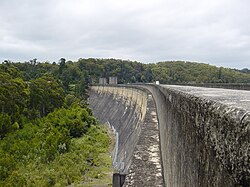
The Cordeaux Dam is a heritage-listed arch dam across the Cordeaux River with an unlined side spillway on the left abutment. It is 58 metres (191 ft) high, 404 metres (1,327 ft) long and creates a reservoir which holds 93,640 ML (2.060×10¹⁰ imp gal; 2.474×10¹⁰ US gal). Construction began in 1918 and was completed in 1926 at a cost of A£945,000. The wall consists of large sandstone blocks, quarried onsite and cemented together, faced with a combination of bluestone and sandstone concrete. The dam featured a number of improvements in design and construction on the earlier-completed Cataract Dam. These included contraction joints between units of construction placed at intervals of 27 metres (90 ft); inspection galleries at upper and lower levels, together with piping for registering any ground water pressure. The blue metal used in the construction of the dam was supplied from the Government Quarries at Kiama and brought by rail to Douglas Park. From here it was conveyed by aerial ropeway across the Nepean Gorge to an interchange on the eastern side where the material was transferred to a 2 ft (610 mm) gauge steam tramway to a point adjacent to the dam site.
Upper Nepean Scheme
The Upper Nepean Scheme is a series of dams and weirs in the catchments of the Cataract, Cordeaux, Avon and Nepean rivers of New South Wales, Australia. The scheme includes four dams and two weirs, and a gravity-fed canal system that feeds into a large storage reservoir to provide water to the Macarthur and Illawarra regions, the Wollondilly Shire, and metropolitan Sydney. The four dams and associated infrastructure are individually listed on the New South Wales State Heritage Register.
By 1867, Sydney was outgrowing the water supply available from Botany Swamps and the Governor (Sir John Young) appointed a Commission to recommend a future water supply. In 1869, the Commission recommended the Upper Nepean Scheme. This comprised weirs on the Cataract and Nepean rivers, a storage reservoir at Prospect and 101.79 kilometres (63.25 mi) of pipelines, tunnels, canals and aqueducts to bring water from the 900 square kilometres (347 sq mi) catchment area to Sydney. Work on the Scheme began in 1880 and was completed in 1888. The Scheme was a significant feat of engineering at the time of construction.
In June 1885 Sydney was in the grip of a severe drought and the Upper Nepean Scheme was incomplete. The Government accepted an offer from Hudson Brothers to bridge the gaps and deliver 14 megalitres; 3.6 million US gallons (3×10⁶ imp gal) of water per day into Botany Swamps. Duplicating the entire length of the half built permanent scheme this became known as Hudsons' Temporary Scheme and was turned into the swamps on 30 January 1886. This emergency work was dismantled as the main scheme was completed.
As originally built, the Upper Nepean Scheme was capable of supporting an estimated population of 540,000. By 1902, Sydney had a population of 523,000 and was again in the grip of a severe drought. A Royal Commission appointed to report on Sydney's water supply recommended a dam on the Cataract River and construction commenced in the same year. Dams were subsequently built on each of the Cordeaux, Avon and Nepean rivers, with the last being completed in 1935. Each dam includes a public picnic area. In total, the four dams hold 483,600 ML (1.064×10¹¹ imp gal; 1.278×10¹¹ US gal) and can safely provide 353 ML (78×106 imp gal; 93×106 US gal) per day.
The Scheme is now managed by the Sydney Catchment Authority.
Further supplementary water supply is provided by a feed from the Shoalhaven Scheme through various pumps, pipes, cuts and diversions.
The Cataract Dam is a heritage-listed gravity dam with an unlined side spillway extending from the left abutment. It is 56 metres (183 ft) tall, 247 metres (811 ft) long and holds 97,190 ML (2.138×10¹⁰ imp gal; 2.567×10¹⁰ US gal) of water. Cataract Dam was the first dam built in the Upper Nepean Scheme, it was also first dam in Australia to use pre-cast moulded concrete blocks for the upstream face of the dam. The core of the dam consists of large 2-to-4.5-long-ton (2.03 to 4.57 t; 2.24-to-5.04-short-ton) sandstone blocks, quarried onsite and cemented together. The downstream face is of mass poured basalt concrete, with a basalt facing. A readily accessible source of suitable rock was located some distance away at Sherbrooke, also known as Ferndale, situated near the top of Bulli Pass. To transport the basalt from the quarry to the dam construction site, a 2 ft (610 mm) gauge steam tramway, 8.8 km (5.5 mi) long, was constructed. Dam construction began in 1902 and was completed in 1907, and the spillway was widened in 1915. Ernest Macartney de Burgh was the supervising engineer for the project from 1904. Poet Banjo Paterson wrote a satirical ballad "The Dam that Keele Built" about the politics behind the construction of Cataract Dam.
The Cordeaux Dam is a heritage-listed arch dam across the Cordeaux River with an unlined side spillway on the left abutment. It is 58 metres (191 ft) high, 404 metres (1,327 ft) long and creates a reservoir which holds 93,640 ML (2.060×10¹⁰ imp gal; 2.474×10¹⁰ US gal). Construction began in 1918 and was completed in 1926 at a cost of A£945,000. The wall consists of large sandstone blocks, quarried onsite and cemented together, faced with a combination of bluestone and sandstone concrete. The dam featured a number of improvements in design and construction on the earlier-completed Cataract Dam. These included contraction joints between units of construction placed at intervals of 27 metres (90 ft); inspection galleries at upper and lower levels, together with piping for registering any ground water pressure. The blue metal used in the construction of the dam was supplied from the Government Quarries at Kiama and brought by rail to Douglas Park. From here it was conveyed by aerial ropeway across the Nepean Gorge to an interchange on the eastern side where the material was transferred to a 2 ft (610 mm) gauge steam tramway to a point adjacent to the dam site.
Recent media
Recent media