



Community hub
Recent from talks
Contribute something to knowledge base
Content stats: 0 posts, 0 articles, 1 media, 0 notes
Members stats: 0 subscribers, 0 contributors, 0 moderators, 0 supporters
Subscribers
Supporters
Contributors
Moderators
Hub AI
Urubhanga AI simulator
(@Urubhanga_simulator)
Hub AI
Urubhanga AI simulator
(@Urubhanga_simulator)
Urubhanga
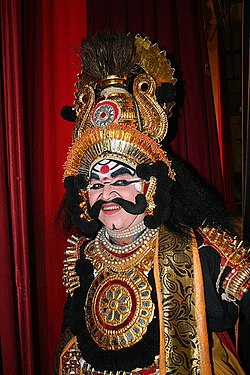
Urubhanga or Urubhangam, (English: Shattered Thighs ) is a Sanskrit play written by Bhasa in the 2nd or 3rd century CE. Based on the well-known epic, the Mahābhārata, by Vyasa, Urubhanga focuses on the story of the character Duryodhana during and after his fight with Bhima. Although Urubhanga contains the same core storyline as that in the Mahābhārata, Bhasa's altering of certain aspects results in a different presentation of the story. The most extreme of these alterations is Bhasa's portrayal of Duryodhana, who, in the Mahābhārata, is viewed as a villain, but in Urubhanga is given more human qualities. Bhasa's presentation of Duryodhana's side of the tale adds certain tragic elements to the play.
Urubhanga is derived from the famous epic Mahabharata. Although portrayed as a villain in the original play, the protagonist Duryodhana is presented in a different light in Urubhanga. He isn't exempted from his original evil deeds, but he is shown as a character with heroic qualities. The play centers around events that happen preceding his death; Duryodhana is shown repenting his past, reconciling with his family, and realizing the futility of war.
In the beginning of the play there are three soldiers that are marveling at the battlefield between the Kauravas and Pandavas. They describe the scene before them in gory detail, each taking turn to muse and exclaim over the various details that they observe. As they progress through the battlefield, they arrive to the battle between the middle Pandava Bhima and the Kaurava Duryodhana
The soldiers then proceed to describe the fight between Bhima and Duryodhana. The audience is seeing the battle entirely through the description of the three soldiers; ultimately, Bhima falls from Duryodhana's incessant blows. Duryodhana, refusing to kill Bhima while he is on the ground, instead has his thighs crushed by Bhima from false play and violation of rules.
After Duryodhana has fallen, Bhima is carried away hurriedly by the other Pandavas, and Duryodhana is left on the battleground. This act of false play incites the anger of Baladeva, who wants to seek justice. However, Duryodhana stops him, having become resigned; this begins the part of the play that starts to emphasize the heroic qualities of Duryodhana.
Duryodhana blames Krishna and forgives Bhima, as the play progresses, he is reconciled with his blind parents, then his queens (Malavi and Pauravi), and his son. Duryodhana is distressed about his situation, as he can no longer salute his father, nor can he let his son sit on his thigh. He also rejects the futility of war.
At the end of the play, Ashvatthaman, the preceptor's son, appears with the intent to seek revenge for Duryodhana and kill the Pandavas during the night, and Ashvatthaman names Durjaya, Duryodhana's son, as king of the kingdom right before Duryodhana dies. However, it needs to be noted that the play does not end completely in a tragic note, as there are signs of hope for the future, since it is unorthodox for Indian Sanskrit dramas to end only on a sad note.
Urubhangam was presented by the Bangladesh Centre for Asian Theatre, adapted by Niranjan Adhikari and directed by Kamaluddin Nilu. The premier of the play was held at Theatre Festival Varmland, Sweden in 2001. The performance is characterized by elements of Bengali folk theatre forms, rites, chorus, dance and modern techniques which goes beyond traditional forms of Sanskrit drama. The Centre for Asian Theatre performed at the Huashan Arts District Outdoor Tent Theatre hosted by the Department of Cultural Affairs of Taipei City Government.
Urubhanga
Urubhanga or Urubhangam, (English: Shattered Thighs ) is a Sanskrit play written by Bhasa in the 2nd or 3rd century CE. Based on the well-known epic, the Mahābhārata, by Vyasa, Urubhanga focuses on the story of the character Duryodhana during and after his fight with Bhima. Although Urubhanga contains the same core storyline as that in the Mahābhārata, Bhasa's altering of certain aspects results in a different presentation of the story. The most extreme of these alterations is Bhasa's portrayal of Duryodhana, who, in the Mahābhārata, is viewed as a villain, but in Urubhanga is given more human qualities. Bhasa's presentation of Duryodhana's side of the tale adds certain tragic elements to the play.
Urubhanga is derived from the famous epic Mahabharata. Although portrayed as a villain in the original play, the protagonist Duryodhana is presented in a different light in Urubhanga. He isn't exempted from his original evil deeds, but he is shown as a character with heroic qualities. The play centers around events that happen preceding his death; Duryodhana is shown repenting his past, reconciling with his family, and realizing the futility of war.
In the beginning of the play there are three soldiers that are marveling at the battlefield between the Kauravas and Pandavas. They describe the scene before them in gory detail, each taking turn to muse and exclaim over the various details that they observe. As they progress through the battlefield, they arrive to the battle between the middle Pandava Bhima and the Kaurava Duryodhana
The soldiers then proceed to describe the fight between Bhima and Duryodhana. The audience is seeing the battle entirely through the description of the three soldiers; ultimately, Bhima falls from Duryodhana's incessant blows. Duryodhana, refusing to kill Bhima while he is on the ground, instead has his thighs crushed by Bhima from false play and violation of rules.
After Duryodhana has fallen, Bhima is carried away hurriedly by the other Pandavas, and Duryodhana is left on the battleground. This act of false play incites the anger of Baladeva, who wants to seek justice. However, Duryodhana stops him, having become resigned; this begins the part of the play that starts to emphasize the heroic qualities of Duryodhana.
Duryodhana blames Krishna and forgives Bhima, as the play progresses, he is reconciled with his blind parents, then his queens (Malavi and Pauravi), and his son. Duryodhana is distressed about his situation, as he can no longer salute his father, nor can he let his son sit on his thigh. He also rejects the futility of war.
At the end of the play, Ashvatthaman, the preceptor's son, appears with the intent to seek revenge for Duryodhana and kill the Pandavas during the night, and Ashvatthaman names Durjaya, Duryodhana's son, as king of the kingdom right before Duryodhana dies. However, it needs to be noted that the play does not end completely in a tragic note, as there are signs of hope for the future, since it is unorthodox for Indian Sanskrit dramas to end only on a sad note.
Urubhangam was presented by the Bangladesh Centre for Asian Theatre, adapted by Niranjan Adhikari and directed by Kamaluddin Nilu. The premier of the play was held at Theatre Festival Varmland, Sweden in 2001. The performance is characterized by elements of Bengali folk theatre forms, rites, chorus, dance and modern techniques which goes beyond traditional forms of Sanskrit drama. The Centre for Asian Theatre performed at the Huashan Arts District Outdoor Tent Theatre hosted by the Department of Cultural Affairs of Taipei City Government.
Recent media
Recent media