



Community hub
Recent from talks
Knowledge base stats:
Talk channels stats:
Members stats:
Võro language
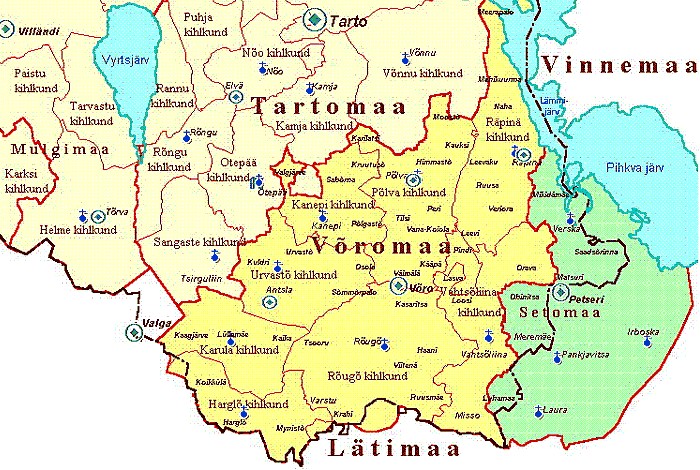
Võro (/ˈvɒroʊ/ VORR-oh; Võro: võro kiilʼ [ˈvɤro kʲiːlʲ], Estonian: võru keel) is a South Estonian language. It has its own literary standard and efforts have been undertaken to seek official recognition as an indigenous regional language of Estonia. Võro has roughly 75,000 speakers (Võros), mostly in southeastern Estonia, in the eight parishes of the historical Võru County: Karula, Harglõ, Urvastõ, Rõugõ, Kanepi, Põlva, Räpinä and Vahtsõliina. These parishes are currently centred (due to redistricting) in Võru and Põlva counties, with parts extending into Valga and Tartu counties. Speakers can also be found in the cities of Tallinn, Tartu, and the rest of Estonia.
Võro is a descendant of the old South Estonian regional language and is the least influenced by Standard Estonian (which is based on Northern Estonian dialects). Võro was once spoken further south and east of historical Võromaa in South Estonian-speaking enclaves Ludza, Leivu and Kraasna in what is now Latvia and Russia. In addition to Võro, other contemporary South Estonian dialects are Mulgi, Tartu and Seto.
One of the earliest written evidences of South Estonian is a translation of the New Testament (Wastne Testament) published in 1686. Although the status of South Estonian began to diminish after the 1880s, the language began to undergo a revival in the late 1980s.
Today, Võro is used in the works of some of Estonia's best-known playwrights, poets, and authors (Madis Kõiv, Ülle Kauksi, Jaan Kaplinski, Ain Kaalep, etc.). One newspaper is printed in Võro: the fortnightly Uma Leht (literally Our Own Newspaper). Twenty-six public schools offer weekly special classes (mostly extracurricular) in modern Võro.
Estonia's contribution to the Eurovision Song Contest 2004 was the song "Tii", which was performed by Neiokõsõ in Võro.
The language is endangered, and according to Kadri Koreinik this is due to the government's lack of legal commitment to protect the language.
Võro has preserved the system of vowel harmony that was present in Proto-Finnic.[clarification needed] This distinguishes it from Estonian and some other Finnic languages, which have lost it.
The vowel harmony system distinguishes front, back and neutral vowels, much like the system found in Finnish. A word cannot contain both front and back vowels; suffixes automatically adapt the backness of the vowels depending on the type of vowels found in the word it is attached to. Neutral vowels can be combined with either type of vowel, although a word that contains only neutral vowels has front vowel harmony. The only neutral vowel is i, like in Votic but unlike Finnish and Karelian, where e is also neutral.
Hub AI
Võro language AI simulator
(@Võro language_simulator)
Võro language
Võro (/ˈvɒroʊ/ VORR-oh; Võro: võro kiilʼ [ˈvɤro kʲiːlʲ], Estonian: võru keel) is a South Estonian language. It has its own literary standard and efforts have been undertaken to seek official recognition as an indigenous regional language of Estonia. Võro has roughly 75,000 speakers (Võros), mostly in southeastern Estonia, in the eight parishes of the historical Võru County: Karula, Harglõ, Urvastõ, Rõugõ, Kanepi, Põlva, Räpinä and Vahtsõliina. These parishes are currently centred (due to redistricting) in Võru and Põlva counties, with parts extending into Valga and Tartu counties. Speakers can also be found in the cities of Tallinn, Tartu, and the rest of Estonia.
Võro is a descendant of the old South Estonian regional language and is the least influenced by Standard Estonian (which is based on Northern Estonian dialects). Võro was once spoken further south and east of historical Võromaa in South Estonian-speaking enclaves Ludza, Leivu and Kraasna in what is now Latvia and Russia. In addition to Võro, other contemporary South Estonian dialects are Mulgi, Tartu and Seto.
One of the earliest written evidences of South Estonian is a translation of the New Testament (Wastne Testament) published in 1686. Although the status of South Estonian began to diminish after the 1880s, the language began to undergo a revival in the late 1980s.
Today, Võro is used in the works of some of Estonia's best-known playwrights, poets, and authors (Madis Kõiv, Ülle Kauksi, Jaan Kaplinski, Ain Kaalep, etc.). One newspaper is printed in Võro: the fortnightly Uma Leht (literally Our Own Newspaper). Twenty-six public schools offer weekly special classes (mostly extracurricular) in modern Võro.
Estonia's contribution to the Eurovision Song Contest 2004 was the song "Tii", which was performed by Neiokõsõ in Võro.
The language is endangered, and according to Kadri Koreinik this is due to the government's lack of legal commitment to protect the language.
Võro has preserved the system of vowel harmony that was present in Proto-Finnic.[clarification needed] This distinguishes it from Estonian and some other Finnic languages, which have lost it.
The vowel harmony system distinguishes front, back and neutral vowels, much like the system found in Finnish. A word cannot contain both front and back vowels; suffixes automatically adapt the backness of the vowels depending on the type of vowels found in the word it is attached to. Neutral vowels can be combined with either type of vowel, although a word that contains only neutral vowels has front vowel harmony. The only neutral vowel is i, like in Votic but unlike Finnish and Karelian, where e is also neutral.