


Community hub
Recent from talks
Contribute something
Nothing was collected or created yet.
VR Class Hr1
View on Wikipedia | This article needs additional citations for verification. (January 2021) |
| VR Class Hr1 | |||||||||||||||||||||
|---|---|---|---|---|---|---|---|---|---|---|---|---|---|---|---|---|---|---|---|---|---|
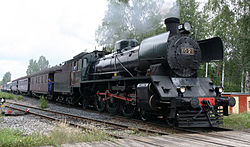
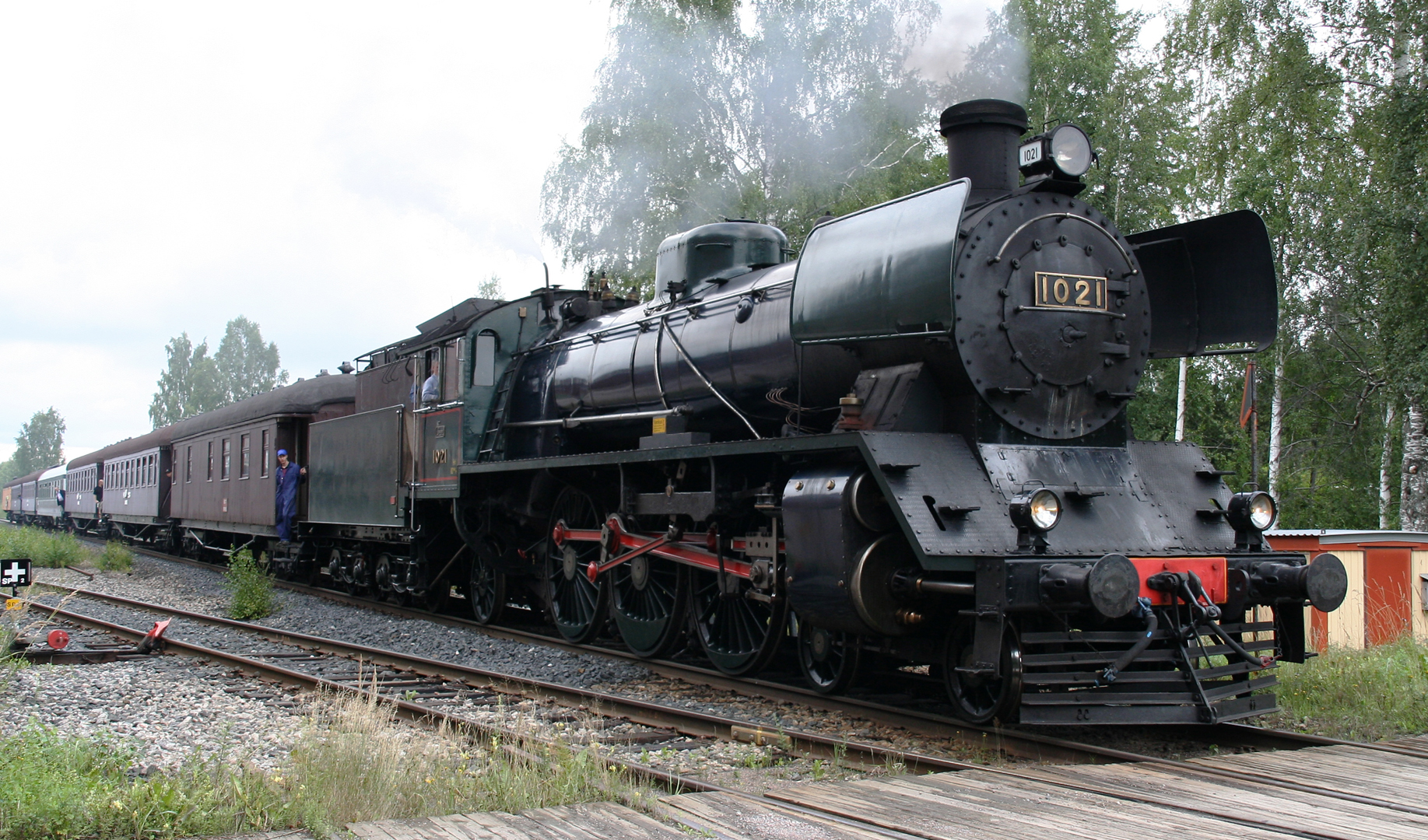
 Hr1 1021 with Witte-type smoke deflectors | |||||||||||||||||||||
| |||||||||||||||||||||
| |||||||||||||||||||||
| |||||||||||||||||||||
| |||||||||||||||||||||
The Hr1 class (original classification P1) was the largest passenger express steam locomotive built in Finland. Twenty-two were built between the years 1937–1957. They were numbered 1000–1021.
In the 1930s, there was a need for faster and heavier express trains in Finland, and the Hv1–Hv3 classes were not powerful enough to fill the need. Lokomo Oy in Tampere built first two prototypes, and after successful trials 20 more were built. Most of the locomotives were fitted with Wagner-type smoke deflectors, but the last two, which were equipped with roller bearings, had Witte-type deflectors.
The class's nickname was "Ukko-Pekka", meaning approximately "(respected) Grandpa Pekka", after the President of Finland Pehr Evind Svinhufvud.
The Hr1 was built for coal firing, but during the coal shortage after the war in 1945, birch wood was used as fuel. Larger chimneys needed for extinguishing wood sparks were temporarily fitted.
The Hr1s were the most important express steam locomotive and could justifiably be called the "flagships" of VR until 1963, when diesel locomotives started to replace steam. Their use ended officially in 1971, but two Hr1s equipped with roller bearings were brought back to use for a short time in the spring of 1974. One engine, 1005, was a participant in the worst peacetime railroad accident in Finland, the Kuurila accident, in 1957. The engine is preserved at Haapamäki.
Hr1's sister locomotive was the Tr1 class, otherwise similar, but with 2-8-2 wheel arrangement and smaller diameter drivers for freight train use.
Preservation
[edit]The following are preserved:
- 1000 Haapamäki
- 1001 Hyvinkää
- 1002–1005 Haapamäki, 1003 sectioned to show the inside of a steam locomotive
- 1008 Epping Ongar Railway
- 1010 Haapamäki
- 1011 Otanmäki
- 1012 Oulainen
- 1014 Haapamäki
- 1016 named "Lady Patricia" on a Private Railway near Windsor, Berkshire, United Kingdom[1]
- 1019, 1020 Haapamäki
- 1021 Riihimäki
Gallery
[edit]-
 Hr1 1002 at Haapamäki
 -
 Hr1 1003 at Haapamäki
 -
 Hr1 1003 at Haapamäki
 -
 Hr1 1003 at Haapamäki
 -

-
 Hr1 1009 at Lappeenranta
 -
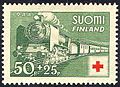 A 1944 Postage stamp depicting a Finnish train with a steam locomotive; the nickname of this heavy locomotive was "Ukko-Pekka"
 -
 Hr1 1009 at Toijala railway station 1953
 -
 Scale 1:10 model of VR Class Hr1 1001 in the ticket hall of Helsinki Central Station
 -
 Scale 1:10 model of VR Class Hr1 1001 in the ticket hall of Helsinki Central Station
 -
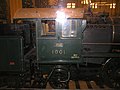 Scale 1:10 model of VR Class Hr1 1001 in the ticket hall of Helsinki Central Station
 -
 Scale 1:10 model of VR Class Hr1 1001 in the ticket hall of Helsinki Central Station
 -
 Scale 1:10 model of VR Class Hr1 1001 in the ticket hall of Helsinki Central Station
 -
 Scale 1:10 model of VR Class Hr1 1001 in the ticket hall of Helsinki Central Station
 -
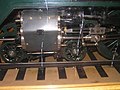 Scale 1:10 model of VR Class Hr1 1001 in the ticket hall of Helsinki Central Station
 -
 Scale 1:10 model of VR Class Hr1 1001 in the ticket hall of Helsinki Central Station
.jpg)
.jpg)
.jpg)


See also
[edit]References
[edit]- ^ "Steamlocomotive.com - Fifield Central". Archived from the original on 2015-09-24. Retrieved 2015-08-11.
External links
[edit] Media related to VR Class Hr1 at Wikimedia Commons
- 1016 "Lady Patricia" on her test run 28 June 2013

VR Class Hr1
View on GrokipediaOverview
Introduction
The VR Class Hr1 was the largest and most powerful class of express passenger steam locomotives operated by the Finnish State Railways (VR), serving as the backbone of high-speed rail travel in Finland during the mid-20th century. A total of 22 locomotives in this 4-6-2 Pacific arrangement were built between 1937 and 1957, marking the final major steam class procured by VR before the widespread adoption of diesel technology.[5] Designed to address the limitations of earlier heavy passenger locomotives, the Hr1 class was developed to haul faster and heavier express trains, effectively succeeding the capabilities of the older Hv1, Hv2, and Hv3 classes that had been in service since the early 1920s. These locomotives operated exclusively on Finland's 1,524 mm broad gauge network, achieving a maximum speed of 110 km/h to support demanding long-distance routes.[6][7][8] As VR's flagship motive power, the Hr1 dominated express services from 1949 until the diesel transition in 1963, particularly on principal southern lines like Helsinki–Tampere and Helsinki–Kouvola. The class remained in use for secondary passenger and freight duties into the late 1960s, with official withdrawals occurring between 1968 and 1971; however, two units briefly returned to operation in 1974 on the Seinäjoki–Vaasa route amid the global oil crisis. Known affectionately as "Ukko-Pekka," the Hr1 exemplified the pinnacle of Finnish steam engineering.[5]Nomenclature and Significance
The VR Class Hr1 locomotives were originally classified as P1 under the Finnish State Railways' pre-war system.[1] In 1942, following a major overhaul of the classification scheme on October 8, the designation shifted to Hr1 to align with the new two-letter-plus-number format; here, "H" denoted passenger service, "r" indicated heavy axle load (over 14.1 tonnes), and "1" marked it as the first such class.[9] This redesignation reflected broader standardization efforts amid wartime pressures and post-war modernization in Finnish rail operations.[10] The class earned the affectionate nickname "Ukko-Pekka," meaning "Old Man Pekka" or "Grandpa Pekka," directly inspired by the popular moniker for President Pehr Evind Svinhufvud (1931–1937), whose dignified stature and leadership mirrored the locomotive's robust, authoritative presence on the rails.[1] This naming convention humanized the machines, fostering public attachment and embedding them in Finnish cultural lore, much like how other classes received nicknames tied to national figures.[11] As Finland's premier express passenger locomotives, the Hr1 class held flagship status for the VR until 1963, when diesel traction began supplanting steam power, symbolizing a pinnacle of domestic engineering ingenuity during the interwar and early postwar eras.[11] Numbered from 1000 to 1021 across 22 units, they represented national self-reliance in heavy rail technology, with their preservation today underscoring their enduring role in Finnish railway heritage as icons of industrial progress and resilience.[8]Design and Specifications
General Configuration
The VR Class Hr1 locomotives employed a 4-6-2 Pacific wheel arrangement, featuring four small leading wheels for stability, six coupled driving wheels for propulsion, and two trailing wheels to support the firebox and cab.[2] This layout optimized the engine for high-speed passenger operations while maintaining balance and traction on Finland's broad-gauge tracks.[12] Overall, the locomotive measured 22.2 meters in length, including the tender, with a total weight of 155 tonnes when fully loaded.[12] The driving wheels had a diameter of 1,900 mm, enabling a maximum speed of 110 km/h, and the engine delivered a tractive effort of 114 kN to haul heavy express trains efficiently.[13] The attached tender provided essential support for extended journeys, with a capacity of 9 tonnes of coal and 27 cubic meters of water, allowing the Hr1 to operate on long mainline routes with minimal refueling interruptions.[2]Technical Features
The VR Class Hr1 locomotives were equipped with a boiler operating at a pressure of 15 bar (1,500 kPa; 218 psi), featuring a Schmidt-type superheater with 68 m² (732 sq ft) of superheating surface and a wide firebox with a grate area of 3.54 m² (38.1 sq ft) to facilitate high-output steam generation for demanding express services.[2][4] Propulsion was provided by two outside high-pressure cylinders, each with a diameter of 590 mm (23.2 in) and a stroke of 650 mm (25.6 in), driven by Walschaerts valve gear to optimize steam admission and exhaust for efficient power delivery.[2] To enhance crew visibility at high speeds, most Hr1 units were fitted with Wagner-type smoke deflectors, characterized by their rounded, "elephant ear" shape flanking the smokebox.[2] The final two locomotives, Nos. 1020 and 1021, instead received Witte-type smoke deflectors and were unique in the class for incorporating roller bearings throughout their running gear.[14][13] The class was designed for coal firing, with tenders holding up to 9 metric tons, though in 1945 amid wartime coal shortages, birch wood was temporarily used as fuel on some units, requiring the installation of larger chimneys to manage increased spark emission.[2][13]Construction
Production Details
The production of the VR Class Hr1 locomotives commenced with the construction of two prototypes by Lokomo Oy in Tampere in 1937, designed to address the increasing demands for faster express train services on Finland's expanding rail network during the late 1930s.[11] These initial units, numbered 1001 and 1002, underwent successful trials that validated the class's performance, paving the way for series production.[15] Following the prototypes, 20 additional locomotives were built between 1939 and 1957, bringing the total to 22 units numbered 1000–1021.[11] The extended timeline reflected a phased approach influenced by World War II disruptions, with construction resuming postwar to support economic recovery and heightened passenger traffic needs.[15] Of these, Lokomo Oy produced 14 locomotives across multiple batches from 1937 to 1957, while Oy Tampella Ab contributed 8 units specifically in 1955.[15] This staggered manufacturing ensured a steady supply of powerful Pacific-type locomotives for VR's flagship express routes, adapting to both prewar growth and postwar rebuilding efforts without overwhelming the builders' capacities.[11]Builders and Variations
The VR Class Hr1 locomotives were primarily constructed by two Finnish engineering firms: Lokomo Oy and Tampella Oy. Lokomo Oy in Tampere produced the first two prototypes in 1937, followed by 12 additional units through the 1940s and 1950s, with early production emphasizing design refinements such as optimized boiler configurations and running gear to enhance reliability and speed for express passenger duties.[15] These efforts addressed initial trial feedback, ensuring the class met the demands of heavier postwar traffic.[11] Tampella Oy, also based in Tampere, built 8 units starting in 1955, incorporating adjustments developed during wartime production constraints that had delayed the overall program, including simplified assembly processes for postwar efficiency.[15] The class exhibited no major subclasses, but progressive variations emerged across the 22-unit production run. Early locomotives used standard plain bearings on the driving axles and Wagner-type smoke deflectors to manage exhaust visibility. In contrast, the final two units, Nos. 1020 and 1021, featured roller bearings for reduced friction and maintenance, paired with Witte-type smoke deflectors to further improve forward vision and aerodynamic efficiency at high speeds.[11] Tender designs also evolved incrementally, with later examples offering enhanced fuel bunkers for greater coal capacity, supporting extended operational ranges without compromising the standard Br1 tender profile.[15]Operational History
Early Service and Peak Usage
The VR Class Hr1 locomotives entered service between 1937 and 1939, initially deployed on major express passenger routes across the Finnish rail network, including the key Helsinki–Tampere line.[8][2] As the largest and most powerful passenger steam engines built in Finland, they were designed to handle demanding long-distance services, with the first units serving as flagships for premium operations shortly after construction began at Lokomo in Tampere.[2][1] They powered prestigious express trains on routes such as Helsinki–Oulu, establishing their role in high-speed passenger services. During the 1940s and 1950s, the Hr1 class reached peak usage as the primary locomotives for the heaviest express trains, powering services that established them as the backbone of VR's high-speed passenger fleet.[2] They demonstrated exceptional reliability on extended runs, routinely achieving speeds of 110 km/h on premium routes and maintaining an average monthly mileage approaching 10,000 km per locomotive by the late 1950s.[8] This era solidified their role until the gradual introduction of diesel locomotives in 1963 began to supplant steam power for such duties.[2] To support these high-mileage operations, routine maintenance practices emphasized frequent inspections of the boiler, running gear, and tender systems at VR's major depots, ensuring sustained performance amid intensive schedules.[2] The class's robust design, including features like spoked drivers and efficient smoke deflectors, contributed to their operational dependability during this period of maximum utilization.[2]Wartime and Postwar Adaptations
During World War II, the construction of additional Hr1 locomotives faced delays due to wartime disruptions, limiting the class's expansion while Finland navigated the Winter War and Continuation War. Express passenger services were curtailed under wartime restrictions on fuel and resources, leading to reduced operations.[2][11] The immediate postwar period brought acute challenges, particularly the 1945 coal shortage stemming from Finland's war reparations to the Soviet Union and disrupted imports. To sustain operations, several Hr1 locomotives were adapted to burn birch wood as an alternative fuel, necessitating modifications including larger chimneys equipped with enhanced spark arrestors to manage the increased sparks from wood combustion.[13] This adaptation allowed continued service amid fuel scarcity but highlighted the improvisational measures required for maintenance, where material shortages prompted improvised repairs and delayed overhauls until supply chains normalized in the late 1940s.[13] In the 1950s, as Finland rebuilt its infrastructure and economy, demand for the Hr1 class surged to restore and expand express networks, with eight new units produced in 1955 and two more in 1957 to meet growing passenger volumes. These postwar locomotives incorporated refinements like roller bearings on the final pair for improved efficiency. However, operational risks persisted, as evidenced by the 1957 Kuurila rail accident, where Hr1 No. 1005 collided head-on with another express train due to a failure in transmitting orders on a single-track section; the incident, which killed 26 and injured 48, underscored vulnerabilities related to high speeds on curved tracks during the class's intensive postwar deployment.[16][11]Withdrawal
The decline of the VR Class Hr1 locomotives began in 1963, when they were gradually replaced on primary express routes by more efficient diesel locomotives, such as the Dv12 class, amid the broader transition to diesel power and rail upgrades.[5] This shift marked the end of their role as flagship engines for high-speed passenger services, relegating them to secondary lines like Helsinki–Riihimäki–Tampere and Kouvola–Pieksämäki.[5] Scheduled service for the class officially concluded in 1971, after which all remaining units were placed into storage as part of strategic reserves.[4] However, two roller-bearing-equipped Hr1 locomotives (numbers 1020 and 1021) were briefly reactivated in spring 1974 for limited operations on the Seinäjoki–Vaasa line, serving as a backup before their permanent withdrawal later that year.[5] By the early 1970s, six Hr1 units had been scrapped primarily due to severe deterioration from prolonged use, compounded by escalating maintenance costs and ongoing electrification plans that rendered steam operations obsolete on electrified routes.[4] The remaining locomotives were mothballed in reserves until the mid-1980s, when further reductions occurred owing to a lack of skilled personnel and dismantled servicing facilities.[4]Preservation
Surviving Examples
Of the 22 VR Class Hr1 locomotives constructed between 1937 and 1957, ten were scrapped, leaving twelve preserved examples. These are stored or displayed at key heritage sites across Finland, with two preserved abroad in the United Kingdom. Preservation efforts began following the class's withdrawal from regular service in the early 1970s, ensuring that over half the fleet survived for educational and historical purposes. The primary preservation site is Haapamäki Steam Locomotive Park, which houses the largest concentration of Hr1 locomotives, including Nos. 1000, 1002, 1003 (sectioned for internal display), 1004, 1005, 1010, 1014, and 1019.[17] No. 1005 is notable for its involvement in the 1957 Kuurila rail accident, after which it underwent restoration and was placed on static display at the park.[18] Other examples are held at the Finnish Railway Museum in Hyvinkää, such as No. 1021, the last-built member of the class from 1957, and No. 1001.[19] Additional locomotives are scattered across various depots and private collections, including No. 1009, owned and operated by Höyryveturimatkat 1009 Oy for heritage excursions, and No. 1016, privately preserved in the UK.[11] No. 1008 is preserved (in derelict condition as of 2025) at the Epping Ongar Railway in England.[20] Most preserved Hr1 locomotives are maintained as static exhibits, with their boilers typically uncertified for steaming to prioritize long-term conservation. However, a few, including Nos. 1009 and 1021, have certified boilers allowing limited operational use in heritage services.[21]Modern Use and Restoration
Since the 1980s, surviving VR Class Hr1 locomotives have been employed in heritage operations, with occasional excursion runs organized by the VR Group and private organizations such as Höyryveturimatkat 1009 Oy, a company founded in 1994 to preserve and operate historic rolling stock.[11][22] These operations typically involve charter services for events, festivals, and tourist attractions, including runs on disused lines and in the Helsinki region, often pulling restored vintage carriages to evoke the era of steam travel.[23] Hr1 No. 1009, affectionately nicknamed Ukko-Pekka, has been a mainstay in these activities, conducting 3–4 excursions annually and serving as a flagship for public heritage trips, such as the fully booked Helsinki–Heinola run in 2008 that drew large crowds along the route.[24] Restoration efforts in the 1990s and 2000s focused on returning select units to operational status, with significant projects conducted at facilities like the Haapamäki Steam Locomotive Park, a seven-hectare site established in 1988 for preserving and maintaining historic locomotives, including boiler overhauls and mechanical refurbishments to meet service requirements.[25] A notable example is Hr1 No. 1009, which was acquired and restored to mainline condition in 1993 by British railway enthusiast Nigel Sill, enabling its return to the rails with a maximum speed of 110 km/h; accompanying efforts from 1990 to 1996 refurbished vintage carriages in England, including a 63-seat mahogany restaurant car and a 48-seat saloon, while later additions in 2019 and 2020 incorporated a 100-passenger car and modern coaches from Finnish Railways.[11][24] These initiatives, often led by enthusiast groups, have ensured a handful of Hr1s remain serviceable for heritage use. The Hr1 class holds a prominent place in Finland's cultural legacy as the pinnacle of domestic steam locomotive engineering, embodying the nation's interwar and postwar railway ambitions with their 4-6-2 Pacific design and status as the most powerful passenger engines built locally between 1937 and 1957.[11] Iconic through the Ukko-Pekka moniker—derived from President Pehr Evind Svinhufvud—the locomotives have appeared in Finnish media, including news coverage of excursions and documentaries highlighting their historical role, while scale models, such as a 1:10 replica of No. 1001 displayed in Helsinki Central Station since 1958 (restored in the early 1990s), underscore their enduring appeal in public education and modeling communities.[24]References
- https://commons.wikimedia.org/wiki/Category:VR_Class_Hr1