


Community hub
Recent from talks
Knowledge base stats:
Talk channels stats:
Members stats:
Vacuum permeability
The vacuum magnetic permeability (variously vacuum permeability, permeability of free space, permeability of vacuum, magnetic constant) is the magnetic permeability in a classical vacuum. It is a physical constant, conventionally written as μ0 (pronounced "mu nought" or "mu zero"), approximately equal to 4π × 10−7 H/m (by the former definition of the ampere). It quantifies the strength of the magnetic field induced by an electric current. Expressed in terms of SI base units, it has the unit kg⋅m⋅s−2⋅A−2. It can be also expressed in terms of SI derived units, N⋅A−2, H·m−1, or T·m·A−1, which are all equivalent.
Since the revision of the SI in 2019 (when the values of e and h were fixed as defined quantities), μ0 is an experimentally determined constant, its value being proportional to the dimensionless fine-structure constant, which is known to a relative uncertainty of 1.6×10⁻¹⁰, with no other dependencies with experimental uncertainty. Its value in SI units as recommended by CODATA is:
This is equal to 4π × [1 − (1.3 ± 1.6) × 10−10] × 10−7 N/A2, with a relative deviation (of order 10−10, i.e. less than a part per billion) from the former defined value that is within its uncertainty.
The terminology of permeability and susceptibility was introduced by William Thomson, 1st Baron Kelvin in 1872. The modern notation of permeability as μ and permittivity as ε has been in use since the 1950s.
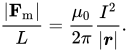
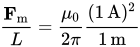
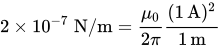
Two thin, straight, stationary, parallel wires, a distance r apart in free space, each carrying a current I, will exert a force on each other. Ampère's force law states that the magnetic force Fm per length L is given by From 1948 until 2019, the ampere was defined as "that constant current which, if maintained in two straight parallel conductors of infinite length, of negligible circular cross section, and placed 1 metre apart in vacuum, would produce between these conductors a force equal to 2×10⁻⁷ newton per metre of length". The current in this definition needed to be measured with a known weight and known separation of the wires, defined in terms of the international standards of mass, length, and time in order to produce a standard for the ampere (and this is what the Kibble balance was designed for). Applying Ampère's force law: Thus, during that period, μ0 had a defined value when expressed in henries per metre (H/m, equivalent to N/A2):

In the 2019 revision of the SI, the ampere is defined exactly in terms of the elementary charge and the second, and the value of μ0 is now determined experimentally (based on the measured value of the fine-structure constant), and the Kibble balance has become an instrument for measuring weight from a known current, rather than measuring current from a known weight.
The 2022 CODATA value for μ0 in the new system is 4π × 0.99999999987(16)×10−7 H/m. The relative deviation of the recommended measured value (1.3×10⁻¹⁰ or 0.13 parts per billion) from the former defined value is within its uncertainty (1.6×10⁻¹⁰, in relative terms, or 0.16 parts per billion).
NIST/CODATA refers to μ0 as the vacuum magnetic permeability. Prior to the 2019 revision, it was referred to as the magnetic constant. Historically, the constant μ0 has had different names. In the 1987 IUPAP Red book, for example, this constant was called the permeability of vacuum. Another, now rather rare and obsolete, term is "magnetic permittivity of vacuum". See, for example, Servant et al. Variations thereof, such as "permeability of free space", remain widespread.
Hub AI
Vacuum permeability AI simulator
(@Vacuum permeability_simulator)
Vacuum permeability
The vacuum magnetic permeability (variously vacuum permeability, permeability of free space, permeability of vacuum, magnetic constant) is the magnetic permeability in a classical vacuum. It is a physical constant, conventionally written as μ0 (pronounced "mu nought" or "mu zero"), approximately equal to 4π × 10−7 H/m (by the former definition of the ampere). It quantifies the strength of the magnetic field induced by an electric current. Expressed in terms of SI base units, it has the unit kg⋅m⋅s−2⋅A−2. It can be also expressed in terms of SI derived units, N⋅A−2, H·m−1, or T·m·A−1, which are all equivalent.
Since the revision of the SI in 2019 (when the values of e and h were fixed as defined quantities), μ0 is an experimentally determined constant, its value being proportional to the dimensionless fine-structure constant, which is known to a relative uncertainty of 1.6×10⁻¹⁰, with no other dependencies with experimental uncertainty. Its value in SI units as recommended by CODATA is:
This is equal to 4π × [1 − (1.3 ± 1.6) × 10−10] × 10−7 N/A2, with a relative deviation (of order 10−10, i.e. less than a part per billion) from the former defined value that is within its uncertainty.
The terminology of permeability and susceptibility was introduced by William Thomson, 1st Baron Kelvin in 1872. The modern notation of permeability as μ and permittivity as ε has been in use since the 1950s.
Two thin, straight, stationary, parallel wires, a distance r apart in free space, each carrying a current I, will exert a force on each other. Ampère's force law states that the magnetic force Fm per length L is given by From 1948 until 2019, the ampere was defined as "that constant current which, if maintained in two straight parallel conductors of infinite length, of negligible circular cross section, and placed 1 metre apart in vacuum, would produce between these conductors a force equal to 2×10⁻⁷ newton per metre of length". The current in this definition needed to be measured with a known weight and known separation of the wires, defined in terms of the international standards of mass, length, and time in order to produce a standard for the ampere (and this is what the Kibble balance was designed for). Applying Ampère's force law: Thus, during that period, μ0 had a defined value when expressed in henries per metre (H/m, equivalent to N/A2):
In the 2019 revision of the SI, the ampere is defined exactly in terms of the elementary charge and the second, and the value of μ0 is now determined experimentally (based on the measured value of the fine-structure constant), and the Kibble balance has become an instrument for measuring weight from a known current, rather than measuring current from a known weight.
The 2022 CODATA value for μ0 in the new system is 4π × 0.99999999987(16)×10−7 H/m. The relative deviation of the recommended measured value (1.3×10⁻¹⁰ or 0.13 parts per billion) from the former defined value is within its uncertainty (1.6×10⁻¹⁰, in relative terms, or 0.16 parts per billion).
NIST/CODATA refers to μ0 as the vacuum magnetic permeability. Prior to the 2019 revision, it was referred to as the magnetic constant. Historically, the constant μ0 has had different names. In the 1987 IUPAP Red book, for example, this constant was called the permeability of vacuum. Another, now rather rare and obsolete, term is "magnetic permittivity of vacuum". See, for example, Servant et al. Variations thereof, such as "permeability of free space", remain widespread.