


Community hub
Recent from talks
Contribute something to knowledge base
Content stats: 0 posts, 0 articles, 1 media, 0 notes
Members stats: 0 subscribers, 0 contributors, 0 moderators, 0 supporters
Subscribers
Supporters
Contributors
Moderators
Hub AI
Vagus nerve AI simulator
(@Vagus nerve_simulator)
Hub AI
Vagus nerve AI simulator
(@Vagus nerve_simulator)
Vagus nerve
The vagus nerve, also known as the tenth cranial nerve (CN X), plays a crucial role in the autonomic nervous system, which is responsible for regulating involuntary functions within the human body. This nerve carries both sensory and motor fibers and serves as a major pathway that connects the brain to various organs, including the heart, lungs, and digestive tract. As a key part of the parasympathetic nervous system, the vagus nerve helps regulate essential involuntary functions like heart rate, breathing, and digestion. By controlling these processes, the vagus nerve contributes to the body's "rest and digest" response, helping to calm the body after stress, lower heart rate, improve digestion, and maintain homeostasis.
There are two separate vagus nerves: the right vagus and the left vagus. In the neck, the right vagus nerve contains on average approximately 105,000 fibers, while the left vagus nerve has about 87,000 fibers, according to one source. Other sources report different figures, with around 25,000 fibers in the right vagus nerve and 23,000 fibers in the left.
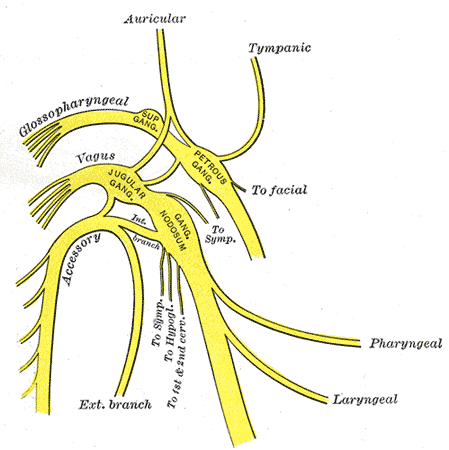
The vagus nerve is the longest nerve of the autonomic nervous system in the human body, consisting of both sensory – the majority – and some motor fibers, both sympathetic and parasympathetic. The sensory fibers originate from the jugular and nodose ganglia, while the motor fibers are derived from neurons in the dorsal nucleus of the vagus and the nucleus ambiguus. Although historically the vagus nerve was also known as the pneumogastric nerve, reflecting its role in regulating both the lungs and digestive system, its role in regulating cardiac function is fundamental.
Upon leaving the medulla oblongata between the olive and the inferior cerebellar peduncle, the vagus nerve extends through the jugular foramen, then passes into the carotid sheath between the internal carotid artery and the internal jugular vein down to the neck, chest, and abdomen, where it contributes to the innervation of the viscera, reaching all the way to the colon. Besides giving some output to various organs, the vagus nerve comprises between 80% and 90% of afferent nerve fibers conveying sensory information about the state of the body's organs to the central nervous system.
The right and left vagus nerves descend from the cranial vault through the jugular foramina, penetrating the carotid sheath between the internal and external carotid arteries, then passing posterolateral to the common carotid artery. The cell bodies of visceral afferent fibers of the vagus nerve are located bilaterally in the inferior ganglion of the vagus nerve (nodose ganglia).The vagus runs parallel to the common carotid artery and internal jugular vein inside the carotid sheath.
Right Vagus Nerve: The right vagus nerve gives rise to the right recurrent laryngeal nerve, which hooks around the right subclavian artery and ascends into the neck between the trachea and esophagus. The right vagus then crosses anterior to the right subclavian artery, runs posterior to the superior vena cava, descends posterior to the right main bronchus, and contributes to cardiac, pulmonary, and esophageal plexuses. It forms the posterior vagal trunk at the lower part of the esophagus and passes through the diaphragm to enter the abdomen through the esophageal hiatus.
Left Vagus Nerve: The left vagus nerve enters the thorax between left common carotid artery and left subclavian artery and descends on the aortic arch. It gives rise to the left recurrent laryngeal nerve, which hooks around the aortic arch to the left of the ligamentum arteriosum and ascends between the trachea and esophagus. The left vagus further gives off thoracic cardiac branches, breaks up into the pulmonary plexus, continues into the esophageal plexus, and enters the abdomen as the anterior vagal trunk by way of the esophageal hiatus of the diaphragm.
The vagus nerve includes axons which emerge from or converge onto four nuclei of the medulla:
Vagus nerve
The vagus nerve, also known as the tenth cranial nerve (CN X), plays a crucial role in the autonomic nervous system, which is responsible for regulating involuntary functions within the human body. This nerve carries both sensory and motor fibers and serves as a major pathway that connects the brain to various organs, including the heart, lungs, and digestive tract. As a key part of the parasympathetic nervous system, the vagus nerve helps regulate essential involuntary functions like heart rate, breathing, and digestion. By controlling these processes, the vagus nerve contributes to the body's "rest and digest" response, helping to calm the body after stress, lower heart rate, improve digestion, and maintain homeostasis.
There are two separate vagus nerves: the right vagus and the left vagus. In the neck, the right vagus nerve contains on average approximately 105,000 fibers, while the left vagus nerve has about 87,000 fibers, according to one source. Other sources report different figures, with around 25,000 fibers in the right vagus nerve and 23,000 fibers in the left.
The vagus nerve is the longest nerve of the autonomic nervous system in the human body, consisting of both sensory – the majority – and some motor fibers, both sympathetic and parasympathetic. The sensory fibers originate from the jugular and nodose ganglia, while the motor fibers are derived from neurons in the dorsal nucleus of the vagus and the nucleus ambiguus. Although historically the vagus nerve was also known as the pneumogastric nerve, reflecting its role in regulating both the lungs and digestive system, its role in regulating cardiac function is fundamental.
Upon leaving the medulla oblongata between the olive and the inferior cerebellar peduncle, the vagus nerve extends through the jugular foramen, then passes into the carotid sheath between the internal carotid artery and the internal jugular vein down to the neck, chest, and abdomen, where it contributes to the innervation of the viscera, reaching all the way to the colon. Besides giving some output to various organs, the vagus nerve comprises between 80% and 90% of afferent nerve fibers conveying sensory information about the state of the body's organs to the central nervous system.
The right and left vagus nerves descend from the cranial vault through the jugular foramina, penetrating the carotid sheath between the internal and external carotid arteries, then passing posterolateral to the common carotid artery. The cell bodies of visceral afferent fibers of the vagus nerve are located bilaterally in the inferior ganglion of the vagus nerve (nodose ganglia).The vagus runs parallel to the common carotid artery and internal jugular vein inside the carotid sheath.
Right Vagus Nerve: The right vagus nerve gives rise to the right recurrent laryngeal nerve, which hooks around the right subclavian artery and ascends into the neck between the trachea and esophagus. The right vagus then crosses anterior to the right subclavian artery, runs posterior to the superior vena cava, descends posterior to the right main bronchus, and contributes to cardiac, pulmonary, and esophageal plexuses. It forms the posterior vagal trunk at the lower part of the esophagus and passes through the diaphragm to enter the abdomen through the esophageal hiatus.
Left Vagus Nerve: The left vagus nerve enters the thorax between left common carotid artery and left subclavian artery and descends on the aortic arch. It gives rise to the left recurrent laryngeal nerve, which hooks around the aortic arch to the left of the ligamentum arteriosum and ascends between the trachea and esophagus. The left vagus further gives off thoracic cardiac branches, breaks up into the pulmonary plexus, continues into the esophageal plexus, and enters the abdomen as the anterior vagal trunk by way of the esophageal hiatus of the diaphragm.
The vagus nerve includes axons which emerge from or converge onto four nuclei of the medulla:
Recent media
Recent media