
Recent from talks
Vaisakhi
Knowledge base stats:
Talk channels stats:
Members stats:
Vaisakhi
'Vaisakhi (Sanskrit: [ʋɐi̯ɕaːkʰiː]), also known as Baisakhi (IPA: [bɛːsaːkʰiː]) or Mesadi,' or Basoa (IPA: [meːsaːɖiː]), marks the first day of the month of Vaisakh and is traditionally celebrated annually on 13 April or sometimes 14 April. It is seen as a spring harvest celebration primarily in Punjab and Northern India. Whilst it is culturally significant in many parts of India as a festival of harvest, Vaisakhi is also the date for the Indian Solar New Year. However, Sikhs celebrate the new year on the first the month Chet, according to the Nanakshahi calendar.
Historically, the festival of Vaisakhi was north India’s most important annual market. Although Vaisakhi began as a grain harvest festival for Hindus and its observance predates the creation of Sikhism, it gained historical association with the Sikhs following the inauguration of the Khalsa.
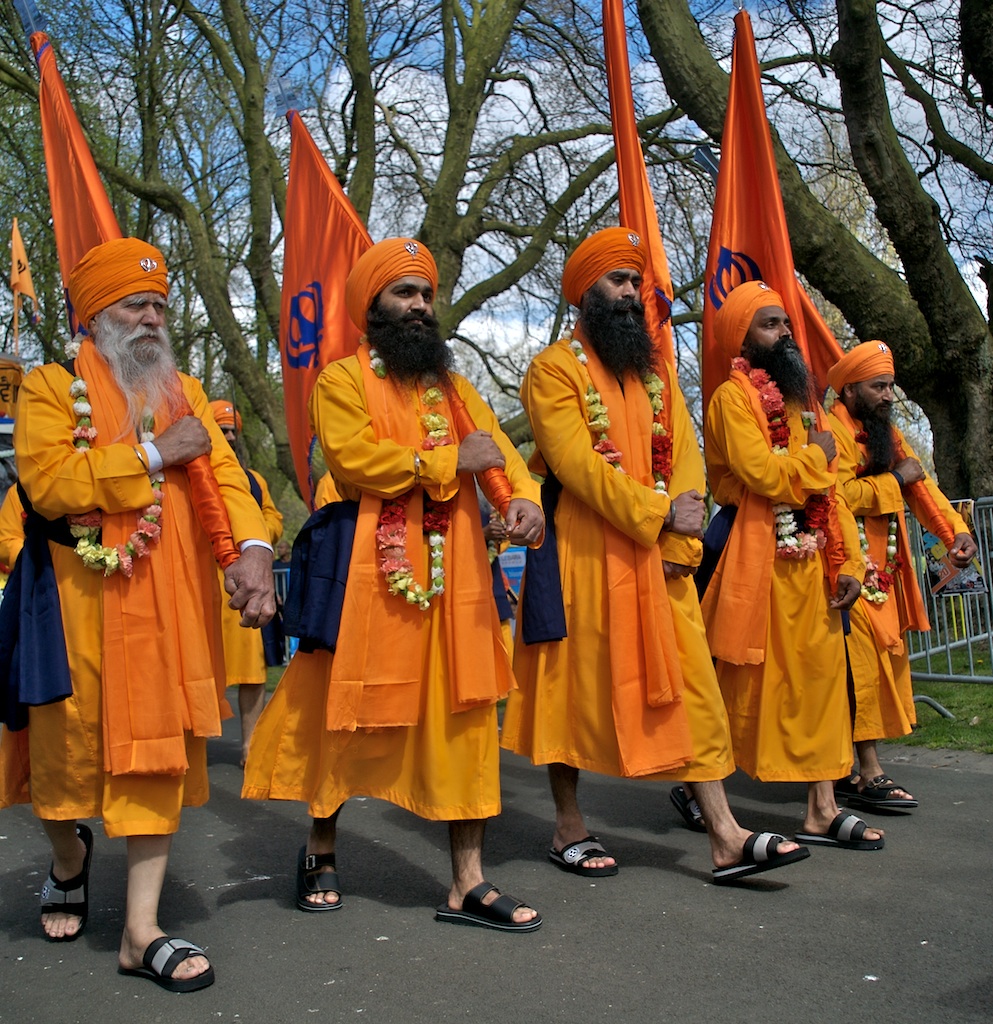
For Sikhs, in addition to its significance as the harvest festival, during which Sikhs hold kirtans, visit local gurdwaras, community fairs, hold nagar kirtan processions, raise the Nishan Sahib flag, and gather to socialize and share festive foods, Vaisakhi observes major events in the history of Sikhism and the Indian subcontinent that happened in the Punjab region. Vaisakhi as a major Sikh festival marks the birth of the Khalsa order by Guru Gobind Singh, the tenth Guru of Sikhism, on 13 April 1699. Later, Ranjit Singh was proclaimed as Maharaja of the Sikh Empire on 12 April 1801 (to coincide with Vaisakhi), creating a unified political state.
Vaisakhi was also the day when British Indian Army officer Reginald Dyer ordered his troops to shoot into a protesting crowd in Amritsar, an event which would come to be known the Jallianwala Bagh massacre; the massacre proved influential to the history of the Indian independence movement.
The holiday is also observed by cultural Hindu communities and is known by various regional names in other parts of India. For many Hindu communities, the festival is an occasion to ritually bathe in sacred rivers such as Ganges, Jhelum, and Kaveri, visit temples, meet friends, take part in other festivities, and perform a mandatory daan (charity) especially of hand fans, water pitchers and seasonal fruits. Community fairs are held at Hindu pilgrimage sites. In many areas, processions of temple deities are taken out. The holiday also marks the worship and propitiation of various deities, such as Durga in Himachal Pradesh, Surya in Bihar, and Vishnu in southern India.
Vaisakhi is observed on the 13 or 14 April every year in the 21st century. However, in 1801 AD, it fell on 11 April. This is because the date of Vaisakhi and other Sankrantis keeps changing slowly over years. Vaisakhi would fall on 29 April in Year 2999. The festival coincides with other new year festivals celebrated on the first day of Vaisakh in other regions of the Indian Subcontinent such as Puthandu, Pohela Boishakh, Bohag Bihu, and Vishu.
It is one of three Sikh celebrations still calculated using the traditional Bikrami calendar, alongside Bandi Chhor Divas and Guru Nanak Gurpurab, where as the rest are determined now as per the Nanakshahi calendar.
The word Vaisakhi or Baisakhi is an Apabhraṃśa form evolved from the word Vaiśākhī (वैशाखी), derived from the name of the Indian month of Vaishakha. There is no distinction between sounds 'sha' (श) & 'sa' (स) and between 'va' (व) & 'ba' (ब) in Prakrit & Apbhramsa. Hence the name, Vaisakhi or Baisakhi. Vaisakhi which is observed on Sankranti of Vaisakh (Vaishakh) month literally means 'related to Vaisakh month', which in turn is derived from the name of a Nakshatra known as Vishakha. In Punjab region, the word Vaisakhi is common, but in the Dogra regions, and the Doabi and Malwai dialects of Punjab, speakers often substitute a B for a V, so it is known as Baisakhi or Basakhi; also people in Jammu call it Basoa.
Hub AI
Vaisakhi AI simulator
(@Vaisakhi_simulator)
Vaisakhi
'Vaisakhi (Sanskrit: [ʋɐi̯ɕaːkʰiː]), also known as Baisakhi (IPA: [bɛːsaːkʰiː]) or Mesadi,' or Basoa (IPA: [meːsaːɖiː]), marks the first day of the month of Vaisakh and is traditionally celebrated annually on 13 April or sometimes 14 April. It is seen as a spring harvest celebration primarily in Punjab and Northern India. Whilst it is culturally significant in many parts of India as a festival of harvest, Vaisakhi is also the date for the Indian Solar New Year. However, Sikhs celebrate the new year on the first the month Chet, according to the Nanakshahi calendar.
Historically, the festival of Vaisakhi was north India’s most important annual market. Although Vaisakhi began as a grain harvest festival for Hindus and its observance predates the creation of Sikhism, it gained historical association with the Sikhs following the inauguration of the Khalsa.
For Sikhs, in addition to its significance as the harvest festival, during which Sikhs hold kirtans, visit local gurdwaras, community fairs, hold nagar kirtan processions, raise the Nishan Sahib flag, and gather to socialize and share festive foods, Vaisakhi observes major events in the history of Sikhism and the Indian subcontinent that happened in the Punjab region. Vaisakhi as a major Sikh festival marks the birth of the Khalsa order by Guru Gobind Singh, the tenth Guru of Sikhism, on 13 April 1699. Later, Ranjit Singh was proclaimed as Maharaja of the Sikh Empire on 12 April 1801 (to coincide with Vaisakhi), creating a unified political state.
Vaisakhi was also the day when British Indian Army officer Reginald Dyer ordered his troops to shoot into a protesting crowd in Amritsar, an event which would come to be known the Jallianwala Bagh massacre; the massacre proved influential to the history of the Indian independence movement.
The holiday is also observed by cultural Hindu communities and is known by various regional names in other parts of India. For many Hindu communities, the festival is an occasion to ritually bathe in sacred rivers such as Ganges, Jhelum, and Kaveri, visit temples, meet friends, take part in other festivities, and perform a mandatory daan (charity) especially of hand fans, water pitchers and seasonal fruits. Community fairs are held at Hindu pilgrimage sites. In many areas, processions of temple deities are taken out. The holiday also marks the worship and propitiation of various deities, such as Durga in Himachal Pradesh, Surya in Bihar, and Vishnu in southern India.
Vaisakhi is observed on the 13 or 14 April every year in the 21st century. However, in 1801 AD, it fell on 11 April. This is because the date of Vaisakhi and other Sankrantis keeps changing slowly over years. Vaisakhi would fall on 29 April in Year 2999. The festival coincides with other new year festivals celebrated on the first day of Vaisakh in other regions of the Indian Subcontinent such as Puthandu, Pohela Boishakh, Bohag Bihu, and Vishu.
It is one of three Sikh celebrations still calculated using the traditional Bikrami calendar, alongside Bandi Chhor Divas and Guru Nanak Gurpurab, where as the rest are determined now as per the Nanakshahi calendar.
The word Vaisakhi or Baisakhi is an Apabhraṃśa form evolved from the word Vaiśākhī (वैशाखी), derived from the name of the Indian month of Vaishakha. There is no distinction between sounds 'sha' (श) & 'sa' (स) and between 'va' (व) & 'ba' (ब) in Prakrit & Apbhramsa. Hence the name, Vaisakhi or Baisakhi. Vaisakhi which is observed on Sankranti of Vaisakh (Vaishakh) month literally means 'related to Vaisakh month', which in turn is derived from the name of a Nakshatra known as Vishakha. In Punjab region, the word Vaisakhi is common, but in the Dogra regions, and the Doabi and Malwai dialects of Punjab, speakers often substitute a B for a V, so it is known as Baisakhi or Basakhi; also people in Jammu call it Basoa.
Recent media