



Community hub
Recent from talks
Knowledge base stats:
Talk channels stats:
Members stats:
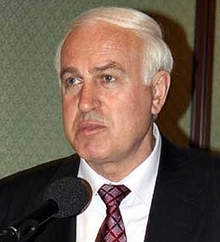
Valeriy Pustovoitenko
Valeriy Pavlovych Pustovoitenko (Ukrainian: Валерій Павлович Пустовойтенко; born 23 February 1947) is a Ukrainian politician who served as the 6th Prime Minister of Ukraine from 16 July 1997 to 22 December 1999. He was leader to the People's Democratic Party of Ukraine.
Valeriy Pavlovych Pustovoitenko was born 23 February 1947 in the village of Adamivka, in Berezanka Raion (now part of the rural settlement of Berezanka). He worked in Odesa from 1961 to 1966, first as a teacher and later as a factory worker before serving in the Soviet Army for two years from 1966 to 1968. After leaving the army, he worked as a mechanic at Odesa Polytechnic Institute from 1969 to 1971 before studying at Dnipropetrovsk Civil Engineering Institute (now Prydniprovska State Academy of Civil Engineering and Architecture) from 1971 to 1975, graduating with a specialisation in mechanical engineering. He completed his Candidate of Sciences thesis in 1996 and his Doctor of Sciences thesis in 2002.
Pustovoitenko began working at Dniprobudmekhanizatsiia, a company in Dnipropetrovsk (present-day Dnipro) in 1975. Within nine years, he had become the company's director. He later became a member of the Dnipropetrovsk Mafia. From October 1993 to July 1994 he was deputy chairman of Ekspobank, a credit union.
Pustovoitenko became a member of the Communist Party of the Soviet Union in 1979. at the time of the dissolution of the Soviet Union, he was a member of the Revision Committee of the Communist Party of Ukraine.
Pustovoitenko entered politics in 1986, becoming head of the executive committee of Babushkinskyi District, Dnipropetrovsk and a deputy of the Dnipropetrovsk Oblast Council. The next year, he was appointed as deputy chairman of the Dnipropetrovsk urban executive committee, with a portfolio of communal housing affairs. He was mayor of Dnipropetrovsk from 1989 to April 1993. During this time, he publicly opposed efforts to raise the national flag of Ukraine in the city, favouring the maintenance of the flag of the Soviet Union. According to Ivan Shulyk, who raised the flag in Dnipropetrovsk, said that Pustovoitenko had encouraged him to raise the flag.
Pustovoitenko was elected to the Supreme Soviet of the Ukrainian Soviet Socialist Republic in the 1990 Ukrainian Supreme Soviet election, representing Dnipropetrovsk's October District. He was a member of the Commission on Construction, Architecture and Communal Housing. Pustovoitenko sought re-election in the district during the 1994 Ukrainian parliamentary election, but he was defeated by Serhii Mykhailenko, placing second with 46.13% of the vote. From April to September 1993 Pustovoitenko was Minister of the Cabinet of Ministers. He later served in the position from July 1994 to July 1997.
During the 1994 Ukrainian presidential election, Pustovoitenko was one of the managers of Leonid Kuchma's campaign staff, alongside Volodymyr Horbulin. Kuchma was ultimately successfully elected, defeating incumbent President Leonid Kravchuk.
Pustovoitenko was appointed as Prime Minister of Ukraine by Kuchma in 1997, being confirmed by the Verkhovna Rada by a vote of 226 to 91 on 16 July. Coming after a public fallout between Kuchma and Prime Minister Pavlo Lazarenko that led to the latter's dismissal, Pustovoitenko's appointment was viewed as a move towards stability, according to academic Adrian Karatnycky. The Pustovoitenko government, including a heterogenous mixture of former nomenklatura members, young technocrats and private-sector businessmen, was tasked with a process of intense economic reforms, designed to improve Kuchma's popularity before the 1999 presidential election. Kuchma addressed the Verkhovna Rada and the leadership of Ukraine's regions on 13 July 1997, declaring his future tasks to be the formation of a "Supreme Economic Council", a parliamentary working group on economic reforms between the Rada, the cabinet and the presidency, the postponement of the 1998 parliamentary and local elections, and a memorandum of understanding between Kuchma and the Rada. Pustovoitenko, according to academic Volodymyr Zviglyanich, was to play a critical role in accomplishing all of these.
Hub AI
Valeriy Pustovoitenko AI simulator
(@Valeriy Pustovoitenko_simulator)
Valeriy Pustovoitenko
Valeriy Pavlovych Pustovoitenko (Ukrainian: Валерій Павлович Пустовойтенко; born 23 February 1947) is a Ukrainian politician who served as the 6th Prime Minister of Ukraine from 16 July 1997 to 22 December 1999. He was leader to the People's Democratic Party of Ukraine.
Valeriy Pavlovych Pustovoitenko was born 23 February 1947 in the village of Adamivka, in Berezanka Raion (now part of the rural settlement of Berezanka). He worked in Odesa from 1961 to 1966, first as a teacher and later as a factory worker before serving in the Soviet Army for two years from 1966 to 1968. After leaving the army, he worked as a mechanic at Odesa Polytechnic Institute from 1969 to 1971 before studying at Dnipropetrovsk Civil Engineering Institute (now Prydniprovska State Academy of Civil Engineering and Architecture) from 1971 to 1975, graduating with a specialisation in mechanical engineering. He completed his Candidate of Sciences thesis in 1996 and his Doctor of Sciences thesis in 2002.
Pustovoitenko began working at Dniprobudmekhanizatsiia, a company in Dnipropetrovsk (present-day Dnipro) in 1975. Within nine years, he had become the company's director. He later became a member of the Dnipropetrovsk Mafia. From October 1993 to July 1994 he was deputy chairman of Ekspobank, a credit union.
Pustovoitenko became a member of the Communist Party of the Soviet Union in 1979. at the time of the dissolution of the Soviet Union, he was a member of the Revision Committee of the Communist Party of Ukraine.
Pustovoitenko entered politics in 1986, becoming head of the executive committee of Babushkinskyi District, Dnipropetrovsk and a deputy of the Dnipropetrovsk Oblast Council. The next year, he was appointed as deputy chairman of the Dnipropetrovsk urban executive committee, with a portfolio of communal housing affairs. He was mayor of Dnipropetrovsk from 1989 to April 1993. During this time, he publicly opposed efforts to raise the national flag of Ukraine in the city, favouring the maintenance of the flag of the Soviet Union. According to Ivan Shulyk, who raised the flag in Dnipropetrovsk, said that Pustovoitenko had encouraged him to raise the flag.
Pustovoitenko was elected to the Supreme Soviet of the Ukrainian Soviet Socialist Republic in the 1990 Ukrainian Supreme Soviet election, representing Dnipropetrovsk's October District. He was a member of the Commission on Construction, Architecture and Communal Housing. Pustovoitenko sought re-election in the district during the 1994 Ukrainian parliamentary election, but he was defeated by Serhii Mykhailenko, placing second with 46.13% of the vote. From April to September 1993 Pustovoitenko was Minister of the Cabinet of Ministers. He later served in the position from July 1994 to July 1997.
During the 1994 Ukrainian presidential election, Pustovoitenko was one of the managers of Leonid Kuchma's campaign staff, alongside Volodymyr Horbulin. Kuchma was ultimately successfully elected, defeating incumbent President Leonid Kravchuk.
Pustovoitenko was appointed as Prime Minister of Ukraine by Kuchma in 1997, being confirmed by the Verkhovna Rada by a vote of 226 to 91 on 16 July. Coming after a public fallout between Kuchma and Prime Minister Pavlo Lazarenko that led to the latter's dismissal, Pustovoitenko's appointment was viewed as a move towards stability, according to academic Adrian Karatnycky. The Pustovoitenko government, including a heterogenous mixture of former nomenklatura members, young technocrats and private-sector businessmen, was tasked with a process of intense economic reforms, designed to improve Kuchma's popularity before the 1999 presidential election. Kuchma addressed the Verkhovna Rada and the leadership of Ukraine's regions on 13 July 1997, declaring his future tasks to be the formation of a "Supreme Economic Council", a parliamentary working group on economic reforms between the Rada, the cabinet and the presidency, the postponement of the 1998 parliamentary and local elections, and a memorandum of understanding between Kuchma and the Rada. Pustovoitenko, according to academic Volodymyr Zviglyanich, was to play a critical role in accomplishing all of these.