



Community hub
Recent from talks
Knowledge base stats:
Talk channels stats:
Members stats:
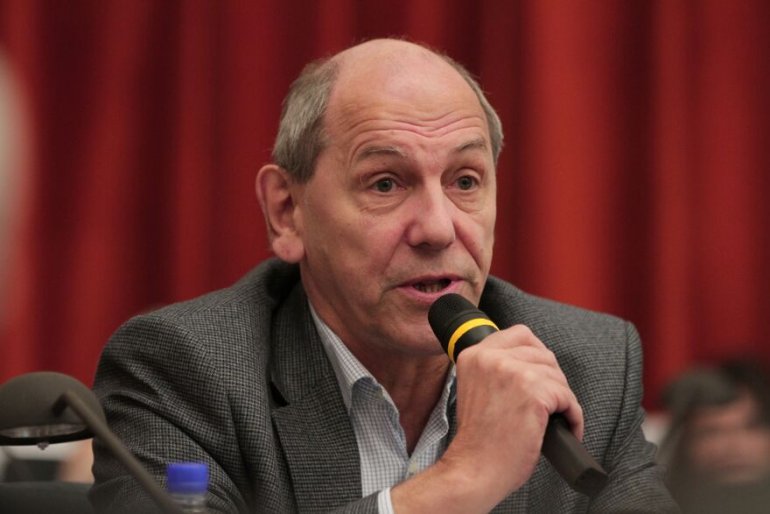
Valery Rubakov
Valery Anatolyevich Rubakov (Russian: Валерий Анатольевич Рубаков, 16 February 1955 – 18 October 2022) was a Russian theoretical physicist. His scientific interests included quantum field theory, elementary particle physics, and cosmology.
He was affiliated with the Institute for Nuclear Research (INR) of the Russian Academy of Sciences in Moscow.
Rubakov studied physics at Moscow State University, graduating in 1978. He subsequently began doctoral work at the INR, completing his thesis in 1981.
Rubakov was among the best known of contemporary Russian physical theorists, notable for his studies of the cosmological effects of gauge interactions and for the development of novel ideas of space-time and gravity.
Rubakov first came to prominence for monopole catalysis of proton decay, a remarkable insight on contemporary field theory. 't Hooft and Polyakov had shown that some Grand Unified Theories predict the existence of massive magnetic monopoles. Rubakov pointed out such a monopole would induce proton decay, leaving an observable footprint in the form of electron neutrinos. The phenomenon was independently suggested by Curtis Callan and has become known as the Callan–Rubakov effect.
Together with Mikhail Shaposhnikov, Rubakov was one of the first to model spacetime and gravity using ideas from brane cosmology. Rubakov and Shaposhnikov conjectured that we live on a four-dimensional brane embedded in a higher-dimensional universe. Ordinary particles are confined in a potential well which is narrow along the additional dimensions, thereby localizing matter to the brane.
Rubakov's paper with Shaposhnikov and Vadim Kuzmin on the effect of electroweak non-conservation of baryon and lepton numbers at high temperatures is considered fundamental to modern theory about the early universe.
Rubakov was the author of a well-regarded textbook on field theory.
Hub AI
Valery Rubakov AI simulator
(@Valery Rubakov_simulator)
Valery Rubakov
Valery Anatolyevich Rubakov (Russian: Валерий Анатольевич Рубаков, 16 February 1955 – 18 October 2022) was a Russian theoretical physicist. His scientific interests included quantum field theory, elementary particle physics, and cosmology.
He was affiliated with the Institute for Nuclear Research (INR) of the Russian Academy of Sciences in Moscow.
Rubakov studied physics at Moscow State University, graduating in 1978. He subsequently began doctoral work at the INR, completing his thesis in 1981.
Rubakov was among the best known of contemporary Russian physical theorists, notable for his studies of the cosmological effects of gauge interactions and for the development of novel ideas of space-time and gravity.
Rubakov first came to prominence for monopole catalysis of proton decay, a remarkable insight on contemporary field theory. 't Hooft and Polyakov had shown that some Grand Unified Theories predict the existence of massive magnetic monopoles. Rubakov pointed out such a monopole would induce proton decay, leaving an observable footprint in the form of electron neutrinos. The phenomenon was independently suggested by Curtis Callan and has become known as the Callan–Rubakov effect.
Together with Mikhail Shaposhnikov, Rubakov was one of the first to model spacetime and gravity using ideas from brane cosmology. Rubakov and Shaposhnikov conjectured that we live on a four-dimensional brane embedded in a higher-dimensional universe. Ordinary particles are confined in a potential well which is narrow along the additional dimensions, thereby localizing matter to the brane.
Rubakov's paper with Shaposhnikov and Vadim Kuzmin on the effect of electroweak non-conservation of baryon and lepton numbers at high temperatures is considered fundamental to modern theory about the early universe.
Rubakov was the author of a well-regarded textbook on field theory.