Hubbry Logo
Noctis LabyrinthusNoctis LabyrinthusMain
Open search
Noctis Labyrinthus
Community hub
Noctis Labyrinthus
logo
8 pages, 0 posts
0 subscribers
Be the first to start a discussion here.
Noctis Labyrinthus
Noctis Labyrinthus
from Wikipedia
Noctis Labyrinthus
}
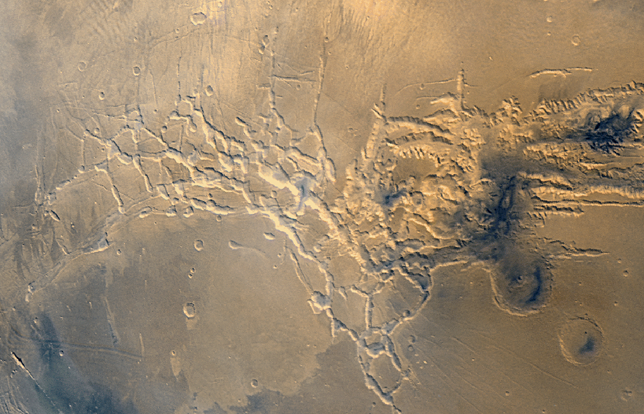
Noctis Labyrinthus, as seen by Viking 1. North is up. The western initiation of the Valles Marineris is visible at the right. The Tharsis Montes are just beyond the horizon.
Feature typeCanyon system
Coordinates7°00′S 102°12′W / 7.0°S 102.2°W / -7.0; -102.2
Length1,263.0 km
EponymLatin – Labyrinth of Night
High resolution THEMIS daytime infrared image mosaic of Noctis Labyrinthus and its surroundings. The area is crisscrossed by multiple sets of graben running in different directions. The shield volcano Pavonis Mons is at upper left.
Mariner 9 view of the Noctis Labyrinthus "labyrinth" at the western end of Valles Marineris on Mars. Linear graben, grooves, and crater chains dominate this region, along with a number of flat-topped mesas. The image is roughly 400 km across, centered at 6 S, 105 W, at the edge of the Tharsis bulge. North is up. Image located in Phoenicis Lacus quadrangle

Noctis Labyrinthus (Latin for 'Labyrinth of the Night') is a region of Mars located in the Phoenicis Lacus quadrangle, between Valles Marineris and the Tharsis upland.[1] The region is notable for its maze-like system of deep, steep-walled valleys. The valleys and canyons of this region formed by faulting and many show classic features of grabens, with the upland plain surface preserved on the valley floor. In some places the valley floors are rougher, disturbed by landslides, and there are places where the land appears to have sunk down into pit-like formations.[2] It is thought that this faulting was triggered by volcanic activity in the Tharsis region.[3] Research described in December 2009 found a variety of minerals, including clays, sulfates, and hydrated silicas, in some of the layers.[4]

Context

[edit]

Noctis Labyrinthus is located in the heart of Tharsis at the western end of the Valles Marineris, manifesting as a network of graben that extends in a spider-like network before coalescing into a coherent, relatively shallow graben swarm that curves in a semicircular fashion towards the south into the Claritas Rise. The graben are known as the Claritas Fossae beyond this point.[5]

Geology

[edit]

The Noctis Labyrinthus fracture zone is centered at the heart of the Tharsis Rise, dividing a plateau of Hesperian-Noachian age that is understood to be of a basaltic composition.[6] The valleys of Noctis Labyrinthus fractured into three distinct trends (NNE/SSW, ENE/WSW, WNW/ESE) in an interlinked pattern that has been compared to the terrestrial fault systems that have formed over terrestrial domes.[5] The formation of the fracture zone have been dated to the Late Hesperian based on crater counting age dates, concurrent with the formation of the lava plains of the adjacent Syria Planum province.[6] Some researchers have modeled the formation of such chasmata on Mars on the propagation of simple graben underlain with dikes. As the underlying magma body drains, the chamber's pressure decreases and it begins to deflate. A chain of crater-like depressions forms, where the extent of the collapse dictated by how deeply the magma body is located. Noctis Labyrinthus is estimated to have experienced collapses from the drainage of magma chambers up to 5 km below the chasmata floors.[7] In Noctis Labyrinthus in particular, some researchers have speculated that the fracture zone's corridors may connect deeper intrusive structures, forming a plumbing network more akin to the terrestrial Thulean mantle plume, which was responsible for the formation of the North Atlantic Igneous Province.[7] In the chasmata of Noctis Labyrinthus, these pit crater chain collapse zones propagate directionally with a V-shaped tip, and can be used as an indicator of the direction into which magma withdraws from its underlying chamber. These V-tipped morphologies are generally found to propagate away from the center of the Tharsis Rise.[7]

Other authors have proposed an alternate origin for Noctis Labyrinthus, linking its formation to the Valles Marineris and likening its initial formation to the expansion and collapse of a dense lava tube network.[8] Supporters of the lava tube hypothesis note that no evidence of lateral lava flows from the chasmata have been observed, suggesting against the notion that dikes must be required to underlie the surface of the modern-day collapse features as there is no evidence that such a near-surface intrusion has breached the surface in the Noctis Labyrinthus region.[8] Critics of a purely tectonic hypothesis have also noted that although pit crater chains (central to the diking hypothesis) are generally aligned and coincident with graben, they are occasionally found to bifurcate and to cross coeval graben in a perpendicular direction in the vicinity of Noctis Labyrinthus.[8] Some authors have also proposed that Noctis Labyrinthus's chasmata may have formed due to extensional faulting in weakened rocks composed of interlayered tuff and lava flows, known to produce pit crater chains parallel to graben.[8]

Other authors have suggested that phreatomagmatic processes were associated with the formation of the Noctis Labyrinthus chasmata. This hypothesis is not widely favored because chaos terrain morphology, proposed to form from this mechanism, is not found in the Noctis Labyrinthus fracture network. Chasmata and pit crater chains like those of Noctis Labyrinthus are likewise also not observed near areas where phreatomagmatic activity is strongly believed to have occurred, such as the Sisyphi Montes.[8] Others have proposed that the chasmata of Noctis Labyrinthus are collapse features of a karstic nature, in which constituent carbonate rock is dissolved by meteoric water that has been acidified by acids originating in volcanic gases. This hypothesis has been challenged because carbonate spectral signatures have not been detected in the Noctis Labyrinthus network.[8]

The walls of the valleys of Noctis Labyrinthus have been widened significantly by slumps that have canvassed the valley floors with debris taking the form of mudflows and boulders. Some authors have attributed the steady collapse of the valley walls to creep tied to thermal cycling, which could cause the repeated freezing and thawing of ground ice.[5] Because of its location at the center of the Tharsis uplift, the melting associated with this creep could have been facilitated by increased heat flow to this area during periods of increased magmatic activity.[6] No evidence of fluvial or aeolian erosion is observed in this region.[5]

Mineralogical diversity

[edit]

An unnamed depression near the southernmost extent of the Noctis Labyrinthus system, near the divide of Syria Planum and Sinai Planum and at the western end of the Valles Marineris, was found to be one of the most mineralogically diverse sites yet observed on the planet. These deposits, dated to the late Hesperian, post-date most Martian deposits of hydrated minerals.[6] Based on CRISM spectral imagery, authors studying this depression have interpretatively identified the presence of:

Of the hydrated iron sulfate minerals observed in the basin, some of them - such as ferricopiapite - are not stable in modern Martian conditions. However, researchers have suggested that they appear to coexist because the different deposits may have been exposed to the open atmosphere at different times, and some of these minerals do only fully dehydrate under Martian conditions over the course of many years.[6] Furthermore, opaline silica deposits observed within this depression display spectra that may occasionally suggest interpersal with the iron sulfate mineral jarosite and the phyllosilicate mineral montmorillonite. The latter material is interpreted as such from an unusual doublet shape resolved on its spectra.[6]

The minerals in this basin were most likely formed as a result of an initially acidic hydrothermal alteration of basaltic terrain, with the dissolution of plagioclase and calcium-rich pyroxenes increasing the pH steadily and causing the other minerals to precipitate. In this basin in particular, the mafic smectite layer overlays sulfates, aluminum phyllosilicate clays, and opaline silica deposits. The order of this layering is unique to the unnamed depression and is typically reversed in most Martian contexts, with the mafic smectites forming the bottom Noachian-age layer.[6] Some researchers have counterproposed that rather than a sequentially reversed depositional event, this basin formed in a single, highly heterogeneous event. This is not necessarily indicative of a global alterational phenomenon, but is most likely tied to a localized heat source such as a volcano or an impact crater.[6] In 2024, scientists Pascal Lee and Sourabh Shubham found evidence from CRISM, the HiRISE camera, and the Mars Orbital Laser Altimeter that this heat source was a volcano near the northeast end of the labyrinthus that they dubbed Noctis Mons, which would be the seventh-highest mountain on Mars at 9,028 m (29,619 ft), and that the eastern part of its base was home to multiple glaciers with potential for hosting life, which could make it a highly valuable candidate target for astrobiology missions.[9][10]

Calcium-rich pyroxenes have been spectrally observed elsewhere in the northern reaches of the Noctis Labyrinthus fracture zone.[6]

Observational history

[edit]
Section of layers near top of Noctis Labyrinthus, as seen by HiRISE under HiWish program.

In 1980, Philippe Masson of the University of Paris-Sud offered an integrated interpretation of the structural geochronology of Valles Marineris, Noctis Labyrinthus, and Claritas Fossae in light of imagery from Mariner 9 and the Viking Orbiter.[5]

In 2003, Daniel Mège (Pierre and Marie Curie University), Anthony C. Cook (University of Nottingham and the Smithsonian Institution), Erwan Garel (University of Maine in France), Yves Lagabrielle (University of Western Brittany), and Marie-Hélène Cormier (Columbia University) proposed a model for rifting on Mars initiated by the deflation of magma chambers, forming pit crater chains tracking directionally with simple graben. The researchers offered the first theoretical explanation as to how the chasmata of Noctis Labyrinthus formed.[7]

In 2012, a collaboration of French researchers Patrick Thollot, Nicolas Mangold, Véronique Ansan, and Stéphan Le Mouélic (University of Nantes), along with a cadre of American researchers including John F. Mustard (Brown University), Ralph E. Milliken (University of Notre Dame), and Scott Murchie (Applied Physics Laboratory) reported on an unnamed basin in southeastern Noctis Labyrinthus showing an extremely wide assemblage of minerals known to form across a wide range of pH and water availability conditions. The pit is the only one of its kind in Noctis Labyrinthus and has a greater variability than almost any other location yet observed on the planet. Using CRISM spectral data on HiRISE visual images for context, the researchers proposed that the variability of this pit is a result of hydrothermal alteration, with the dissolution of extant calcium-rich minerals (e.g. plagioclase) diminishing the acidity and thus kinds of minerals observed. The variability was explained without evoking a global warm and wet Martian climatic condition for the period.[6]

See also

[edit]

References

[edit]
[edit]
Revisions and contributorsEdit on WikipediaRead on Wikipedia
from Grokipedia
Noctis Labyrinthus, Latin for "Labyrinth of the Night," is a sprawling network of deeply incised canyons and valleys on Mars, forming a maze-like terrain at the western edge of the canyon system. This region, centered around coordinates 6.5° S, 260° E, spans approximately 1,200 km in length and features segments up to 120 km wide, with canyons plunging several kilometers deep and walls rising as high as 5 km at slopes of about 35°. The labyrinthine structure of Noctis Labyrinthus originated from driven by intense volcanic activity in the nearby region, which caused the Martian crust to stretch, thin, and fracture into a complex system. Recent analysis has identified Noctis Mons, a giant rising to 9 km elevation and spanning 450 km wide, within the eastern part of the region, further highlighting its volcanic significance. This process involved normal faulting, crustal collapse, and landslides, creating trench-like incisions up to 5 km deep bounded by steep scarps, while and redistribution further sculpted the . Key features include flat-topped plateaus stranded amid the valleys, wind-sculpted dunes, prominent fault lines, and ridges of resistant material amid a dust-covered surface that often conceals finer details. Observations from missions have highlighted Noctis Labyrinthus's dynamic , including evidence of morning clouds and recent slides forming dark streaks on the slopes. Imaged extensively by ESA's High Resolution since 2006 and 's Mars orbiter since 2002, the region reveals younger rock layers on elevated rims and eroded debris at canyon floors, underscoring its role as a prime example of Martian tectonic evolution. Its proximity to makes it a critical site for studying the planet's volcanic, tectonic, and erosional history, with potential implications for understanding subsurface and in the past.

Overview

Location and Extent

Noctis Labyrinthus is situated on the surface of Mars, centered at approximately 7°S and 102.5°W . This positioning places it within the Phoenicis Lacus quadrangle (MC-17), a standard mapping division for Martian geography. The region spans approximately 1,200 km in an east-west direction and about 400 km north-south, encompassing a of fractures and valleys. Its boundaries are defined by the official , with latitudes ranging from roughly 3°S to 14°S and longitudes from 249°E to 269°E (or 111°W to 91°W). This extent covers an area of roughly 1,190 km in diameter, making it a significant fractured terrain on the planet. As the westernmost part of the system, Noctis Labyrinthus serves as a transitional zone of canyons leading into the larger chasma network. It borders the elevated rise to the west, a vast volcanic province, while lying adjacent to the broader Phoenicis Lacus quadrangle. The canyons here descend from the plateau, which stands at elevations of around 4-6 km above the Martian datum, to depths of up to 5 km below the local surface.

Morphological Features

Noctis Labyrinthus consists of a of intersecting grabens and valleys that create a distinctive labyrinthine pattern across the Martian surface. These features, primarily oriented northwest-southeast and northeast-southwest, form an intricate web of canyons with typical widths ranging from 6 to 20 kilometers and individual lengths extending up to 200 kilometers, though some broader valleys reach 30 kilometers across. The overall region spans approximately 1,200 kilometers in length, serving as the western gateway to the larger canyon system. Prominent landforms within this network include steep-walled canyons rising up to 8-10 kilometers in depth, often with relatively flat floors that preserve ancient upland surfaces. Isolated mesas and buttes, some reaching heights of 7 kilometers, dot the landscape, separated by the deep incisions and representing elevated remnants of the original plateau. Layered deposits are visible along canyon walls and on plateau tops, exhibiting horizontal stratification that highlights differential , while localized areas show irregular, hummocky textures akin to chaotic elements, though not the classic form seen elsewhere on Mars. Notably, in the eastern portion, a large eroded provisionally named Noctis Mons, identified in 2024, spans approximately 450 km in width and reaches elevations up to 9 km above the datum. Surface textures in Noctis Labyrinthus reflect ongoing modification by atop the tectonic framework, with fractured plateaus displaying extensive cracking and jointing. Canyon edges often exhibit scalloped margins, indicative of retreat through and , while wind-sculpted features such as yardangs—elongated, streamlined ridges—appear on exposed floors and slopes, shaped by into low-relief hills aligned parallel to wind direction. These textures contribute to the region's maze-like, eroded appearance when viewed from orbit. The morphological characteristics of Noctis Labyrinthus bear resemblance to terrestrial rift valleys, such as those in the system, but on a vastly larger scale, with deeper incisions and broader spacing that underscore the intense unique to Mars' region.

Geological Formation

Tectonic and Structural Origins

Noctis Labyrinthus is situated on the western margin of the bulge, where driven by the rise's formation induced rifting and crustal deformation. The bulge, resulting from activity and volcanic loading, generated radial tensile stresses that propagated outward, leading to the development of systems in this region. These extensional stresses, oriented primarily north-south and east-west, initiated around 3.5 to 3 billion years ago during the Noachian-Hesperian boundary, coinciding with early Martian and lithospheric thinning beneath the bulge. The primary structural elements of Noctis Labyrinthus consist of normal faulting along parallel and intersecting fault planes, which produced a network of rectilinear troughs and horst-graben morphologies. These faults exhibit en echelon arrangements and geometries, with evidence preserved in prominent fault scarps featuring triangular facets and displaced crustal blocks that indicate brittle failure and vertical offsets up to several kilometers. The fault system's NNE-trending segments, spanning widths of approximately 20 to 150 kilometers, reflect a segmented extensional regime modulated by pre-existing lithospheric weaknesses. As a western extension of the canyon system, Noctis Labyrinthus functions as a tectonic "feeder" zone, where rifts and fractures propagated eastward, linking the labyrinth's grabens to the main chasmata and facilitating stress transfer from the dome. This connectivity is evident in the alignment of troughs that transition into the broader Tithonium Chasma, suggesting that initial rifting in Noctis Labyrinthus contributed to the nucleation and widening of through continued extension. The initial formation timeline aligns closely with the peak of volcanism, during which isostatic uplift and gravitational loading caused crustal thinning and ascent, promoting the extensional faulting observed today; subsequent modifications by other processes have further shaped the landscape.

Erosional and Volcanic Processes

Following the initial tectonic rifting, Noctis Labyrinthus experienced significant modification through various erosional processes, including fluvial, aeolian, and mass-wasting activities that deepened and widened the troughs. Fluvial erosion is evidenced by sinuous channels and inverted relief features within trough floors, particularly in the central region, where light-toned deposits of and indicate aqueous activity carving incisions during the Late to Amazonian epochs. Mass-wasting processes, such as landslides and debris flows, contributed to slope instability and , with episodic fluidized discharges from eastern troughs delivering materials into adjacent . Aeolian abrasion has played a dominant role in recent modification, exhuming paleo-bedforms and smoothing surfaces through wind-driven sandblasting and dust deposition. Volcanic processes have also influenced the region's evolution, potentially infilling portions of the troughs with younger lava flows originating from the nearby volcanic province. These basaltic flows, observed on some trough floors, suggest episodic resurfacing that partially buried erosional features during the period. Additionally, a network of collapsed lava tubes and channels may represent an early volcano-erosional phase, where thermal erosion by molten material initiated the labyrinthine morphology before subsequent collapse and dissection. A 2024 hypothesis proposes an underlying giant , termed Noctis Mons, in eastern Noctis Labyrinthus, spanning approximately 250 km in diameter with a central caldera-like depression and radiating flank deposits, indicating prolonged effusive activity modified by later fracturing and erosion; a 2025 geophysical study using orbital data further supports its volcano-tectonic formation history. The interplay of these processes has progressively widened and deepened the canyons over billions of years, transitioning from water-influenced erosion in the to wind-dominated aeolian activity in the Amazonian, with active throughout. This evolutionary sequence reflects declining volatile availability on Mars, shaping the current rugged terrain. Estimated long-term erosion rates in Hesperian-aged terrains range from about 0.001 to 0.03 meters per million years, based on retention and stratigraphic analysis at comparable sites, though rates have slowed to nanometers per year in recent Amazonian times due to arid conditions.

Mineralogical Composition

Key Mineral Assemblages

Noctis Labyrinthus hosts a diverse array of hydrated minerals, primarily phyllosilicates, sulfates, and opaline silica, identified through from the CRISM instrument aboard the . Phyllosilicates include Fe/Mg smectites and Al-rich clays such as or beidellite, detected in light-toned layered deposits. Sulfates encompass monohydrated and polyhydrated varieties, , and jarosite. Opaline silica, characterized by Si-OH absorptions, appears alongside iron oxides like and possible Fe-oxyhydroxides in various units. These minerals exhibit notable spatial diversity across the region's troughs. In deeper trough walls and low-elevation , Al-rich phyllosilicates dominate, as seen in units at approximately 3200 m elevation. Sulfates are concentrated in layered deposits on trough and mounds, with forming beds in southern portions of specific troughs and polyhydrated sulfates in bright floor materials. Opaline silica occurs in central basins and along slopes, often at higher elevations around 3250–3500 m, sometimes co-located with Fe/Mg smectites. For instance, in troughs near Ius Chasma margins, Fe/Mg smectites overlie sulfates and silica in stratified sequences, while two adjacent troughs display overlapping assemblages of clays, sulfates, and silica within meters-scale proximity. Iron oxides are more widespread on plateau surfaces adjacent to the canyons. Spectral analyses reveal a higher mineral diversity in Noctis Labyrinthus than in most other Martian regions, with nearly all major hydrated classes—phyllosilicates, sulfates, and silica—spatially collocated in individual troughs, unlike the more segregated distributions elsewhere. This collocation spans outcrops of up to several square kilometers, with phyllosilicates covering significant portions of exposed wall and floor surfaces based on CRISM mapping, though exact abundances vary by unit and are estimated in the range of several percent for sulfates within mixed layers.

Evidence of Aqueous Activity

The diverse mineral assemblages in Noctis Labyrinthus, including clays, sulfates, and silica, indicate formation through multiple aqueous processes such as hydrothermal alteration of volcanic materials, surface , and precipitation of evaporative deposits. Hydrothermal activity, potentially driven by volcanism, altered basaltic or ash deposits to produce smectites and other phyllosilicates, while influx and fumarolic emissions contributed to localized chemical . Evaporative processes are evidenced by sulfate-rich layers, suggesting and drying of surface waters in closed depressions during wetter climatic episodes. These formations occurred during the late to early Amazonian periods (~2-3 Ga), later than typical Noachian phyllosilicates found elsewhere on Mars. The presence of these minerals points to environmental conditions involving neutral to acidic waters, with fluctuations that supported varied chemical reactions over time. In some troughs, acidic waters ( ~3-5) formed during early alteration phases, transitioning to more neutral conditions ( ~6-8) that favored clay stability, possibly from upwelling or melting ice/snow interacting with volcanic gases. Such settings, including potential shallow lakes or subsurface aquifers in the trough floors, created habitable niches for microbial life, particularly in clay-rich zones that could preserve organic compounds and provide sources through mineral-water interactions. The stratigraphic layering of these deposits further implies sustained water availability, contrasting with the planet's later arid phases. Stratigraphically, the sequence reveals phyllosilicate formation followed by sulfate deposition during the late to early Amazonian (~2-3 Ga), when conditions shifted to more acidic and evaporative environments amid Mars' global drying, with sulfates overlaying older clays in many exposures. These clay deposits in Noctis Labyrinthus are younger (late to early Amazonian, ~2-3 Ga) than those in other Martian regions, indicating prolonged local aqueous activity. Compared to the central , where sulfate-dominated signatures prevail with limited phyllosilicates, Noctis Labyrinthus exhibits greater mineral diversity, including both early clays and later sulfates, which suggests extended and more varied aqueous episodes influenced by its proximity to heat sources. This richness implies that the region's grabens trapped waters longer, fostering a more complex hydrological history than the sulfate-focused alterations in eastern .

Observation and Exploration

Early Telescopic and Orbiter Discoveries

The region of Noctis Labyrinthus was initially observed through Earth-based telescopic observations in the late , appearing as a dark suggestive of a complex, shadowy network. Italian astronomer coined the name "Labyrinthus Noctis" (later standardized as Noctis Labyrinthus, meaning "Labyrinth of Night") in his 1888 atlas of Mars, based on its intricate, maze-like pattern visible under favorable viewing conditions. Early hand-drawn sketches from these telescopic views, such as those in Schiaparelli's maps, illustrated the area as a convoluted system of interconnected dark patches and linear markings, though atmospheric distortion and low limited accurate depiction of its scale and depth. The first detailed orbital imagery of Noctis Labyrinthus came from NASA's Mariner 9 mission, which entered Mars orbit in November 1971 and began systematic mapping in 1972 after a global dust storm cleared. These images, with resolutions around 1 km per pixel, unveiled the region's extraordinary canyon complexity, showing a labyrinth of deep, intersecting grabens extending over hundreds of kilometers and marking the western entrance to the larger Valles Marineris system. The mission's data highlighted the feature's rectilinear valleys and plateaus, transforming prior vague telescopic impressions into evidence of a vast tectonic landscape. Subsequent observations by the and 2 Orbiters, arriving in 1976, offered significantly higher resolution imaging, up to about 50 meters per pixel in targeted frames, enabling comprehensive mapping of Noctis Labyrinthus as an integral part of . These photographs captured dramatic details like steep-walled troughs, fault scarps, and morning fogs filling the canyons, while global mosaics integrated the region into broader topographic surveys. By the late 1970s, analyses of Mariner and Viking data had established Noctis Labyrinthus as a prime example of Martian tectonic rifting, with its maze-like valleys interpreted as grabens formed by crustal extension linked to volcanism. Despite these advances, the resolutions of early missions concealed finer geological nuances, such as small-scale fractures, layered outcrops, and potential variations, necessitating later high-resolution for deeper insights.

Modern Remote Sensing and Missions

Modern of Noctis Labyrinthus has been advanced primarily through NASA's (MRO), launched in 2005 and operational since 2006, which carries the Compact Reconnaissance Imaging Spectrometer for Mars (CRISM). CRISM provides in the visible to near-infrared range, enabling detailed mapping by detecting diagnostic absorption features associated with hydrated silicates, sulfates, and other compounds. This instrument has revealed diverse aqueous alteration products within the region's troughs, building on earlier orbiter imagery to identify light-toned deposits indicative of past . Complementary data come from the European Space Agency's orbiter, launched in 2003, featuring the High Resolution Stereo Camera (HRSC) for topographic and multispectral analysis, and NASA's Mars Odyssey, launched in 2001, with the for thermal infrared mapping. THEMIS has characterized surface temperatures and rock abundances in Noctis Labyrinthus, highlighting cooler, dust-free areas in the maze-like valleys that suggest compositional variations. HRSC stereo pairs have produced digital elevation models, quantifying valley depths up to 7 km and aiding in the reconstruction of tectonic fracture patterns. Additionally, MRO's Context Camera (CTX) generates wide-context stereo imagery for broader topographic profiling, with resolutions around 6 m/pixel, allowing measurements of canyon wall slopes and erosion features with sub-meter vertical accuracy in paired observations. Significant findings from these missions include a 2011 study using CRISM and CTX data that documented a rare spatial collocation of clay minerals (such as Al-phyllosilicates) and sulfates (like and ) in two eastern troughs, indicating prolonged aqueous episodes under varying chemical conditions from the to epochs. More recently, in 2024, reanalysis of MRO's () images, combined with SHARAD radar sounding, uncovered evidence for a massive eroded in eastern Noctis Labyrinthus, featuring a central approximately 100 km across within a structure spanning about 450 km wide and rising over 9 km high—potentially the largest such feature near the Martian . These discoveries underscore the region's complex volcanic and hydrological history, with hyperspectral signatures pointing to potential through sustained water-rock interactions. Due to these signals of past , including diverse hydrated minerals and possible preserved deposits beneath the volcanic edifice, Noctis Labyrinthus has been proposed as a candidate exploration zone for future missions, such as NASA's Mars Sample Return campaign or a next-generation . In 2025, the "Nighthawk" mission concept was proposed as a exploration of the region to investigate the , relict glaciers, and potential for life and human exploration. The "Noctis " site, at the region's lowest elevations near , offers access to stratified deposits for in-situ analysis and sample collection, leveraging its geothermal proximity and mineral diversity to investigate microbial preservation.

References

  1. https://commons.wikimedia.org/wiki/File:Mars_Atlas_by_Giovanni_Schiaparelli_1888.jpg
  2. https:///news/2025-03-nighthawk-mars-chopper-mission-glaciers.html
Add your contribution
Related Hubs
User Avatar
No comments yet.