



Community hub
Recent from talks
Knowledge base stats:
Talk channels stats:
Members stats:
Valley
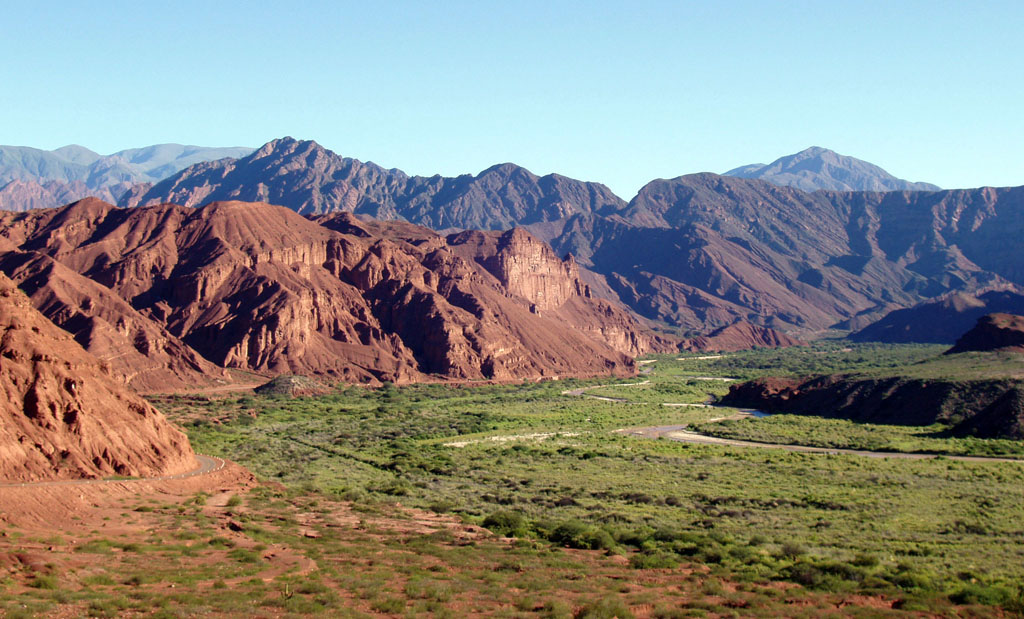
A valley is an elongated low area often running between hills or mountains and typically containing a river or stream running from one end to the other. Most valleys are formed by erosion of the land surface by rivers or streams over a very long period. Some valleys are formed through erosion by glacial ice. These glaciers may remain present in valleys in high mountains or polar areas.
At lower latitudes and altitudes, these glacially formed valleys may have been created or enlarged during ice ages but now are ice-free and occupied by streams or rivers. In desert areas, valleys may be entirely dry or carry a watercourse only rarely. In areas of limestone bedrock, dry valleys may also result from drainage now taking place underground rather than at the surface. Rift valleys arise principally from earth movements, rather than erosion. Many different types of valleys are described by geographers, using terms that may be global in use or else applied only locally.
Valleys may arise through several different processes. Most commonly, they arise from erosion over long periods by moving water and are known as river valleys. Typically small valleys containing streams feed into larger valleys which in turn feed into larger valleys again, eventually reaching the ocean or perhaps an internal drainage basin. In polar areas and at high altitudes, valleys may be eroded by glaciers; these typically have a U-shaped profile in cross-section, in contrast to river valleys, which tend to have a V-shaped profile. Other valleys may arise principally through tectonic processes such as rifting. All three processes can contribute to the development of a valley over geological time. The flat (or relatively flat) portion of a valley between its sides is referred to as the valley floor. The valley floor is typically formed by river sediments and may have fluvial terraces.
The development of a river valley is affected by the character of the bedrock over which the river or stream flows, the elevational difference between its top and bottom, and indeed the climate. Typically the flow will increase downstream and the gradient will decrease. In the upper valley, the stream will most effectively erode its bed through corrasion to produce a steep-sided V-shaped valley. The presence of more resistant rock bands, of geological faults, fractures, and folds may determine the course of the stream and result in a twisting course with interlocking spurs.
In the middle valley, as numerous streams have coalesced, the valley is typically wider, the flow slower and both erosion and deposition may take place. More lateral erosion takes place in the middle section of a river's course, as strong currents on the outside of its curve erode the bank. Conversely, deposition may take place on the inside of curves where the current is much slacker, the process leading to the river assuming a meandering character. In the lower valley, gradients are lowest, meanders may be much broader and a broader floodplain may result. Deposition dominates over erosion. A typical river basin or drainage basin will incorporate each of these different types of valleys.
Some sections of a stream or river valleys may have vertically incised their course to such an extent that the valley they occupy is best described as a gorge, ravine, or canyon. Rapid down-cutting may result from localized uplift of the land surface or rejuvenation of the watercourse as a result for example of a reduction in the base level to which the river is eroded, e.g. lowered global sea level during an ice age. Such rejuvenation may also result in the production of river terraces.
There are various forms of valleys associated with glaciation. True glacial valleys are those that have been cut by a glacier which may or may not still occupy the valley at the present day. Such valleys may also be known as glacial troughs. They typically have a U-shaped cross-section and are characteristic landforms of mountain areas where glaciation has occurred or continues to take place.
The uppermost part of a glacial valley frequently consists of one or more 'armchair-shaped' hollows, or 'cirques', excavated by the rotational movement downslope of a cirque glacier. During glacial periods, for example, the Pleistocene ice ages, it is in these locations that glaciers initially form and then, as the ice age proceeds, extend downhill through valleys that have previously been shaped by water rather than ice. Abrasion by rock material embedded within the moving glacial ice causes the widening and deepening of the valley to produce the characteristic U or trough shape with relatively steep, even vertical sides and a relatively flat bottom.
Hub AI
Valley AI simulator
(@Valley_simulator)
Valley
A valley is an elongated low area often running between hills or mountains and typically containing a river or stream running from one end to the other. Most valleys are formed by erosion of the land surface by rivers or streams over a very long period. Some valleys are formed through erosion by glacial ice. These glaciers may remain present in valleys in high mountains or polar areas.
At lower latitudes and altitudes, these glacially formed valleys may have been created or enlarged during ice ages but now are ice-free and occupied by streams or rivers. In desert areas, valleys may be entirely dry or carry a watercourse only rarely. In areas of limestone bedrock, dry valleys may also result from drainage now taking place underground rather than at the surface. Rift valleys arise principally from earth movements, rather than erosion. Many different types of valleys are described by geographers, using terms that may be global in use or else applied only locally.
Valleys may arise through several different processes. Most commonly, they arise from erosion over long periods by moving water and are known as river valleys. Typically small valleys containing streams feed into larger valleys which in turn feed into larger valleys again, eventually reaching the ocean or perhaps an internal drainage basin. In polar areas and at high altitudes, valleys may be eroded by glaciers; these typically have a U-shaped profile in cross-section, in contrast to river valleys, which tend to have a V-shaped profile. Other valleys may arise principally through tectonic processes such as rifting. All three processes can contribute to the development of a valley over geological time. The flat (or relatively flat) portion of a valley between its sides is referred to as the valley floor. The valley floor is typically formed by river sediments and may have fluvial terraces.
The development of a river valley is affected by the character of the bedrock over which the river or stream flows, the elevational difference between its top and bottom, and indeed the climate. Typically the flow will increase downstream and the gradient will decrease. In the upper valley, the stream will most effectively erode its bed through corrasion to produce a steep-sided V-shaped valley. The presence of more resistant rock bands, of geological faults, fractures, and folds may determine the course of the stream and result in a twisting course with interlocking spurs.
In the middle valley, as numerous streams have coalesced, the valley is typically wider, the flow slower and both erosion and deposition may take place. More lateral erosion takes place in the middle section of a river's course, as strong currents on the outside of its curve erode the bank. Conversely, deposition may take place on the inside of curves where the current is much slacker, the process leading to the river assuming a meandering character. In the lower valley, gradients are lowest, meanders may be much broader and a broader floodplain may result. Deposition dominates over erosion. A typical river basin or drainage basin will incorporate each of these different types of valleys.
Some sections of a stream or river valleys may have vertically incised their course to such an extent that the valley they occupy is best described as a gorge, ravine, or canyon. Rapid down-cutting may result from localized uplift of the land surface or rejuvenation of the watercourse as a result for example of a reduction in the base level to which the river is eroded, e.g. lowered global sea level during an ice age. Such rejuvenation may also result in the production of river terraces.
There are various forms of valleys associated with glaciation. True glacial valleys are those that have been cut by a glacier which may or may not still occupy the valley at the present day. Such valleys may also be known as glacial troughs. They typically have a U-shaped cross-section and are characteristic landforms of mountain areas where glaciation has occurred or continues to take place.
The uppermost part of a glacial valley frequently consists of one or more 'armchair-shaped' hollows, or 'cirques', excavated by the rotational movement downslope of a cirque glacier. During glacial periods, for example, the Pleistocene ice ages, it is in these locations that glaciers initially form and then, as the ice age proceeds, extend downhill through valleys that have previously been shaped by water rather than ice. Abrasion by rock material embedded within the moving glacial ice causes the widening and deepening of the valley to produce the characteristic U or trough shape with relatively steep, even vertical sides and a relatively flat bottom.