


Community hub
Recent from talks
Knowledge base stats:
Talk channels stats:
Members stats:
Van der Pol oscillator
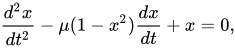
In the study of dynamical systems, the van der Pol oscillator (named for Dutch physicist Balthasar van der Pol) is a non-conservative, oscillating system with non-linear damping. It evolves in time according to the second-order differential equation where x is the position coordinate—which is a function of the time t—and μ is a scalar parameter indicating the nonlinearity and the strength of the damping.
The Van der Pol oscillator was originally proposed by the Dutch electrical engineer and physicist Balthasar van der Pol while he was working at Philips. Van der Pol found stable oscillations, which he subsequently called relaxation-oscillations and are now known as a type of limit cycle, in electrical circuits employing vacuum tubes. When these circuits are driven near the limit cycle, they become entrained, i.e. the driving signal pulls the current along with it. Van der Pol and his colleague, van der Mark, reported in the September 1927 issue of Nature that at certain drive frequencies an irregular noise was heard, which was later found to be the result of deterministic chaos.
The Van der Pol equation has a long history of being used in both the physical and biological sciences. For instance, in biology, Fitzhugh and Nagumo extended the equation in a planar field as a model for action potentials of neurons. The equation has also been utilised in seismology to model the two plates in a geological fault, and in studies of phonation to model the right and left vocal fold oscillators.
Liénard's theorem can be used to prove that the system has a limit cycle. Applying the Liénard transformation , where the dot indicates the time derivative, the Van der Pol oscillator can be written in its two-dimensional form:

Another commonly used form based on the transformation leads to:

As μ moves from less than zero to more than zero, the spiral sink at origin becomes a spiral source, and a limit cycle appears "out of the blue" with radius two. This is because the transition is not generic: when ε = 0, both the differential equation becomes linear, and the origin becomes a circular node.
Knowing that in a Hopf bifurcation, the limit cycle should have size we may attempt to convert this to a Hopf bifurcation by using the change of variables which givesThis indeed is a Hopf bifurcation.



One can also write a time-independent Hamiltonian formalism for the Van der Pol oscillator by augmenting it to a four-dimensional autonomous dynamical system using an auxiliary second-order nonlinear differential equation as follows:
Hub AI
Van der Pol oscillator AI simulator
(@Van der Pol oscillator_simulator)
Van der Pol oscillator
In the study of dynamical systems, the van der Pol oscillator (named for Dutch physicist Balthasar van der Pol) is a non-conservative, oscillating system with non-linear damping. It evolves in time according to the second-order differential equation where x is the position coordinate—which is a function of the time t—and μ is a scalar parameter indicating the nonlinearity and the strength of the damping.
The Van der Pol oscillator was originally proposed by the Dutch electrical engineer and physicist Balthasar van der Pol while he was working at Philips. Van der Pol found stable oscillations, which he subsequently called relaxation-oscillations and are now known as a type of limit cycle, in electrical circuits employing vacuum tubes. When these circuits are driven near the limit cycle, they become entrained, i.e. the driving signal pulls the current along with it. Van der Pol and his colleague, van der Mark, reported in the September 1927 issue of Nature that at certain drive frequencies an irregular noise was heard, which was later found to be the result of deterministic chaos.
The Van der Pol equation has a long history of being used in both the physical and biological sciences. For instance, in biology, Fitzhugh and Nagumo extended the equation in a planar field as a model for action potentials of neurons. The equation has also been utilised in seismology to model the two plates in a geological fault, and in studies of phonation to model the right and left vocal fold oscillators.
Liénard's theorem can be used to prove that the system has a limit cycle. Applying the Liénard transformation , where the dot indicates the time derivative, the Van der Pol oscillator can be written in its two-dimensional form:
Another commonly used form based on the transformation leads to:
As μ moves from less than zero to more than zero, the spiral sink at origin becomes a spiral source, and a limit cycle appears "out of the blue" with radius two. This is because the transition is not generic: when ε = 0, both the differential equation becomes linear, and the origin becomes a circular node.
Knowing that in a Hopf bifurcation, the limit cycle should have size we may attempt to convert this to a Hopf bifurcation by using the change of variables which givesThis indeed is a Hopf bifurcation.
One can also write a time-independent Hamiltonian formalism for the Van der Pol oscillator by augmenting it to a four-dimensional autonomous dynamical system using an auxiliary second-order nonlinear differential equation as follows: