



Community hub
Recent from talks
Contribute something to knowledge base
Content stats: 0 posts, 0 articles, 0 media, 0 notes
Members stats: 0 subscribers, 0 contributors, 0 moderators, 0 supporters
Subscribers
Supporters
Contributors
Moderators
Hub AI
Variational method (quantum mechanics) AI simulator
(@Variational method (quantum mechanics)_simulator)
Hub AI
Variational method (quantum mechanics) AI simulator
(@Variational method (quantum mechanics)_simulator)
Variational method (quantum mechanics)
In quantum mechanics, the variational method is one way of finding approximations to the lowest energy eigenstate or ground state, and some excited states. This allows calculating approximate wavefunctions such as molecular orbitals. The basis for this method is the variational principle.
The method consists of choosing a "trial wavefunction" depending on one or more parameters, and finding the values of these parameters for which the expectation value of the energy is the lowest possible. The wavefunction obtained by fixing the parameters to such values is then an approximation to the ground state wavefunction, and the expectation value of the energy in that state is an upper bound to the ground state energy. The Hartree–Fock method, density matrix renormalization group, and Ritz method apply the variational method.
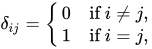
Suppose we are given a Hilbert space and a Hermitian operator over it called the Hamiltonian . Ignoring complications about continuous spectra, we consider the discrete spectrum of and a basis of eigenvectors (see spectral theorem for Hermitian operators for the mathematical background): where is the Kronecker delta and the satisfy the eigenvalue equation





Once again ignoring complications involved with a continuous spectrum of , suppose the spectrum of is bounded from below and that its greatest lower bound is E0. The expectation value of in a state is then


If we were to vary over all possible states with norm 1 trying to minimize the expectation value of , the lowest value would be and the corresponding state would be the ground state, as well as an eigenstate of . Varying over the entire Hilbert space is usually too complicated for physical calculations, and a subspace of the entire Hilbert space is chosen, parametrized by some (real) differentiable parameters (i = 1, 2, ..., N)}}. The choice of the subspace is called the ansatz. Some choices of ansatzes lead to better approximations than others, therefore the choice of ansatz is important.


Let's assume there is some overlap between the ansatz and the ground state (otherwise, it's a bad ansatz). We wish to normalize the ansatz, so we have the constraints and we wish to minimize


This, in general, is not an easy task, since we are looking for a global minimum and finding the zeroes of the partial derivatives of over all is not sufficient. If is expressed as a linear combination of other functions ( being the coefficients), as in the Ritz method, there is only one minimum and the problem is straightforward. There are other, non-linear methods, however, such as the Hartree–Fock method, that are also not characterized by a multitude of minima and are therefore comfortable in calculations.


Although usually limited to calculations of the ground state energy, this method can be applied in certain cases to calculations of excited states as well. If the ground state wavefunction is known, either by the method of variation or by direct calculation, a subset of the Hilbert space can be chosen which is orthogonal to the ground state wavefunction.
Variational method (quantum mechanics)
In quantum mechanics, the variational method is one way of finding approximations to the lowest energy eigenstate or ground state, and some excited states. This allows calculating approximate wavefunctions such as molecular orbitals. The basis for this method is the variational principle.
The method consists of choosing a "trial wavefunction" depending on one or more parameters, and finding the values of these parameters for which the expectation value of the energy is the lowest possible. The wavefunction obtained by fixing the parameters to such values is then an approximation to the ground state wavefunction, and the expectation value of the energy in that state is an upper bound to the ground state energy. The Hartree–Fock method, density matrix renormalization group, and Ritz method apply the variational method.
Suppose we are given a Hilbert space and a Hermitian operator over it called the Hamiltonian . Ignoring complications about continuous spectra, we consider the discrete spectrum of and a basis of eigenvectors (see spectral theorem for Hermitian operators for the mathematical background): where is the Kronecker delta and the satisfy the eigenvalue equation
Once again ignoring complications involved with a continuous spectrum of , suppose the spectrum of is bounded from below and that its greatest lower bound is E0. The expectation value of in a state is then
If we were to vary over all possible states with norm 1 trying to minimize the expectation value of , the lowest value would be and the corresponding state would be the ground state, as well as an eigenstate of . Varying over the entire Hilbert space is usually too complicated for physical calculations, and a subspace of the entire Hilbert space is chosen, parametrized by some (real) differentiable parameters (i = 1, 2, ..., N)}}. The choice of the subspace is called the ansatz. Some choices of ansatzes lead to better approximations than others, therefore the choice of ansatz is important.
Let's assume there is some overlap between the ansatz and the ground state (otherwise, it's a bad ansatz). We wish to normalize the ansatz, so we have the constraints and we wish to minimize
This, in general, is not an easy task, since we are looking for a global minimum and finding the zeroes of the partial derivatives of over all is not sufficient. If is expressed as a linear combination of other functions ( being the coefficients), as in the Ritz method, there is only one minimum and the problem is straightforward. There are other, non-linear methods, however, such as the Hartree–Fock method, that are also not characterized by a multitude of minima and are therefore comfortable in calculations.
Although usually limited to calculations of the ground state energy, this method can be applied in certain cases to calculations of excited states as well. If the ground state wavefunction is known, either by the method of variation or by direct calculation, a subset of the Hilbert space can be chosen which is orthogonal to the ground state wavefunction.