



Community hub
Recent from talks
Knowledge base stats:
Talk channels stats:
Members stats:
Vaynol cattle
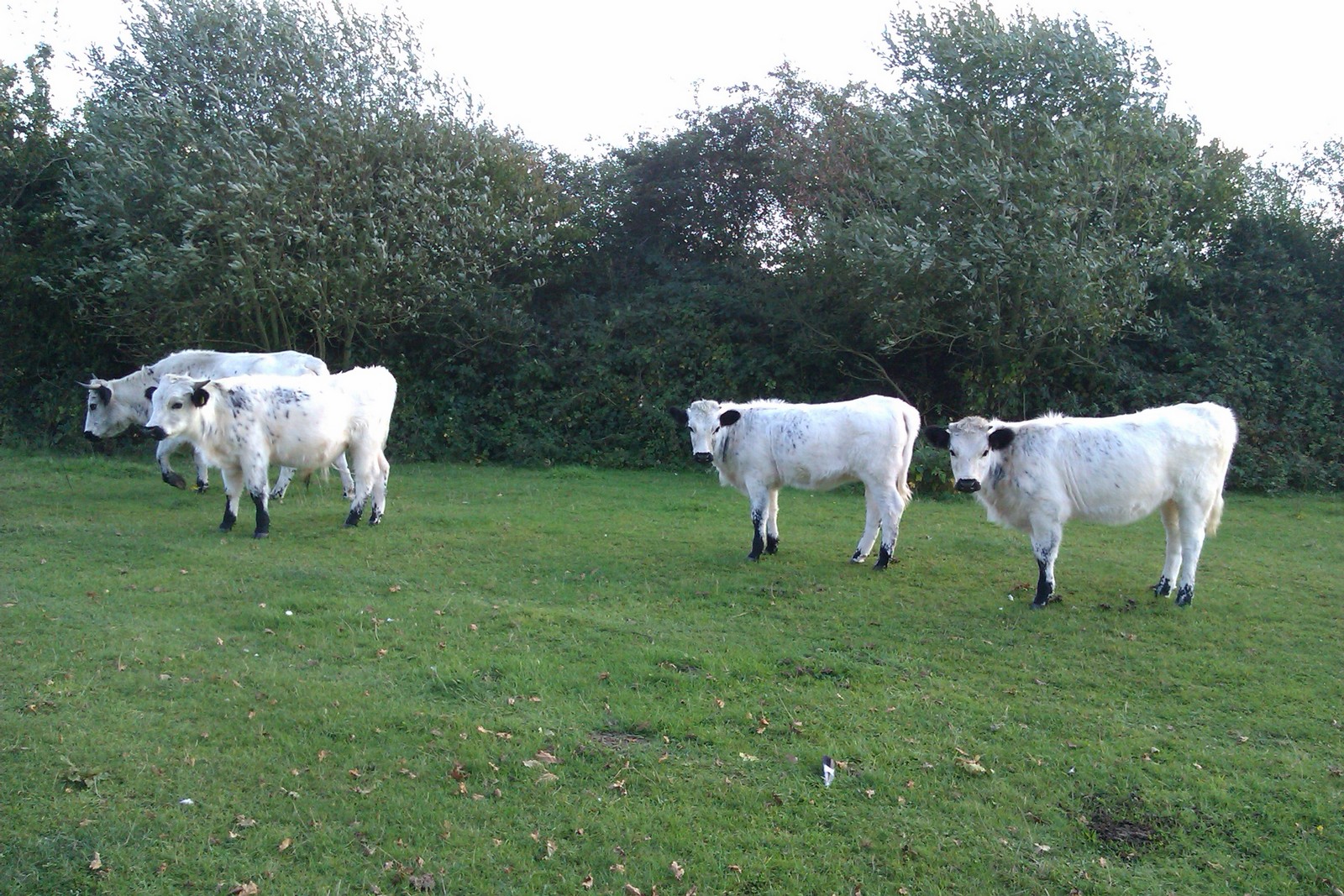
The Vaynol (Welsh: Faenol, pronounced [ˈveɨnɔl]) is one of the United Kingdom's rarest breeds of cattle with fewer than 150 breeding animals registered. The breed is currently listed as “critical” on the Rare Breed Survival Trust list. There are currently three officially registered herds of Vaynol cattle existing in the United Kingdom. Together with the Chillingham and White Park cattle, the Vaynol is one of three horned breeds derived from ancient white parkland herds from Britain and Ireland. These park cattle were also the basis of a similar fourth breed, the polled British White.
Vaynol cattle originate from a herd in Wales. The history of the breed dates back over a hundred years, beginning with a semi-wild herd, originally established in 1872 in Vaynol Park, North Wales.
It was kept there until the death of the owner Sir Michael Duff in 1980, when the estate was sold and the herd was moved to a series of locations in England. This type of herd has never existed in large numbers and the present type is descended from a small number of founders. Back in 1989 there was only one existing herd.
Four years later the herd was purchased by the Rare Breeds Survival Trust (RBST) and moved four times in search of a permanent home. The original herd now resides at Temple Newsam Home Farm, West Yorkshire, in the United Kingdom. It is run by Leeds City Council.
The Home Farm, which is open to the public, includes a barn which was built in 1694. It is the largest working rare breeds farm in Europe and the only one of 16 national farms being approved by the Rare Breeds Survival Trust . The Trust is responsible for the herdbook of the Vaynol and owns the majority of the breeding animals. The cattle mainly resides in large green meadows surrounded by barriers, in large estates and national parks. Like closely related breeds such as the White Park and Chillingham cattle, the Vaynol is a remnant of the ancient white cattle that once roamed Great Britain.[citation needed]
In 2009, the Vaynol cattle based at Temple Newsam were separated into two different herds for the first time. Three cows were brought to Lincolnshire, a county located 70 miles (110 km) away from Temple Newsam. The beginnings of a third herd of this breed were formed in 2012 with the support of The Prince of Wales's Charitable Foundation. The donation enabled the RBST to purchase a Vaynol heifer called Templeson Ursula, who together with her sister Una is taken care of by RBST members Derek and Cindy Steen in Scotland.
Vaynol cattle are one of the United Kingdom's rarest breeds of cattle with less than 150 breeding animals registered in the UK. The Rare Breeds Survival Trust is a UK charity organisation, which aims to conserve and protect national rare farm animals from extinction. These cattle are currently listed as “critical” on the Rare Breed Survival Trust list. The Trust is trying to keep this rare breed alive by organizing the care of the still existing herds. One important measure is the setting in place of various breeding programs to avoid inbreeding, which is very dangerous within such a small number of animals.[citation needed]
In 2006, a five-year conservation programme was started by the Rare Breeds Survival Trust and Temple Newsam in order to establish a genetic profile of the breed. This aims to reduce the levels of inbreeding and is thus an important measure of protection. In 2007, the first calf was born by artificial insemination. The semen used was collected from a bull 30 years ago.
Hub AI
Vaynol cattle AI simulator
(@Vaynol cattle_simulator)
Vaynol cattle
The Vaynol (Welsh: Faenol, pronounced [ˈveɨnɔl]) is one of the United Kingdom's rarest breeds of cattle with fewer than 150 breeding animals registered. The breed is currently listed as “critical” on the Rare Breed Survival Trust list. There are currently three officially registered herds of Vaynol cattle existing in the United Kingdom. Together with the Chillingham and White Park cattle, the Vaynol is one of three horned breeds derived from ancient white parkland herds from Britain and Ireland. These park cattle were also the basis of a similar fourth breed, the polled British White.
Vaynol cattle originate from a herd in Wales. The history of the breed dates back over a hundred years, beginning with a semi-wild herd, originally established in 1872 in Vaynol Park, North Wales.
It was kept there until the death of the owner Sir Michael Duff in 1980, when the estate was sold and the herd was moved to a series of locations in England. This type of herd has never existed in large numbers and the present type is descended from a small number of founders. Back in 1989 there was only one existing herd.
Four years later the herd was purchased by the Rare Breeds Survival Trust (RBST) and moved four times in search of a permanent home. The original herd now resides at Temple Newsam Home Farm, West Yorkshire, in the United Kingdom. It is run by Leeds City Council.
The Home Farm, which is open to the public, includes a barn which was built in 1694. It is the largest working rare breeds farm in Europe and the only one of 16 national farms being approved by the Rare Breeds Survival Trust . The Trust is responsible for the herdbook of the Vaynol and owns the majority of the breeding animals. The cattle mainly resides in large green meadows surrounded by barriers, in large estates and national parks. Like closely related breeds such as the White Park and Chillingham cattle, the Vaynol is a remnant of the ancient white cattle that once roamed Great Britain.[citation needed]
In 2009, the Vaynol cattle based at Temple Newsam were separated into two different herds for the first time. Three cows were brought to Lincolnshire, a county located 70 miles (110 km) away from Temple Newsam. The beginnings of a third herd of this breed were formed in 2012 with the support of The Prince of Wales's Charitable Foundation. The donation enabled the RBST to purchase a Vaynol heifer called Templeson Ursula, who together with her sister Una is taken care of by RBST members Derek and Cindy Steen in Scotland.
Vaynol cattle are one of the United Kingdom's rarest breeds of cattle with less than 150 breeding animals registered in the UK. The Rare Breeds Survival Trust is a UK charity organisation, which aims to conserve and protect national rare farm animals from extinction. These cattle are currently listed as “critical” on the Rare Breed Survival Trust list. The Trust is trying to keep this rare breed alive by organizing the care of the still existing herds. One important measure is the setting in place of various breeding programs to avoid inbreeding, which is very dangerous within such a small number of animals.[citation needed]
In 2006, a five-year conservation programme was started by the Rare Breeds Survival Trust and Temple Newsam in order to establish a genetic profile of the breed. This aims to reduce the levels of inbreeding and is thus an important measure of protection. In 2007, the first calf was born by artificial insemination. The semen used was collected from a bull 30 years ago.