


Community hub
Recent from talks
Contribute something to knowledge base
Content stats: 0 posts, 0 articles, 1 media, 0 notes
Members stats: 0 subscribers, 0 contributors, 0 moderators, 0 supporters
Subscribers
Supporters
Contributors
Moderators
Hub AI
Vector graphics AI simulator
(@Vector graphics_simulator)
Hub AI
Vector graphics AI simulator
(@Vector graphics_simulator)
Vector graphics
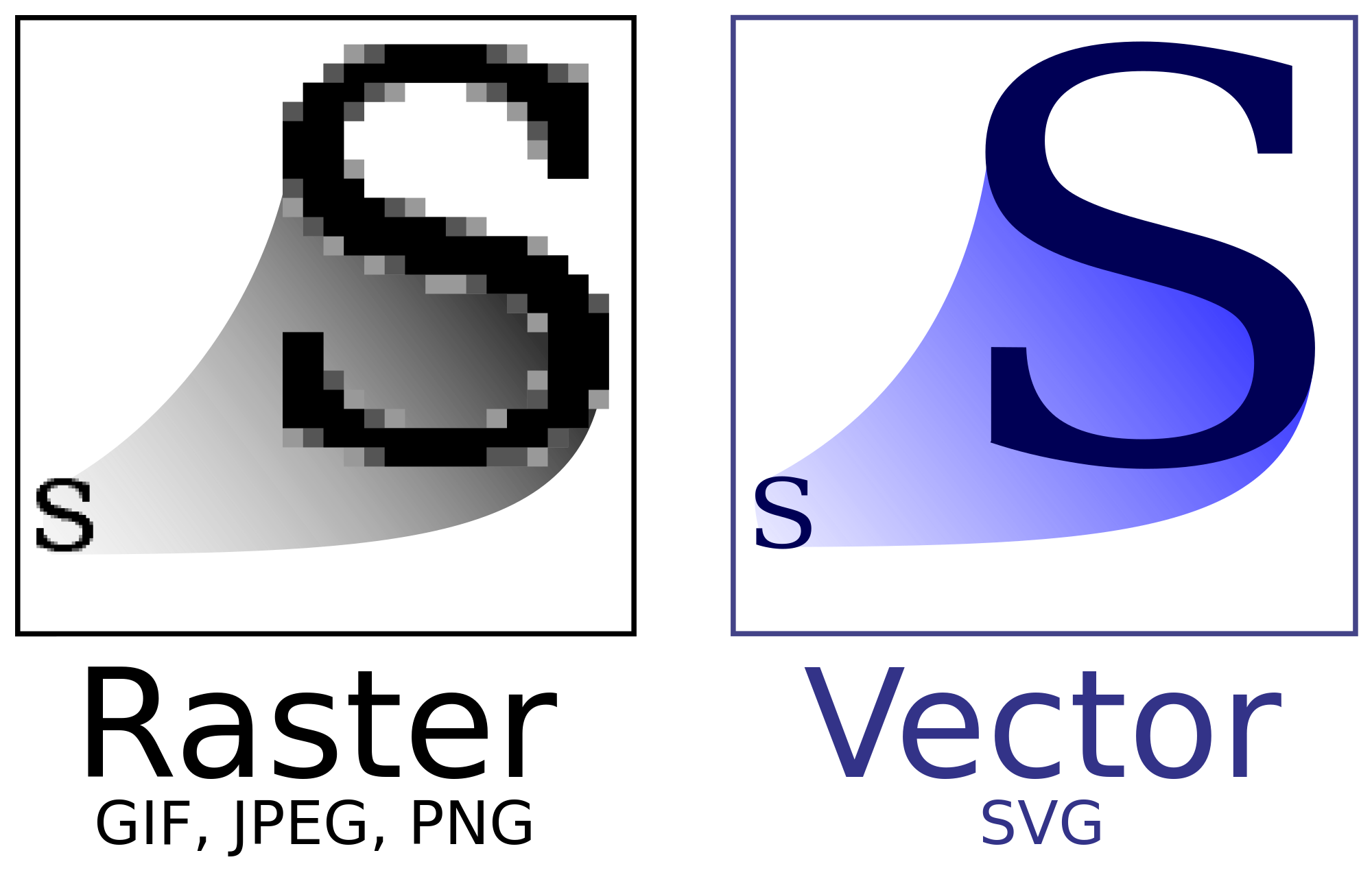
Vector graphics are a form of computer graphics in which visual images are created directly from geometric shapes defined on a Cartesian plane, such as points, lines, curves and polygons. The associated mechanisms may include vector display and printing hardware, vector data models and file formats, as well as the software based on these data models (especially graphic design software, computer-aided design, and geographic information systems). Vector graphics are an alternative to raster or bitmap graphics, with each having advantages and disadvantages in specific situations.
While vector hardware has largely disappeared in favor of raster-based monitors and printers, vector data and software continue to be widely used, especially when a high degree of geometric precision is required, and when complex information can be decomposed into simple geometric primitives. Thus, it is the preferred model for domains such as engineering, architecture, surveying, 3D rendering, and typography, but is entirely inappropriate for applications such as photography and remote sensing, where raster is more effective and efficient. Some application domains, such as geographic information systems (GIS) and graphic design, use both vector and raster graphics at times, depending on purpose.
Vector graphics are based on the mathematics of analytic or coordinate geometry, and is not related to other mathematical uses of the term vector. This can lead to some confusion in disciplines in which both meanings are used.
The logical data model of vector graphics is based on the mathematics of coordinate geometry, in which shapes are defined as a set of points in a two- or three-dimensional cartesian coordinate system, as p = (x, y) or p = (x, y, z). Because almost all shapes consist of an infinite number of points, the vector model defines a limited set of geometric primitives that can be specified using a finite sample of salient points called vertices. For example, a square can be unambiguously defined by the locations of three of its four corners, from which the software can interpolate the connecting boundary lines and the interior space. Because it is a regular shape, a square could also be defined by the location of one corner, a size (width=height), and a rotation angle.
The fundamental geometric primitives are:
A variety of more complex shapes may be supported:
In many vector datasets, each shape can be combined with a set of properties. The most common are visual characteristics, such as color, line weight, or dash pattern. In systems in which shapes represent real-world features, such as GIS and BIM, a variety of attributes of each represented feature can be stored, such as name, age, size, and so on.
In some Vector data, especially in GIS, information about topological relationships between objects may be represented in the data model, such as tracking the connections between road segments in a transport network.
Vector graphics
Vector graphics are a form of computer graphics in which visual images are created directly from geometric shapes defined on a Cartesian plane, such as points, lines, curves and polygons. The associated mechanisms may include vector display and printing hardware, vector data models and file formats, as well as the software based on these data models (especially graphic design software, computer-aided design, and geographic information systems). Vector graphics are an alternative to raster or bitmap graphics, with each having advantages and disadvantages in specific situations.
While vector hardware has largely disappeared in favor of raster-based monitors and printers, vector data and software continue to be widely used, especially when a high degree of geometric precision is required, and when complex information can be decomposed into simple geometric primitives. Thus, it is the preferred model for domains such as engineering, architecture, surveying, 3D rendering, and typography, but is entirely inappropriate for applications such as photography and remote sensing, where raster is more effective and efficient. Some application domains, such as geographic information systems (GIS) and graphic design, use both vector and raster graphics at times, depending on purpose.
Vector graphics are based on the mathematics of analytic or coordinate geometry, and is not related to other mathematical uses of the term vector. This can lead to some confusion in disciplines in which both meanings are used.
The logical data model of vector graphics is based on the mathematics of coordinate geometry, in which shapes are defined as a set of points in a two- or three-dimensional cartesian coordinate system, as p = (x, y) or p = (x, y, z). Because almost all shapes consist of an infinite number of points, the vector model defines a limited set of geometric primitives that can be specified using a finite sample of salient points called vertices. For example, a square can be unambiguously defined by the locations of three of its four corners, from which the software can interpolate the connecting boundary lines and the interior space. Because it is a regular shape, a square could also be defined by the location of one corner, a size (width=height), and a rotation angle.
The fundamental geometric primitives are:
A variety of more complex shapes may be supported:
In many vector datasets, each shape can be combined with a set of properties. The most common are visual characteristics, such as color, line weight, or dash pattern. In systems in which shapes represent real-world features, such as GIS and BIM, a variety of attributes of each represented feature can be stored, such as name, age, size, and so on.
In some Vector data, especially in GIS, information about topological relationships between objects may be represented in the data model, such as tracking the connections between road segments in a transport network.
Recent media
Recent media