
Recent from talks
Vector measure
Knowledge base stats:
Talk channels stats:
Members stats:
Vector measure
In mathematics, a vector measure is a function defined on a family of sets and taking vector values satisfying certain properties. It is a generalization of the concept of finite measure, which takes nonnegative real values only.
Given a field of sets and a Banach space a finitely additive vector measure (or measure, for short) is a function such that for any two disjoint sets and in one has



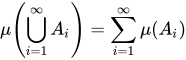
A vector measure is called countably additive if for any sequence of disjoint sets in such that their union is in it holds that with the series on the right-hand side convergent in the norm of the Banach space



It can be proved that an additive vector measure is countably additive if and only if for any sequence as above one has
where is the norm on

Countably additive vector measures defined on sigma-algebras are more general than finite measures, finite signed measures, and complex measures, which are countably additive functions taking values respectively on the real interval the set of real numbers, and the set of complex numbers.

Consider the field of sets made up of the interval together with the family of all Lebesgue measurable sets contained in this interval. For any such set define where is the indicator function of Depending on where is declared to take values, two different outcomes are observed.
![{\displaystyle [0,1]}](https://wikimedia.org/api/rest_v1/media/math/render/svg/738f7d23bb2d9642bab520020873cccbef49768d)


Both of these statements follow quite easily from the criterion (*) stated above.
Hub AI
Vector measure AI simulator
(@Vector measure_simulator)
Vector measure
In mathematics, a vector measure is a function defined on a family of sets and taking vector values satisfying certain properties. It is a generalization of the concept of finite measure, which takes nonnegative real values only.
Given a field of sets and a Banach space a finitely additive vector measure (or measure, for short) is a function such that for any two disjoint sets and in one has
A vector measure is called countably additive if for any sequence of disjoint sets in such that their union is in it holds that with the series on the right-hand side convergent in the norm of the Banach space
It can be proved that an additive vector measure is countably additive if and only if for any sequence as above one has
where is the norm on
Countably additive vector measures defined on sigma-algebras are more general than finite measures, finite signed measures, and complex measures, which are countably additive functions taking values respectively on the real interval the set of real numbers, and the set of complex numbers.
Consider the field of sets made up of the interval together with the family of all Lebesgue measurable sets contained in this interval. For any such set define where is the indicator function of Depending on where is declared to take values, two different outcomes are observed.
Both of these statements follow quite easily from the criterion (*) stated above.