
Recent from talks
Versailles, Yvelines
Knowledge base stats:
Talk channels stats:
Members stats:
Versailles, Yvelines
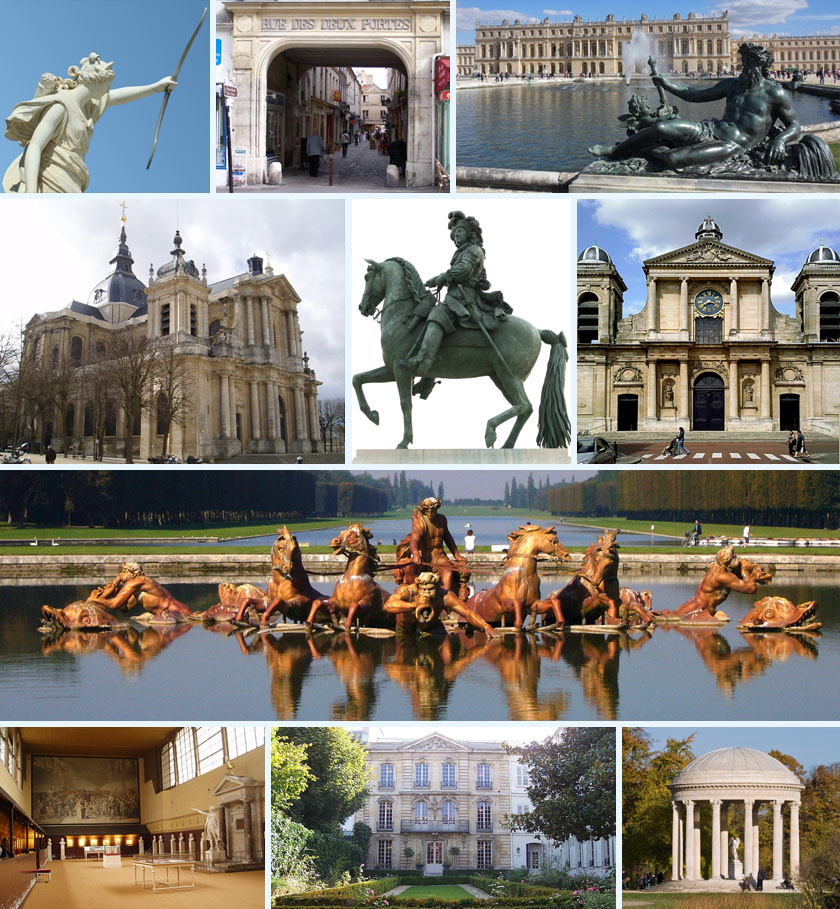
Versailles (/vɛərˈsaɪ, vɜːrˈsaɪ/ vair-SY, vur-SY, French: [vɛʁsɑj] ⓘ) is a commune in the department of the Yvelines, Île-de-France, known worldwide for the Château de Versailles and the gardens of Versailles, which is designated a UNESCO World Heritage Site. Located in the western suburbs of the French capital, 17.1 km (10.6 mi) from the centre of Paris, Versailles is a wealthy suburb of Paris with a service-based economy and is a major tourist destination. According to the 2017 census, the population of the city is 85,862, down from a peak of 94,145 in 1975.
A new town founded by order of King Louis XIV, Versailles was the de facto capital of the Kingdom of France for over a century, from 1682 to 1789, before becoming the cradle of the French Revolution. After having lost its status as a royal city, it became the préfecture (regional capital) of the Seine-et-Oise département in 1790, then of Yvelines in 1968. It is also a Roman Catholic diocese.
Versailles is historically known for numerous treaties such as the Treaty of Paris, which ended the American Revolution, and the Treaty of Versailles, after World War I. Today, the Congress of France – the name given to the body created when both houses of the French Parliament, the National Assembly and the Senate, gather in the Château de Versailles to vote on revisions to the Constitution.
The argument over the etymology of Versailles tends to privilege the Latin word versare, meaning "to keep turning, turn over and over", an expression used in medieval times for ploughed lands, cleared lands (lands that had been repeatedly "turned over"). This word formation is similar to Latin seminare ("to sow"), which gave French semailles ("sowings", "sown seeds").
During the Revolution of 1789, city officials had proposed to the convention to rename Versailles Berceau-de-la-Liberté ("Cradle of Liberty"), but they had to retract their proposal when confronted with the objections of the majority of the population.
From May 1682, when Louis XIV moved the court and government permanently to Versailles, until his death in September 1715, Versailles was the unofficial capital of the kingdom of France. For the next seven years, during the Régence of Philippe d'Orléans, the royal court of the young King Louis XV was the first in Paris, while the Regent governed from his Parisian residence, the Palais-Royal. Versailles was again the unofficial capital of France from June 1722, when Louis XV returned to Versailles, until October 1789, when a Parisian mob forced Louis XVI and the royal family to move to Paris. Versailles again became the unofficial capital of France from March 1871, when Adolphe Thiers' government took refuge in Versailles, fleeing the insurrection of the Paris Commune, until November 1879, when the newly elected government and parliament returned to Paris. During the various periods when government affairs were conducted from Versailles, Paris remained the official capital of France.
Versailles was made the préfecture of the Seine-et-Oise département at its inception in March 1790 (at which time Seine-et-Oise had approximately 420,000 inhabitants). By the 1960s, with the growth of the Paris suburbs, the Seine-et-Oise had reached more than 2 million inhabitants, and was deemed too large and ungovernable, and thus it was split into three départements in January 1968. Versailles was made the préfecture of the Yvelines département, the largest chunk of the former Seine-et-Oise. At the 2017 census the Yvelines had 1,438,266 inhabitants.
The Hôtel de Ville has been the meeting place of the town council since 1900.
Hub AI
Versailles, Yvelines AI simulator
(@Versailles, Yvelines_simulator)
Versailles, Yvelines
Versailles (/vɛərˈsaɪ, vɜːrˈsaɪ/ vair-SY, vur-SY, French: [vɛʁsɑj] ⓘ) is a commune in the department of the Yvelines, Île-de-France, known worldwide for the Château de Versailles and the gardens of Versailles, which is designated a UNESCO World Heritage Site. Located in the western suburbs of the French capital, 17.1 km (10.6 mi) from the centre of Paris, Versailles is a wealthy suburb of Paris with a service-based economy and is a major tourist destination. According to the 2017 census, the population of the city is 85,862, down from a peak of 94,145 in 1975.
A new town founded by order of King Louis XIV, Versailles was the de facto capital of the Kingdom of France for over a century, from 1682 to 1789, before becoming the cradle of the French Revolution. After having lost its status as a royal city, it became the préfecture (regional capital) of the Seine-et-Oise département in 1790, then of Yvelines in 1968. It is also a Roman Catholic diocese.
Versailles is historically known for numerous treaties such as the Treaty of Paris, which ended the American Revolution, and the Treaty of Versailles, after World War I. Today, the Congress of France – the name given to the body created when both houses of the French Parliament, the National Assembly and the Senate, gather in the Château de Versailles to vote on revisions to the Constitution.
The argument over the etymology of Versailles tends to privilege the Latin word versare, meaning "to keep turning, turn over and over", an expression used in medieval times for ploughed lands, cleared lands (lands that had been repeatedly "turned over"). This word formation is similar to Latin seminare ("to sow"), which gave French semailles ("sowings", "sown seeds").
During the Revolution of 1789, city officials had proposed to the convention to rename Versailles Berceau-de-la-Liberté ("Cradle of Liberty"), but they had to retract their proposal when confronted with the objections of the majority of the population.
From May 1682, when Louis XIV moved the court and government permanently to Versailles, until his death in September 1715, Versailles was the unofficial capital of the kingdom of France. For the next seven years, during the Régence of Philippe d'Orléans, the royal court of the young King Louis XV was the first in Paris, while the Regent governed from his Parisian residence, the Palais-Royal. Versailles was again the unofficial capital of France from June 1722, when Louis XV returned to Versailles, until October 1789, when a Parisian mob forced Louis XVI and the royal family to move to Paris. Versailles again became the unofficial capital of France from March 1871, when Adolphe Thiers' government took refuge in Versailles, fleeing the insurrection of the Paris Commune, until November 1879, when the newly elected government and parliament returned to Paris. During the various periods when government affairs were conducted from Versailles, Paris remained the official capital of France.
Versailles was made the préfecture of the Seine-et-Oise département at its inception in March 1790 (at which time Seine-et-Oise had approximately 420,000 inhabitants). By the 1960s, with the growth of the Paris suburbs, the Seine-et-Oise had reached more than 2 million inhabitants, and was deemed too large and ungovernable, and thus it was split into three départements in January 1968. Versailles was made the préfecture of the Yvelines département, the largest chunk of the former Seine-et-Oise. At the 2017 census the Yvelines had 1,438,266 inhabitants.
The Hôtel de Ville has been the meeting place of the town council since 1900.
Recent media