Hubbry Logo
Paris CommuneParis CommuneMain
Open search
Paris Commune
Community hub
Paris Commune
logo
8 pages, 0 posts
0 subscribers
Be the first to start a discussion here.
Contribute something
Paris Commune
Paris Commune
from Wikipedia

Paris Commune
Part of the aftermath of the siege of Paris in the Franco-Prussian War

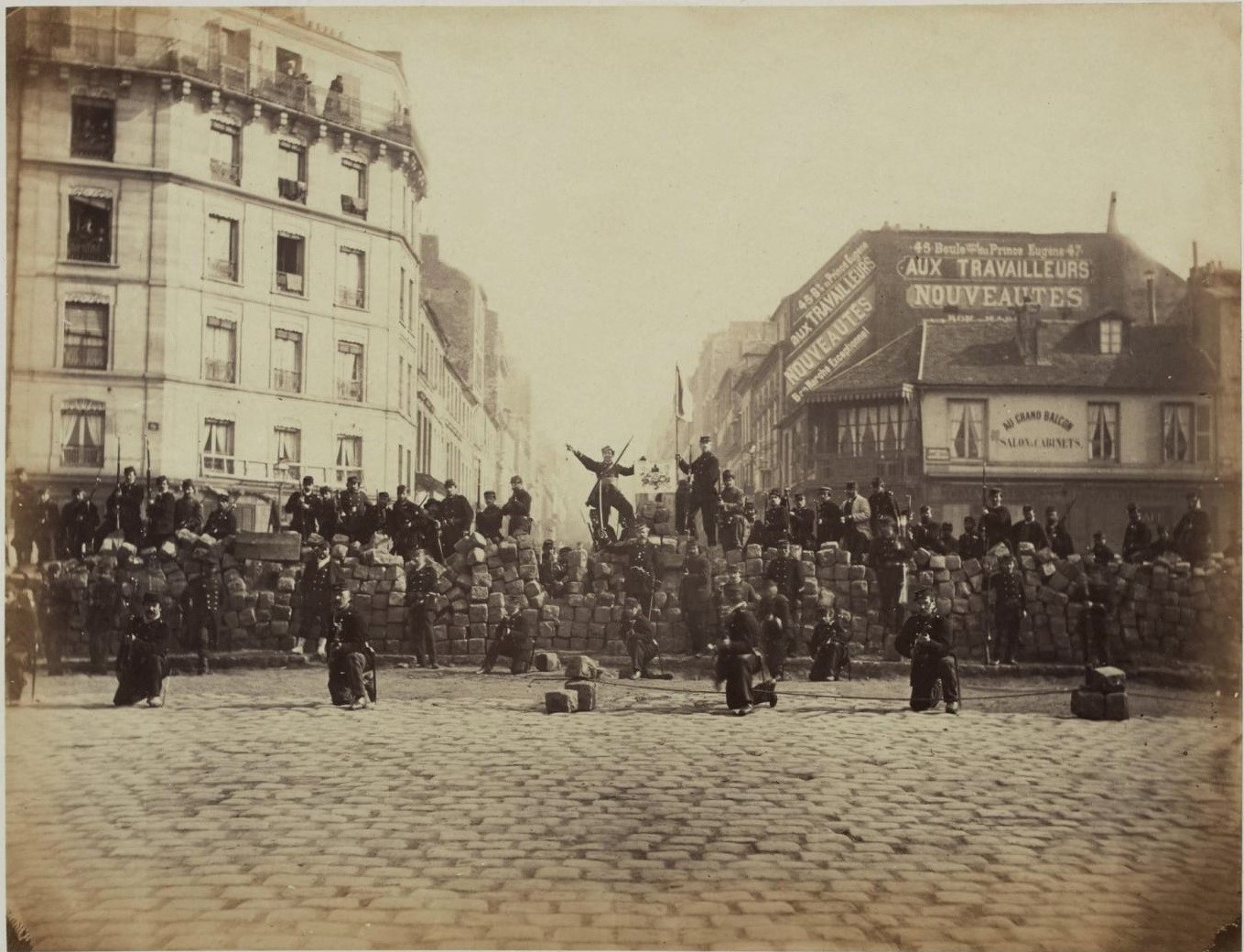
A barricade thrown up by Communard National Guard on 18 March 1871.
Date18 March – 28 May 1871
(2 months, 1 week and 3 days)
Location48°51′24″N 2°21′8″E / 48.85667°N 2.35222°E / 48.85667; 2.35222
Result

Revolt suppressed

  • Disbanding of the second National Guard by the French government
Belligerents

France French Republic

Communards
National Guard
Commanders and leaders
Strength
170,000[1] 25,000–50,000[2]
Casualties and losses
987–1,162 killed
6,580–6,755 wounded
183 missing[3]
6,667[4]—20,000 killed[5][6][7]
43,000 captured
6,500-7,500 fled abroad[8]
Map

The Paris Commune (French: Commune de Paris, pronounced [kɔ.myn pa.ʁi]) was a French revolutionary government that seized power in Paris on 18 March 1871 and controlled parts of the city until 28 May 1871. During the Franco-Prussian War of 1870–71, the French National Guard had defended Paris, and working class radicalism grew among its soldiers. Following the establishment of the French Third Republic in September 1870 (under French chief-executive Adolphe Thiers from February 1871) and the complete defeat of the French Army by the Germans by March 1871, soldiers of the National Guard seized control of the city on 18 March. The Communards killed two French Army generals and refused to accept the authority of the Third Republic; instead, the radicals set about establishing their own independent government.

The Commune governed Paris for two months, promoting policies that tended toward a progressive, anti-religious system, which was an eclectic mix of many 19th-century schools of thought. These policies included the separation of church and state, self-policing, the remission of rent, the abolition of child labor, and the right of employees to take over an enterprise deserted by its owner. The Commune closed all Catholic churches and schools in Paris. Feminist, communist, old-style social democracy (a mix of reformism and revolutionism), and anarchist/Proudhonist currents, among other socialist types, played important roles in the Commune.

The various Communards had little more than two months to achieve their respective goals before the national French Army suppressed the Commune during the semaine sanglante ("bloody week") beginning on 21 May 1871. The national forces still loyal to the Third Republic government either killed in battle or executed an estimated 10,000 to 15,000 Communards, though one unconfirmed estimate from 1876 put the toll as high as 20,000.[5] In its final days, the Commune executed the Archbishop of Paris, Georges Darboy, and about one hundred hostages, mostly gendarmes and priests.

National army forces took 43,522 Communards as prisoners, including 1,054 women. More than half of the prisoners had not fought, and were released immediately. The Third Republic tried around 15,000 in court, 13,500 of whom were found guilty, 95 were sentenced to death, 251 to forced labor, and 1,169 to deportation (mostly to New Caledonia). Many other Commune supporters, including several of the leaders, fled abroad, mostly to England, Belgium or Switzerland. All the surviving prisoners and exiles received pardons in 1880 and could return home, where some resumed political careers.[8]

Debates over the policies and result of the Commune had significant influence on the ideas of Karl Marx and Friedrich Engels, who described the régime in Paris as the first example of the dictatorship of the proletariat. Engels wrote: "Of late, the Social-Democratic philistine has once more been filled with wholesome terror at the words: Dictatorship of the Proletariat. Well and good, gentlemen, do you want to know what this dictatorship looks like? Look at the Paris Commune. That was the Dictatorship of the Proletariat."[9]

Prelude

[edit]

On 2 September 1870, France was defeated in the Battle of Sedan, and Emperor Napoleon III was captured. When the news reached Paris the next day, shocked and angry crowds came out into the streets. Empress Eugénie, the acting Regent, fled the city, and the government of the Second Empire swiftly collapsed. Republican and radical deputies of the National Assembly proclaimed the new French Republic, and formed a Government of National Defence with the intention of continuing the war. The Prussian army marched swiftly toward Paris.

Demographics

[edit]

In 1871, France was deeply divided between the large rural, Catholic, and conservative population of the French countryside and the more republican and radical cities of Paris, Marseille, Lyon and a few others. In the first round of the 1869 parliamentary elections held under the French Empire, 4,438,000 had voted for the Bonapartist candidates supporting Napoleon III, while 3,350,000 had voted for the republicans or the legitimists. In Paris, however, the republican candidates dominated, winning 234,000 votes against 77,000 for the Bonapartists.[10]

Of the two million people in Paris in 1869, according to the official census, there were about 500,000 industrial workers, or fifteen percent of all the industrial workers in France, plus another 300,000–400,000 workers in other enterprises. Only about 40,000 were employed in factories and large enterprises; most were employed in small industries in textiles, furniture, and construction. There were also 115,000 servants and 45,000 concierges. In addition to the native French population, there were about 100,000 immigrant workers and political refugees, the largest number being from Italy and Poland.[10]

During the war and the Siege of Paris, various members of the middle and upper classes departed the city. At the same time, there was an influx of refugees from parts of France occupied by the Germans. The working class and immigrants suffered the most from the lack of industrial activity due to the war and the siege; they formed the bedrock of the Commune's popular support.[10]

Radicalisation of the Paris workers

[edit]
Children in factory at the forge under the Second French Empire

The Commune resulted in part from growing discontent among the Paris workers.[11] This discontent can be traced to the first worker uprisings, the Canut revolts (a canut was a Lyonnais silk worker, often working on Jacquard looms), in Lyon and Paris in the 1830s.[12] Many Parisians, especially workers and the lower-middle classes, supported a democratic republic. A specific demand was that Paris should be self-governing with its own elected council, something enjoyed by smaller French towns but denied to Paris by a national government wary of the capital's unruly populace.

Socialist movements, such as the First International, had been growing in influence with hundreds of societies affiliated to it across France. In early 1867, Parisian employers of bronze-workers attempted to de-unionise their workers. This was defeated by a strike organised by the International. Later in 1867, a public demonstration in Paris was answered by the dissolution of its executive committee and the leadership being fined. Tensions escalated: Internationalists elected a new committee and put forth a more radical programme, the authorities imprisoned their leaders, and a more revolutionary perspective was taken to the International's 1868 Brussels Congress. The International had considerable influence even among unaffiliated French workers, particularly in Paris and the large cities.[13]

The killing of journalist Victor Noir incensed Parisians, and the arrests of journalists critical of the Emperor did nothing to quiet the city. The German military attaché, Alfred von Waldersee, wrote in his diary in February:

"Every night, isolated barricades were thrown up, constructed for the most part out of disused conveyances, especially omnibuses, a few shots were fired at random, and scenes of disorder were taken part in by a few hundreds of persons, mostly quite young".

He noted, however, that "working-men, as a class, took no part in the proceedings."[14] A coup was attempted in early 1870, but tensions eased significantly after the plebiscite in May. The war with Prussia, initiated by Napoleon III in July, was initially met with patriotic fervour.[15]

Radicals and revolutionaries

[edit]
Louis Auguste Blanqui, leader of the Commune's far-left faction, was imprisoned for the entire time of the Commune.

Paris was the traditional home of French radical movements. Revolutionaries had gone into the streets and overthrown their governments during the popular uprisings of July 1830 and the French Revolution of 1848, as well as subsequent failed attempts such as the 1832 June Rebellion and the uprising of June 1848.

Of the radical and revolutionary groups in Paris at the time of the Commune, the most conservative were the "radical republicans". This group included the young doctor and future prime minister Georges Clemenceau, who was a member of the National Assembly and Mayor of the 18th arrondissement. Clemenceau tried to negotiate a compromise between the Commune and the government, but neither side trusted him. He was considered extremely radical by the provincial deputies of rural France, but too moderate by the leaders of the Commune.

The most extreme revolutionaries in Paris were the followers of Louis Auguste Blanqui, a charismatic professional revolutionary who had spent most of his adult life in prison.[16] He had about a thousand followers, many of them armed and organized into cells of ten persons each. Each cell operated independently and was unaware of the members of the other groups, communicating only with their leaders by code. Blanqui had written a manual on revolution, Instructions for an Armed Uprising, to give guidance to his followers. Though their numbers were small, the Blanquists provided many of the most disciplined soldiers and several of the senior leaders of the Commune.

Defenders of Paris

[edit]
French National Guard soldier, 1870

By 20 September 1870, the Imperial German Army had surrounded Paris and was camped just 2,000 metres (6,600 ft) from the French front lines. The regular French Army in Paris, under General Trochu's command, had only 50,000 professional soldiers of the line; the majority of the French first-line soldiers were prisoners of war, or trapped in Metz, surrounded by the Germans. The regulars were thus supported by around 5,000 firemen, 3,000 gendarmes, and 15,000 sailors.[17] The regulars were also supported by the Garde Mobile, new recruits with little training or experience. 17,000 of them were Parisian, and 73,000 from the provinces. These included twenty battalions of men from Brittany, who spoke little French.[17]

The largest armed force in Paris was the National Guard, numbering about 300,000 men. They also had very little training or experience. They were organised by neighbourhoods. Those from the upper- and middle-class arrondissements tended to support the national government, while those from the working-class neighbourhoods were far more radical and politicised. Guardsmen from many units were known for their lack of discipline; some units refused to wear uniforms, often refused to obey orders without discussing them, and demanded the right to elect their own officers. The members of the National Guard from working-class neighbourhoods became the main armed force of the Commune.[17]

Siege of Paris; first demonstrations

[edit]
Eugène Varlin led several thousand National Guard soldiers to march to the Hôtel de Ville chanting "Long Live the Commune!"

As the Germans surrounded the city, radical groups saw that the Government of National Defence had few soldiers to defend itself, and launched the first demonstrations against it. On 19 September, National Guard units from the main working-class neighbourhoods—Belleville, Ménilmontant, La Villette, Montrouge, the Faubourg Saint-Antoine, and the Faubourg du Temple—marched to the centre of the city and demanded that a new government, a Commune, be elected. They were met by regular army units loyal to the Government of National Defence, and the demonstrators eventually dispersed peacefully. On 5 October, 5,000 protesters marched from Belleville to the Hôtel de Ville, demanding immediate municipal elections and rifles. On 8 October, several thousand soldiers from the National Guard, led by Eugène Varlin of the First International, marched to the centre chanting 'Long Live the Commune!", but they also dispersed without incident.

Later in October, General Louis-Jules Trochu launched a series of armed attacks to break the German siege, with heavy losses and no success. The telegraph line connecting Paris with the rest of France had been cut by the Germans on 27 September. On 6 October, Defense Minister Léon Gambetta departed the city by balloon to try to organise national resistance against the Germans.[18]

Uprising of 31 October

[edit]
Revolutionary units of the National Guard briefly seized the Hôtel de Ville on 31 October 1870, but the uprising failed.

On 28 October, the news arrived in Paris that the 160,000 soldiers of the French army at Metz, which had been surrounded by the Germans since August, had surrendered. The news arrived the same day of the failure of another attempt by the French army to break the siege of Paris at Le Bourget, with heavy losses. On 31 October, the leaders of the main revolutionary groups in Paris, including Blanqui, Félix Pyat and Louis Charles Delescluze, called new demonstrations at the Hôtel de Ville against General Trochu and the government. Fifteen thousand demonstrators, some of them armed, gathered in front of the Hôtel de Ville in pouring rain, calling for the resignation of Trochu and the proclamation of a commune. Shots were fired from the Hôtel de Ville, one narrowly missing Trochu, and the demonstrators crowded into the building, demanding the creation of a new government, and making lists of its proposed members.[19]

Blanqui, the leader of the most radical faction, established his own headquarters at the nearby Prefecture of the Seine, issuing orders and decrees to his followers, intent upon establishing his own government. While the formation of the new government was taking place inside the Hôtel de Ville, however, units of the National Guard and the Garde Mobile loyal to General Trochu arrived and recaptured the building without violence. By three o'clock, the demonstrators had been given safe passage and left, and the brief uprising was over.[19]

On 3 November, city authorities organized a plebiscite of Parisian voters, asking if they had confidence in the Government of National Defence. "Yes" votes totalled 557,996, while 62,638 voted "no". Two days later, municipal councils in each of the twenty arrondissements of Paris voted to elect mayors; five councils elected radical opposition candidates, including Delescluze and a young Montmartrean doctor, Georges Clemenceau.[20]

Negotiations with the Germans; continued war

[edit]

In September and October, Adolphe Thiers, the leader of the National Assembly conservatives, had toured Europe, consulting with the foreign ministers of Britain, Russia, and Austria-Hungary, and found that none of them were willing to support France against the Germans. He reported to the government that there was no alternative to negotiating an armistice. He travelled to German-occupied Tours and met with Otto von Bismarck on 1 November. The German Chancellor demanded the cession of all of Alsace, parts of Lorraine, and enormous reparations. The Government of National Defence decided to continue the war and raise a new army to fight the Germans. The newly organized French armies won a single victory at Coulmiers on 10 November, but an attempt by General Auguste-Alexandre Ducrot on 29 November at Villiers to break out of Paris was defeated with a loss of 4,000 soldiers, compared with 1,700 German casualties.

Bombardment of Paris by German artillery during the siege of Paris in 1870-1871

Everyday life for Parisians became increasingly difficult during the siege. In December, temperatures dropped to −15 °C (5 °F), and the Seine froze for three weeks. Parisians suffered shortages of food, firewood, coal and medicine. The city was almost completely dark at night. The only communication with the outside world was by balloon, carrier pigeon, or letters packed in iron balls floated down the Seine. Rumours and conspiracy theories abounded. Because supplies of ordinary food ran out, starving denizens ate most of the city zoo's animals, then resorted to feeding on rats.

By early January 1871, Bismarck and the Germans themselves were tired of the prolonged siege. They installed seventy-two 120- and 150-mm artillery pieces in the forts around Paris and on 5 January began to bombard the city day and night. Between 300 and 600 shells hit the city centre every day.[21]

Uprising and armistice

[edit]

Between 11 and 19 January 1871, the French armies had been defeated on four fronts and Paris was facing a famine. General Trochu received reports from the prefect of Paris that agitation against the government and military leaders was increasing in the political clubs and in the National Guard of the working-class neighbourhoods of Belleville, La Chapelle, Montmartre, and Gros-Caillou.[22]

Uprising of 22 January 1871 at the Hôtel de Ville

At midday on 22 January, three or four hundred National Guards and members of radical groups—mostly Blanquists—gathered outside the Hôtel de Ville. A Garde Mobile battalion from Brittany was inside the building to defend it in case of an assault. The demonstrators presented their demands that the military be placed under civil control, and that there be an immediate election of a commune. The atmosphere was tense, and in the middle of the afternoon, gunfire broke out between the two sides; each side blamed the other for firing first. Six demonstrators were killed, and the army cleared the square. The government quickly banned two publications, Delescluze's Le Reveil and Pyat's Le Combat, and arrested 83 revolutionaries.[23]

At the same time as the demonstration in Paris, the leaders of the Government of National Defence in Bordeaux had concluded that the war could not continue. On 26 January, they signed a ceasefire and armistice, with special conditions for Paris. The city would not be occupied by the Germans. Regular soldiers would give up their arms, but would not be taken into captivity. Paris would pay an indemnity of 200 million francs. At Jules Favre's request, Bismarck agreed not to disarm the National Guard, so that order could be maintained in the city.[24]

Adolphe Thiers; parliamentary elections of 1871

[edit]
Adolphe Thiers, the chief executive of the French Government during the Commune

The national government in Bordeaux called for national elections at the end of January, held just ten days later on 8 February. Most electors in France were rural, Catholic and conservative, and this was reflected in the results; of the 645 deputies assembled in Bordeaux on February, about 400 favoured a constitutional monarchy under either Henri, Count of Chambord (grandson of Charles X) or Prince Philippe, Count of Paris (grandson of Louis Philippe).[25]

Of the 200 republicans in the new parliament, 80 were former Orléanists (Philippe's supporters) and moderately conservative. They were led by Adolphe Thiers, who was elected in 26 departments, the most of any candidate. There were an equal number of more radical republicans, including Jules Favre and Jules Ferry, who wanted a republic without a monarch, and who felt that signing the peace treaty was unavoidable. Finally, on the extreme left, there were the radical republicans and socialists, a group that included Louis Blanc, Léon Gambetta and Georges Clemenceau. This group was dominant in Paris, where they won 37 of the 42 seats.[26]

On 17 February the new parliament elected the 74-year-old Thiers as chief executive of the Third Republic. He was considered to be the candidate most likely to bring peace and to restore order. Long an opponent of the Prussian war, Thiers persuaded parliament that peace was necessary. He travelled to Versailles, where Bismarck and the German Emperor were waiting, and on 24 February the armistice was signed.

Triumphal entry of German troops into Paris on 1 March 1871, after the signing of the armistice

Establishment

[edit]

Dispute over cannons of Paris

[edit]
A Battery in the Montmartre Hill, paid for by the Parisian via a subscription

At the end of the war, 400 obsolete muzzle-loading bronze cannons, paid for by the Paris public via a subscription, remained in the city. The new Central Committee of the National Guard, now dominated by radicals, decided to put the cannons in parks in the working-class neighborhoods of Belleville, Buttes-Chaumont and Montmartre, to keep them away from the regular army and to defend the city against any attack by the national government. Thiers was equally determined to bring the cannons under national-government control.

Clemenceau, a friend of several revolutionaries, tried to negotiate a compromise; some cannons would remain in Paris and the rest go to the army. However, neither Thiers nor the National Assembly accepted his proposals. The chief executive wanted to restore order and national authority in Paris as quickly as possible, and the cannons became a symbol of that authority. The Assembly also refused to prolong the moratorium on debt collections imposed during the war; and suspended two radical newspapers, Le Cri du Peuple of Jules Vallès and Le Mot d'Ordre of Henri Rochefort, which further inflamed Parisian radical opinion. Thiers also decided to move the National Assembly and government from Bordeaux to Versailles, rather than to Paris, to be farther away from the pressure of demonstrations, which further enraged the National Guard and the radical political clubs.[27]

On 17 March 1871, there was a meeting of Thiers and his cabinet, who were joined by Paris mayor Jules Ferry, National Guard commander General Louis d'Aurelle de Paladines and General Joseph Vinoy, commander of the regular army units in Paris. Thiers announced a plan to send the army the next day to take charge of the cannons. The plan was initially opposed by War Minister Adolphe Le Flô, d'Aurelle de Paladines, and Vinoy, who argued that the move was premature, because the army had too few soldiers, was undisciplined and demoralized, and that many units had become politicized and were unreliable. Vinoy urged that they wait until Germany had released the French prisoners of war, and the army returned to full strength. Thiers insisted that the planned operation must go ahead as quickly as possible, to have the element of surprise. If the seizure of the cannon was not successful, the government would withdraw from the centre of Paris, build up its forces, and then attack with overwhelming force, as they had done during the uprising of June 1848. The Council accepted his decision, and Vinoy gave orders for the operation to begin the next day.[28]

Failed seizure attempt and government retreat

[edit]
Troops sent by Adolphe Thiers seizing the cannons of Montmartre, paid for by the Parisian via a subscription. These were later taken back by the National Guards during the uprising of 18 March 1871, the starting point of the Paris Commune.

Early in the morning of 18 March, two brigades of soldiers climbed the butte of Montmartre, where the largest collection of cannons, 170 in number, were located. A small group of revolutionary national guardsmen were already there, and there was a brief confrontation between the brigade led by General Claude Lecomte, and the National Guard; one guardsman, named Turpin, was shot, later dying. Word of the shooting spread quickly, and members of the National Guard from all over the neighbourhood, along with others including Clemenceau, hurried to the site to confront the soldiers.[29]

Cannons taken back from the army by the national guards.

While the Army had succeeded in securing the cannons at Belleville and Buttes-Chaumont and other strategic points, at Montmartre a crowd gathered and continued to grow, and the situation grew increasingly tense. The horses that were needed to take the cannon away did not arrive, and the army units were immobilized. As the soldiers were surrounded, they began to break ranks and join the crowd. General Lecomte tried to withdraw, and then ordered his soldiers to load their weapons and fix bayonets. He thrice ordered them to fire, but the soldiers refused. Some of the officers were disarmed and taken to the city hall of Montmartre, under the protection of Clemenceau. General Lecomte and his staff officers were seized by the guardsmen and his mutinous soldiers and taken to the local headquarters of the National Guard under the command of captain Simon Charles Mayer[30] at the ballroom of the Château Rouge. The officers were pelted with rocks, struck, threatened, and insulted by the crowd. In the middle of the afternoon, Lecomte and the other officers were taken to 6 rue des Rosiers by members of a group calling themselves the Committee of Vigilance of the 18th arrondissement, who demanded that they be tried and executed.[31]

General Clément-Thomas, executed by the National Guards for trying to seize their cannons

At 5:00 in the afternoon, the National Guard had captured another important prisoner: General Jacques Leon Clément-Thomas. An ardent republican and fierce disciplinarian, he had helped suppress the armed uprising of June 1848 against the Second Republic. Because of his republican beliefs, he had been arrested by Napoleon III and exiled, and had only returned to France after the downfall of the Empire. He was particularly hated by the national guardsmen of Montmartre and Belleville because of the severe discipline he imposed during the siege of Paris.[32] Earlier that day, dressed in civilian clothes, he had been trying to find out what was going on, when he was recognized by a soldier and arrested, and brought to the building at rue des Rosiers. At about 5:30 on 18 March, the angry crowd of national guardsmen and deserters from Lecomte's regiment at rue des Rosiers seized Clément-Thomas, beat him with rifle butts, pushed him into the garden, and shot him repeatedly. A few minutes later, they did the same to General Lecomte. Doctor Jean Casimir Félix Guyon, who examined the bodies shortly afterwards, found forty bullets in Clément-Thomas's body and nine in Lecomte's back.[33][34] By late morning, the operation to recapture the cannons had failed, and crowds and barricades were appearing in all the working-class neighborhoods of Paris. General Vinoy ordered the army to pull back to the Seine, and Thiers began to organise a withdrawal to Versailles, where he could gather enough troops to take back Paris.

"The Holy Family": Thiers, Favre and Philippe d'Orléans, Count of Paris and pretender to the throne, fleeing to Versailles, caricature by Charles de Frondat

On the afternoon of 18 March, following the government's failed attempt to seize the cannons at Montmartre, the Central Committee of the National Guard ordered the three battalions to seize the Hôtel de Ville, where they believed the government was located. They were not aware that Thiers, the government, and the military commanders were at the Ministry of Foreign Affairs, where the gates were open and there were few guards. They were also unaware that Marshal Patrice de MacMahon, the future commander of the forces against the Commune, had just arrived at his home in Paris, having just been released from imprisonment in Germany. As soon as he heard the news of the uprising, he made his way to the railway station, where national guardsmen were already stopping and checking the identity of departing passengers. A sympathetic station manager hid him in his office and helped him board a train, and he escaped the city. While he was at the railway station, national guardsmen sent by the Central Committee arrived at his house looking for him.[35][36]

On the advice of General Vinoy, Thiers ordered the evacuation to Versailles of all the regular forces in Paris, some 40,000 soldiers, including those in the fortresses around the city; the regrouping of all the army units in Versailles; and the departure of all government ministries from the city.

National Guard takes power

[edit]
A barricade thrown up by national guards on 18 March 1871.
Barricades during the Paris Commune, near the Place de la Concorde

In February, while the national government had been organising in Bordeaux, a new rival government had been organised in Paris. The National Guard had not been disarmed as per the armistice, and had on paper 260 battalions of 1,500 men each, a total of 390,000 men.[37] Between 15 and 24 February, some 500 delegates elected by the National Guard began meeting in Paris. On 15 March, just before the confrontation between the National Guard and the regular army over the cannons, 1,325 delegates of the federation of organisations created by the National Guard elected a leader, Giuseppe Garibaldi (who was in Italy and respectfully declined the title), and created a Central Committee of 38 members, which made its headquarters in a school on the rue Basfroi, between Place de la Bastille and Rue de la Roquette [fr]. The first vote of the new Central Committee was to refuse to recognise the authority of General D'Aurelle de Paladines, the official commander of the National Guard appointed by Thiers, or of General Vinoy, the Military Governor of Paris.[38]

Late on 18 March, when they learned that the regular army was leaving Paris, units of the National Guard moved quickly to take control of the city. The first to take action were the followers of Blanqui, who went quickly to the Latin Quarter and took charge of the gunpowder stored in the Panthéon, and to the Orléans railway station. Four battalions crossed the Seine and captured the prefecture of police, while other units occupied the former headquarters of the National Guard at the Place Vendôme, as well as the Ministry of Justice. That night, the National Guard occupied the offices vacated by the government. They quickly took over the Ministries of Finance, the Interior, and War. At eight in the morning the next day, the Central Committee was meeting in the Hôtel de Ville. By the end of the day, 20,000 national guardsmen camped in triumph in the square in front of the Hôtel de Ville, with several dozen cannons. A red flag was hoisted over the building.[39]

The extreme-left members of the Central Committee, led by the Blanquists, demanded an immediate march on Versailles to disperse the Thiers government and to impose their authority on all of France; but the majority first wanted to establish a more solid base of legal authority in Paris. The Committee officially lifted the state of siege, named commissions to administer the government, and called elections for 23 March. They also sent a delegation of mayors of the Paris arrondissements, led by Clemenceau, to negotiate with Thiers in Versailles to obtain a special independent status for Paris.

On 22 March 1871, demonstrators holding banners declaring them to be "Friends of Peace" were blocked from entering the Place Vendôme by guardsmen who, after being fired on, opened fire on the crowd. At least 12 people were killed and many wounded.[40] The event was labeled the Massacre in the Rue de la Paix.[41]

Council elections

[edit]
The celebration of the election of the Commune, 28 March 1871

In Paris, hostility was growing between the elected republican mayors, including Clemenceau, who believed that they were legitimate leaders of Paris, and the Central Committee of the National Guard.[42] On 22 March, the day before the elections, the Central Committee declared that it, not the mayors, was the legitimate government of Paris.[43] It declared that Clemenceau was no longer the Mayor of Montmartre, and seized the city hall there, as well as the city halls of the 1st and 2nd arrondissements, which were occupied by more radical national guardsmen. "We are caught between two bands of crazy people," Clemenceau complained, "those sitting in Versailles and those in Paris."

The elections of 26 March elected a Commune council of 92 members, one for every 20,000 residents. Ahead of the elections, the Central Committee and the leaders of the International gave out their lists of candidates, mostly belonging to the extreme left. The candidates had only a few days to campaign. Thiers' government in Versailles urged Parisians to abstain from voting. When the voting was finished, 233,000 Parisians had voted, out of 485,000 registered voters, or forty-eight percent. In upper-class neighborhoods many abstained from voting: 77 percent of voters in the 7th and 8th arrondissements; 68 percent in the 15th, 66 percent in the 16th, and 62 percent in the 6th and 9th. But in the working-class neighborhoods, turnout was high: 76 percent in the 20th arrondissement, 65 percent in the 19th, and 55 to 60 percent in the 10th, 11th, and 12th.[44]

A few candidates, including Blanqui (who had been arrested when outside Paris, and was in prison in Brittany), won in several arrondissements. Other candidates who were elected, including about twenty moderate republicans and five radicals, refused to take their seats. In the end, the council had just 60 members. Nine of the winners were Blanquists (some of whom were also from the International); twenty-five, including Delescluze and Pyat, classified themselves as "Independent Revolutionaries"; about fifteen were from the International; the rest were from a variety of radical groups. One of the best-known candidates, Clemenceau, received only 752 votes. The professions represented in the council were 33 workers; five small businessmen; 19 clerks, accountants and other office staff; twelve journalists; and a selection of workers in the liberal arts. 20 members were Freemasons.[45] All were men; women were not allowed to vote.[46] The winners were announced on 27 March, and a large ceremony and parade by the National Guard was held the next day in front of the Hôtel de Ville, decorated with red flags.

Organisation and early work

[edit]

The new Commune held its first meeting on 28 March in a euphoric mood. The members adopted a dozen proposals, including an honorary presidency for Blanqui; the abolition of the death penalty; the abolition of military conscription; a proposal to send delegates to other cities to help launch communes there; and a resolution declaring that membership in the Paris Commune was incompatible with being a member of the National Assembly. This was aimed particularly at Pierre Tirard, the republican mayor of the 2nd arrondissement, who had been elected to both Commune and National Assembly. Seeing the more radical political direction of the new Commune, Tirard and some twenty republicans decided it was wisest to resign from the Commune. A resolution was also passed, after a long debate, that the deliberations of the council were to be secret, since the Commune was effectively at war with the government in Versailles and should not make its intentions known to the enemy.[47]

"The men of the Commune" in L'Illustration magazine, July 1871

Following the model proposed by the more radical members, the new government had no president, no mayor, and no commander in chief. The Commune began by establishing nine commissions, similar to those of the National Assembly, to manage the affairs of Paris. The commissions in turn reported to an Executive Commission. One of the first measures passed declared that military conscription was abolished, that no military force other than the National Guard could be formed or introduced into the capital, and that all healthy male citizens were members of the National Guard. The new system had one important weakness: the National Guard now had two different commanders. They reported to both the Central Committee of the National Guard and to the Executive Commission, and it was not clear which one was in charge of the inevitable war with Thiers' government.[48]

Administration and actions

[edit]

Programme

[edit]
The Commune returns workmen's tools pawned during the siege.

The Commune adopted the discarded French Republican calendar[49] during its brief existence and used the socialist red flag rather than the republican tricolor. Despite internal differences, the council began to organise public services for the city which at the time consisted of two million residents. It also reached a consensus on certain policies that tended towards a progressive, secular, and social democracy. Because the Commune only existed for two months before it was suppressed, only a few decrees were actually implemented. The decrees included:

  • Remission of rents owed for the entire period of the siege (during which payment had been suspended);
  • abolition of child labour and night work in bakeries;
  • granting of pensions to the unmarried companions and children of national guardsmen killed in active service;
  • free return by pawnshops of all workmen's tools and household items, valued up to 20 francs, pledged during the siege;
  • postponement of commercial debt obligations, and the abolition of interest on the debts;
  • right of employees to take over and run an enterprise if it were deserted by its owner; the Commune, nonetheless, recognised the previous owner's right to compensation;
  • Prohibition of fines imposed by employers on their workmen.[50]

Feminist initiatives

[edit]
Louise Michel, anarchist and famed "Red Virgin of Montmartre", became an important part of the legend of the Commune.

Women played an important role in both the initiation and the governance of the Commune, though women could not vote in the Commune elections and there were no elected women members of the Commune itself.[46] Their participation included building barricades and caring for wounded fighters.[51] Joséphine Marchais, a washer woman, picked up a gun during the battles of 22-23 May and said, "You cowardly crew! Go and Fight! If I'm killed it will be because I've done some killing first!" She was arrested as an incendiary, but there is no documentation that she was a pétroleuse (female arsonist). She worked as a vivandière with the Enfants perdus. While carrying back the laundry she was given by the guardsmen, she carried away the body of her lover, Jean Guy, who was a butcher's apprentice.[51][52] There were reports in various newspapers of female arsonists, but evidence remains weak. The Paris Journal reported that soldiers arrested 13 women who allegedly threw petrol into houses. There were rumours that pétroleuses were paid 10 francs per house. While it was clear that communard arsonists burned the Tuileries Palace, the Hotel de Ville and other landmarks, the reports of women participating were exaggerated at the time.[53]

Some women organised a feminist movement, following earlier attempts in 1789 and 1848. Thus, Nathalie Lemel, a socialist bookbinder, and Elisabeth Dmitrieff, a young Russian exile and member of the Russian section of the First International, created the Women's Union for the Defence of Paris and Care of the Wounded on 11 April 1871. The feminist writer André Léo, a friend of Paule Mink, was also active in the Women's Union. Believing that the situation of women could only be improved through a global struggle against capitalism, the association demanded gender and wage equality, the right of divorce for women, the right to secular education, and professional education for girls. They also demanded suppression of the distinction between married women and concubines, and between legitimate and illegitimate children. They advocated the abolition of prostitution (obtaining the closing of the maisons de tolérance, or legal brothels). The Women's Union also participated in several municipal commissions and organised cooperative workshops.[54] Along with Eugène Varlin, Nathalie Lemel created the cooperative restaurant La Marmite, which served free food for indigents, and then fought during the Bloody Week on the barricades.[55]

Paule Minck opened a free school in the Church of Saint-Pierre de Montmartre and ran the Club de la Victoire in the Church of Saint-Sulpice on the Left Bank.[55] The Russian Anne Jaclard, who declined to marry Fyodor Dostoevsky and finally became the wife of Blanquist activist Victor Jaclard, founded the newspaper La Sociale with André Léo. She was also a member of the Comité de vigilance de Montmartre, along with Louise Michel and Paule Minck, as well as of the Russian section of the First International. Victorine Brocher, close to the IWA activists, and founder of a cooperative bakery in 1867, also fought during the Commune and the Bloody Week.[55][56] Louise Michel, who would later be deported to New Caledonia, was one of those who symbolised the active participation of a small number of women in the insurrectionary events. A women's battalion of the National Guard defended the Place Blanche during the repression.

Bank of France

[edit]

The Commune named François Jourde [fr; it; oc; ru] as the head of the Commission of Finance. A former clerk of a notary, accountant in a bank and employee of the city's bridges and roads department, Jourde maintained the Commune's accounts with prudence. Paris's tax receipts amounted to 20 million francs, with another six million seized at the Hôtel de Ville. The expenses of the Commune were 42 million, the largest part going to pay the daily salary of the National Guard. Jourde first obtained a loan from the Rothschild Bank, then paid the bills from the city account, which was soon exhausted.

The gold reserves of the Bank of France had been moved out of Paris for safety in August 1870, in addition to 88 million francs in gold coins and 166 million francs in banknotes. When the Thiers government left Paris in March, they did not have the time or the reliable soldiers to take the money with them. The reserves were guarded by 500 national guardsmen who were themselves Bank of France employees. Some Communards wanted to appropriate the bank's reserves to fund social projects, but Jourde resisted, explaining that without the gold reserves the currency would collapse and all the money of the Commune would be worthless. The Commune appointed Charles Beslay as the Commissioner of the Bank of France, and he arranged for the Bank to loan the Commune 400,000 francs a day. This was approved by Thiers, who felt that to negotiate a future peace treaty the Germans were demanding war reparations of five billion francs; the gold reserves would be needed to keep the franc stable and pay the indemnity. Jourde's actions were later condemned by Karl Marx and other Marxists, who felt the Commune should have confiscated the bank's reserves.[57]

Press

[edit]
Le Père Duchêne looks at the statue of Napoleon on top of the Vendôme column, about to be torn down by the Communards.

From 21 March, the Central Committee of the National Guard banned the major pro-Versailles newspapers, Le Gaulois and Le Figaro. Their offices were invaded and closed by crowds of the Commune's supporters. After 18 April other newspapers sympathetic to Versailles were also closed. The Versailles government, in turn, imposed strict censorship and prohibited any publication in favour of the Commune.

At the same time, the number of pro-Commune newspapers and magazines published in Paris during the Commune expanded exponentially. The most popular of the pro-Commune newspapers was Le Cri du Peuple, published by Jules Vallès, which was published from 22 February until 23 May. Another highly popular publication was Le Père Duchêne, inspired by a similar paper of the same name published from 1790 until 1794; after its first issue on 6 March, it was briefly closed by General Vinoy, but it reappeared until 23 May. It specialised in humour, vulgarity and extreme abuse against the opponents of the Commune.[58]

A republican press also flourished, including such papers as Le Mot d'Ordre of Henri Rochefort, which was both violently anti-Versailles and critical of the faults and excesses of the Commune. The most popular republican paper was Le Rappel, which condemned both Thiers and the killing of generals Lecomte and Clement-Thomas by the Communards. Its editor Auguste Vacquerie was close to Victor Hugo, whose son François-Victor Hugo wrote for the paper. The editors wrote,

"We are against the National Assembly, but we are not for the Commune. That which we defend, that which we love, that which we admire, is Paris."[59]

Anti-clericalism

[edit]
The Church of Saint-Germain l'Auxerrois was briefly turned into a Socialist women's club

From the beginning, the Commune had a hostile relationship with the Catholic Church. On 2 April, soon after the Commune was established, it voted a decree accusing the Catholic Church of "complicity in the crimes of the monarchy." The decree declared the separation of church and state, confiscated the state funds allotted to the Church, seized the property of religious congregations, and ordered that Catholic schools cease religious education and become secular.

Over the next seven weeks, some two hundred priests, nuns and monks were arrested, and twenty-six churches were closed to the public. At the urging of the more radical newspapers, National Guard units searched the basements of churches, looking for evidence of alleged sadism and criminal practices. More extreme elements of the National Guard carried out mock religious processions and parodies of religious services. Some churches, like Saint-Germain l'Auxerrois, were turned into socialist meeting clubs.

Early in May, some of the political clubs began to demand the immediate execution of Archbishop Darboy and the other priests in the prison. The Archbishop and a number of priests were executed during Bloody Week, in retaliation for the execution of Commune soldiers by the regular army.[60]

Destruction of the Vendôme Column

[edit]
Toppling of the Vendôme Column on 16 May 1871. The column's destruction fulfilled an official proposition made the previous September by painter Gustave Courbet. After the end of the Commune, Courbet was sentenced to six months in prison and later ordered to pay for putting the column back up. He could never pay, and died soon after in exile
Statue on the ground of Emperor Napoleon I, considered the symbol of imperial despotism

The destruction of the Vendôme Column honouring the victories of Napoleon I, topped by a statue of the Emperor, was one of the most prominent civic events during the Commune. It was voted on 12 April by the executive committee of the Commune, which declared that the column was "a monument of barbarism" and a "symbol of brute force and false pride." The idea had originally come from the painter Gustave Courbet, who had written to the Government of National Defence on 4 September calling for the demolition of the column. In October, he had called for a new column, made of melted-down German cannons, "the column of peoples, the column of Germany and France, forever federated." Courbet was elected to the Council of the Commune on 16 April, after the decision to tear down the column had already been made. The ceremonial destruction took place on 16 May. In the presence of two battalions of the National Guard and the leaders of the Commune, a band played "La Marseillaise" and the "Chant du Départ". The first effort to pull down the column failed, but at 5:30 in the afternoon the column broke from its base and shattered into three pieces. The pedestal was draped with red flags, and pieces of the statue were taken to be melted down and made into coins.[61]

On 12 May a crowd organised by the Commune destroyed the residence of Adolphe Thiers, the leader of the Third Republic, on Place Saint-Georges. Proposed by Henri Rochefort, editor of the Le Mot d'Ordre, on 6 April, it was not voted upon by the Commune until 10 May.[62]

War with the national government

[edit]

Mobilization of both sides and attack by the government army

[edit]

In Versailles, Thiers had estimated that he needed 150,000 men to recapture Paris, and that he had only about 20,000 reliable first-line soldiers, plus about 5,000 gendarmes. He worked rapidly to assemble a new and reliable regular army. Most of the soldiers were prisoners of war who had just been released by the Germans, following the terms of the armistice. Others were sent from military units in all of the provinces. To command the new army, Thiers chose Patrice de MacMahon, who had won fame fighting the Austrians in Italy under Napoleon III, and who had been seriously wounded at the Battle of Sedan. He was highly popular both within the army and in the country. By 30 March, less than two weeks after the Army's Montmartre rout, it began skirmishing with the National Guard on the outskirts of Paris.

The Versailles Army was the first to attack. On 21 March, it occupied the fort of Mont-Valérien where the Commune's fédérés had neglected to settle. This position, which dominated the entire near western suburbs of Paris, gave them a considerable advantage. On 30 March, General de Gallifet occupied the Courbevoie roundabout and on 2 April, the Versaillais seized Courbevoie and Puteaux, the fédérés retreating towards Neuilly.

Failure of the march on Versailles

[edit]
On 3 April, the Federates were pushed back to the Nanterre plain by artillery fire from the Fort Mont-Valérien

In Paris, members of the Military Commission and the executive committee of the Commune, as well as the Central Committee of the National Guard, met on 1 April. They decided to launch an offensive against the Army in Versailles within five days. The attack was first launched on the morning of 2 April by five battalions who crossed the Seine at the Pont de Neuilly. The National Guard troops were quickly repulsed by the Army, with a loss of about twelve soldiers. One officer of the Versailles army, a surgeon from the medical corps, was killed; the National Guardsmen had mistaken his uniform for that of a gendarme. Five national guardsmen were captured by the regulars; two were Army deserters and two were caught with their weapons in their hands. General Vinoy, the commander of the Paris Military District, had ordered any prisoners who were deserters from the Army to be shot. The commander of the regular forces, Colonel Georges Ernest Boulanger, went further and ordered that all four prisoners be summarily shot. The practice of shooting prisoners captured with weapons became common in the bitter fighting in the weeks ahead.[63]

Despite this first failure, Commune leaders were still convinced that, as at Montmartre, French army soldiers would refuse to fire on national guardsmen. They prepared a massive offensive of 27,000 national guardsmen who would advance in three columns. They were expected to converge at the end of 24 hours at the gates of the Palace of Versailles. They advanced on the morning of 3 April—without cavalry to protect the flanks, without artillery, without stores of food and ammunition, and without ambulances—confident of rapid success. They passed by the line of forts outside the city, believing them to be occupied by national guardsmen. In fact the army had re-occupied the abandoned forts on 28 March. The National Guard soon came under heavy artillery and rifle fire; they broke ranks and fled back to Paris. Once again national guardsmen captured with weapons were routinely shot by army units.[64]

Decree on Hostages

[edit]

Commune leaders responded to the execution of prisoners by the Army by passing a new order on 5 April—the Decree on Hostages, which will only be implemented when the insurrection is crushed (Bloody Week). Under the decree, any person accused of complicity with the Versailles government could be immediately arrested, imprisoned and tried by a special jury of accusation. Those convicted by the jury would become "hostages of the people of Paris." Article 5 stated,

"Every execution of a prisoner of war or of a partisan of the government of the Commune of Paris will be immediately followed by the execution of a triple number of hostages held by virtue of article four."

Prisoners of war would be brought before a jury, which would decide if they would be released or held as hostages.[65] The National Assembly in Versailles responded to the decree the next day; it passed a law allowing military tribunals to judge and punish suspects within 24 hours. Émile Zola wrote,

"Thus we citizens of Paris are placed between two terrible laws; the law of suspects brought back by the Commune and the law on rapid executions which will certainly be approved by the Assembly. They are not fighting with cannon shots, they are slaughtering each other with decrees."[66]

About one hundred hostages, including the Archbishop, were shot by the Commune before its end.[65]

Radicalisation

[edit]
Demonstration of seven thousand London workers on Sunday, 16 April 1871, between Clerkenwell Green and Hyde Park, in support of the Paris Commune

By April, as MacMahon's forces steadily approached Paris, divisions arose within the Commune about whether to give absolute priority to military defence, or to political and social freedoms and reforms. The majority, including the Blanquists and the more radical revolutionaries, supported by Le Vengeur of Pyat and Le Père Duchesne of Vermersch, supported giving the military priority. The publications La Commune, La Justice and Valles' Le Cri du Peuple feared that a more authoritarian government would destroy the kind of social republic they wanted to achieve. Soon, the Council of the Commune voted, with strong opposition, for the creation of a Committee of Public Safety, modelled on and named after the committee that carried out the Reign of Terror (1793–94). Because of the implications carried by its name, many members of the Commune opposed the Committee of Public Safety's creation.

The committee was given extensive powers to hunt down and imprison enemies of the Commune. Led by Raoul Rigault, it began to make several arrests, usually on suspicion of treason, intelligence with the enemy, or insults to the Commune. Those arrested included General Edmond-Charles de Martimprey, the governor of Les Invalides, alleged to have caused the assassination of revolutionaries in December 1851, as well as more recent commanders of the National Guard, including Gustave Cluseret. High religious officials had been arrested: Archbishop Darboy, the Vicar General Abbé Lagarde, and the Curé of the Madeleine Abbé Deguerry. The policy of holding hostages for possible reprisals was denounced by some defenders of the Commune, including Victor Hugo, in a poem entitled "No Reprisals" published in Brussels on 21 April.[67] On 12 April, Rigault proposed to exchange Archbishop Darboy and several other priests for the imprisoned Blanqui. Thiers refused the proposal, arguing that it would encourage more hostage-taking. On 14 May, Rigault proposed to exchange 70 hostages for the extreme-left leader, and Thiers again refused.[68]

Composition of the National Guard

[edit]
A barricade constructed by the Commune in April 1871 on the Rue de Rivoli near the Hotel de Ville. The figures are blurred due to the camera's lengthy exposure time, an effect commonly seen in early photographs.

Since every able-bodied man in Paris was obliged to be a member of the National Guard, the Commune on paper had an army of about 200,000 men on 6 May; the actual number was much lower, probably between 25,000 and 50,000 men. At the beginning of May, 20 percent of the National Guard was reported absent without leave.[2]

By the end of the Commune, 43,522 prisoners were captured, 7,000 to 8,000 Communards had gone into exile abroad, and an estimated 10 to 15,000 Communards were killed, giving a total Commune force of about 65,000 men.

The National Guard had hundreds of cannons and thousands of rifles in its arsenal, but only half of the cannons and two-thirds of the rifles were ever used. There were heavy naval cannons mounted on the ramparts of Paris, but few national guardsmen were trained to use them. Between the end of April and 20 May, the number of trained artillerymen fell from 5,445 to 2,340.[2]

The officers of the National Guard were elected by the soldiers, and their leadership qualities and military skills varied widely. Gustave Cluseret, the commander of the National Guard until his dismissal on 1 May, had tried to impose more discipline in the force, disbanding many unreliable units and making soldiers live in barracks instead of at home. He recruited officers with military experience, particularly Poles who had fled to France in 1863, after the Russians quelled the January Uprising; they played a prominent role in the last days of the Commune.[69] One of these officers was General Jarosław Dąbrowski (Jaroslav Dombrowski in French), a Polish noble and a former Imperial Russian Army officer, who was appointed commander of the Commune forces on the right bank of the Seine. On 5 May, he was appointed commander of the Commune's whole army. Dąbrowski held this position until 23 May, when he was killed while defending the city barricades.[70]

Capture of Fort Issy

[edit]

One of the key strategic points around Paris was Fort d'Issy, south of the city near the Porte de Versailles, which blocked the route of the Army into Paris. The fort's garrison was commanded by Leon Megy, a former mechanic and a militant Blanquist, who had been sentenced to 20 years of hard labour for killing a policeman. After being freed he had led the takeover of the prefecture of Marseille by militant revolutionaries. When he came back to Paris, he was given the rank of colonel by the Central Committee of the National Guard, and the command of Fort d'Issy on 13 April.

On 29 April 1871, the Freemasons demonstrated peacefully and planted their banners on the fortifications at Porte Maillot, in order to ask the Versailles troops to stop the bombardments and to negotiate

The army commander, General Ernest Courtot de Cissey, began a systematic siege and a heavy bombardment of the fort that lasted three days and three nights. At the same time Cissey sent a message to Colonel Megy, with the permission of Marshal MacMahon, offering to spare the lives of the fort's defenders, and let them return to Paris with their belongings and weapons, if they surrendered the fort. Colonel Megy gave the order, and during the night of 29–30 April, most of the soldiers evacuated the fort and returned to Paris, but news of the evacuation reached the Central Committee of the National Guard and the Commune. Before General Cissey and the Versailles army could occupy the fort, the National Guard rushed reinforcements there and re-occupied all the positions. General Cluseret, commander of the National Guard, was dismissed and put in prison. General Cissey resumed the intense bombardment of the fort. The defenders resisted until the night of 7–8 May, when the remaining national guardsmen in the fort, unable to withstand further attacks, decided to withdraw. The new commander of the National Guard, Louis Rossel, issued a terse bulletin: "The tricolor flag flies over the fort of Issy, abandoned yesterday by the garrison." The abandonment of the fort led the Commune to dismiss Rossel, and replace him with Delescluze, a fervent Communard but a journalist with no military experience.[71]

Bitter fighting followed, as MacMahon's army worked its way systematically forward to the walls of Paris. On 20 May, MacMahon's artillery batteries at Montretout, Mont-Valerian, Boulogne, Issy, and Vanves opened fire on the western neighbourhoods of the city—Auteuil, Passy, and Trocadéro—with shells falling close to l'Étoile. Dąbrowski reported that the soldiers he had sent to defend the ramparts of the city between Point du Jour and Porte d'Auteuil had retreated to the city and that he had only 4,000 soldiers left at la Muette, 2,000 at Neuilly, and 200 at Asnières and Saint Ouen. "I lack artillerymen and workers to hold off the catastrophe."[72] On 19 May, while the Commune executive committee was meeting to judge the former military commander Cluseret for the loss of the Issy fortress, it received word that the forces of Marshal MacMahon were within the fortifications of Paris.

"Bloody Week"

[edit]
Map of Paris Commune and the ″bloody week″, drawn according with Michèle Audin, (fr) La Semaine sanglante, mai 1871, légendes et comptes, Libertalia publ., Montreuil 2021, ISBN 978-2-37729-176-2.

21 May: Army enters Paris

[edit]
Jaroslav Dombrowski, a Polish exile and former military officer, was one of the few capable commanders of the National Guard. He was killed early in the Bloody Week.

The final offensive on Paris by MacMahon's army began on Sunday, 21 May. On the front line in the southwest, soldiers camped just outside the city learned from an agent inside the walls that the National Guard had withdrawn from one section of the city wall at Point-du-Jour, and that the fortifications were undefended. An army engineer crossed the moat and inspected the empty fortifications, and immediately telegraphed the news to Marshal MacMahon, who was with Thiers at Fort Mont-Valérien. MacMahon promptly gave orders, and two battalions passed through the fortifications without meeting resistance. The Versailles forces were able to swiftly capture the city gates of the Porte de Saint-Cloud, La Muette and the Porte de Versailles from inside. By four o'clock in the morning, fifty thousand soldiers had passed into the city, and advanced as far as the Champs-Élysées.[73][74]

When he received the news from Dombrowski that the army was inside Paris, the Commune leader Delescluze refused to believe it, and refused to ring the bells to warn the city until the following morning.[74] The trial of Gustave Cluseret, the former commander, was still going on at the Commune when they received the message from General Dombrowski that the army was inside the city. He asked for reinforcements and proposed an immediate counterattack. "Remain calm," he wrote, "and everything will be saved. We must not be defeated!".[75] When they had received this news, the members of the Commune executive returned to their deliberations on the fate of Cluseret, which continued until eight o'clock that evening.

The first reaction of many of the National Guard was to find someone to blame, and Dombrowski was the first to be accused. Rumours circulated that he had accepted a million francs to give up the city. He was deeply offended by the rumours. They stopped when Dombrowski died two days later from wounds received on the barricades. His last reported words were: "Do they still say I was a traitor?"[76]

22 May: Barricades, first street battles

[edit]
A barricade on Place Blanche during Bloody Week, whose defenders included Louise Michel and a unit of 30 women

On the morning of 22 May, bells finally were rung around the city, and Delescluze, as delegate for war of the Commune, issued a proclamation, posted all over Paris:

In the name of this glorious France, mother of all the popular revolutions, permanent home of the ideas of justice and solidarity which should be and will be the laws of the world, march at the enemy, and may your revolutionary energy show him that someone can sell Paris, but no one can give it up, or conquer it! The Commune counts on you, count on the Commune![77]

The Committee of Public Safety issued its own decree:

TO ARMS! That Paris be bristling with barricades, and that, behind these improvised ramparts, it will hurl again its cry of war, its cry of pride, its cry of defiance, but its cry of victory; because Paris, with its barricades, is undefeatable ...That revolutionary Paris, that Paris of great days, does its duty; the Commune and the Committee of Public Safety will do theirs![78]

A street in Paris in May 1871, by Maximilien Luce

Despite the appeals, only fifteen to twenty thousand persons, including many women and children, responded. The forces of the Commune were outnumbered five-to-one by the army of Marshal MacMahon.[79]

Once the fighting began inside Paris, the strong neighborhood loyalties that had been an advantage of the Commune became something of a disadvantage: instead of an overall planned defence, each "quartier" fought desperately for its survival, and each was overcome in turn. The webs of narrow streets that made entire districts nearly impregnable in earlier Parisian revolutions had in the centre been replaced by wide boulevards during Haussmann's renovation of Paris. The Versailles forces enjoyed a centralised command and had superior numbers. Equally important, they had learned the tactics of street fighting from 1848 and earlier uprisings. They avoided making frontal attacks on Commune barricades. They tunnelled through walls of neighbouring houses to establish positions above the barricades, and gradually worked their way around and behind them, usually forcing the Communards to withdraw without a fight. The majority of the barricades in Paris were abandoned without combat.[80] On the morning of 22 May, the regular army occupied a large area from the Porte Dauphine; to the Champ de Mars and the École Militaire, where General Cissey established his headquarters; to the Porte de Vanves. In a short time the army's 5th Corps advanced toward Parc Monceau and Place Clichy, while General Félix Douay occupied the Place de l'Étoile and General Clichant occupied the Gare Saint-Lazare. Little resistance was encountered in the west of Paris, but the army moved forward slowly and cautiously, in no hurry.

No one had expected the army to enter the city, so only a few large barricades were already in place, on the rue Saint-Florentin and Avenue de l'Opéra, and the rue de Rivoli. Barricades had not been prepared in advance; some nine hundred barricades were built hurriedly out of paving stones and sacks of earth. Many other people prepared shelters in the cellars. The first serious fighting took place on the afternoon of the 22nd: an artillery duel between regular army batteries on the Quai d'Orsay and the Madeleine, and National Guard batteries on the terrace of the Tuileries Palace. On the same day, the first executions of National Guard soldiers by the regular army inside Paris took place; some sixteen prisoners captured on the rue du Bac were given a summary hearing, and then shot.[81]

23 May: Battle for Montmartre; burning of Tuileries Palace

[edit]
Communards defending a barricade on the rue de Rivoli
Fires lit by the Commune during the night of 23-24 May

On 23 May the next objective of the army was the butte Montmartre, where the uprising had begun. The National Guard had built and manned a circle of barricades and makeshift forts around the base of the butte. The eighty-five cannon and twenty rapid-firing guns captured from the army at the beginning of the Commune were still there, but no one had expected an attack and they had no ammunition, powder cartridges or trained gunners.[82]

The garrison of one barricade, at Chaussee Clignancourt, included a battalion of about thirty women, including Louise Michel. She was seized by regular soldiers and thrown into the trench in front of the barricade and left for dead. She escaped and soon afterwards surrendered to the army, to prevent the arrest of her mother. The battalions of the National Guard were no match for the army; by midday on the 23rd the regular soldiers were at the top of Montmartre, and the tricolor flag was raised over the Solferino tower. The soldiers captured 42 guardsmen and several women, took them to the same house on rue des Rosier where generals Clement-Thomas and Lecomte had been executed, and shot them. On the rue Royale, soldiers seized the formidable barricade around the Madeleine church; 300 prisoners captured with their weapons were shot there, the largest of the mass executions of the rebels.[76]

On the same day, having had little success fighting the army, units of national guardsmen began to take revenge by burning public buildings symbolising the government. The guardsmen led by Paul Brunel, one of the original leaders of the Commune, took cans of oil and set fire to buildings near the rue Royale and the rue du Faubourg Saint-Honoré. Following the example set by Brunel, guardsmen set fire to dozens of other buildings on rue Saint-Florentin, rue de Rivoli, rue du Bac, rue de Lille, and other streets.

The Tuileries Palace, which had been the residence of most of the monarchs of France from Henry IV to Napoleon III, was defended by a garrison of some three hundred National Guard with thirty cannon placed in the garden. They had been engaged in a day-long artillery duel with the regular army. At about seven in the evening, the commander of the garrison, Jules Bergeret, gave the order to burn the palace. The walls, floors, curtains and woodwork were soaked with oil and turpentine, and barrels of gunpowder were placed at the foot of the grand staircase and in the courtyard, then the fires were set. The fire lasted 48 hours and gutted the palace, except for the southernmost part, the Pavillon de Flore.[83] Bergeret sent a message to the Hotel de Ville:

"The last vestiges of royalty have just disappeared. I wish that the same will happen to all the monuments of Paris."[84]

The Richelieu library of the Louvre, connected to the Tuileries, was also set on fire and entirely destroyed. The rest of the Louvre was saved by the efforts of the museum curators and fire brigades.[85] The consensus of later historians is that most of the major fires were started by the National Guard and several organised Communard groups; but that few if any fires were started by women.[86] In addition to public buildings, the National Guard also started fires at the homes of a number of residents associated with the regime of Napoleon III, including that of historian and playwright Prosper Mérimée, author of Carmen.[86]

24 May: Burning of Hotel de Ville; executions of Communards, the archbishop and hostages

[edit]
Fire at The Hôtel de Ville, the headquarters of the Commune, attacked by the Versailles Army and burned by the National Guard

At two in the morning on 24 May, Brunel and his men went to the Hôtel de Ville, which was still the headquarters of the Commune and of its chief executive, Delescluze. Wounded men were being tended in the halls, and some of the National Guard officers and Commune members were changing from their uniforms into civilian clothes and shaving their beards, preparing to escape from the city. Delescluze ordered everyone to leave the building, and Brunel's men set it on fire.[87]

The battles resumed at daylight on 24 May, under a sky black with smoke from the burning palaces and ministries. There was no co-ordination or central direction on the Commune side; each neighborhood fought on its own. The National Guard disintegrated, with many soldiers changing into civilian clothes and fleeing the city, leaving between 10,000 and 15,000 Communards to defend the barricades. Delescluze moved his headquarters from the Hôtel de Ville to the city hall of the 11th arrondissement, and set fire to the Hotel de Ville. More public buildings were set afire, including the Palais de Justice, the Prefecture de Police, the theatres of Châtelet and Porte-Saint-Martin, and the Church of Saint-Eustache. Most of the Palais de Justice was destroyed, but the Sainte-Chapelle survived. Fires set at the Louvre Palace, Palais-Royal and Notre-Dame were extinguished without causing significant damage.[88]

Execution of Communards by Versailles troops

As the army continued its methodical advance, the summary executions of captured Communard soldiers by the army continued. Informal military courts were established at the École Polytechnique, Châtelet, the Luxembourg Palace, Parc Monceau, and other locations around Paris. The hands of captured prisoners were examined to see if they had fired weapons. The prisoners gave their identity, sentence was pronounced by a court of two or three gendarme officers, the prisoners were taken out and sentences immediately carried out.[89]

Amid the news of the growing number of executions carried out by the army in different parts of the city, the Communards carried out their own executions as a desperate and futile attempt at retaliation. Raoul Rigaut, the chairman of the Committee of Public Safety, without getting the authorisation of the Commune, executed one group of four prisoners, before he himself was captured and shot by an army patrol. On 24 May, a delegation of national guardsmen and Gustave Genton, a member of the Committee of Public Safety, came to the new headquarters of the Commune at the city hall of the 11th arrondissement and demanded the immediate execution of the hostages held at the prison of La Roquette. The new prosecutor of the Commune, Théophile Ferré, hesitated and then wrote a note: "Order to the Citizen Director of La Roquette to execute six hostages." Genton asked for volunteers to serve as a firing squad, and went to the La Roquette prison, where many of the hostages were being held. Genton was given a list of hostages and selected six names, including Georges Darboy, the Archbishop of Paris, and three priests. The governor of the prison, M. François, refused to give up the Archbishop without a specific order from the Commune. Genton sent a deputy back to the Prosecutor, who wrote "and especially the archbishop" on the bottom of his note. Archbishop Darboy and five other hostages were promptly taken out into the courtyard of the prison, lined up against the wall, and shot.[90]

25 May: Death of Delescluze

[edit]
Louis Charles Delescluze, last military leader of the Commune, was shot dead after he stood atop a barricade, unarmed.

By the end of 24 May, the regular army had cleared most of the Latin Quarter barricades, and held three-fifths of Paris. MacMahon had his headquarters at the Quai d'Orsay. The insurgents held only the 11th, 12th, 19th and 20th arrondissements, and parts of the 3rd, 5th, and 13th. Delescluze and the remaining leaders of the Commune, about 20 in all, were at the city hall of the 13th arrondissement on Place Voltaire. A bitter battle took place between about 1,500 national guardsmen from the 13th arrondissement and the Mouffetard district, commanded by Walery Antoni Wróblewski, a Polish exile who had participated in the uprising against the Russians, against three brigades commanded by General de Cissey.[91]

During the course of the 25th, the insurgents lost the city hall of the 13th arrondissement and moved to a barricade on Place Jeanne-d'Arc, where 700 were taken prisoner. Wróblewski and some of his men escaped to the city hall of the 11th arrondissement, where he met Delescluze, the chief executive of the Commune. Several of the other Commune leaders, including Brunel, were wounded, and Pyat had disappeared. Delescluze offered Wróblewski the command of the Commune forces, which he declined, saying that he preferred to fight as a private soldier. At about seven-thirty, Delescluze put on his red sash of office, walked unarmed to the barricade on the Place du Château-d'Eau, climbed to the top and showed himself to the soldiers, and was promptly shot dead.[92]

26 May: Capture of Place de la Bastille; more executions

[edit]

On the afternoon of 26 May, after six hours of heavy fighting, the regular army captured the Place de la Bastille. The National Guard still held parts of the 3rd Arrondissement, from the Carreau du Temple to the Arts-et-Metiers, and the National Guard still had artillery at their strongpoints at the Buttes-Chaumont and Père-Lachaise, from which they continued to bombard the regular army forces along the Canal Saint-Martin.[93]

A contingent of several dozen national guardsmen led by Antoine Clavier, a commissaire, and Emile Gois, a colonel of the National Guard, arrived at La Roquette prison and demanded, at gunpoint, the remaining hostages there: ten priests, thirty-five policemen and gendarmes, and two civilians. They took them first to the city hall of the 20th arrondissement; the Commune leader of that district refused to allow his city hall to be used as a place of execution. Clavier and Gois took them instead to Rue Haxo. The procession of hostages was joined by a large and furious crowd of national guardsmen and civilians who insulted, spat upon, and struck the hostages. Arriving at an open yard, they were lined up against a wall and shot in groups of ten. National guardsmen in the crowd opened fire along with the firing squad. The hostages were shot from all directions, then beaten with rifle butts and stabbed with bayonets.[94] According to Prosper-Olivier Lissagaray, a defender of the Commune, a total of 63 people were executed by the Commune during the bloody week.[7]

27–28 May: Final battles; executions at Père-Lachaise Cemetery

[edit]
Last battles at Père-Lachaise
Execution of Communards at Père-Lachaise (Communards' Wall).

On the morning of 27 May, the regular army soldiers of Generals Grenier, Paul de Ladmirault and Jean-Baptiste Montaudon launched an attack on the National Guard artillery on the heights of the Buttes-Chaumont. The heights were captured at the end of the afternoon by the 1st Foreign Regiment of the French Foreign Legion. One of the last remaining strongpoints of the National Guard was the Père Lachaise Cemetery, defended by about 200 men. At 6 PM, the army used cannon to demolish the gates and the 1st Marine Infantry Regiment stormed the cemetery. Savage fighting followed around the tombs until nightfall, when the last Communards were taken prisoner. The captured guardsmen were taken to the wall of the cemetery and shot.[95] Another group of prisoners, consisting of the National guard officers, was collected at Mazas Prison and La Roquette prison. They were given brief trials before the military tribunal, sentenced to death, and then delivered to Père Lachaise. There they were lined up in front of the same wall and executed in groups, and then buried with them in a common grave. This group include one woman, the only recorded execution of a woman by the army during the Bloody Week. The wall is now called the Communards' Wall, and is the site of annual commemorations of the Commune.[96]

Eugène Varlin, one of the leaders of the Commune, was captured and shot by soldiers at Montmartre on 28 May, the last day of the uprising.

On 28 May, the regular army captured the remaining positions of the Commune, which offered little resistance. In the morning, the regular army captured La Roquette prison and freed the remaining 170 hostages. The army took 1,500 prisoners at the National Guard position on Rue Haxo, and 2,000 more at Derroja, near Père Lachaise. A handful of barricades at rue Ramponneau and Avenue de Tourville held out into the middle of the afternoon, when all resistance ceased.[97]

Communard prisoners and casualties

[edit]

Prisoners and exiles

[edit]
Communard prisoners at Satory camp
Mass execution of Communard prisoners in the Lobau barracks, engraving by Frédéric Lix

The French Army officially recorded the capture of 43,522 prisoners during and immediately after Bloody Week. Of these, 1,054 were women, and 615 were under the age of 16. They were marched in groups of 150 or 200, escorted by cavalrymen, to Versailles or the Camp de Satory, where they were held in extremely crowded and unsanitary conditions until they could be tried. More than half of the prisoners, 22,727, were released before trial for extenuating circumstances or on humanitarian grounds. Since Paris had been officially under a state of siege during the Commune, the prisoners were tried by military tribunals. Trials were held for 15,895 prisoners, of whom 13,500 were found guilty. Ninety-five were sentenced to death; 251 to forced labour; 1,169 to deportation, usually to New Caledonia; 3,147 to simple deportation; 1,257 to solitary confinement; 1,305 to prison for more than a year; and 2,054 to prison for less than a year.[8]

The Commune's deputy prosecutor Théophile Ferré, who handed over six hostages for execution, was executed in November 1871.

A separate and more formal trial was held beginning 7 August for the Commune leaders who survived and had been captured, including Théophile Ferré, who had signed the death warrant for the hostages, and the painter Gustave Courbet, who had proposed the destruction of the column in Place Vendôme. They were tried by a panel of seven senior army officers. Ferré was sentenced to death, and Courbet was sentenced to six months in prison, and later ordered to pay the cost of rebuilding the column. Serving part of his sentence in the Sainte-Pélagie Prison in Paris, he was allowed an easel and paints, but he could not have models pose for him. He did a famous series of still-life paintings of flowers and fruit.[98] He was released, but was unable to pay for the rebuilding of the column. He went into exile in Switzerland and died before making a payment.

In October 1871 a commission of the National Assembly reviewed the sentences; 310 of those convicted were pardoned, 286 had their sentences reduced, and 1,295 commuted. Of the 270 condemned to death—175 in absentia—25 were shot, including Ferré and Gustave Genton, who had selected the hostages for execution.[99] Thousands of Communards, including leaders such as Félix Pyat, succeeded in slipping out of Paris before the end of the battle, and went into exile; some 3,500 going to England, 2,000–3,000 to Belgium, and 1,000 to Switzerland.[100]

A partial amnesty was granted on 3 March 1879, allowing 400 of the 600 deportees sent to New Caledonia to return, and 2,000 of the 2,400 prisoners sentenced in absentia. A general amnesty was granted on 11 July 1880, allowing the remaining 543 condemned prisoners, and 262 sentenced in absentia, to return to France.[101]

Casualties

[edit]
When the battle was over, Parisians buried the bodies of the Communards in temporary mass graves. They were quickly moved to the public cemeteries, where between 6,000 and 7,000 Communards were buried.

Historians have long debated the number of Communards killed during Semaine sanglante (Bloody Week). The official army report by General Félix Antoine Appert mentioned only Army casualties, which amounted, from April through May, to 877 killed, 6,454 wounded, and 183 missing. The report assessed information on Communard casualties only as "very incomplete".[3] The issue of casualties during the Bloody Week arose at a National Assembly hearing on 28 August 1871, when Marshal MacMahon testified. Deputy M. Vacherot told him, "A general has told me that the number killed in combat, on the barricades, or after the combat, was as many as 17,000 men." MacMahon responded, "I don't know what that estimate is based upon; it seems exaggerated to me. All I can say is that the insurgents lost a lot more people than we did." Vacherot continued, "Perhaps this number applies to all of the siege, and to the fighting at Forts d'Issy and Vanves." MacMahon replied, "the number is exaggerated." Vacherot persisted, "It was General Appert who gave me that information. Perhaps he meant both dead and wounded." MacMahon replied, "That's a different matter."[102]

Communard exiles in London, June 1872

In 1876 Prosper-Olivier Lissagaray, who had fought on the barricades during Bloody Week, and had gone into exile in London, wrote a highly popular and sympathetic history of the Commune. At the end, he wrote: "No one knows the exact number of victims of the Bloody Week. The chief of the military justice department claimed seventeen thousand shot." This was inaccurate; Appert made no such claim, he referred only to prisoners. "The municipal council of Paris," Lissagaray continued, "paid for the burial of seventeen thousand bodies; but a large number of persons were killed or cremated outside of Paris." Later historians, including Robert Tombs, could not find the source Lissagaray cited for the city payment for seventeen thousand burials, and Lissagaray provided no evidence that thousands of Communards were cremated or buried outside Paris. "It is no exaggeration," Lissagaray concluded, "to say twenty thousand, a number admitted by the officers."[7] But neither MacMahon or Appert had "admitted" that twenty thousand were killed, they both said the number was exaggerated.[102]

In a new 1896 edition, Lissagaray wrote that the twenty thousand estimate included those killed not only in Paris, but also in the other Communes that broke out in France at the same time, and those killed in fighting outside Paris before the Bloody Week. Several historians repeated versions of Lissagaray's estimate, among them Pierre Milza ("...As many as twenty thousand"),[103] Alfred Cobban[104] and Benedict Anderson.[105] Vladimir Lenin said that Lissagaray's estimate demonstrated ruling-class brutality: "20,000 killed in the streets... Lessons: bourgeoisie will stop at nothing."[106]

Communards killed in 1871

Between 1878 and 1880, a French historian and member of the Académie française, Maxime Du Camp, wrote a new history Les Convulsions de Paris. Du Camp had witnessed the last days of the Commune, went inside the Tuileries Palace shortly after the fires were put out, witnessed the executions of Communards by soldiers, and the bodies in the streets. He studied the question of the number of dead, and studied the records of the office of inspection of the Paris cemeteries, which was in charge of burying the dead. Based on their records, he reported that between 20 and 30 May, 5,339 Communard corpses had been taken from the streets or Paris morgue to the city cemeteries for burial. Between 24 May and 6 September, the office of inspection of cemeteries reported that an additional 1,328 corpses were exhumed from temporary graves at 48 sites, including 754 corpses inside the old quarries near Parc des Buttes-Chaumont, for a total of 6,667.[107]

Marxist critics attacked du Camp and his book; Collette Wilson called it "a key text in the construction and promulgation of the reactionary memory of the Commune" and Paul Lidsky called it "the bible of the anti-Communard literature."[108] In 2012, however, supporting du Camp's research, historian Robert Tombs made a new study of the Paris cemetery records and placed the total number killed between 6,000 and 7,000, estimating around 1,400 of those to have been executed and the rest being killed in combat or dying from wounds received during the fighting.[4][109] Jacques Rougerie, who had earlier accepted the 20,000 figure, wrote in 2014, "the number ten thousand victims seems today the most plausible; it remains an enormous number for the time."[6]

The debate was still underway in 2021. A new book was published by mathematician Michele Audin in May, 2021, to commemorate the 150th anniversary of The Commune. Citing cemetery and police records which she said had not been consulted by Tombs and other earlier historians, she wrote that "more than ten thousand" and "certainly fifteen thousand" Communards had been killed in the "Bloody Week".[5]

The number killed during the "Bloody Week", usually estimated at ten to fifteen thousand or possibly more, was extraordinarily high by historical standards. Eight years before the Bloody Week, during the three days of the Battle of Gettysburg in July 1863, the deadliest battle of the American Civil War, a total of 7,863 soldiers, both Confederate and Union, were killed, or about half as many as the estimated Commune casualties.[110] The number may have equalled or exceeded the number executed during the Reign of Terror during the French Revolution, when, following June 1793, 16,594 official death sentences were carried out throughout France.[111]

Critique

[edit]

Contemporary artists and writers

[edit]
View of the Rue de Rivoli after Bloody Week

French writers and artists had strong views about the Commune. Gustave Courbet was the most prominent artist to take part in the Commune, and was an enthusiastic participant and supporter, though he criticised its executions of suspected enemies. On the other side, the young Anatole France described the Commune as "A committee of assassins, a band of hooligans [fripouillards], a government of crime and madness."[112] The diarist Edmond de Goncourt wrote, three days after La Semaine Sanglante, "...the bleeding has been done thoroughly, and a bleeding like that, by killing the rebellious part of a population, postpones the next revolution... The old society has twenty years of peace before it..."[113]

On 23 April, George Sand, an ardent republican who had taken part in the 1848 revolution, took the opposite view. She wrote "The horrible adventure continues. They ransom, they threaten, they arrest, they judge. They have taken over all the city halls, all the public establishments, they're pillaging the munitions and the food supplies."[112] Soon after the Commune began, Gustave Flaubert wrote to Sand, "Austria did not go into Revolution after Sadowa, nor Italy after Novara, nor Russia after Sebastopol! But our good Frenchmen hasten to pull down their house as soon as the chimney takes fire..." Near the end of the Commune, Flaubert wrote to her again, "As for the Commune, which is about to die out, it is the last manifestation of the Middle Ages." On 10 June, when the Commune was finished, Flaubert wrote to Sand:[114]

I come from Paris, and I do not know whom to speak to. I am suffocated. I am quite upset, or rather out of heart. The sight of the ruins is nothing compared to the great Parisian insanity. With very rare exceptions, everybody seemed to me only fit for the strait-jacket. One half of the population longs to hang the other half, which returns the compliment. That is clearly to be read in the eyes of the passers-by.

Victor Hugo blamed Thiers for his short-sightedness. At the news that the government had failed to have the cannons seized he wrote in his diary, "He touched off the fuse to the powder keg. Thiers is premeditated thoughtlessness."[115] On the other hand, he was critical of the Commune but sympathetic to the Communards. At the beginning of April, he moved to Brussels to take care of the family of his son, who had just died. On 9 April, he wrote, "In short, this Commune is as idiotic as the National Assembly is ferocious. From both sides, folly."[112] He wrote poems that criticized both the government and the Commune's policy of taking hostages for reprisals, and condemned the destruction of the Vendôme Column.[116] On 25 May, during the Bloody Week, he wrote: "A monstrous act; they've set fire to Paris. They've been searching for firemen as far away as Brussels." But after the repression, he offered to give sanctuary to members of the Commune, which, he said, "was barely elected, and of which I never approved."[112] He became the most vocal advocate of an amnesty for exiled Communards, finally granted in the 1880s.[117]

Émile Zola, as a journalist for Le Sémaphore de Marseille [fr], reported on the fall of the Commune, and was one of the first reporters to enter the city during Bloody Week. On 25 May he reported: "Never in civilised times has such a terrible crime ravaged a great city... The men of the Hôtel de Ville could not be other than assassins and arsonists. They were beaten and fled like robbers from the regular army, and took vengeance upon the monuments and houses.... The fires of Paris have pushed over the limit the exasperation of the army. ...Those who burn and who massacre merit no other justice than the gunshot of a soldier."[118] But on 1 June, when the fighting was over, his tone had changed, "The court martials [sic] are still meeting and the summary executions continue, less numerous, it's true. The sound of firing squads, which one still hears in the mournful city, atrociously prolongs the nightmare ... Paris is sick of executions. It seems to Paris that they're shooting everyone. Paris is not complaining about the shooting of the members of the Commune, but of innocent people. It believes that, among the pile, there are innocent people, and that it's time that each execution is preceded by at least an attempt at a serious inquiry ... When the echoes of the last shots have ceased, it will take a great deal of gentleness to heal the million people suffering nightmares, those who have emerged, shivering from the fire and massacre."[119]

Anarchists

[edit]

The anarchist philosopher George Woodcock said that "a notable contribution to the activities of the Commune and particularly to the organization of public services was made by members of various anarchist factions, including the mutualists Courbet, Longuet, and Vermorel, the libertarian collectivists Varlin, Malon, and Lefrangais, and the Bakuninists Elie and Elisée Reclus and Louise Michel."[120] Anarchist Mikhail Bakunin was a strong supporter of the Commune. He saw the Commune as above all a "rebellion against the State," and commended the Communards for rejecting not only the State but also revolutionary dictatorship.[121]

Louise Michel was an important participant in the Paris Commune, though she was not formally introduced to anarchist doctrines until her exile after the Commune. Initially she worked as an ambulance woman, treating those injured on the barricades. During the Siege of Paris, she untiringly preached resistance to the Prussians. On the establishment of the Commune, she joined the National Guard. She offered to shoot Thiers, and suggested the destruction of Paris by way of vengeance for its surrender. In December 1871, she was brought before the 6th council of war and charged with offences including trying to overthrow the government, encouraging citizens to arm themselves, and herself using weapons and wearing a military uniform. Defiantly, she vowed to never renounce the Commune, and dared the judges to sentence her to death.[122] According to court records, Michel told the court, "Since it seems that every heart that beats for freedom has no right to anything but a little slug of lead, I demand my share. If you let me live, I shall never cease to cry for vengeance."[123] Michel was sentenced to penal transportation. Following the 1871 Paris Commune, the anarchist movement, as with the whole of the workers' movement, was decapitated and severely crippled for years.

Marxism

[edit]

Communists, left-wing socialists, anarchists, and others have seen the Commune as a model for, or a prefiguration of, a liberated society, with a political system based on participatory democracy from the grassroots up. Marx and Engels, Mikhail Bakunin, and later Lenin, tried to draw major theoretical lessons (in particular as regards the "dictatorship of the proletariat" and the "withering away of the state") from the limited experience of the Commune.

Marx, in The Civil War in France (1871), written during the Commune, praised the Commune's achievements, and described it as the prototype for a revolutionary government of the future, "the form at last discovered" for the emancipation of the proletariat. Marx wrote that, "Working men's Paris, with its Commune, will be forever celebrated as the glorious harbinger of a new society. Its martyrs are enshrined in the great heart of the working class. Its exterminators, history has already nailed to that eternal pillory from which all of the prayers of their priest will not avail to redeem them."[124]

Later, however, in private, Marx expressed a different, more critical view of the Commune. In 1881, in a letter to a Dutch friend, Nieuwenhuis, he wrote: "The Commune was simply the rebellion of a city in exceptional circumstances, and furthermore, the majority of the Commune was in no way socialist, and could not have been. With a little bit of good sense, they might, however, have obtained a compromise with Versailles favourable to the mass of the people, which was in fact the only real possibility."[125][126]

Engels echoed his partner, maintaining that the absence of a standing army, the self-policing of the "quarters", and other features meant that the Commune was no longer a "state" in the old, repressive sense of the term. It was a transitional form, moving towards the abolition of the state as such. He used the famous term later taken up by Lenin and the Bolsheviks: the Commune was, he said, the first "dictatorship of the proletariat", a state run by workers and in the interests of workers. But Marx and Engels also analyzed what they perceived to be the weaknesses or errors of the commune, including its inability to link up with the rest of the French people, its failure to completely re-organize state machinery, its Central Committee passing over power too soon to the representative assembly, its failure to immediately pursue the retreating bourgeois, and the failure to recognize the possibility that France and Prussia would unite against the commune.[127]

The other point of disagreement was the anti-authoritarian socialists' opposition to the Communist conception of conquest of power and of a temporary transitional state: the anarchists were in favour of general strike and immediate dismantlement of the state through the constitution of decentralised workers' councils, as those seen in the Commune.

Lenin, like Marx, considered the Commune a living example of the "dictatorship of the proletariat". But he criticised the Communards for not having done enough to secure their position, highlighting two errors in particular. The first was that the Communards "stopped half way ... led astray by dreams of ... establishing a higher [capitalist] justice in the country ... such institutions as the banks, for example, were not taken over". Secondly, he thought their "excessive magnanimity" had prevented them from "destroying" the class enemy. For Lenin, the Communards "underestimated the significance of direct military operations in civil war; and instead of launching a resolute offensive against Versailles that would have crowned its victory in Paris, it tarried and gave the Versailles government time to gather the dark forces and prepare for the blood-soaked week of May".[128]

In 1926, Mao Zedong published The Importance of Commemorating the Paris Commune.[129] Similarly to Lenin's analysis, Mao wrote that there were two reasons for the Commune's failure: (1) it lacked a united and disciplined party to lead it, and (2) it was too benevolent towards its enemies.[129]

Other commentary

[edit]
National Guard commander Jules Bergeret escaped Paris during the Bloody Week and went into exile in New York, where he died in 1905.

The American Ambassador in Paris during the Commune, Elihu Washburne, writing in his personal diary which is quoted at length in noted historian David McCullough's book The Greater Journey (Simon & Schuster 2011), described the Communards as "brigands", "assassins", and "scoundrels"; "I have no time now to express my detestation ... [T]hey threaten to destroy Paris and bury everybody in its ruins before they will surrender."

Edwin Child, a young Londoner working in Paris, noted that during the Commune, "the women behaved like tigresses, throwing petroleum everywhere and distinguishing themselves by the fury with which they fought".[130] However, it has been argued in recent research that these famous female arsonists of the Commune, or pétroleuses, may have been exaggerated or a myth.[131][132] Lissagaray claimed that because of this myth, hundreds of working-class women were murdered in Paris in late May, falsely accused of being pétroleuses, but he offered no evidence to support his claim. Lissagaray also claimed that the artillery fire by the French army was responsible for probably half of the fires that consumed the city during the Bloody Week.[133] However, photographs of the ruins of the Tuileries Palace, the Hotel de Ville, and other prominent government buildings that burned show that the exteriors were untouched by cannon fire, while the interiors were completely gutted by fire; and prominent Communards such as Jules Bergeret, who escaped to live in New York, proudly claimed credit for the most famous acts of arson.[86]

Academic dispute over Thiers' handling of the crisis

[edit]

Historian J.P.T. Bury considers that Thiers tackled the crisis in a ruthless but successful way, thus giving a solid base to the Third Republic. As he put it, "the exile of so many extremists enabled the new Republic to [...] develop in a peaceful and orderly fashion.[134]"

This view is shared by French historian Alain Plessis, who writes that "the crushing of the communards [...] was ultimately to facilitate the advent of the Third Republic.[135]"

For David Thomson, Thiers had no other option to restore the unity of a country fractured by an overwhelming defeat and innumerable factions.[136]

Another French historian, Paul Lidsky, argues that Thiers felt urged by mainstream newspapers and leading intellectuals to take decisive action against 'the social and democratic vermin' (Le Figaro), 'those abominable ruffians' (Countess of Ségur).[137]

Even a moderate daily newspaper like le Drapeau tricolore wrote, "even though we were to drown this uprising in blood, were we to bury it under the ruins of the burning city, there would be no room for compromise.[138]"

Theodore Zeldin in France 1848–1945, vol.I goes so far as to say Thiers deliberately ordered Paris to be evacuated in order to incite part of the population to rise up and eventually have a pretext for crushing Paris as a rebellious force.[139]

Influence and legacy

[edit]
The red banner from the Commune brought to Moscow by French communists in June 1924.
Kliment Voroshilov is at right, Grigory Zinoviev third from right, Avel Enukidze fourth, and Nikolay Antipov fifth.

The Paris Commune inspired other uprisings named or called Communes: in Moscow (December 1905); Hungary (March–July 1919); Canton (December 1927), most famously, Petrograd (1917), and Shanghai, 1927 and Shanghai, 1967. The Commune was regarded with admiration and awe by later Communist and leftist leaders. Vladimir Lenin identified the Russian soviets as the contemporary forms of the Commune[140] and wrote: "We are only dwarves perched on the shoulders of those giants." He celebrated by dancing in the snow in Moscow on the day that his Bolshevik government was more than two months old, surpassing the Commune. The ministers and officials of the Bolshevik government were given the title Commissar, which was borrowed directly from the Commissaires of the Commune. Lenin's Mausoleum in Moscow was (and still is) decorated with red banners from the Commune, brought to Moscow in 1924 by French communists.[141] Stalin wrote: "In 1917 we thought that we would form a commune, an association of workers, and that we would put an end to bureaucracy...That is a goal that we are still far from reaching."[141] The Bolsheviks renamed their dreadnought battleship Sevastopol to Parizhskaya Kommuna. In the years of the Soviet Union, the spaceflight Voskhod 1 carried part of a Communard banner.

The Communards inspired many anarchists, such as Paul Brousse, Errico Malatesta, Carlo Cafiero, and Andrea Costa. By taking up arms, they spread their ideas faster and more forcefully than they would have with the written word. The historian Zoe Baker writes that "while a person must find, buy, and read a book or newspaper for it to radicalise them, an insurrection rapidly gains the attention of large numbers of people, including those who cannot read, and puts them in a position where they must take a side in the ongoing struggle."[142]

The National Assembly decreed a law on 24 July 1873 for the construction of the Basilica of Sacré-Cœur on Montmartre, near the location of the cannon park and where General Clément-Thomas and General Lecomte were killed, specifying that it be erected to "expiate the crimes of the Commune".[143] A plaque and a church, Notre-Dame-des-Otages [fr] (Our Lady of the Hostages) on Rue Haxo mark the place where fifty hostages, including priests, gendarmes and four civilians, were shot by a firing squad.[144]

A plaque also marks the wall in Père Lachaise Cemetery where 147 Communards were executed, commonly known as the Communards' Wall.[145] Memorial commemorations are held at the cemetery every year in May to remember the Commune. Another plaque behind the Hôtel de Ville marks the site of a mass grave of Communards shot by the army. Their remains were later reburied in city cemeteries.

A plaque honours the dead of the Commune in Père Lachaise Cemetery.

There are several locations named after the Paris Commune. Including the Place de la Commune-de-Paris [fr] in Paris, the Straße der Pariser Kommune in Berlin, Germany, the Komunardů in Prague, Czech Republic, and the Công xã Paris Square in Ho Chi Minh City, Vietnam.

The Paris Commune was a recurring theme during China's Cultural Revolution.[129] When students put up the first big character poster following the 16 May Notification, Mao Zedong described it as the "declaration of China's twentieth-century Paris Commune."[146] In the Cultural Revolution's early period, the spontaneity of everyday life and mass political participation during the Paris Commune became lessons to be learned.[147] For example, the 8 August 1966 "Decision of the Central Committee of the Chinese Communist Party concerning the Great Proletarian Revolution" stated, "It is necessary to institute a system of general elections, like that of the Paris Commune, for electing members to the cultural revolutionary groups and committees and delegates to the cultural revolutionary congresses."[147] During the phase of the Cultural Revolution where mass political mobilization was trending downward, the Shengwulian (an ultraleft group in Hunan province) modeled its ideology on the radically egalitarian nature of the Paris Commune.[148]

Pol Pot, the leader of Khmer Rouge was also inspired by Paris Commune and said the Commune had been overthrown because the proletariat had failed to exercise dictatorship over the bourgeoisie. He would not make the same mistake.[149]

In 2021, Paris commemorated the 150th anniversary of the Commune with "a series of exhibitions, lectures and concerts, plays and poetry readings" lasting from March through May.[150] The Mayor of Paris, Anne Hidalgo, planted a memorial Araucaria tree native to New Caledonia in Montmartre; New Caledonia is where thousands of Communards were deported after the Commune was suppressed.[151] The city's plans to commemorate the Commune proved controversial, evoking protest from right-wing members of the city council.[150][152]

The Commune is still an emotional and politically-charged subject, even 150 years later. On 29 May 2021, a Catholic procession of 300 people honouring the memory of the Archbishop of Paris and the other hostages shot by the Commune in its final days was physically attacked by far-left anti-fascists, who were celebrating the Commune near the Père Lachaise Cemetery.[153][154] Two Catholic sixty-year-olds fell to the ground and a man with a head injury was taken to a hospital due to left-wing violence.[154]

According to BBC News, as of 2021, supporters of the Paris Commune view it as "a springtime of hope bloodily repressed by the forces of conservatism", while members of the political right view the Commune as "a time of chaos and class vengeance. They remembered the killings of priests and the burning of landmarks like the Hôtel de Ville."[152]

Other communes of 1871

[edit]

Soon after the Paris Commune took power in Paris, revolutionary and socialist groups in several other French cities tried to establish their own communes. The Paris Commune sent delegates to the large cities to encourage them. The longest-lasting commune outside Paris was that of Marseille, from 23 March to 4 April, which was suppressed with the loss of thirty soldiers and one hundred and fifty insurgents. None of the other Communes lasted more than a few days, and most ended with little or no bloodshed.

Army attack on the insurgents entrenched around the town hall of La Guillotière, on 30 April and 1 May 1871, the last episode of the Lyon Commune
  • Lyon. The Lyon Commune was a short-lived revolutionary movement in Lyon. Lyon had a long history of worker's movements and uprisings. On 28 September 1870, even before the Paris Commune, the anarchist Mikhail Bakunin and socialist Paul Clusaret led an unsuccessful attempt to seize the Hôtel de Ville (City Hall), but were stopped, arrested and expelled from the city by national guardsmen who supported the Republic. On 22 March, when the news of the seizure of power by the Paris Commune reached Lyon, socialist and revolutionary members of the National Guard met and heard a speech by a representative of the Paris Commune. They marched to the city hall, occupied it, and established a Commune of fifteen members, of whom eleven were militant revolutionaries. They arrested the mayor and the prefect of the city, hoisted a red flag over the city hall, and declared support for the Paris Commune. A delegate from the Paris Commune, Charles Amouroux, spoke to an enthusiastic crowd of several thousand people in front of the city hall. However, the following day the national guardsmen from other neighborhoods gathered at the city hall, held a meeting, and put out their own bulletin, declaring that the takeover was a "regrettable misunderstanding," and declared their support for the government of the Republic. On 24 March, the four major newspapers of Lyon also repudiated the Commune. On 25 March, the last members of the Commune resigned and left the city hall peacefully. The Commune had lasted only two days.[155]
  • Saint-Étienne. On 24 March, inspired by the news from Paris, a crowd of republican and revolutionary workers and national guardsmen invaded the Hôtel de Ville (City Hall) of Saint-Étienne, and demanded a plebiscite for the establishment of a Commune. Revolutionary members of the National Guard and a unit of regular army soldiers supporting the Republic were both outside the city. The prefect, an engineer named de L'Espée, was meeting with a delegation from the National Guard in his office when a shot was fired outside, killing a worker. The national guardsmen stormed the city hall, capturing the prefect. In the resulting chaos, more shots were fired and the prefect was killed. The National Guard members quickly established an executive committee, sent soldiers to occupy the railway station and telegraph office, and proclaimed a Commune, with elections to be held on 29 March. However, on the 26th, the more moderate republican members of the National Guard disassociated themselves from the Commune. An army unit entered the city on the morning of 28 March and went to the city hall. The few hundred revolutionary national guardsmen still at the city hall dispersed quietly, without any shots being fired.[156]
  • Marseille. Even before the Commune, Marseille had a strongly republican mayor and a tradition of revolutionary and radical movements. On 22 March, socialist politician Gaston Cremieux addressed a meeting of workers in Marseille and called upon them to take up arms and to support the Paris Commune. Parades of radicals and socialists took to the street, chanting "Long live Paris! Long live the Commune!" On 23 March, the Prefect of the city called a mass meeting of the National Guard, expecting they would support the government; but, instead, the national guardsmen, as in Paris, stormed the Hôtel de Ville (City Hall) and took the mayor and prefect prisoner. They declared a Commune, led by a commission of six members, later increased to twelve, composed of both revolutionaries and moderate socialists. The military commander of Marseille, General Henry Espivent de la Villeboisnet, withdrew his troops from the city, along with many city government officials, to Aubagne, to see what would happen. The revolutionary commission soon split into two factions, one in the city hall and the other in the prefecture, each claiming to be the legal government of the city. On 4 April, General Espivent, with six to seven thousand regular soldiers supported by sailors and National Guard units loyal to the Republic, entered Marseille, where the Commune was defended by about 2,000 national guardsmen. The regular army forces laid siege to the prefecture, defended by about 400 national guardsmen. The building was bombarded by artillery and then stormed by the soldiers and sailors. About 30 soldiers and 150 insurgents were killed. As in Paris, insurgents captured with weapons in hand were executed, and about 900 others were imprisoned. Gaston Cremieux was arrested, condemned to death in June 1871, and executed five months later.[157]
  • Besançon. The Besançon Commune originated from the emergence of unions, including a section of International Workingmen's Association, in connection with the future Jura Federation. An insurrection in Besançon was planned for late May or early June 1871; the plan was abandoned following Semaine sanglante.[158]
  • Other cities. There were attempts to establish Communes in other cities. A radical government briefly took charge in the industrial town of Le Creusot, from 24 to 27 March, but left without violence when confronted by the army. The Capitole (City Hall), prefecture and arsenal of Toulouse were taken over by revolutionary national guardsmen on 24 March, but handed back to the army without fighting on 27 March. There was a similar short-lived takeover of the city hall in Narbonne (23–28 March). In Limoges, no Commune was declared, but from 3 to 5 April revolutionary National Guard soldiers blockaded the Hôtel de Ville (City Hall), mortally wounded an army colonel, and briefly prevented a regular army unit from being sent to Paris to fight the Commune, before being themselves disarmed by the army.[159]

Aftermath

[edit]

Some leaders of the Commune, including Delescluze, died on the barricades, but most of the others survived and lived long afterwards, and some of them resumed political careers in France. Between 1873 and 1876, 4,200 political prisoners were sent to the penal colony of New Caledonia.[162] The convicts included about one thousand Communards, including Henri de Rochefort and Louise Michel.[163]

The popular journalist Félix Pyat became one of the most influential members of the Commune and its Committee for Public Safety. He went into exile during the Bloody Week, was later amnestied and elected to the National Assembly.
  • The most remarkable comeback was that of Commune leader Felix Pyat, who had been a former military leader of the Commune, and member of the Committee of Public safety. On the Commune he organised the destruction of the column in Place Vendome, as well the demolition of the home of Adolphe Thiers and the expiatory chapel to Louis XVI. He escaped Paris during Bloody Week, was condemned to death in absentia in 1873, and went into exile in England. After the general amnesty in 1881 he returned to Paris, and in March 1888 was elected to the National Assembly for the department of Bouches-du-Rhône. He took his seat on the extreme Left; he died at Saint-Gratien the following year.[164]
  • Louis Auguste Blanqui had been elected the honorary President of the Commune, but was in prison for its duration. He was given a sentence in a penal colony in 1872, but because of his health the sentence was changed to imprisonment. He was elected Deputy of Bordeaux in April 1879, but was disqualified. After he was released from prison, he continued his career as an agitator. He died after giving a speech in Paris in January 1881. Like Adolphe Thiers, he is buried in Père Lachaise Cemetery, where one of the last battles of the Commune was fought.
  • Louise Michel, the famous "Red Virgin", was sentenced to transportation to a penal colony in New Caledonia, where she served as a schoolteacher. She received amnesty in 1880, and returned to Paris, where she resumed her career as an activist and anarchist. She was arrested in 1880 for leading a mob that pillaged a bakery, was imprisoned, then pardoned. She was arrested several more times, and once was freed with the intervention of Georges Clemenceau. She died in 1905, and was buried near her close friend and colleague during the Commune, Théophile Ferré, the man who had signed the death warrant for the archbishop of Paris and other hostages.
  • Adrien Lejeune, the last surviving communard, settled in the Soviet Union in 1928 where he died in 1942.

In fiction

[edit]

Poetry

[edit]
  • Among the first to write about the Commune was Victor Hugo, whose poem "Sur une barricade", written on 11 June 1871 and published in 1872 in a collection of poems under the name L'Année terrible, honours the bravery of a twelve-year-old Communard being led to the execution squad.
  • William Morris' sequence of poems, "The Pilgrims of Hope" (1885), features a climax set in the Commune.[165]

Novels

[edit]
  • Contes du lundi is a collection of novels written by Alphonse Daudet, published in 1873, set during the Franco-Prussian war and the Paris Commune.
  • Jules Vallès, editor of Le Cri du Peuple, wrote a trilogy Jacques Vingtras: L'Enfant, Le Bachelier, L'insurgé, between 1878 and 1880, the complete novels being published only in 1886, after his death.
  • Émile Zola's 1892 novel La Débâcle is set against the background of the Franco-Prussian War, the Battle of Sedan and the Paris Commune.
  • British writer Arnold Bennett's 1908 novel The Old Wives' Tale, is in part set in Paris during the Commune.
  • Guy Endore's 1933 horror novel The Werewolf of Paris is set during the Paris Commune and contrasts the savagery of the werewolf with the savagery of La Semaine Sanglante.
  • French writer Jean Vautrin's 1998 novel Le Cri du Peuple deals with the rise and fall of the Commune. The Prix Goncourt-winning novel is an account of the tumultuous events of 1871, told in free indirect style from the points of view of a police officer and a Communard whose lives are intertwined by the murder of a child and love for an Italian woman called Miss Pecci. The novel begins with the discovery of the corpse of a woman dumped in the Seine and the subsequent investigation in which the two main protagonists, Grondin and Tarpagnan, are involved. The title is drawn from the eponymous Communard newspaper, Le Cri du Peuple, edited by Jules Vallès. The book itself is supposedly his account. Painter Gustave Courbet also makes an appearance.
  • In The Prague Cemetery, Italian author Umberto Eco sets chapter 17 against the background of the Paris Commune.
  • The Queen of the Night by Alexander Chee (2016) depicts the survival of fictional opera singer Lilliet Berne during the siege of Paris. The novel's heroine also interacts with several notable figures of the day, including George Sand and the Empress Eugénie de Montijo.
  • Several popular British and American novelists of the late 19th century depicted the Commune as a tyranny against which Anglo-Americans and their aristocratic French allies heroically pitted themselves.[166] Among the most well-known of these anti-Commune novels are Woman of the Commune (1895, AKA A Girl of the Commune) by G. A. Henty and in the same year, The Red Republic: A Romance of the Commune by Robert W. Chambers.[166]
  • In Marx Returns by the British writer and filmmaker Jason Barker, the Commune provides the historical context to Karl Marx's revolutionary struggles, and is depicted "as a symbol of an unfinished political project."[167]

Theatre

[edit]

Film

[edit]
  • Of the numerous films set in the Commune, particularly notable is La Commune, which runs for 5¾ hours and was directed by Peter Watkins. It was made in Montreuil in 2000, and as with most of Watkins' films uses ordinary people instead of actors to create a documentary effect. Some participants were the children of cast members from Watkin's masterpiece Edvard Munch (1974). La Commune was shot on film by Odd-Geir Saether, the Norwegian cameraman from the Munch film.
  • Soviet filmmakers Grigori Kozintsev and Leonid Trauberg wrote and directed, in 1929, the silent film The New Babylon (Novyy Vavilon) about the Paris Commune. It features Dmitri Shostakovich's first film score.
  • British filmmaker Ken McMullen has made two films directly or indirectly influenced by the Commune: Ghost Dance (1983) and 1871 (1990). Ghost Dance includes an appearance by French philosopher Jacques Derrida.
  • Moinak Biswas, Indian filmmaker and professor of film studies at Jadavpur University in Kolkata, showed a split-screen entry connecting the work of 1970s Left filmmaker Ritwik Ghatak with contemporary shots of the Paris Commune at the 11th Shanghai Biennale (2016).[168]

Other

[edit]
Soviet stamp of 1971 marking the Commune's centenary.
  • Italian composer Luigi Nono wrote the opera Al gran sole carico d'amore (In the Bright Sunshine, Heavy with Love), which is based on the Paris Commune.
  • Comics artist Jacques Tardi adapted Vautrin's novel (listed above) into a graphic novel, also called Le Cri du Peuple.
  • In the long-running British TV series The Onedin Line (episode 27, screened 10 December 1972), shipowner James Onedin is lured into the Commune in pursuit of a commercial debt and finds himself under heavy fire.

See also

[edit]

References

[edit]

Further reading

[edit]
[edit]
Revisions and contributorsEdit on WikipediaRead on Wikipedia
from Grokipedia
The Paris Commune was a radical that took control of from 18 March to 28 May 1871, in the immediate aftermath of France's humiliating defeat in the and the fall of III's Second Empire. Triggered by the of National Defense's armistice with and attempts to disarm the Parisian , the Commune emerged from popular resistance at , where two generals were executed by mutinous guardsmen, leading to the collapse of central authority in the city. An elected council of diverse radicals, including socialists, Blanquists, and Proudhonists, implemented sweeping reforms such as the , remission of overdue rents, abolition of night work for bakers, and encouragement of workers' cooperatives, aiming to decentralize power and promote amid economic distress. Despite initial broad support from Parisian and artisans, the Commune's rule devolved into factional infighting, ineffective governance, and escalating violence, including the execution of around 100 hostages, notably Archbishop . Its downfall came during the "Bloody Week" of 21–28 May, when Thiers's Versailles army breached the city's defenses, unleashing a ferocious counter-repression that killed an estimated 10,000 to 20,000 communards in combat and summary executions, marking one of the bloodiest episodes in 19th-century European . The shattered romanticized narratives of proletarian uprising propagated by later Marxists, revealing instead a chaotic municipal rebellion rooted in local grievances against perceived national betrayal, with participation skewed toward skilled tradesmen rather than an industrial .

Historical Context

Franco-Prussian War and Defeat of France

The erupted on July 19, 1870, when declared war on following the Ems Dispatch, a telegram edited by on July 13 to inflame French opinion by portraying Prussian King Wilhelm I as insulting the French ambassador. This provocation exploited French domestic pressures on Emperor , who sought a short victorious war to bolster his regime amid declining popularity, but rested on miscalculations of Prussian military readiness and underestimation of Bismarck's diplomatic maneuvering to unify German states against . French strategic blunders compounded the error, including delayed mobilization— mobilized 1.2 million troops within weeks via superior railroads and universal , while fielded only about 500,000 effectively organized forces—and reliance on outdated tactics favoring offensive élan over Prussian-style artillery and infantry coordination. Prussian forces under Helmuth von Moltke achieved rapid victories, encircling and defeating French armies at battles such as Wörth (August 6, 1870, where 100,000 Prussians routed 140,000 French) and advancing toward . The decisive on September 1–2, 1870, saw the French Army of Châlons, numbering approximately 120,000 men under Marshal Patrice de Mac-Mahon and accompanied by , trapped and bombarded by over 200,000 Prussian troops with 600 guns; French losses exceeded 17,000 killed or wounded, with 100,000 surrendering, including the emperor himself. This catastrophe triggered the collapse of the Second Empire, as news reached on September 4, 1870, prompting crowds to proclaim the Third Republic and depose , with and others forming the to continue resistance amid Prussian encirclement of the capital. Despite the republic's efforts, including guerrilla actions and attempts to raise new armies, Prussian advances persisted, besieging from September 1870 and capturing (October 1870, 173,000 French surrendered). negotiated an armistice on January 28, 1871, halting hostilities but requiring to cede Alsace-Lorraine (annexing about 1.6 million people and key fortresses), pay a 5 billion franc indemnity, and occupy northern until payment, terms formalized in the Treaty of on May 10, 1871. These concessions stemmed directly from 's initial overconfidence and logistical failures, which allowed Prussian numerical superiority and operational efficiency to dictate the war's outcome, humiliating the nation and fracturing internal unity.

Siege of Paris and Hardships

The Siege of Paris commenced on 19 September 1870, when Prussian forces under Frederick William encircled the city following French defeats at Sedan, isolating approximately 2 million residents and 400,000 troops from external supplies. Over the ensuing four months, French attempts to break the encirclement, such as the sortie at Buzenval on 19–20 January 1871, failed decisively, with Prussian forces repelling advances and inflicting heavy losses while preserving their positions. Communication with the outside world relied on hot-air balloons and carrier pigeons, which delivered limited intelligence and mail but could not alleviate the blockade's effects. Civilian hardships intensified as food stocks dwindled, leading to strict —by , bread allotments fell to 300 grams per person daily—and widespread consumption of unconventional sources including rats, dogs, cats, horses, and zoo animals like the elephants from the . The resulting , compounded by harsh winter conditions, drove mortality rates to more than double pre-siege levels across all ages, with rising over 25 percent; estimates attribute around 6,250 civilian casualties directly from hostilities and , plus 4,800 additional deaths among infants and the elderly from and . These deprivations stemmed primarily from the physical isolation and logistical collapse, independent of internal political dynamics. Prussian initiated on 5 January 1871, firing approximately 12,000 shells over three weeks from long-range guns positioned south of the city, targeting fortifications and areas to hasten surrender. Though the shelling caused limited direct fatalities—fewer than 100 deaths due to inaccurate fire and inadequate heavy —it exacerbated psychological strain and material damage, contributing to the cumulative toll of around 47,000 dead or wounded across the . The signed on 28 January 1871 ended , permitting limited food imports and national elections on 8 February but requiring French disarmament and acceptance of harsh preliminary terms, including occupation of key forts. This capitulation, viewed by many Parisians as emblematic of governmental capitulation amid their prolonged suffering, bred immediate resentment toward the provisional authorities for perceived weakness in negotiating relief.

Political Instability and Radical Factions

The elections to the French National Assembly on , 1871, produced a conservative of approximately monarchist and rural delegates out of 630 seats, prioritizing peace negotiations with over continued war, in stark contrast to the republican and radical preferences dominant in urban centers like . This outcome, driven by higher rural turnout and conservative voter mobilization, marginalized Parisian radicals who had endured the siege and favored resistance, deepening perceptions of disconnect between the provincial assembly and the capital's unrest. Paris harbored diverse radical factions, including Blanquists led by , who advocated a centralized dictatorship to seize state power; Proudhonists influenced by Pierre-Joseph Proudhon's mutualist ideas, emphasizing and worker cooperatives over state control; drawing from republican traditions, favoring a strong ; and Internationalists affiliated with the First International, promoting and class struggle. These groups exhibited sharp ideological divisions, particularly between centralist approaches (Blanquists and ) that prioritized for insurrection and views (Proudhonists and some Internationalists) that stressed decentralized , hindering unified action amid the post-siege crisis. Patterns of instability were evident in prior failed uprisings, such as the October 31, 1870, insurrection triggered by news of the Government of National Defense's negotiations with after the surrender at , where crowds stormed the Hôtel de Ville demanding Blanqui's release and the overthrow of perceived capitulators, only to be dispersed by loyal units without bloodshed. This event, suppressing radical demands for continued war and revolutionary change, exemplified recurring tensions between the moderate republican government and extremist elements suspecting , foreshadowing broader fractures. The provisional government's relocation to Versailles on March 10, 1871, under , stemmed from security imperatives, including the unreliability of Paris's —many units radicalized during —and fears of mob violence in a city rife with armories and discontented battalions. While radicals interpreted this move as elite abandonment of the besieged capital, it reflected pragmatic efforts to establish a stable base away from urban volatility, further alienating Parisian factions already distrustful of rural-dominated institutions.

Economic Pressures and Worker Discontent

Prior to the , Paris's economy was characterized by a predominance of small-scale artisanal workshops rather than large factories, reflecting France's relatively slow pace of industrialization compared to Britain or . In 1864, approximately 900,000 of Paris's 1.7 million inhabitants were engaged in workshops and industry, with most enterprises employing fewer than six workers, particularly in like and furniture production. This structure fostered chronic underemployment and competition among craftsmen, exacerbating income instability in trades vulnerable to fluctuating demand; wages for building craftsmen and laborers remained low, often insufficient to cover rising urban living costs amid Haussmann's renovations. The war and subsequent Siege of Paris from September 1870 to January 1871 intensified these pressures, halting trade and causing widespread and closures due to the Prussian , which severed supply lines and raw materials. Unemployment surged as export-oriented industries collapsed, leaving tens of thousands without income; the government's decision to pay members—many of whom were workers—a daily of 1.5 francs provided temporary but contributed to inflation, particularly for scarce and , doubling mortality rates from by early 1871. This economic distress was compounded by pre-existing debt burdens from imperial spending and the loss of colonial markets, pushing many artisans toward subsistence levels without the buffer of large-scale proletarian employment seen in more industrialized nations. Worker responses included reliance on mutual aid societies, which offered limited sickness and burial benefits but lacked the scale for widespread unemployment support; these organizations, numbering in the hundreds by the 1860s, emphasized self-help among skilled trades rather than . Proletarianization remained incomplete, with Paris workers retaining artisanal identities and small-shop dependencies, hindering the formation of a unified industrial akin to later European developments. In contrast, rural maintained greater economic stability through smallholdings and agricultural self-sufficiency, insulated from urban industrial disruptions and hardships; this disparity fueled an urban-rural electoral chasm, with Parisian voters—hit hardest by joblessness and —expressing discontent against the more conservative countryside, where farm output sustained basic needs despite wartime requisitions.

Outbreak of the Uprising

Armistice Disputes and Cannon Incident

Following the armistice signed on January 26, 1871, between France and Prussia, which ended the Franco-Prussian War but left Paris under a radicalized National Guard, the provisional government under Adolphe Thiers relocated to Versailles on March 10, 1871, amid fears of unrest. The armistice terms required the surrender of French forts and artillery around Paris, but the approximately 200-227 cannons positioned on Montmartre heights—funded by voluntary Parisian subscriptions during the siege as symbols of popular defense—remained under National Guard control, sparking disputes over disarmament. Thiers viewed these weapons as a threat to central authority, issuing orders on March 17, 1871, to seize them quietly at dawn to avoid provoking the Guard, whom the government deemed unreliable after their resistance during the siege. On the morning of March 18, 1871, regular army troops under General Claude Lecomte advanced on to confiscate the cannons but encountered crowds of civilians and National Guardsmen alerted by women raising alarms. Lecomte, commanding the 88th , ordered his men to fire on the gathering protesters—estimated at several thousand—but the soldiers refused, fraternizing instead with the Guard by stacking arms and sharing wine, an act witnessed by bystanders as spontaneous defiance rooted in shared siege hardships rather than premeditated conspiracy. Lecomte was arrested by mutinous troops and Guardsmen; later that day, General Jacques Léon Clément Thomas, a former Paris military governor observing in civilian attire, was recognized by the crowd, denounced for past repressions, and both generals were summarily executed by firing squad in a nearby wall recess, with eyewitness accounts describing the killings as impulsive mob actions amid chaos, not directed by Commune leaders. Thiers, informed of the failed seizure and executions, ordered a retreat of government forces from Paris by midday to avoid further bloodshed, effectively ceding the city to the insurgents. Prussian forces, occupying eastern Paris suburbs under the , observed the disturbances without intervention, as Chancellor pragmatically tolerated the unrest to exacerbate French divisions and hinder national recovery, later permitting Thiers to recruit former prisoners for Versailles armies. This incident, blending legal friction over armament sovereignty with on-the-ground military indiscipline, ignited the Commune's seizure of power, though contemporary reports from neutral observers emphasized its unplanned eruption from crowd dynamics over orchestrated radical plots.

Government Retreat and Commune Seizure

Following the failed government attempt to seize cannons stored on hill on the morning of March 18, 1871, spontaneous uprisings erupted across as Guard units refused orders and crowds overwhelmed regular army troops. General Clément Thomas, observing the unrest, was recognized and shot dead by insurgents, while General Anne Lecomte, attempting to order fire on the crowd, met a similar fate shortly after. These summary executions created immediate chaos, prompting and the national government to abandon and relocate to Versailles by midday, leaving a in the capital. In response, battalions of the National Guard, coordinated by the Central Committee of the Twenty Arrondissements—a body elected by Guard delegates in preceding weeks—advanced on and occupied the Hôtel de Ville, the symbolic seat of municipal power, by early afternoon. The Committee, comprising radicals from various factions including Blanquists and Internationalists, issued a manifesto that afternoon proclaiming the defense of the Republic against perceived monarchical threats from Versailles and calling for municipal elections within days. This ad hoc seizure filled the governmental void, with Guard units establishing control over key sites amid barricade construction and patrols. The swiftly asserted authority over municipal institutions, compelling the 20 mayors—who had initially sought compromise with Versailles—to capitulate and resign their posts under Guard pressure. They also took charge of the , dismissing the prefect and installing provisional delegates, while decreeing freedoms for the press to facilitate public debate. Symbolically, the tricolor flag was retained at the Hôtel de Ville but adorned with a black band or crape in mourning for the victims of government repression and the fallen generals, signaling continuity with republican traditions amid grief. Initially, the demonstrated restraint by prioritizing organizational stability over aggressive expansion, postponing an immediate march on Versailles to consolidate internal control and prepare for elections scheduled for March 26. This moderation stemmed from awareness of incomplete military readiness, as evidenced by interventions to halt premature clashes with loyalist forces. However, underlying tensions emerged as more extremist elements within the Guard and radical clubs advocated for swift revolutionary purges and offensive actions, foreshadowing factional divides despite the provisional unity.

Elections to the Commune Council

Elections for the Paris Commune Council were held on 26 March , utilizing for Paris's registered voters, with one councilor intended per approximately 20,000 residents across the city's 20 arrondissements. Approximately 229,000 to 230,000 votes were cast out of 485,000 eligible voters, yielding a turnout of roughly 47 percent, which undermined the council's claim to broad representativeness. This low participation was skewed by systematic factors, including boycotts from moderate and conservative factions who rejected the legitimacy of the uprising's electoral , high in affluent districts (reaching 77 percent in some wealthy arrondissements), and the absence of personnel who had evacuated with the national government, leaving the electorate dominated by militants and working-class residents sympathetic to radical causes. The resulting council comprised around 81 members after some adjustments for vacancies and refusals, featuring over 60 radicals aligned with revolutionary factions such as Blanquists, Proudhonists, and Internationalists, with only a handful of moderates or Jacobin centralists securing seats. Demographically, the body skewed young with an average age of 37 to 38 years and reflected working-class influences, as about 24 of the elected were manual laborers, though leadership was disproportionately held by intellectuals, journalists, and petit-bourgeois professionals rather than proletarian representatives, highlighting a gap between the council's radical rhetoric and its bourgeois-inflected composition. Internal debates immediately exposed federalist fractures, as Proudhonist and anarchist-leaning members advocated decentralizing powers to the arrondissements for autonomy, clashing with Blanquist and Jacobin pushes for a centralized executive committee to ensure revolutionary unity and defense against Versailles. These tensions revealed ideological inconsistencies, with the council's provisional retention of some central contradicting its proclaimed anti-statist principles. Validation of results proved contentious, as the outgoing of the initially sought to confirm all seats regardless of turnout thresholds, leading to protests from a minority of councilors who decried insufficient scrutiny and feared it enabled unrepresentative radicals; some elections were retroactively invalidated, prompting resignations among decentralists wary of creeping .

Initial Power Consolidation

Following the elections of 26 March 1871, the Commune Council assumed authority from the provisional of the on 28 March and immediately formed an Executive Commission on 29 March, comprising nine members tasked with overseeing specialized sub-commissions for , , public services, , and subsistence. This body aimed to operationalize the Council's directives amid pressing administrative needs, but its effectiveness was hampered by the Council's ideological fragmentation—spanning Blanquists advocating centralized revolutionary dictatorship, Proudhonist mutualists favoring , and neo-Jacobins emphasizing —which fostered protracted debates and overlapping jurisdictions rather than swift execution. To counter centralized bureaucratic tendencies inherited from the Second Empire, the Commune decreed measures for , empowering the 20 arrondissements with elected mayors and autonomous councils responsible for local services, justice, and militia organization, though practical coordination faltered due to inconsistent participation and resource shortages across districts. This structure reflected aspirations for grassroots self-management but amplified divisions, as arrondissement-level initiatives often clashed with central directives, diluting unified authority in the early weeks of April. The press proliferated under relaxed , with over a dozen daily newspapers launching by early April, including Le Cri du Peuple under Jules Vallès and L'Affranchi linked to the International, enabling broad dissemination of Commune debates but intensifying factionalism through partisan editorials that criticized rivals and undermined collective resolve. Military consolidation efforts centered on expanding the , Paris's primary defense force, via open enlistment campaigns targeting able-bodied men, yet these yielded limited gains as persisted—only about 20,000-30,000 of the nominally 200,000 enrolled guardsmen proved reliable—and defections accelerated after the 3 setback against Versailles forces, eroding cohesion amid poor leadership and voluntary service's inherent laxity. Ideological disputes over command structures further stalled professionalization, prioritizing political loyalty over tactical discipline.

Governance Structure and Policies

Administrative Decentralization

The Paris Commune implemented administrative decentralization by abolishing the centralized prefecture system inherited from the Second Empire and empowering the 20 arrondissements of Paris with elected local governance. On March 28, 1871, the Commune decreed elections for mayors and adjuncts in each arrondissement, to be conducted by their existing municipal councils, intending to replace appointed officials with directly accountable local leaders. This reform aligned with pre-uprising demands for municipal autonomy, as voiced in petitions from Parisian districts seeking self-rule over services like policing and infrastructure. However, implementation varied: only five arrondissements elected radical-aligned mayors, while conservative councils in wealthier areas resisted, leading the Commune to appoint delegates in non-compliant districts such as the 3rd, 10th, and 11th. Local executive committees were established under the Commune's central commissions to handle sector-specific administration, including and welfare. The Commission, formed shortly after the Commune's proclamation, aimed to decentralize schooling by transferring oversight to arrondissement-level bodies, promoting free, secular instruction and teacher autonomy from clerical influence. Welfare efforts involved subsistence committees in , which coordinated relief distribution amid siege shortages, drawing on neighborhood assemblies for input but often improvising due to lack of prior bureaucratic experience. These structures emphasized participation, with unelected residents joining committees to manage services previously controlled by state appointees. Worker self-management was introduced in select state-owned workshops, such as arms manufactories, the mint, and presses, where laborers elected supervisors to oversee production without hierarchical oversight. This applied primarily to military-related facilities requisitioned for defense, with decrees on , 1871, mandating cooperative operation in abandoned enterprises, though private firms remained untouched. Implementation remained limited, affecting fewer than a dozen sites and yielding inconsistent output due to material shortages and unskilled leadership transitions. The Commune's council was elected on March 26, 1871, via universal male suffrage, with 92 members apportioned at one per 20,000 residents, but turnout reached only 229,167 of 484,569 registered voters (approximately 47%), comparable to prior elections yet skewed by class: low participation in affluent arrondissements contrasted with up to 70% in proletarian districts. This uneven engagement undermined representativeness, as conservative abstention amplified radical voices without broadening consensus for decentralized reforms. From a causal standpoint, these measures, while rooted in opposition to imperial centralization, proved impractical amid escalating ; fragmented authority across arrondissements hindered coordinated and military mobilization, as local committees prioritized ideological experiments over unified defense against Versailles forces. Overambitious diverted administrative energies from frontline needs, contributing to internal disorganization evident in delayed decrees and conflicting local initiatives, ultimately exacerbating vulnerabilities that facilitated the Commune's rapid suppression. Empirical outcomes—such as stalled workshop productivity and welfare distribution failures amid —demonstrate how , untested in peacetime, amplified chaos rather than efficiency in a besieged urban context.

Economic Decrees and Their Shortcomings

The Paris Commune implemented economic decrees intended to provide immediate relief to workers amid wartime hardships. On 29 March 1871, it suspended all rent payments, including arrears since October 1870, crediting any erroneous payments toward future tenancies without . A broader moratorium followed on the same date, postponing repayment of debts over three years and abolishing charges, while progressive tax reforms reduced levies on the poor by 50% and raised them on businesses. These measures extended to pawnshops, banning forced sales of pledged items and later allowing free recovery for small loans under 20 francs on 30 April 1871. Although emphasized worker cooperatives and seizure of abandoned workshops, actual nationalizations remained limited, with no systematic expropriation of major industries. These policies, however, engendered significant shortcomings by disrupting and deterring investment. The debt and rent suspensions eroded creditor confidence, prompting as property owners and financiers relocated assets beyond Commune control, which compounded economic contraction in an already besieged city. Production declined sharply, with factories and workshops shuttering due to payment uncertainties and the ongoing , as owners withheld operations absent reliable streams. A critical failure lay in the Commune's inability to mobilize substantial reserves, receiving merely 16.7 million francs from the —comprising 9.4 million from existing assets and 7.3 million in loans—while the Versailles government secured 257.6 million francs. This disparity arose from ideological restraint against seizing the bank, fearing disruption to currency issuance despite the reserves' prior relocation to Brest, thus forgoing control over monetary levers essential for sustaining expenditures. In contrast, Versailles maintained fiscal prudence by negotiating with financial elites, issuing bonds, and preserving creditor incentives, enabling broader without alienating capital markets. By prioritizing redistributive suspensions over production incentives, the decrees ignored causal mechanisms of economic activity, such as repayment obligations signaling creditworthiness and motivating output. Allocating 80% of limited funds to defense left scant margins for industrial revival, hastening as market disruptions persisted unchecked during the 72-day .

Social Reforms and Gender Roles

The Union des Femmes, founded on April 11, 1871, by working-class women including seamstresses Nathalie Lemel and Aglaé Jarry, emerged as the primary organization mobilizing female support for the Commune, advocating demands such as , credit access for women's producer cooperatives, professional training for girls, and secular coeducational schooling. This group established around ten cooperatives for clothing and other trades, while also coordinating ambulance services and workshops to sustain efforts amid shortages. Figures like , an educator who joined the and fought on barricades, exemplified women's direct involvement, though her contemporaneous advocacy focused more on defense than formalized gender policy. Key decrees reflected partial responsiveness to these initiatives: on April 2, 1871, the Commune mandated equal remuneration for municipal workers, extending to some public roles but not broadly enforced in private industry due to the overriding emphasis on military mobilization. A decree established free, compulsory, for children aged six to thirteen, promoting coeducation to foster equality, yet wartime disruptions converted many schools into hospitals or , resulting in widespread closures and a sharp decline in attendance as families prioritized survival over formal instruction. The Union des Femmes proposed public childcare facilities to enable women's workforce participation, with limited experiments tied to cooperatives, but these remained nascent and unevenly implemented across arrondissements. Women's formal political integration was negligible, with zero of the 92 elected Council members female, reflecting entrenched male dominance in electoral structures and working-class organizations influenced by Proudhonist views skeptical of women's public roles. Active participation occurred instead through clubs, vigilance committees, and militias, where hundreds of women served in combat or support capacities, including provisioning and ; post-suppression arrests included 1,054 women, though most were non-combatants charged with auxiliary activities. Demands for simplified divorce procedures and legitimation of children born out of wedlock circulated in women's clubs but yielded no comprehensive decrees, hampered by the Commune's 72-day lifespan and internal divisions that prioritized economic survival over social restructuring. These efforts, while innovative in intent, faced resistance from traditionalist factions within the and alienated moderate supporters wary of perceived overreach amid existential threats, underscoring the causal limits of radical reforms in a context of and factional disunity.

Cultural and Symbolic Measures

The Paris Commune implemented symbolic measures aimed at eradicating imperial and promoting ideals, including the of the Vendôme Column on April 12, 1871, which the Commune's decree condemned as a to "brutal force and false glory" tied to Napoleonic militarism. The column, modeled after Trajan's in and topped with Napoleon's , was felled on May 16, 1871, before a cheering crowd of approximately 20,000 spectators who sang as it crashed, an event orchestrated by artist as part of the Commune's cultural commission. This destruction served as an anti-Bonapartist ritual, symbolically inverting the Second Empire's legacy of conquest, yet it required significant labor and artillery resources at a time when the Commune faced by Versailles troops. Such acts provided short-term catharsis and morale elevation for committed radicals, reinforcing communal against perceived authoritarian symbols, but they proved counterproductive by diverting manpower from fortifying and signaled to provincial and international observers an iconoclastic that undermined broader legitimacy. The toppling, for instance, failed to translate into sustained political gains, as it alienated moderates who viewed the gesture as rather than principled reform, contributing to the Commune's isolation amid ongoing . The Commune's extension of press freedoms, decreed early in its tenure, permitted the rapid emergence of over a dozen daily newspapers by April 1871, fostering satirical critiques of the Versailles government—such as caricatures lampooning —but also amplifying incendiary rhetoric that advocated class warfare and reprisals, which intensified internal without counterbalancing . This proliferation, while nominally advancing expression, often prioritized polemics over constructive discourse, mirroring the destructive symbolism elsewhere and eroding prospects for . Public festivals and ersatz commemorations, including illuminations and parades following the elections, sought to cultivate revolutionary fervor through mass gatherings, yet these events squandered scarce supplies like and under siege conditions, prioritizing spectacle over survival and further entrenching the Commune's image as ideologically driven rather than pragmatically viable. In causal terms, these measures yielded transient enthusiasm among the urban but accelerated perceptions of frivolity and , hastening the loss of sympathy from rural conservatives and foreign powers wary of Parisian .

Financial Management and Bank of France Oversight

The Commune's Finance Commission, chaired by Proudhonist Gustave Beslay, nominally oversaw the after seizing control of its Paris headquarters on March 18, 1871, but exercised little effective authority over its operations or reserves. Beslay, adhering to Pierre-Joseph Proudhon's mutualist principles that emphasized decentralized and opposed state seizure of financial institutions, treated the Bank as autonomous rather than a asset to be expropriated. This ideological restraint prevented the Commune from accessing the Bank's substantial specie reserves—primarily gold and silver coins held in vaults estimated at over 200 million francs—despite the institution's physical location within Commune-held territory. Instead of confiscation, the Commission negotiated limited advances from the Bank, totaling around 17 million francs by mid-April 1871, while the institution's governor, Pierre-Pascal Routier, maintained de facto independence and continued routine operations. This dithering, rooted in Proudhonist aversion to centralized state banking and fear of alienating moderate supporters by appearing as plunderers, allowed the Bank to transfer 315 million francs from its 74 provincial branches to the Versailles government under Adolphe Thiers, directly financing the Commune's adversaries. The Bank's recognition of Versailles as the legitimate national authority, rather than the insurgent Commune, facilitated these transfers without physical seizure, underscoring the Commune's strategic naivety in relying on legalistic negotiations over forceful control. The failure to tap reserves compelled the Commune to issue short-term paper scrip (bons) for wages and small transactions, which quickly depreciated amid wartime uncertainty and lack of backing, eroding public confidence and contributing to localized financial instability. This ironic —eschewing radical appropriation in favor of ideological purity—deprived the Commune of sustainable funding, hastening its economic vulnerability despite abundant untapped liquidity under its nominal purview.

Escalation to Civil War

Mobilization Against Versailles

The Paris Commune, upon assuming control of the city following the 18 March 1871 government retreat, initiated of the to confront the Versailles regime's forces. The Guard comprised 200,000 to 300,000 enrolled members, drawn largely from Parisian workers and artisans, but exhibited severe organizational weaknesses, including inconsistent attendance and a lack of professional training, rendering only an estimated 20 to 30 percent—roughly 40,000 to 60,000—reliable for sustained combat, with many units refusing operations outside the city limits. Opposing them, Adolphe Thiers's at Versailles assembled a disciplined that reached approximately 130,000 troops by late , placed under Patrice de MacMahon's command on 6 April; this force benefited from superior , , and reinforcements drawn from French prisoners of war released by Prussian authorities, who tacitly supported Thiers by facilitating their return without interfering in internal French affairs. In early April, Communard forces attempted to capture or reinforce key southern forts, such as Issy, to control approaches to Paris and disrupt Versailles supply lines, but these initiatives faltered due to fragmented leadership, inadequate ammunition distribution, and decentralized Guard battalions that prioritized local defense over coordinated offensives, exacerbating shortages in provisions and engineering support. Prussian occupation troops, holding eastern enclaves around under the February armistice terms, maintained a policy of non-intervention that effectively neutralized potential Communard expansion eastward while permitting Versailles armies to transit encircled areas and receive POW repatriations, numbering up to 400,000, thereby tipping the balance toward Thiers without direct German combat involvement.

Failed Advance on Versailles Government

On April 3, 1871, the Commune's War Delegation, under Gustave Paul Cluseret, ordered an offensive toward Versailles to preempt the government's buildup of forces, mobilizing around 30,000 National Guardsmen in uncoordinated columns from both banks of the . Commanded primarily by generals like Émile Eudes (responsible for the southern sector) and Adolphe Édouard Bergeret, the advance aimed to exploit perceived weaknesses in the Versailles lines but lacked a unified plan, sufficient support, and reliable , such as adequate cartridges for sustained fighting. The Communard forces advanced toward key positions including the redoubt at Châtillon, a strategic height controlling southern approaches to , but encountered fierce resistance from approximately 40,000 Versailles troops, including battle-hardened regulars reassembled from the defeats. Eudes's leadership proved particularly deficient; his column stalled at Châtillon due to hesitant assaults and failure to press advantages, such as when Versailles elements briefly evacuated the position on April 4 before reinforcing it. By April 5, the offensive collapsed into retreat amid mounting disorder, with Communard casualties exceeding 700 killed and wounded—far outpacing Versailles losses in the engagement—while the government army captured prisoners and advanced to threaten Paris's southwestern suburbs. The debacle exposed deep fractures within Communard ranks: Blanquist radicals, favoring bold insurrectionary tactics, urged relentless pursuit of the enemy, while more cautious Jacobin and moderate factions hesitated, prioritizing defensive consolidation over risky maneuvers. This hesitation compounded command errors, including undisciplined battalions breaking formation and officers issuing contradictory orders without central oversight. Fundamentally, the failure arose from overconfidence engendered by the Commune's bloodless seizure of cannons on , which fostered illusions of military parity, coupled with systematic underestimation of Versailles regulars' discipline and superiority against the improvised militias, many of whom were recent recruits lacking professional training. Accounts from participant Prosper-Olivier Lissagaray, a Commune supporter, detail these lapses but reflect pro-revolutionary bias in downplaying strategic timidity; cross-verified with broader historical analyses, the episode marked the Commune's shift to a defensive posture, ceding initiative to Thiers's government.

Defensive Strategies and National Guard Composition

The formed the backbone of the Commune's defensive forces, comprising approximately 234 battalions nominally drawn from Parisian civilians, though effective strength dwindled to 20,000–30,000 fighters by the conflict's later stages. Guardsmen were predominantly artisans, shopkeepers, and laborers from working-class , reflecting a petty-bourgeois and proletarian base rather than a unified proletarian army. Ideological commitment varied widely; while radical battalions showed fervor, many units included members motivated initially by anti-Prussian defense during , leading to inconsistent discipline in the civil war context. Defensive strategies centered on urban , with erecting over 900 barricades across to create interconnected strongpoints and block avenues of approach. efforts emphasized height and materials like paving stones, overturned , and trees, aiming to channel attackers into kill zones, but the static nature of these defenses—lacking mobile reserves or coordinated support—proved vulnerable to the Versailles army's systematic advances using enfilading fire and flanking maneuvers. High exacerbated unreliability, with reports of 20% or more guardsmen absent without leave by early May, contrasting sharply with the professional discipline of government troops. This morale erosion stemmed from prolonged fighting, economic hardship, and realization of isolation against a numerically superior foe. Ammunition and supply shortages intensified by May, as initial stockpiles from depleted without reliable resupply, forcing and improvised scavenging that further hampered sustained defense. The Guard's decentralized structure, while fostering local initiative, hindered unified command, with federated units often prioritizing neighborhood holds over strategic redeployment, underscoring the limitations of a volunteer against a centralized . Empirical data on turnout reveals effective participation rarely exceeded half the nominal rolls in critical sectors, highlighting causal factors like and in ultimate victory.

Hostage-Taking and Radical Decrees

On April 5, 1871, the Paris Commune issued a decree declaring all individuals accused of complicity with the Versailles government as hostages of the people of Paris, stipulating that for every Communard executed by Versailles forces, three hostages would face execution in reprisal. This measure followed the summary executions of Communard leaders Gustave Flourens and Théophile Ferré by Versailles troops, aiming to deter further reprisals against captured insurgents. Commune police chief Raoul Rigault oversaw the abduction of prominent figures, including clergy and officials, amassing over 70 hostages by mid-May, with records indicating at least 74 held for potential exchange or execution. On May 14, the Commune proposed swapping all hostages for the imprisoned revolutionary Louis Blanqui, but Versailles rejected the offer, prompting intensified hostage retention as leverage amid advancing government troops. These actions, framed as defensive terror against Versailles aggression, systematically targeted perceived enemies, including and gendarmes, to enforce compliance and retaliate for reported prisoner killings. In early May 1871, facing military setbacks, the Commune revived the on May 1, echoing the Jacobin terror apparatus of and centralizing power to coordinate "defense by terror" against perceived traitors and invaders. This body, dominated by Blanquists and radicals, issued orders amplifying hostage policies and suppressing dissent, signaling a shift toward revolutionary extremism that alienated moderate republicans and monarchists who might otherwise have tolerated the Commune's initial demands. The policy culminated in executions as Versailles closed in, such as the May 24 shooting of Archbishop , along with priests and , at La Roquette prison, directly avenging Communard deaths and executed leaders like Blanqui's associates. By prioritizing hostage reprisals over negotiation or alliance-building, these decrees eroded any residual sympathy from conservative or clerical elements in , precipitating a unified national backlash that hardened Versailles' resolve for total suppression.

Suppression and Bloody Week

Government Army's Entry into Paris

On May 21, 1871, the Army of Versailles, under the command of Marshal , initiated the reconquest of Paris by breaching the city's southwestern defenses at the Porte de Saint-Cloud, a gate left weakly guarded or entirely undefended due to Communard negligence or possible internal lapses in vigilance. This surprise entry exploited intelligence gaps and the Commune's failure to concentrate its forces, enabling the Versaillais troops to advance into the affluent western arrondissements—such as and Auteuil—with minimal initial resistance from scattered units. MacMahon's forces, numbering around 130,000 well-equipped regulars and line troops supported by , significantly outnumbered the Commune's estimated 20,000 to 30,000 National Guardsmen, who were dispersed across the city and disorganized in their defensive preparations. The initial penetration occurred in the late afternoon, with the first divisions crossing the gate unopposed and securing nearby munitions depots, capturing over 100 prisoners in the process; by nightfall, the vanguard had pushed eastward along the toward the 16th without encountering significant barricades or coordinated counterattacks. As word of the incursion spread through civilian networks in the western suburbs, alerts reached Communard battalions in central , prompting hasty mobilizations and the erection of impromptu in anticipation of deeper advances; however, the Versaillais maintained an orderly progression overnight, reinforcing their lodgment and positioning for a broader by dawn on , when approximately 70,000 troops had entered the city and seized key elevations like the Trocadéro heights. This foothold in the periphery set the conditions for systematic urban combat, transforming the western sectors into the opening theater of what became known as the .

Barricade Battles and Key Engagements

The Versailles government's army, numbering around 130,000 troops under MacMahon, initiated its assault on during what became known as Bloody Week, beginning with undetected entry on May 21, 1871, via the unguarded gate. By May 22, systematic advances targeted over 500 erected by , primarily in working-class eastern and northern districts, where densities were highest—often multiple per block in narrow streets of the 11th, 19th, and 20th arrondissements. These improvised fortifications, constructed from paving stones, overturned vehicles, and furniture, aimed to canalize attackers into kill zones but suffered from incomplete engineering and insufficient armaments, rendering them vulnerable to enfilading fire from 60-pounder guns deployed by government forces. Communard tactics emphasized neighborhood-based static defense, with National Guard battalions holding positions in isolation rather than mounting coordinated counterattacks or shifting to mobile guerrilla operations, a failure exacerbated by Louis Charles Delescluze's proclamation dispersing forces into fragmented units. Efforts to prepare streets with for incendiary barriers faltered amid ammunition shortages and desertions, leaving defenders exposed in futile house-to-house struggles. Government troops progressed methodically westward to eastward, capturing on after breaching incomplete with charges, then pushing to by May 23, where massed dismantled defenses. Key engagements intensified around the (near Château d'Eau), where on May 24-25, repelled initial probes but succumbed to flanking maneuvers and , contributing to Delescluze's death on May 25 while exposed atop a directing fire. Further east, at Père-Lachaise Cemetery, holdouts persisted until May 27-28, with barricades in adjacent Belleville streets providing temporary cover amid sniper fire and , but ultimate collapse stemmed from numerical inferiority—roughly 20,000 disorganized against superior firepower. Casualties escalated sharply, with estimates of over 1,000 Communard deaths daily in the week's latter phases, driven by the asymmetry of urban combat where barricade immobility invited overwhelming suppression rather than inflicting proportional losses on attackers. The chronology underscored the tactical futility of barricade-centric warfare against a professional army: initial delays in the west gave way to rapid eastern breakthroughs by May 26, as failed attempts at guerrilla dispersal only fragmented resistance without disrupting supply lines or reinforcements. By May 28, the last major at Rue Ramponeau fell, marking the Commune's military defeat amid streets choked with debris and unburied dead.

Communard Atrocities and Reprisals

As Versailles forces breached on May 21, 1871, Communard radicals implemented a policy of executions as reprisals for reported killings of prisoners by troops. On May 24, at the Grande Roquette prison, Archbishop of was selected and shot alongside four other prominent hostages, including priests and gendarmes, under orders from Théophile Ferré, a Commune delegate. This act followed a Commune decree from April 5 authorizing -taking and executions in retaliation for each executed Communard, though implementation accelerated only in the final days amid military collapse. Overall, executed around 100 hostages during the Commune's tenure, targeting elites such as clerics, gendarmes, and officials perceived as ; victims included at least 47 confirmed cases in late May, with others like journalists and monks killed summarily at sites including the . These killings, numbering over 100 in total for elites, contrasted with the Commune's earlier restraint but were triggered by radical factions' demands for "life for life" reciprocity, escalating a cycle rooted in the hostage decree rather than immediate defensive imperatives. Concurrent with these executions, retreating Communards ignited deliberate fires in symbolic public buildings during May 23–24, destroying the —former imperial residence—and the Hôtel de Ville, the Commune's administrative seat, using petroleum and other accelerants to hinder advancing troops or enact ideological scorched-earth tactics. Government reprisals mirrored this intensity: as troops captured , officers ordered on-site executions of armed Communards, with thousands summarily shot against walls—including the eventual Mur des Fédérés site—bypassing trials for those deemed combatants, in direct response to the slayings and that had inflamed Versailles resolve. This pattern of reciprocal violence, while systematic on the army's part against fighters, underscored the mutual breakdown where Communard provocations via decrees and targeted killings of non-combatants fueled broader retribution.

Fall of the Commune and Leadership Casualties

The final phase of resistance during Bloody Week saw Communard forces retreat to eastern Paris, where disorganized defenses failed to halt the advancing Versailles army. On May 28, 1871, the last significant holdouts at Belleville cemetery surrendered, effectively ending the Commune's control over the city. This collapse concluded the 72-day experiment in radical self-government, which had commenced on March 18, 1871, following the seizure of cannons from . The deaths of prominent leaders highlighted the Commune's internal chaos and lack of coordinated retreat. Eugène Varlin, a bookbinder, , and key Internationalist figure in the Commune's , was captured near Rue Haxo while fleeing eastward; Versailles troops then beat and shot him repeatedly before mutilating his body, an act witnessed by bystanders and underscoring summary reprisals against fleeing radicals. Théophile Ferré, a member of the who had signed orders for the execution of Archbishop and other hostages on as leverage against advancing forces, was arrested amid the rout at Belleville but survived initial violence. Prussian military observers, positioned around Paris under the armistice terms from the , monitored the Versailles operation without direct intervention, their oversight reflecting the geopolitical constraints on Thiers's government even as French troops secured victory.

Casualties, Trials, and Aftermath

Death Toll Estimates and Disputes

Estimates of fatalities during the suppression of the Paris Commune, encompassing combat from May 21 to 28, , and subsequent executions, vary widely due to incomplete records, propagandistic inflation by Communard sympathizers, and reliance on eyewitness accounts prone to exaggeration. Early pro-Commune histories, such as Prosper-Olivier Lissagaray's account, asserted at least 17,000 to 20,000 insurgent deaths, figures echoed in Marxist interpretations to emphasize state repression. These higher numbers drew from unverified reports of mass graves and alleged widespread summary executions, often without distinguishing battlefield losses from post-combat killings. Revisionist scholarship, particularly Robert Tombs's analysis of Parisian burial registers, hospital logs, and official Versailles army dispatches, revises the Communard toll downward to approximately 6,000 to 7,000 total deaths, including around 5,000 during the itself. Tombs attributes the discrepancy to overcounting of wounded who later died from or unrelated causes, as well as deliberate inflation by Commune advocates to frame the event as genocidal martyrdom, contrasting with empirical evidence from mass interments at sites like , where 6,667 bodies were documented but many included non-Communard civilians or prior casualties. Government forces under incurred lighter losses, with official tallies reporting 877 killed, 6,454 wounded, and 183 missing across the campaign, reflecting superior artillery and troop discipline in urban assaults. Civilian deaths, estimated at over 1,000 from stray fire, incendiary destruction of landmarks like the , and outbreaks of in overcrowded sectors, further complicate aggregates but are often bundled into inflated Communard figures without differentiation. Disputes persist over the proportion attributable to summary executions versus sustained combat, with critics of Versailles alleging indiscriminate shootings of unarmed fighters, yet Tombs's review of execution orders and survivor testimonies indicates most post-battle deaths followed brief identifications of active combatants, aligning with practices in contemporaneous like the American Civil War's urban sieges. Higher estimates, lacking corroboration from neutral archival sources such as municipal death ledgers, appear shaped by ideological agendas to vilify the Third , whereas lower figures grounded in cross-verified data underscore the toll's severity within the norms of irregular .
Source TypeCommunard Deaths EstimateKey BasisNotes
Pro-Commune (e.g., Lissagaray, 1876)17,000–20,000+Eyewitness reports, unverified gravesPropagandistic; conflates wounded/disease with executions
Revisionist (Tombs, 2012)6,000–7,000 records, army logsEmpirical; distinguishes combat from reprisals
Versailles ~877 killed (own forces)DispatchesExcludes Communard side; focuses on military losses

Arrests, Executions, and Amnesty Debates

Following the fall of the Commune on May 28, 1871, the Versailles government arrested approximately 43,000 suspected participants, including combatants, sympathizers, and bystanders, in a widespread roundup across . Many detainees were held in makeshift camps under harsh conditions, but roughly half were released within weeks or months due to lack of linking them to insurgent activities, underscoring a degree of procedural scrutiny amid the post-suppression chaos rather than indiscriminate mass punishment. Of those processed, around 15,000 faced formal trials before councils of courts established at Versailles—which prioritized rapid adjudication of and rebellion charges. These councils sentenced about 13,700 individuals by early 1875, with outcomes including 95 death penalties (many commuted by ), 251 terms of forced labor, and roughly 4,500 deportations, primarily to the penal colony of in the Pacific. Judicial executions totaled approximately 100, often after documented proceedings, including that of Louis Rossel, the former Commune war delegate, who was shot by firing squad on November 28, 1871, at camp near Versailles following his conviction for . While initial reprisals involved summary killings during Bloody Week, the subsequent legal framework—evident in acquittals, evidentiary dismissals, and sentence reductions—challenges portrayals of repression as purely vengeful, as thousands avoided conviction through lack of proof or mitigating testimony. Deportees to faced grueling voyages and isolation, with over 4,000 Communards enduring forced labor and settlement amid tropical hardships until partial amnesties began in the late 1870s. Full amnesty debates intensified in the French Assembly during the 1870s, pitting republicans advocating reconciliation against conservatives fearing renewed radicalism; President ultimately signed the amnesty law on July 11, 1880, permitting returnees' reintegration, though exiles' prolonged suffering— including disease, separation, and economic ruin—fueled ongoing grievances without restoring lost years. This measure reflected pragmatic stabilization under the Third , yet empirical records of releases and commutations indicate the justice system's selectivity, tempering claims of outsized "repression" against the empirical baseline of evidentiary thresholds applied.

Exile and Suppression of Radical Networks

Following the suppression of the Paris Commune on May 28, 1871, approximately 6,000 survivors fled into exile, primarily to neighboring countries offering temporary refuge, including , , and Britain. In , around 1,500 Communards sought asylum, while smaller numbers, such as about 800, reached in ; became a key destination for roughly 1,500 Communards and their families, totaling around 3,500 refugees in Britain due to its relatively liberal asylum policies. These dispersals fragmented radical networks, as exiles struggled with isolation, , and internal disputes, preventing the formation of cohesive opposition structures abroad. The diaspora exacerbated divisions within the First International, accelerating its split between Marxist and anarchist factions. The Paris Commune's defeat, wrongly attributed by some to International influence, intensified scrutiny and infighting; at the 1872 Hague Congress, Karl Marx's supporters expelled Mikhail Bakunin's followers, leading to the organization's dissolution by 1876 and the creation of rival groups like the anarchist St. Imier International. This fragmentation undermined prospects for unified radical action, as exiles in and prioritized survival and local adaptation over coordinated revival, resulting in over 3,000 permanent emigrants who never returned and contributed to the dilution of militant solidarity. In , the Versaillais systematically suppressed surviving radical networks, including Jacobin clubs and masonic lodges associated with Communard . Post-Commune laws outlawed associations, dissolving groups like the Philadelphes masonic rite and targeting lodges linked to insurrectionary elements, while broader repression extended to informal radical circles through arrests and . This dismantled organizational bases, with state efforts to eradicate Commune symbols and memory further isolating remnants and preventing resurgence until partial amnesties. A general amnesty in July 1880 allowed surviving exiles and prisoners to return, but reintegration proved largely unsuccessful, marked by social stigma, economic hardship, and legal disabilities. Many returnees faced ongoing , as the amnesty offered no formal rehabilitation or erasure of prior convictions, confining most to marginal roles in labor movements rather than leadership; this contributed to the radical left's weakened state, with networks remaining splintered and unable to capitalize on returning cadres for renewed mobilization.

Critiques and Contemporary Assessments

Immediate French and International Reactions

In France, the suppression of the Paris Commune on May 28, 1871, elicited widespread relief among conservative and moderate factions, who viewed , the head of the provisional government, as the restorer of national order after two months of radical upheaval. Thiers himself proclaimed that "an end has been put to for a long time," framing the military victory as a decisive blow against revolutionary threats that had exacerbated 's post-war vulnerabilities. Conservative newspapers, such as , condemned the Commune as a descent into , associating its radical republicanism with destructive chaos and celebrating the Versailles army's reconquest as a triumph over barbarism. This perspective aligned with broader provincial and bourgeois sentiments, which prioritized stability amid the recent Franco-Prussian defeat, though it overlooked the Commune's localized grievances over disarmament and armistice terms. Radical elements in Paris and among surviving expressed profound outrage at the scale of the reprisals during Bloody Week (May 21–28, 1871), decrying the estimated 20,000 civilian deaths as a engineered by Thiers' forces. Eyewitness accounts from Communard sympathizers highlighted summary executions and the torching of neighborhoods, fueling immediate protests against what they termed Versailles' "exécrable tuerie" (execrable slaughter). This indignation persisted among working-class networks, who saw the suppression not merely as military defeat but as class retribution, though their voices were marginalized by the government's control over post-Commune narratives. Internationally, reactions blended opportunism with ideological wariness. Otto von Bismarck, Prussian chancellor, pragmatically permitted the release of over 100,000 French prisoners of war to bolster Thiers' army against the Commune, viewing the internal conflict as a means to further enfeeble France following its surrender in January 1871. In the United States, press coverage, including dispatches in the New York World on April 14, 1871, evoked fears of socialism's spread, portraying the Commune as a spectral threat to property and order, though some radicals expressed limited sympathy for its democratic experiments. British responses were comparatively muted, with less alarm over communism but criticism of French instability, reflecting a focus on maintaining European balance rather than ideological solidarity. Among French intellectuals, critiqued the Commune as an "outburst of blind violence," emphasizing its chaotic excesses over any principled reforms in contemporaneous writings. , exiled in , adopted a more ambivalent stance, supporting ' cause against monarchical remnants while decrying the "madness" on both sides—Versailles' brutality and the insurgents' fervor—later advocating for prisoners and sheltering exiles. These views underscored a tension between humanitarian concern and rejection of revolutionary disorder, informed by direct reports of the violence rather than abstract .

Violence and Moral Failings

The Communards seized numerous hostages during their rule, including prominent figures such as Archbishop , with the intent of using them as leverage for prisoner exchanges, such as the release of revolutionary leader , but these efforts failed to yield strategic gains. On May 24, 1871, Darboy and five other priests were executed by firing squad at La Roquette prison, an act framed by Communard prosecutor Théophile Ferré as retaliation for Versailles forces' refusal to negotiate amid their advancing suppression, yet it neither deterred the government army nor secured concessions, serving instead as vengeful retribution disconnected from defensive imperatives. This targeting of clergy reflected deeper anti-Catholic animus within radical factions, exemplified by the May 26 execution of five additional priests—Lazare-Mathurin Moreau, Henri-Louis Gabriel Planchat, Modeste Wilhelm, Marcel-Henri Gaugain, and Jean-Baptiste Noguès—alongside dozens of others in Belleville, actions that alienated potential neutral support without advancing military objectives. Estimates of total executions range from 64 in the Commune's final days to around 100 overall, including civilians and officials held at sites like the Rue Haxo garden where 47 were summarily shot on May 26, but these killings—often improvised by decentralized committees rather than centralized policy—provided no tactical advantage, as Versailles troops continued their inexorable advance into Paris. Unlike calculated reprisals that might compel , such escalated without reciprocity, undermining any claim to when juxtaposed against the Versailles government's post-capture executions numbering in the thousands during the . Incendiarism during the Commune's collapse further exemplified non-strategic destruction, with Communard elements igniting petroleum-soaked fires in landmarks like the , Hôtel de Ville, and Bibliothèque du on May 23–24, 1871, ostensibly to create barriers against advancing troops but resulting in uncontrolled conflagrations that razed irreplaceable cultural assets. These acts inflicted by devastating infrastructure the Communards purported to govern for the , yielding negligible delays to the Versaillais— who bypassed burning zones via alternative routes—while fostering chaos that hastened their own defeat and eroded public sympathy. Rooted in ideological fury rather than causal efficacy, such tactics prioritized symbolic scorched-earth gestures over preserving resources for sustained resistance, highlighting a pattern of terror that prioritized emotional over rational ends.

Economic and Administrative Inefficiencies

The Paris Commune's decentralized structure, relying on 20 arrondissement-level committees alongside the central council's executive commissions, engendered chronic delays in decision-making, particularly for urgent matters. Coordination among these bodies often devolved into protracted debates and vetoes, stalling initiatives like a unified offensive against Versailles in late March 1871, which allowed Thiers's forces to regroup and receive Prussian-released prisoners. This administrative fragmentation, intended to embody , instead paralyzed strategic responses, contributing directly to the Commune's operational collapse by mid-May. Economic policies exacerbated these woes, as the Commune seized over 40 abandoned workshops and factories—many vacated by owners fleeing the unrest—and repurposed them under worker cooperatives lacking managerial expertise, raw materials, and supply chains disrupted by the ongoing Prussian . Productivity in these seized enterprises plummeted, with output limited to sporadic, low-volume production insufficient to sustain Paris's wartime ; for instance, and sectors, vital to the city's pre-siege industrial base, saw near-total idling due to unskilled oversight and internal disputes among workers. Concurrently, the replacement of fled civil servants with unpaid or minimally compensated volunteers—often ideologically motivated but untrained—fostered bureaucratic disarray, including inconsistent enforcement of decrees and neglected public services, further eroding administrative efficacy. The regime's inward focus on ideological conformity and purges diverted scarce resources from confronting the Prussian perimeter, whose forces encircled Paris and neutralized potential Communard sorties, while internal factionalism ignored the existential external threat until Versailles exploited the vacuum. This misprioritization accelerated economic strangulation, with bourgeois spiking—estimates place 100,000 to 200,000 residents fleeing to safer provinces or abroad—and capital outflows compounding shortages, equivalent to a severe contraction in Paris's local output during the 72-day span. Such inefficiencies, rooted in untested radical experiments amid conditions, underscored causal links to the Commune's rapid downfall, as unaddressed logistical frailties undermined both defense and sustenance.

Interpretations and Historiography

Marxist Idealization vs. Empirical Realities

, in (1871), hailed the Paris Commune as the embryonic form of the , praising its replacement of standing armies with armed citizens, elective revocable officials, and separation of church from state, while conceding tactical shortcomings such as the Commune's delay in advancing on Versailles on March 18, 1871, and its failure to confiscate the Bank of France's reserves, which allowed the Thiers government to fund counter-revolutionary forces. These admissions underscored that the Commune's brevity—from March 18 to May 28, 1871—stemmed partly from hesitations incompatible with decisive proletarian rule. Friedrich Engels, in his 1891 introduction to the text marking the Commune's twentieth anniversary, critiqued Marx's portrayal by emphasizing its deviation from proletarian : the lacked a worker , permitting petty-bourgeois reformers—often Blanquists or Proudhonists—to temper revolutionary measures with narrow, decentralist agendas, while the absence of centralized command fragmented military efforts against Versailles troops. Engels noted that Paris's population skewed toward artisans and small proprietors rather than industrial proletarians, fostering a more republican than socialist in execution, with policies like wage caps for officials reflecting egalitarian impulses but not systematic class expropriation. The empirical composition of the Commune's 92-member , elected on March 26, 1871, via universal male suffrage, belied proletarian dominance: approximately 15 to 20 were manual laborers, while the majority included journalists, lawyers, educators, and shopkeepers—petty-bourgeois figures whose influence prioritized municipal self-rule and defense against perceived monarchical restoration over worker seizure of production means. This heterogeneity manifested in factional paralysis, as Proudhonist mutualism clashed with Blanquist , yielding administrative reforms like worker cooperatives but no comprehensive enforcing proletarian interests, thus undermining claims of it as a class . Post-1917 Bolshevik , led by Lenin, recast the Commune as a heroic forerunner to Soviet power, extracting "lessons" on centralism while downplaying its structural failures—such as the petty-bourgeois sway that prevented rural outreach or sustained —despite Engels' warnings, thereby idealizing a 72-day episode of urban as a blueprint adaptable to broader contexts. In the , some interpretations impose ecological frameworks, portraying the Commune's urban experiments as proto-sustainable resistance to industrial , an ahistorical overlay that neglects its roots in fallout and republican patriotism rather than environmental critique.

Anarchist and Libertarian Critiques

Anarchists critiqued the Paris Commune for failing to transcend statist structures, arguing that its retention of centralized committees and executive bodies perpetuated rather than fostering genuine worker . , writing in June 1871 shortly after the Commune's suppression, lauded its spontaneous uprising as a "bold and outspoken negation of the State" but condemned its leaders for reconstituting government under the guise of , influenced by Blanquist tendencies toward conspiratorial and Jacobin centralism. He asserted that true liberation required the immediate destruction of all political organization, replaced by federations of autonomous producers' associations, warning that the Commune's half-measures—such as electing a and debating a new —invited paralysis and betrayal by power-seeking minorities. Followers of , who advocated mutualist federalism and worker self-management without overarching state control, viewed the Commune's evolution as a deviation from decentralized principles toward authoritarian consolidation. Proudhonist delegates like Eugène Varlin initially pushed for arrondissement-based and economic mutualism, but critiques from mutualist circles highlighted how Blanquist dominance and the formation of bodies like the on April 1, 1871, suppressed local initiatives in favor of top-down decrees, eroding the base-level idealized in Proudhon's General Idea of the Revolution in the Nineteenth Century. This drift, they argued, exemplified how revolutionary experiments risk recapitulating the hierarchies they seek to dismantle unless grounded in contractual, non-political associations. Libertarian perspectives emphasize that the Commune's proliferation of overlapping commissions—over 40 by mid-April 1871—generated bureaucratic infighting and gridlock, contradicting claims of liberated self-rule. Rather than enabling efficient coordination, this structure fostered factional intrigue among ideologues, as evidenced by documented disputes over and that delayed responses to Versailles forces, ultimately contributing to the regime's collapse on May 28, 1871. Such empirical failures underscore critiques that enforced collectivism without market signals or voluntary hierarchies leads not to freedom but to coercive stasis, where "base " devolves into unaccountable cliques dominating the masses.

Conservative Perspectives on Order and Chaos

Conservative observers and historians have depicted the Paris Commune as a perilous outbreak of anarchy stemming from radical ideologies unchecked by established authority, ultimately requiring firm suppression to avert national collapse. Following France's defeat at the on September 2, 1870, which precipitated the fall of the Second Empire and the fragile inception of the Third Republic, the republican government's perceived weakness fostered conditions ripe for radical seizure of power in on , 1871. This instability, exacerbated by the armistice terms that ceded territory and imposed reparations, enabled communard forces to defy the at Versailles, embodying a causal progression from military humiliation to domestic disorder where ideological fervor supplanted rational governance. The Commune's immediate resort to extrajudicial violence underscored the perils of mob rule, as evidenced by the of Generals Claude Lecomte and Jacques Léon Clément-Thomas on March 18, 1871, without , which conservatives cited as a stark illustration of law's erosion under revolutionary zeal. Contemporary accounts lambasted such acts as "mob law," reflecting a broader breakdown where vigilance committees and armed crowds supplanted judicial institutions, fostering an environment of terror that alienated even moderate Parisians. ' directive to reclaim National Guard cannons triggered these events but, from a conservative standpoint, highlighted the necessity of decisive intervention to reclaim order from chaotic insurgents. Thiers' orchestration of the Versailles army's advance during the from May 21 to 28, 1871, was defended as indispensable for reimposing unity and forestalling the Commune's potential to incite provincial revolts or territorial fragmentation amid postwar vulnerability. By quelling the uprising, Thiers not only neutralized immediate threats but facilitated France's rapid economic rebound, including fulfillment of the 5 billion indemnity by 1873, thereby vindicating the prioritization of hierarchical stability over egalitarian experiments prone to dissolution. Conservatives thus framed the episode as a cautionary exemplar of how wartime defeats and institutional frailty can engender anarchic upheavals, echoing warnings against contemporary populist agitations that risk similar erosions of civil order.

Modern Scholarly Debates on Causality

Recent scholarship on the Paris Commune has increasingly emphasized empirical reassessments of its scale and composition, challenging earlier inflated narratives. British historian , in analyses tied to the 150th anniversary commemorations, revised the death toll during the from traditional estimates of 20,000–25,000 Communards killed to approximately 5,700–7,400, based on burial records, hospital data, and eyewitness accounts indicating mutual casualties rather than one-sided slaughter. These revisions highlight that Versailles forces suffered around 6,000 losses, suggesting intensified combat dynamics over systematic executions. Participant diversity is similarly reframed: studies post-2020 portray the Commune's base as encompassing petit-bourgeois shopkeepers, artisans, and white-collar workers alongside laborers, diluting the image of a uniformly proletarian revolt and attributing broader appeal to wartime grievances and local autonomist sentiments rather than class warfare ideology. Debates on Prussian agency underscore causal contingencies tied to the Franco-Prussian War's aftermath. Post-2020 analyses argue that Otto von Bismarck's strategic leniency—releasing over 60,000 French prisoners to bolster ' Versailles army while maintaining a siege perimeter—exploited French divisions to consolidate German gains, though evidence shows no direct Prussian incitement of the cannon seizure that sparked the uprising. This external pressure amplified internal triggers like the armistice's unpopular terms, including Parisian disarmament and delayed elections, but scholars caution against overemphasizing foreign manipulation, prioritizing instead domestic military failures post-Sedan. Gender dynamics receive scrutiny for their practical constraints, countering romanticized views of proto-feminist breakthroughs. While women formed vigilance committees and contributed to defense efforts, recent scholarship notes the Commune's leadership barred them from electoral participation and formal governance, confining roles to auxiliary support amid entrenched patriarchal norms; for instance, the Union des Femmes advocated workshops but achieved limited policy integration before suppression. This reflects causal limits: wartime exigencies enabled visibility, yet ideological fragmentation and resource scarcity prevented structural reforms, with women's activism often reactive rather than transformative. Causal realism in post-2020 works privileges economic mismanagement over heroic defiance as a core failure mode. The Commune's decrees—halting national debt payments, suspending rents without compensatory mechanisms, and experimenting with decentralized workshops—exacerbated fiscal shortfalls, alienating potential middle-class allies and straining munitions production amid Versailles encirclement; revenues, though redirected (80% to defense), proved insufficient without centralized banking or export resumption. These choices, rooted in anti-statist improvisation rather than strategic foresight, hastened collapse by May 1871, as internal debates paralyzed offensive action. Such analyses, drawing on archival ledgers, contrast with ideologically driven anniversary narratives that prioritize martyrdom, urging evidence-based scrutiny of administrative dysfunctions amid biased commemorative activism.

Legacy and Influence

Impact on Socialist and Revolutionary Movements

The Paris Commune accelerated the division within the First International, culminating in the split at the 1872 Hague Congress, where Karl Marx's supporters expelled and his anarchists over disputes including interpretations of the Commune's decentralized governance and failure to consolidate proletarian power. This fracture separated Marxist advocates of political centralism from Bakuninist federalists, reshaping socialist organization by prioritizing disciplined parties over loose alliances. Vladimir Lenin analyzed the Commune as the prototype of proletarian revolution, adapting its emphasis on worker-elected councils into Bolshevik strategy by stressing centralized leadership to overcome the Commune's hesitations in expropriating the bourgeoisie and suppressing counter-revolution. In the Russian revolutions of 1905 and 1917, Bolsheviks applied these lessons through soviets that integrated armed forces under party control, contrasting the Commune's National Guard militias which lacked unified command and enabled Versailles troops' reconquest on May 28, 1871. Lenin marked the Soviet government's endurance beyond the Commune's 72 days as a tactical success, with the Bolsheviks holding power from October 25, 1917, onward. Anarchist movements globally invoked the Commune's communal assemblies as inspiration for self-managed production, evident in the 1936 Spanish Revolution where CNT-FAI collectives in collectivized over 1,500 enterprises involving 300,000 workers, echoing the Commune's workshops but without establishing lasting state alternatives. Despite rhetorical veneration in socialist manifestos—from the Second International's programs to liberation fronts—the Commune produced no direct institutional successors, functioning instead as a symbolic precursor to emphasize worker amid power vacuums.

Symbolic Role in Labor and Political History

The Paris Commune of endures as a symbol in labor history, invoked in early May Day celebrations by international workers' movements to evoke proletarian self-organization against bourgeois authority, often alongside events like the Haymarket affair. In visual representations, Mexican artist Diego Rivera's 1928 gouache Communards (Comuna de Paris) dramatized the uprising's fighters in vibrant colors, framing it as a foundational socialist revolt and influencing later revolutionary iconography. Politically, the Commune featured in 1936 rallies at Paris's Mur des Fédérés, where crowds honored executed amid strikes and electoral gains, positioning it as a precursor to unified leftist action against economic hardship. Literary engagements, such as Victor Hugo's 1874 novel , which grappled with revolutionary excess in a Vendéan setting shortly after the Commune's suppression, contributed to selective narratives that amplified its mythic appeal for agitators while downplaying Hugo's real-time condemnation of its violence. In contemporary contexts, figures in France's 2018–2019 occasionally referenced the Commune to legitimize decentralized resistance, yet such allusions typically abstracted its 72-day span—from March 18 to May 28, 1871—stripping away causal realities like factional infighting and military defeat to serve rhetorical ends rather than empirical emulation. This pattern of invocation prioritizes inspirational myth over the Commune's documented brevity and operational limits, as critiqued in analyses of its historiographic distortion for mobilizing discontent.

Lessons for Governance and Civil Conflict

The Paris Commune's decentralized military structure, rooted in ideological aversion to centralized authority, contributed decisively to its rapid defeat. Composed primarily of autonomous battalions totaling around 200,000 men in March 1871, the Commune lacked a unified command, hampering coordinated action against the Versailles government's forces. This disunity prevented an early offensive on Versailles when the Commune held numerical superiority, allowing to assemble a of over 130,000 by mid-May, which then systematically dismantled barricades during the from May 21-28. Ideological commitments to and local , influenced by Proudhonist principles, prioritized purity over pragmatic centralization, illustrating how such fails in existential conflicts requiring swift, hierarchical decision-making. Economic policies driven by populist redistribution exacerbated fiscal vulnerabilities without addressing underlying resource constraints. Measures such as the remission of overdue rents and small debts, enacted in late March 1871, aimed to alleviate working-class burdens but strained municipal finances amid a Prussian and internal disarray. Critically, the Commune refrained from seizing the , which held reserves exceeding 250 million francs, opting instead for negotiations that preserved elite financial power and denied the insurgents essential funds for defense or supplies. This hesitation, coupled with unregulated money printing and failure to integrate rural agricultural producers, accelerated , underscoring the perils of ideological imposing redistributive experiments without viable revenue mechanisms or broader alliances during crisis. In civil conflict dynamics, the Commune exemplifies how initial acts of unrestrained violence precipitate mutual escalations absent mechanisms for or decisive victory. The lynching of two generals, Clément Thomas and Jean-Louis Lecomte, on March 18, 1871, by Commune militants set a for hostage executions, including Archbishop in early May, which fueled Versailles' resolve for total suppression. This cycle culminated in the Bloody Week, with estimates of 10,000 to 20,000 killed, often summarily, reflecting the inexorable logic of polarized insurgencies where restraint yields to retaliation without external mediation or internal moderation. Such patterns highlight the causal realism of civil wars: fragmented revolutionary forces, ideologically committed to purity, invite overwhelming counterforce from centralized opponents prioritizing order. Experiments in expanded and revealed inherent flaws when imposed amid upheaval, fostering paralysis rather than effective . The Commune's elections on March 26, 1871, under universal male yielded low turnout and initial dominance by moderates, necessitating radical by-elections that amplified factional infighting among Blanquists, Internationalists, and others. Women's informal participation in clubs and vigils, while mobilizing support, exposed the limits of inclusivity without formalized rights, as debates over central versus arrondissement-level powers stalled critical decisions like military . These shortcomings affirm that expansions in unstable contexts, divorced from institutional safeguards, prioritize ideological experimentation over administrative coherence, often collapsing under the weight of unresolved power-sharing disputes. The Commune's suppression ultimately reinforced the resilience of liberal constitutional order against radical disruption. Following the Versailles victory on , 1871, the Third Republic, despite initial authoritarian measures under Thiers, transitioned to stable parliamentary governance by 1875, with economic recovery and national unification eclipsing the brief chaos. This outcome empirically validates the stabilizing role of centralized liberal institutions, capable of absorbing shocks through restrained force and legal continuity, in contrast to the fragility of ideologically driven upheavals that alienate broader societal support.

References

Add your contribution
Related Hubs
Contribute something
User Avatar
No comments yet.