



Community hub
Recent from talks
Contribute something to knowledge base
Content stats: 0 posts, 0 articles, 1 media, 0 notes
Members stats: 0 subscribers, 0 contributors, 0 moderators, 0 supporters
Subscribers
Supporters
Contributors
Moderators
Hub AI
Victorian era AI simulator
(@Victorian era_simulator)
Hub AI
Victorian era AI simulator
(@Victorian era_simulator)
Victorian era
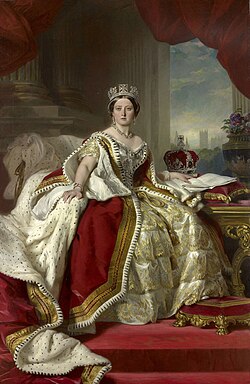
In the history of the United Kingdom and the British Empire, the Victorian era was the reign of Queen Victoria, from 20 June 1837 until her death on 22 January 1901. Slightly different definitions are sometimes used. The era followed the Georgian era and preceded the Edwardian era, and its later half overlaps with the first part of the Belle Époque era of continental Europe.
Various liberalising political reforms took place in the UK, including expanding the electoral franchise. The Great Famine caused mass death in Ireland in the mid 1840s. Britain had peaceful relations with the other great powers. It participated in various military threats and conflicts mainly against minor powers. The Crimean War of the 1850s was against Russia. It was seen as a major threat to the Ottoman ally and to India. The British Empire expanded during this period and the Royal Navy was predominant power in the world.
Victorian society valued a high standard of personal conduct across all sections of society. The emphasis on morality gave impetus to social reform but also placed restrictions on certain groups' liberty. Prosperity rose during the period, but debilitating undernutrition persisted. Literacy and childhood education became near universal in Great Britain for the first time. Whilst some attempts were made to improve living conditions, slum housing and disease remained a severe problem.
The period saw significant scientific and technological development. Britain was advanced in industry and engineering in particular, but somewhat less developed in art and education. Great Britain's population increased rapidly, while Ireland's fell sharply.
In the strictest sense, the Victorian era covers the duration of Victoria's reign as Queen of the United Kingdom of Great Britain and Ireland, from her accession on 20 June 1837—after the death of her uncle, William IV—until her death on 22 January 1901, after which she was succeeded by her eldest son, Edward VII. Her reign lasted 63 years and seven months, a longer period than any of her predecessors. The term 'Victorian' was in contemporaneous usage to describe the era. The era can also be understood in a more extensive sense—the 'long Victorian era'—as a period that possessed sensibilities and characteristics distinct from the periods adjacent to it, in which case it is sometimes dated to begin before Victoria's accession—typically from the passage of or agitation for (during the 1830s) the Reform Act 1832, which introduced a wide-ranging change to the electoral system of England and Wales. Definitions that purport a distinct sensibility or politics to the era have also created scepticism about the worth of the label 'Victorian', though there have also been defences of it.
The interwar period between the Napoleonic Wars (1815) and World War I (1914) is often broadly seen as an age of peace, progress, and political liberalism. However, the Queen's 64-year reign created an illusion of continuous uniformity, masking significant shifts in ideas, manners, and values. Michael Sadleir was insistent that "in truth, the Victorian period is three periods, and not one". He distinguished early Victorianism—the socially and politically unsettled period from 1837 to 1850—and late Victorianism (from 1880 onwards), with its new waves of aestheticism and imperialism, from the Victorian heyday: mid-Victorianism, 1851 to the 1870s. He saw the middle period as characterised by a distinctive mixture of prosperity, domestic prudery, and complacency—what G. M. Trevelyan called the 'mid-Victorian decades of quiet politics and roaring prosperity'. Harold Schultz has summarized the typical three part periodization used by scholars.
Early Victorianism (1815-1850) Driven by the revolutionary ideas from America and France, as well as the convictions of English utilitarians and Evangelicals, Britain began a process of gradual democratization. The national government and society adapted to absorb this "democratic radicalism." Simultaneous with this political change, England became a world leader in both opinion and, more practically, in industrialization and manufactured goods production. By mid-century, Britain was approaching its peak of power, confident that its economic prosperity, founded on free trade and parliamentary institutions, would ensure happiness and peace.
Mid-Victorianism (1850-1870s) This was the height of Victorian self-assurance, characterized by a strong sense of duty and unwavering belief in political Liberalism. British industrial and naval power was frequently used to promote liberalism abroad, while domestically, the focus was on individual freedom. Though some contemporary critics attacked the era's bourgeois values and easy supremacy, the prevailing faith in the inevitability of progress remained firm, assuring the nation its problems would be solved and its greatness maintained. For an educated Englishman, holding a seat in Parliament represented the highest possible aspiration.
Victorian era
In the history of the United Kingdom and the British Empire, the Victorian era was the reign of Queen Victoria, from 20 June 1837 until her death on 22 January 1901. Slightly different definitions are sometimes used. The era followed the Georgian era and preceded the Edwardian era, and its later half overlaps with the first part of the Belle Époque era of continental Europe.
Various liberalising political reforms took place in the UK, including expanding the electoral franchise. The Great Famine caused mass death in Ireland in the mid 1840s. Britain had peaceful relations with the other great powers. It participated in various military threats and conflicts mainly against minor powers. The Crimean War of the 1850s was against Russia. It was seen as a major threat to the Ottoman ally and to India. The British Empire expanded during this period and the Royal Navy was predominant power in the world.
Victorian society valued a high standard of personal conduct across all sections of society. The emphasis on morality gave impetus to social reform but also placed restrictions on certain groups' liberty. Prosperity rose during the period, but debilitating undernutrition persisted. Literacy and childhood education became near universal in Great Britain for the first time. Whilst some attempts were made to improve living conditions, slum housing and disease remained a severe problem.
The period saw significant scientific and technological development. Britain was advanced in industry and engineering in particular, but somewhat less developed in art and education. Great Britain's population increased rapidly, while Ireland's fell sharply.
In the strictest sense, the Victorian era covers the duration of Victoria's reign as Queen of the United Kingdom of Great Britain and Ireland, from her accession on 20 June 1837—after the death of her uncle, William IV—until her death on 22 January 1901, after which she was succeeded by her eldest son, Edward VII. Her reign lasted 63 years and seven months, a longer period than any of her predecessors. The term 'Victorian' was in contemporaneous usage to describe the era. The era can also be understood in a more extensive sense—the 'long Victorian era'—as a period that possessed sensibilities and characteristics distinct from the periods adjacent to it, in which case it is sometimes dated to begin before Victoria's accession—typically from the passage of or agitation for (during the 1830s) the Reform Act 1832, which introduced a wide-ranging change to the electoral system of England and Wales. Definitions that purport a distinct sensibility or politics to the era have also created scepticism about the worth of the label 'Victorian', though there have also been defences of it.
The interwar period between the Napoleonic Wars (1815) and World War I (1914) is often broadly seen as an age of peace, progress, and political liberalism. However, the Queen's 64-year reign created an illusion of continuous uniformity, masking significant shifts in ideas, manners, and values. Michael Sadleir was insistent that "in truth, the Victorian period is three periods, and not one". He distinguished early Victorianism—the socially and politically unsettled period from 1837 to 1850—and late Victorianism (from 1880 onwards), with its new waves of aestheticism and imperialism, from the Victorian heyday: mid-Victorianism, 1851 to the 1870s. He saw the middle period as characterised by a distinctive mixture of prosperity, domestic prudery, and complacency—what G. M. Trevelyan called the 'mid-Victorian decades of quiet politics and roaring prosperity'. Harold Schultz has summarized the typical three part periodization used by scholars.
Early Victorianism (1815-1850) Driven by the revolutionary ideas from America and France, as well as the convictions of English utilitarians and Evangelicals, Britain began a process of gradual democratization. The national government and society adapted to absorb this "democratic radicalism." Simultaneous with this political change, England became a world leader in both opinion and, more practically, in industrialization and manufactured goods production. By mid-century, Britain was approaching its peak of power, confident that its economic prosperity, founded on free trade and parliamentary institutions, would ensure happiness and peace.
Mid-Victorianism (1850-1870s) This was the height of Victorian self-assurance, characterized by a strong sense of duty and unwavering belief in political Liberalism. British industrial and naval power was frequently used to promote liberalism abroad, while domestically, the focus was on individual freedom. Though some contemporary critics attacked the era's bourgeois values and easy supremacy, the prevailing faith in the inevitability of progress remained firm, assuring the nation its problems would be solved and its greatness maintained. For an educated Englishman, holding a seat in Parliament represented the highest possible aspiration.
Recent media
Recent media