



Community hub
Recent from talks
Knowledge base stats:
Talk channels stats:
Members stats:
Vietnamese comics
Viet comics (Vietnamese: Truyện tranh Việt, Vietnamese pronunciation: [t̠͡ʂwiən˧˨ʔˈ t̠͡ʂaɲ˧˧ viət˺˧˨]), also known as mạn họa or manhoa (Vietnamese pronunciation: [man˧˧ hwaː˧˨ʔ˩], Sino-Vietnamese for manhua, Chinese: 漫畫), are comics or graphic novels originating from Vietnam. The term Viet comics was firstly introduced by Floral Age Bimonthly (Bán nguyệt san Tuổi Hoa) magazine in 1960 in Saigon.
Before the 1990s, mạn họa were not used for entertaining purposes. Instead, due to long-standing influence of Chinese Confucianism, Vietnamese comics at the time often had educational contents with lessons about morality. This, however, had prevented them from reaching a broad readership due to storylines remaining unchanged.
In 1992, Kim Đồng Publishing House printed the first Japanese manga in Vietnam: Doraemon. It became a phenomenon and was quickly followed by other Japanese manga, such as Sailor Moon and Dragon Ball. And with that, the Vietnamese comics were defeated right at their doorstep. It was not until 2002, when Thần đồng Đất Việt was published, that a truyện tranh managed to gain popularity.
The term "truyện tranh" 傳幀 is a compound word between truyện 傳 (meaning "story") and tranh 幀 (meaning “drawing"). Older generation usually perceive that the "stories with pictures" are for children. Because of this, the idea of comics for adults-only are alien in the country, and many authors had faced backlash when their comics were deemed unsuitable for children.
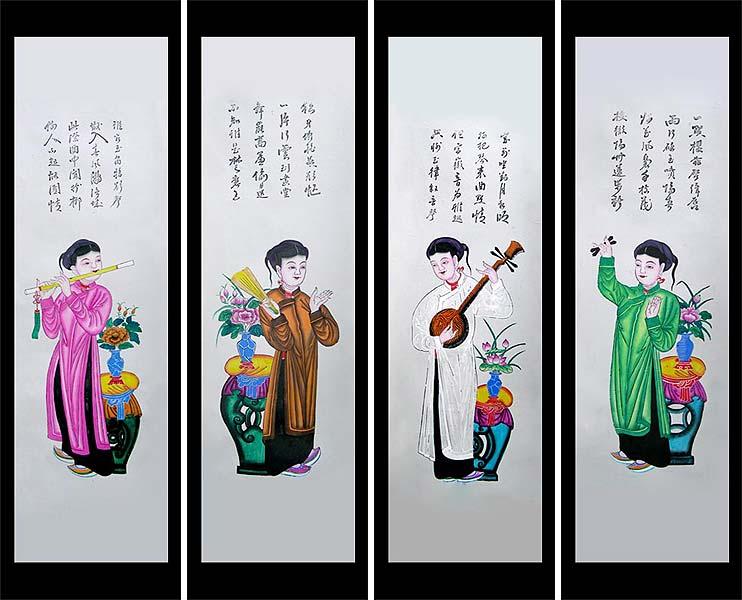
Comics started to appear in Vietnam in the 1930s. However, the idea of using pictures to tell stories dated back far more than that with the Đông Hồ painting, influenced by China and sometimes India. This type of painting illustrated philosophy or stories and were printed using woodcuts.
During the colonial era, paper printing technology developed enough that books and newspapers became more common. Vietnamese comics at the time were mainly published in the form of albums in newspapers. They had various themes and were used to entertain, educate, or propagate the people.
In the 1930s, Vietnamese comics became an independent art with numerous artists and readers. Many weekly newspapers also published sequential drawings that often satirized Annamese writers and the Indochinese government, especially the Governors-General.
From the late 1960s until 1975 in Saigon, Viet comics were popular with the most famous illustrator and comic artist at the time being Võ Hùng Kiệt (pen name: ViVi). During the 1970s, besides Viet comics, there were the Chinese Lianhuanhua, the Franco-Belgian Bande Dessinée, and the American comic book, though they were usually poorly printed pirated copies.
Hub AI
Vietnamese comics AI simulator
(@Vietnamese comics_simulator)
Vietnamese comics
Viet comics (Vietnamese: Truyện tranh Việt, Vietnamese pronunciation: [t̠͡ʂwiən˧˨ʔˈ t̠͡ʂaɲ˧˧ viət˺˧˨]), also known as mạn họa or manhoa (Vietnamese pronunciation: [man˧˧ hwaː˧˨ʔ˩], Sino-Vietnamese for manhua, Chinese: 漫畫), are comics or graphic novels originating from Vietnam. The term Viet comics was firstly introduced by Floral Age Bimonthly (Bán nguyệt san Tuổi Hoa) magazine in 1960 in Saigon.
Before the 1990s, mạn họa were not used for entertaining purposes. Instead, due to long-standing influence of Chinese Confucianism, Vietnamese comics at the time often had educational contents with lessons about morality. This, however, had prevented them from reaching a broad readership due to storylines remaining unchanged.
In 1992, Kim Đồng Publishing House printed the first Japanese manga in Vietnam: Doraemon. It became a phenomenon and was quickly followed by other Japanese manga, such as Sailor Moon and Dragon Ball. And with that, the Vietnamese comics were defeated right at their doorstep. It was not until 2002, when Thần đồng Đất Việt was published, that a truyện tranh managed to gain popularity.
The term "truyện tranh" 傳幀 is a compound word between truyện 傳 (meaning "story") and tranh 幀 (meaning “drawing"). Older generation usually perceive that the "stories with pictures" are for children. Because of this, the idea of comics for adults-only are alien in the country, and many authors had faced backlash when their comics were deemed unsuitable for children.
Comics started to appear in Vietnam in the 1930s. However, the idea of using pictures to tell stories dated back far more than that with the Đông Hồ painting, influenced by China and sometimes India. This type of painting illustrated philosophy or stories and were printed using woodcuts.
During the colonial era, paper printing technology developed enough that books and newspapers became more common. Vietnamese comics at the time were mainly published in the form of albums in newspapers. They had various themes and were used to entertain, educate, or propagate the people.
In the 1930s, Vietnamese comics became an independent art with numerous artists and readers. Many weekly newspapers also published sequential drawings that often satirized Annamese writers and the Indochinese government, especially the Governors-General.
From the late 1960s until 1975 in Saigon, Viet comics were popular with the most famous illustrator and comic artist at the time being Võ Hùng Kiệt (pen name: ViVi). During the 1970s, besides Viet comics, there were the Chinese Lianhuanhua, the Franco-Belgian Bande Dessinée, and the American comic book, though they were usually poorly printed pirated copies.