
.jpg/250px-Ho_Chi_Minh_City_panorama_2019_(cropped2).jpg)


.jpg/2000px-Ho_Chi_Minh_City_panorama_2019_(cropped2).jpg)
Community hub
Recent from talks
Contribute something
Nothing was collected or created yet.
Ho Chi Minh City
View on Wikipedia
Ho Chi Minh City (HCMC; Vietnamese: Thành phố Hồ Chí Minh, IPA: [tʰan˨˩ fow˦˥ how˨˩ cɪj˦˥ mɨn˧˧]), formerly known as Saigon (Vietnamese: Sài Gòn, IPA: [saːj˨˩ ɣɔŋ˨˩]), is the most populous city in Vietnam with a population of 14,002,598 in 2025.[4]
Key Information


.jpg)

.jpg)

.jpg)


The city's geography is defined by rivers and canals, of which the largest is Saigon River. As the largest financial centre in Vietnam, Ho Chi Minh City has the largest gross regional domestic product out of all Vietnam provinces and municipalities,[7] contributing around a quarter of the country's total GDP.[8] Ho Chi Minh City's metropolitan area is ASEAN's 5th largest economy, also the biggest outside an ASEAN country capital.
The area was initially part of Cambodian states until it became part of the Vietnamese Nguyễn lords in 1698, due to Đại Việt's expansionist policy of Nam tiến. It was capital of the Nguyễn lords at the end of their existence before the Nguyễn dynasty was formed. After the fall of the Citadel of Saigon, it became the capital of French Cochinchina from 1862 to 1949. It was also the capital of French Indochina from 1887 to 1902, and again from 1945 until its cessation in 1954. After France recognized Vietnam's independence and unity,[nb 1] it was the capital of the State of Vietnam from 1949 to 1955. Following the 1954 partition, it became the capital of South Vietnam until it was captured by North Vietnam, leading to a unified communist state in 1976. The city was subsequently renamed after the late leader Ho Chi Minh, though Saigon is still widely used in informal usages but slowly out of use. Beginning in the 1990s, the city underwent rapid expansion and modernization, which contributed to Vietnam's post-war economic recovery and helped revive its international trade hub status.
Ho Chi Minh City has a long tradition of being one of the centers of economy, entertainment and education in Southern Vietnam in particular and Vietnam in general. It is also the busiest international transport hub in Vietnam, with Tân Sơn Nhất International Airport accounting for nearly half of all international arrivals to Vietnam, and the Port of Saigon among the busiest container ports in Southeast Asia.[10][11] The city is also a tourist attraction; some of its historic landmarks with modern landmarks, including the Independence Palace, Bitexco Financial Tower, Landmark 81 Tower, the War Remnants Museum, and Bến Thành Market. It is also known for its narrow walkable alleys and bustling nightlife, most notably the Phạm Ngũ Lão Ward and its Bùi Viện street.
In 2025, the Bình Dương and Bà Rịa–Vũng Tàu provinces were merged into Ho Chi Minh City, making it a megacity while inheriting the major industrial towns and coastal cities of the two former provinces. Currently, Ho Chi Minh City is facing increasing threats of sea level rise and flooding as well as heavy strains on public infrastructures.
Etymology
[edit]The first known human habitation in the area was either a Cham settlement called Baigaur,[nb 2] or a Cambodian city named Prey Nokor,[12] which was a small fishing village.[13][14] Over time, under the control of the Vietnamese, it was officially renamed Gia Định (嘉定) in 1698, a name that was retained until the time of the French conquest in the 1860s, when it adopted the name Sài Gòn, francized as Saïgon,[14] although the city was still indicated as 嘉定 on Vietnamese maps written in chữ Hán until at least 1891.[15] An old name of Gia Định was Phan Yên 藩安, which was later commonly glossed as Phiên An.[16]
The current name, Ho Chi Minh City, was given after reunification in 1976 to honour Ho Chi Minh.[nb 3] Even today, however, the informal name of Sài Gòn remains in daily speech. However, there is a technical difference between the two terms: Sài Gòn is commonly used to refer to the city centre in District 1 and the adjacent areas, while Ho Chi Minh City refers to all of its urban and rural districts.[14]
Saigon
[edit]
The original toponym behind Sài Gòn was attested earliest as 柴棍, with two phonograms whose Sino-Vietnamese readings are sài and côn respectively, in Lê Quý Đôn's "Miscellaneous Chronicles of the Pacified Frontier" (撫邊雜錄, Phủ biên tạp lục c. 1776), wherein Lê relates that, in 1674, Cambodian prince Ang Nan was installed as uparaja in 柴棍 (Sài Gòn) by Vietnamese forces.
柴棍 also appears later in Trịnh Hoài Đức's "Comprehensive Records about the Gia Định Citadel" (嘉定城通志, Gia Định thành thông chí, c. 1820), "Textbook on the Geography of the Southern Country" (南國地輿教科書, Nam quốc địa dư giáo khoa thư, 1908),[18] etc.
Adrien Launay's Histoire de la Mission de Cochinchine (1688–1823), "Documents Historiques II: 1728 – 1771" (1924: 190) cites 1747 documents containing the toponyms: provincia Rai-gon, Rai-gon thong (for *Sài Gòn thượng "Upper Saigon"), & Rai-gon-ha (for *Sài Gòn hạ "Lower Saigon").
It is probably a transcription of Khmer ព្រៃនគរ (Prey Nokôr)[19][20][nb 4], or Khmer ព្រៃគរ (Prey Kôr).
The proposal that Sài Gòn is from non-Sino-Vietnamese reading of Chinese 堤岸 ("embankment", tai4 ngon6, SV: đê ngạn)[nb 5], the Cantonese name of Chợ Lớn, (e.g. by Vương Hồng Sển) has been critiqued as folk-etymological, as: (1) the Vietnamese source Phủ biên tạp lục (albeit written in literary Chinese) was the earliest extant one containing the local toponym's transcription; (2) 堤岸 has variant form 提岸, thus suggesting that both were transcriptions of a local toponym and thus are cognates to, not originals of, Sài Gòn. Saigon is unlikely to be from 堤岸 since in "Textbook on the Geography of the Southern Country", it also lists Chợ Lớn as 𢄂𢀲 separate from 柴棍 Sài Gòn.[original research?]
Ho Chi Minh City
[edit]The current official name, Thành phố Hồ Chí Minh, was first proposed by the Viet Minh in August 1946 and was later officially adopted in July 1976. It is abbreviated as TP.HCM, and translated in English as Ho Chi Minh City, abbreviated as HCMC, and in French as Hô-Chi-Minh-Ville (the circumflex is sometimes omitted), abbreviated as HCMV.
The name commemorates Ho Chi Minh, the first leader of North Vietnam. This name, though not his given name, was one he favored throughout his later years. It combines a common Vietnamese surname (Hồ, 胡) with a given name meaning "enlightened will" (from Sino-Vietnamese, 志 明; Chí meaning 'will' or 'spirit', and Minh meaning 'light'), in essence, meaning "light bringer".[23]
Nowadays, "Saigon" is still used as a semi-official name for the city, in some cases being used interchangeably with Ho Chi Minh City, partly due to its long history and familiarity.[24]
History
[edit]Early settlement
[edit]The earliest settlement in the area was a Funan temple at the location of the current Phụng Sơn Buddhist temple, founded in the 4th century AD.[25] A settlement called Baigaur was established on the site in the 11th century by the Champa.[25] Baigaur was renamed Prey Nokor after conquest by the Khmer Empire around 1145,[25] Prey Nokor grew on the site of a small fishing village and area of forest.[26]
The first Vietnamese people crossed the sea to explore this land completely without the organisation of the Nguyễn Lords. Thanks to the marriage between Princess Nguyễn Phúc Ngọc Vạn – daughter of Lord Nguyễn Phúc Nguyên – and the King of Cambodia Chey Chettha II in 1620, the relationship between Vietnam and Cambodia became smooth, and the people of the two countries could freely move back and forth. In exchange, Chey Chettha II gifted Prei Nokor to the Nguyễn lords.[27] Vietnamese settlers began to migrate to the area of Saigon, Đồng Nai. Before that, the Funanese, Khmer, and Cham had lived there, scattered from time immemorial.
The period from 1623 to 1698 is considered the period of the formation of later Saigon. In 1623, Lord Nguyen sent a mission to ask his son-in-law, King Chey Chettha II, to set up tax collection stations in Prey Nokor (Sài Gòn) and Kas Krobei (Bến Nghé). Although this was a deserted jungle area, it was located on the traffic routes between Vietnam, Cambodia, and Siam. The next two important events of this period were the establishment of the barracks and residence of Vice King Ang Non and the establishment of a palace at Tân Mỹ (near the present-day Cống Quỳnh–Nguyễn Trãi crossroads). It can be said that Saigon was formed from these three government agencies.
Nguyễn dynasty rule
[edit]

In 1679, Lord Nguyễn Phúc Tần allowed a group of Chinese refugees from the Qing dynasty to settle in Mỹ Tho, Biên Hòa and Saigon to seek refuge. In 1698, Nguyễn Hữu Cảnh, a Vietnamese noble, was sent by the Nguyễn rulers of Huế by sea to establish Vietnamese administrative structures in the area, thus detaching the area from Cambodia, which was not strong enough to intervene. He is often credited with the expansion of Saigon into a significant settlement.[28][29] King Chey Chettha IV of Cambodia tried to stop the Vietnamese but was defeated by Nguyễn Hữu Cảnh in 1700. In February 1700, he invaded Cambodia from An Giang. In March, the Vietnamese expedition under Cảnh and a Chinese general Trần Thượng Xuyên (Chen Shangchuan) defeated the main Cambodian army at Bích Đôi citadel, king Chey Chettha IV took flight while his nephew Ang Em surrendered to the invaders, as the Vietnamese marched onto and captured Cambodia's capital Phnom Penh.[30] As a result, Saigon and Long An were officially and securely obtained by the Nguyễn, more Vietnamese settlers moved into the new conquered lands.[30]
In 1788, Nguyễn Ánh captured the city, and used it as a centre of resistance against Tây Sơn.[31] Two years later, a large Vauban citadel called Gia Định, or Thành Bát Quái ("Eight Diagrams") was built by Victor Olivier de Puymanel, one of the Nguyễn Ánh's French mercenaries.[32] The citadel was captured by Lê Văn Khôi during his revolt of 1833–35 against Emperor Minh Mạng. Following the revolt, Minh Mạng ordered it to be dismantled, and a new citadel, called Phụng Thành, was built in 1836.[33] In 1859, the citadel was destroyed by the French following the Battle of Kỳ Hòa.[33] Initially called Gia Định, the Vietnamese city became Saigon in the 18th century.[25]
French colonial era
[edit]Ceded to France by the 1862 Treaty of Saigon,[34] the city was planned by the French to transform into a large town for colonization. During the late 19th and early 20th centuries, construction of various French-style buildings began, including a botanical garden, the Norodom Palace, Hotel Continental, Notre-Dame Cathedral, and Bến Thành Market, among many others.[35][36] In April 1865, Gia Định Báo was established in Saigon, becoming the first newspaper published in Vietnam.[37] During the French colonial era, Saigon became known as "Pearl of the Orient" (Hòn ngọc Viễn Đông),[38] or "Paris of the Extreme Orient".[39]

On 27 April 1931, a new région called Saigon–Cholon consisting of Saigon and Cholon was formed; the name Cholon was dropped after South Vietnam gained independence from France in 1955.[40] From about 256,000 in 1930,[41] Saigon's population rose to 1.2 million in 1950.[41]
- Gallery of Saigon during the French colonial era
-
 The Siege of Saigon fortress in 1859 by Franco-Spanish forces.
 -
 Coat of arms of Saigon established during French colonial administration and used from 1870 to 1975.
 -
 Map of Saigon in 1881.
 -
 French soldiers stationed at a barrack in Saigon in 1930.
 -
 Imperial Japanese soldiers entering Saigon in 1941, during World War II.
 -
 Saigon afire after aerial attacks from carrier-based planes of the US Pacific Fleet in 1945.


State of Vietnam and Republic of Vietnam era
[edit]On 14 June 1949, 10 days after France returned Cochinchina to Vietnam, former Emperor Bảo Đại made Saigon the capital of the State of Vietnam within the French Union with himself as head of state.[42] The state was proclaimed in July. In July 1954, the Geneva Agreement partitioned Vietnam along the 17th parallel (Bến Hải River), with the Việt Minh, under Ho Chi Minh, gaining complete control of the northern half of the country, while the southern half remained the rule of the State of Vietnam.[43]
The State officially became the Republic of Vietnam when Bảo Đại was deposed by his Prime Minister Ngô Đình Diệm in the 1955 referendum,[43] with Saigon as its capital.[44] On 22 October 1956, the city was given the official name, Đô Thành Sài Gòn ("Capital City Saigon").[45] After the decree of 27 March 1959 came into effect, Saigon was divided into eight districts and 41 wards.[45]
In December 1966, two wards from old An Khánh Commune of Gia Định, were formed into District 1, then seceded shortly later to become District 9.[46] In July 1969, District 10 and District 11 were founded, and by 1975, the city's area consisted of eleven districts, Gia Định, Củ Chi District (Hậu Nghĩa), and Phú Hòa District (Bình Dương).[46]
Saigon served as the financial, industrial and transport centre of the Republic of Vietnam.[47] In the late 1950s, with the U.S. providing nearly $2 billion in aid to the Diệm regime, the country's economy grew rapidly under the capitalist model;[45] by 1960, over half of South Vietnam's factories were located in Saigon.[48] However, beginning in the 1960s, Saigon experienced economic downturn and high inflation, as it was completely dependent on U.S. aid and imports from other countries.[45] As a result of widespread urbanisation, with the population reaching 3.3 million by 1970, the city was described by the USAID as being turned "into a huge slum".[49] The city also suffered from "prostitutes, drug addicts, corrupt officials, beggars, orphans, and Americans with money", and according to Stanley Karnow, it was "a black-market city in the largest sense of the word".[44]
On 28 April 1955, the Vietnamese National Army launched an attack against Bình Xuyên military force in the city. The battle lasted until May, killing an estimated 500 people and leaving about 20,000 homeless.[44][50] Ngô Đình Diệm then later turned on other paramilitary groups in Saigon, including the Hòa Hảo Buddhist reform movement.[44] On 11 June 1963, Buddhist monk Thích Quảng Đức self-immolated in the city, in protest of the Diệm regime. On 2 November of the same year, Diệm was assassinated in Saigon, in a successful coup by Dương Văn Minh.[44]
During the 1968 Tet Offensive, communist forces launched a failed attempt to capture the city. Seven years later, on 30 April 1975, Saigon was captured, ending the Vietnam War with a victory for North Vietnam,[51] and the city came under the control of the Vietnamese People's Army.[44]
- Gallery of Saigon during the Republic of Vietnam era
-
 The Independence Palace in 1967. It was the official residence and workplace of the President of South Vietnam.
 -
 The Saigon Opera House as seen from Tự Do (Liberty) Street in 1967.
 -
 Street view of Saigon in 1968.
 -


Post–Vietnam War and today
[edit]In July 1976, upon the establishment of the unified Socialist Republic of Vietnam, the city of Saigon (including the Cholon area), the province of Gia Ðịnh and two suburban districts of two other nearby provinces were combined to create Ho Chi Minh City, in honour of the late Communist leader Ho Chi Minh.[nb 6] At the time, the city covered an area of 1,295.5 square kilometres (500.2 sq mi) with eight districts and five rurals: Thủ Đức, Hóc Môn, Củ Chi, Bình Chánh, and Nhà Bè.[46] Since 1978, administrative divisions in the city have been revised numerous times,[46] most recently in 2020, when District 2, District 9, and Thủ Đức District were consolidated to form a municipal city.[52]
.jpg)
On 29 October 2002, 60 people died and 90 were injured in the International Trade Center building fire in Ho Chi Minh City.[53] Today, Ho Chi Minh City, along with its surrounding provinces, is described as "the manufacturing hub" of Vietnam, and "an attractive business hub".[54] In terms of cost, it was ranked the 178th-most expensive major city in the world according to the Mercer Cost Of Living 2024 survey of 226 cities.[55] In terms of international connectedness, as of 2024, the city was classified as a "Beta+" city by the Globalization and World Cities Research Network.[56]
Geography
[edit].jpg)
The city is located in the south-eastern region of Vietnam, 1,760 km (1,090 mi) south of Hanoi. The average elevation is 5 m (16 ft) above sea level for the city centre and 16 m (52 ft) for the suburb areas.[57] It borders Tây Ninh Province and Bình Dương Province to the north, Đồng Nai Province and Bà Rịa–Vũng Tàu province to the east, Long An Province to the west, and Tiền Giang Province and the South China Sea to the south with a coast 15 km (9 mi) long. The city covers an area of 2,095 km2 (809 sq mi) or 0.63% of the surface of Vietnam), extending up to Củ Chi District (12 mi or 19 km from the Cambodian border) and down to Cần Giờ on the Eastern Sea.
The distance from the northernmost point (Phú Mỹ Hưng Commune, Củ Chi District) to the southernmost one (Long Hòa Commune, Cần Giờ District) is 102 km (63 mi), and from the easternmost point (Long Bình ward, District Nine) to the westernmost one (Bình Chánh Commune, Bình Chánh District) is 47 km (29 mi).[citation needed] Due to its location on the Mekong Delta, the city is fringed by tidal flats that have been heavily modified for agriculture.[58]
Flooding
[edit]Saigon is considered one of the most vulnerable cities to the effects of flooding. During the rainy season, a combination of high tide, heavy rains, high flow volume in the Saigon River and Đồng Nai River and land subsidence results in regular flooding in several parts of the city.[59][60] A once-in-100 year flood would cause 23% of the city to suffer flooding.[61]
Climate
[edit]| Ho Chi Minh City, Vietnam | ||||||||||||||||||||||||||||||||||||||||||||||||||||||||||||
|---|---|---|---|---|---|---|---|---|---|---|---|---|---|---|---|---|---|---|---|---|---|---|---|---|---|---|---|---|---|---|---|---|---|---|---|---|---|---|---|---|---|---|---|---|---|---|---|---|---|---|---|---|---|---|---|---|---|---|---|---|
| Climate chart (explanation) | ||||||||||||||||||||||||||||||||||||||||||||||||||||||||||||
| ||||||||||||||||||||||||||||||||||||||||||||||||||||||||||||
| ||||||||||||||||||||||||||||||||||||||||||||||||||||||||||||
The city has a tropical climate, specifically tropical savanna (Aw), with a high average humidity of 78–82%.[64] The year is divided into two distinct seasons.[64] The rainy season, with an average rainfall of about 1,800 mm (71 in) annually (about 150 rainy days per year), usually lasts from May to November.[64] The dry season lasts from December to April.[64]
The average temperature is 28 °C (82 °F), with little variation throughout the year.[64] The highest temperature recorded was 40.0 °C (104 °F) in April while the lowest temperature recorded was 13.8 °C (57 °F) in January.[64] On average, the city experiences between 2,400 and 2,700 hours of sunshine per year.[64]
| Climate data for Ho Chi Minh City (Tan Son Nhat International Airport) | |||||||||||||
|---|---|---|---|---|---|---|---|---|---|---|---|---|---|
| Month | Jan | Feb | Mar | Apr | May | Jun | Jul | Aug | Sep | Oct | Nov | Dec | Year |
| Record high °C (°F) | 36.4 (97.5) |
38.7 (101.7) |
39.4 (102.9) |
40.0 (104.0) |
39.0 (102.2) |
37.5 (99.5) |
35.2 (95.4) |
36.1 (97.0) |
35.3 (95.5) |
34.9 (94.8) |
35.0 (95.0) |
36.3 (97.3) |
40.0 (104.0) |
| Mean daily maximum °C (°F) | 32.0 (89.6) |
32.7 (90.9) |
33.6 (92.5) |
34.5 (94.1) |
34.9 (94.8) |
33.5 (92.3) |
33.0 (91.4) |
32.9 (91.2) |
32.6 (90.7) |
32.3 (90.1) |
32.4 (90.3) |
31.6 (88.9) |
33.0 (91.4) |
| Daily mean °C (°F) | 27.3 (81.1) |
27.5 (81.5) |
28.1 (82.6) |
29.3 (84.7) |
29.5 (85.1) |
28.8 (83.8) |
28.4 (83.1) |
28.3 (82.9) |
28.1 (82.6) |
28.0 (82.4) |
28.0 (82.4) |
27.3 (81.1) |
28.2 (82.8) |
| Mean daily minimum °C (°F) | 23.4 (74.1) |
23.1 (73.6) |
24.9 (76.8) |
26.4 (79.5) |
26.4 (79.5) |
25.5 (77.9) |
25.2 (77.4) |
25.1 (77.2) |
25.0 (77.0) |
25.0 (77.0) |
24.9 (76.8) |
23.9 (75.0) |
24.9 (76.8) |
| Record low °C (°F) | 13.8 (56.8) |
16.0 (60.8) |
17.5 (63.5) |
20.0 (68.0) |
21.1 (70.0) |
20.4 (68.7) |
19.4 (66.9) |
20.0 (68.0) |
20.8 (69.4) |
19.8 (67.6) |
17.6 (63.7) |
13.9 (57.0) |
13.8 (56.8) |
| Average rainfall mm (inches) | 12 (0.5) |
8 (0.3) |
18 (0.7) |
57 (2.2) |
202 (8.0) |
224 (8.8) |
231 (9.1) |
219 (8.6) |
490 (19.3) |
340 (13.4) |
128 (5.0) |
41 (1.6) |
1,970 (77.5) |
| Average rainy days | 2.0 | 1.0 | 1.0 | 4.0 | 13.0 | 16.0 | 19.0 | 17.0 | 18.0 | 16.0 | 9.0 | 5.0 | 121 |
| Average relative humidity (%) | 72 | 70 | 70 | 72 | 79 | 82 | 83 | 83 | 85 | 84 | 80 | 77 | 78 |
| Mean monthly sunshine hours | 245 | 246 | 272 | 239 | 195 | 171 | 180 | 172 | 162 | 182 | 200 | 226 | 2,490 |
| Source 1: Vietnam Institute for Building Science and Technology,[62] | |||||||||||||
| Source 2: World Meteorological Organization (rainfall)[63] | |||||||||||||
Administration
[edit]
The city is a municipality at the same level as Vietnam's provinces, which is divided into 113 wards, 54 communes, and 1 special administrative zone (as of 2025):[65]
- 113 wards (2,023.6266 km2 or 781.3266 sq mi in area), which are designated as urban or suburban (phường):
- An Đông
- An Hội Đông
- An Hội Tây
- An Khánh
- An Lạc
- An Nhơn
- An Phú
- An Phú Đông
- Bà Rịa
- Bàn Cờ
- Bảy Hiền
- Bến Cát
- Bến Thành
- Bình Cơ
- Bình Dương
- Bình Đông
- Bình Hòa
- Bình Hưng Hòa
- Bình Lợi Trung
- Bình Phú
- Bình Quới
- Bình Tân
- Bình Tây
- Bình Thạnh
- Bình Thới
- Bình Tiên
- Bình Trị Đông
- Bình Trưng
- Cát Lái
- Cầu Kiệu
- Cầu Ông Lãnh
- Chánh Hiệp
- Chánh Hưng
- Chánh Phú Hòa
- Chợ Lớn
- Chợ Quán
- Diên Hồng
- Dĩ An
- Đông Hòa
- Đông Hưng Thuận
- Đức Nhuận
- Gia Định
- Sài Gòn
- Phú Lâm
- Tân Phú
- Tân Phước
- Tân Sơn
- Tân Sơn Hòa
- Tân Sơn Nhất
- Tân Sơn Nhì
- Tân Tạo
- Tân Thành
- Tân Thới Hiệp
- Tân Thuận
- Tân Uyên
- Tây Nam
- Tây Thạnh
- Thạnh Mỹ Tây
- Thông Tây Hội
- Thới An
- Thới Hòa
- Thuận An
- Thuận Giao
- Thủ Dầu Một
- Thủ Đức
- Trung Mỹ Tây
- Vĩnh Hội
- Vĩnh Tân
- Vũng Tàu
- Vườn Lài
- Xóm Chiếu
- Xuân Hòa
- 54 communes (4,682.001 km2 or 1,807.731 sq mi in area), which are designated rural (xã):
- Cần Giờ
- Châu Đức
- Châu Pha
- Củ Chi
- Dầu Tiếng
- Đất Đỏ
- Đông Thạnh
- Hiệp Phước
- Hòa Hiệp
- Hòa Hội
- Hóc Môn
- Hồ Tràm
- Hưng Long
- Kim Long
- Long Điền
- Long Hải
- Long Hòa
- Long Sơn
- Minh Thạnh
- Ngãi Giao
- Nghĩa Thành
- Nhà Bè
- Nhuận Đức
- Phú Giáo
- Phú Hòa Đông
- Phước Hải
- Phước Hòa
- Phước Thành
- Tân An Hội
- Tân Nhựt
- Tân Vĩnh Lộc
- Thanh An
- Thạnh An
- Thái Mỹ
- Thường Tân
- Trừ Văn Thố
- Vĩnh Lộc
- Xuân Sơn
- Xuân Thới Sơn
- Xuyên Mộc
- 1 special administrative zone (75.8 km2 or 29.3 sq mi in area), which is designated municipal city (đặc khu thuộc thành phố trực thuộc trung ương):
City government
[edit]The Ho Chi Minh City People's Committee is a 13-member executive branch of the city. The current chairman is Nguyễn Văn Được. There are several vice chairmen and chairwomen on the committee with responsibility over various city departments.
The legislative branch of the city is the Ho Chi Minh City People's Council and consists of 105 members. The current chairman is Võ Văn Minh. The judiciary branch of the city is the Ho Chi Minh City People's Court. The current chief judge is Lê Thanh Phong.
The executive committee of Communist Party of Ho Chi Minh City is the leading organ of the Communist Party in Ho Chi Minh City. The current secretary is Trần Lưu Quang. The permanent deputy secretary of the Communist Party is ranked second in the city politics after the Secretary of the Communist Party, while chairman of the People's Committee is ranked third and the chairman of the People's Council is ranked fourth.[citation needed]
Demographics
[edit]| Historical population (prior to July 2025) | ||||||||
|---|---|---|---|---|---|---|---|---|
| Year | Area km2 | Population | Person/km2 | Urban | Rural | |||
| Census[66] | ||||||||
| 1999 | - | 5,034,058 | - | 4,207,825 | 826,233 | |||
| 2004 | - | 6,117,251 | - | 5,140,412 | 976,839 | |||
| 2009 | 2,097.1 | 7,162,864 | 3,416 | 5,880,615 | 1,282,249 | |||
| 2019 | 2,061.2 | 8,993,082 | 4,363 | 7,127,364 | 1,865,718 | |||
| Estimate | ||||||||
| 2010 | 2,095.6 | 7,346,600 | 3,506 | 6,114,300 | 1,232,300 | |||
| 2011 | 2,095.6 | 7,498,400 | 3,578 | 6,238,000 | 1,260,400 | |||
| 2012 | 2,095.6 | 7,660,300 | 3,655 | 6,309,100 | 1,351,100 | |||
| 2013 | 2,095.6 | 7,820,000 | 3,732 | 6,479,200 | 1,340,800 | |||
| 2014 | 2,095.5 | 7,981,900 | 3,809 | 6,554,700 | 1,427,200 | |||
| 2015 | 2,095.5 | 8,127,900 | 3,879 | 6,632,800 | 1,495,100 | |||
| 2016 | 2,061.4 | 8,287,000 | 4,020 | 6,733,100 | 1,553,900 | |||
| 2017 | 2,061.2 | 8,444,600 | 4,097 | 6,825,300 | 1,619,300 | |||
| 2025 | 9,816,320 | |||||||
| Sources:[67][68][69][70][71] | ||||||||
The population of the city, as of the 1 October 2004 census, was 6,117,251 (of which 19 inner districts had 5,140,412 residents and 5 suburban districts had 976,839 inhabitants).[72]
In mid-2007, the city's population was 6,650,942 – with the 19 inner districts home to 5,564,975 residents and the five suburban districts containing 1,085,967 inhabitants. The result of the 2009 Census shows that the city's population was 7,162,864 people,[73] about 8.34% of the total population of Vietnam, making it the highest population-concentrated city in the country. As of the end of 2012, the total population of the city was 7,750,900 people, an increase of 3.1% from 2011.[74]
As an administrative unit, its population is also the largest at the provincial level. According to the 2019 census, Ho Chi Minh City has a population of over 8.9 million within the city proper and over 21 million within its metropolitan area.[75]
In August 2017, the city's mayor, Nguyễn Thành Phong, admitted that previous estimates of 8–10 million were drastic underestimations.[76] The actual population (including those who have not officially registered) was estimated 13 million in 2017.[77] The Ho Chi Minh City Metropolitan Area, a metropolitan area covering most parts of the southeast region plus Tiền Giang Province and Long An Province under planning, will have an area of 30,000 km2 (12,000 sq mi) with a population of 20 million inhabitants by 2020.[78] Inhabitants of Ho Chi Minh City are usually known as "Saigonese" in English and "dân Sài Gòn" in Vietnamese.
Ethnic groups
[edit]The majority of the population are ethnic Vietnamese (Kinh) at about 93.52%. Ho Chi Minh City's largest minority ethnic group are the Chinese (Hoa) with 5.78%. Cholon – in District 5 and parts of Districts 6, 10, and 11 – is home to the largest Chinese community in Vietnam. The Hoa (Chinese) speak a number of varieties of Chinese, including Cantonese, Teochew (Chaozhou), Hokkien, Hainanese, and Hakka; smaller numbers also speak Mandarin Chinese. Other ethnic minorities include Khmer with 0.34%, Cham with 0.1%, as well as a small group of Baweans from Bawean Island in Indonesia (about 400; as of 2015), they occupy District 1.[79]
Various other nationalities including Koreans, Japanese, Americans, Russians, South Africans, Filipinos, French and Britons reside in Ho Chi Minh City as expatriate workers. The highest concentration of which are in Thủ Đức and District 7.[80]
Religion
[edit]As of April 2009, the city recognises 13 religions and 1,983,048 residents identify as religious people. Buddhism and Catholicism are the two predominant religions in Ho Chi Minh City. The largest is Buddhism as it has 1,164,930 followers followed by Catholicism with 745,283 followers, Caodaism with 31,633 followers, Protestantism with 27,016 followers, Islam with 6,580 followers, Hòa Hảo with 4,894 followers, Tịnh độ cư sĩ Phật hội Việt Nam with 1,387 followers, Hinduism with 395 followers, Đạo Tứ ấn hiếu nghĩa with 298 followers, Minh Sư Đạo with 283 followers, Baháʼí Faith with 192 followers, Bửu Sơn Kỳ Hương with 89 followers, Minh Lý Đạo with 67 followers.[81]
Economy
[edit] | This section may need to be rewritten to comply with Wikipedia's quality standards. (December 2018) |
The city is the economic center of Vietnam and accounts for a large proportion of the economy of Vietnam. Although the city takes up just 0.6% of the country's land area, it contains 8.34% of the population of Vietnam, 20.2% of its GDP, 27.9% of industrial output and 34.9% of the FDI projects in the country in 2005.[82] In 2005, the city had 4,344,000 labourers, of whom 130,000 are over the labour age norm (in Vietnam, 60 for male and 55 for female workers).[83] In 2009, GDP per capita reached $2,800, compared to the country's average level of $1,042.[84]
Refer to the chart below for year-by-year summary of HCMC's economy:
| Year | General description |
|---|---|
| 2006 | As of June 2006, the city has been home to three export processing zones and twelve industrial parks. Ho Chi Minh City is the leading recipient of foreign direct investment in Vietnam, with 2,530 FDI projects worth $16.6 billion at the end of 2007.[85] In 2007, the city received over 400 FDI projects worth $3 billion.[86] |
| 2007 | In 2007, the city's GDP was estimated at $14.3 billion, or about $2,180 per capita, up 12.6 percent from 2006 and accounting for 20% of the country's GDP. The GDP adjusted to Purchasing Power Parity (PPP) reached $71.5 billion, or about $10,870 per capita (approximately three times higher than the country's average). The city's Industrial Product Value was $6.4 billion, equivalent to 30% of the value of the entire nation. Export – Import Turnover through HCMC ports accounted for $36 billion, or 40% of the national total, of which export revenue reached $18.3 billion (40% of Vietnam's total export revenues). In 2007, Ho Chi Minh City's contribution to the annual revenues in the national budget increased by 30 percent, accounting for about 20.5 percent of total revenues. The consumption demand of Ho Chi Minh City is higher than other Vietnamese provinces and municipalities and 1.5 times higher than that of Hanoi.[87][failed verification] |
| 2008 | In 2008, it attracted $8.5 billion in FDI.[88] In 2010, the city's GDP was estimated at $20.902 billion, or about $2,800 per capita, up 11.8 percent from 2009.[89] |
| 2012 | By the end of 2012, the city's GDP was estimated around $28,595 billion [dubious – discuss], or about $3,700 per capita, up 9.2 percent from 2011.[90] Total trade (export and import) reached $47.7 billion, with export at $21.57 billion and import $26.14 billion.[74] |
| 2013 | In 2013, GDP of the city grew 7.6% by Q1, 8.1% by Q2, and 10.3% by the end of Q3. By the end of 2013, the city's GDP grew 9.3%, with GDP per capita reaching $4,500.[91] |
| 2014 | By the end of 2014, the city's GDP grew 9.5%, with GDP per capita reaching $5,100.[92] |
| 2020 | The city's economic performance transcended 6%, at 7.84% from 2016–2019 and 2016–2020; the town grew at 6,59%. Its performance assists the city in reaching the GDP per capita at $6.328;[93] however, it yielded the preferred growth at $9.800 per capita due to the repercussion result of Covid-19.[94] |
| 2023 | In 2023, the city had a GDP of $121.1 billion USD and GRDP per capita of $9.6K USD. |
Sectors
[edit]

The economy of the city consists of industries ranging from mining, seafood processing, agriculture, and construction, to tourism, finance, industry and trade. The state-owned sector makes up 33.3% of the economy, the private sector 4.6%, and the remainder in foreign investment. Concerning its economic structure, the service sector accounts for 51.1%, industry and construction account for 47.7% and forestry, agriculture and others make up just 1.2%.[95]
The city and its ports are part of the 21st Century Maritime Silk Road that runs from the Chinese coast via the Suez Canal to the Mediterranean, there to the Upper Adriatic region of Trieste with its rail connections to Central and Eastern Europe.[96][97]
Quang Trung Software Park is a software park situated in District 12. The park is approximately 15 km (9 mi) from downtown Ho Chi Minh City and hosts software enterprises as well as dot.com companies. The park also includes a software training school. Dot.com investors here are supplied with other facilities and services such as residences and high-speed access to the internet as well as favorable taxation. Together with the Hi-Tech Park in Thủ Đức, and the 32 ha. software park inside Tân Thuận Export Processing Zone in District 7 of the city, Ho Chi Minh City aims to become an important hi-tech city in the country and the South-East Asia region.
This park helps the city in particular and Vietnam in general to become an outsourcing location for other enterprises in developed countries, as India has done. Some 300,000 businesses, including many large enterprises, are involved in high-tech, electronic, processing and light industries, and also in construction, building materials and agricultural products. Additionally, crude oil is a popular economic base in the city. Investors are still pouring money into the city. Total local private investment was 160 billion đồng (US$7.5 million)[98] with 18,500 newly founded companies. Investment trends to high technology, services and real estate projects.[citation needed]
As of June 2006, the city had three export processing zones and twelve industrial parks, in addition to Quang Trung Software Park and Ho Chi Minh City hi-tech park. Intel has invested about 1 billion dollars in a factory in the city. More than fifty banks with hundreds of branches and about 20 insurance companies are also located inside the city. The Stock Exchange, the first stock exchange in Vietnam, was opened in 2001. There are 171 medium and large-scale markets as well as several supermarket chains, shopping malls, and fashion and beauty centers.[citation needed]
On Vietnam's Provincial Competitiveness Index 2023, a key tool for evaluating the business environment in Vietnam's provinces, Ho Chi Minh City received a score of 67.19.[99] This was a fall from 2022 in which the province received a score of 65.86. In 2023, the province received its highest scores on the 'Time Costs' and 'Law and Order' criterion and lowest on 'Access To Land' and 'Policy Bias'.[100]
Urbanisation
[edit].jpg)
With a population now of 8,382,287 (as of Census 2010 on 1 April 2010)[101] (registered residents plus migrant workers as well as a metropolitan population of 10 million), the city needs increased public infrastructure.[72] To this end, the city and central governments have embarked on an effort to develop new urban centres. The two most prominent projects are the Thủ Thiêm city centre in District 2 and the Phú Mỹ Hưng Urban Area, a new city centre in District 7 (as part of the Saigon South project) where various international schools such as Saigon South International School and Australian Royal Melbourne Institute of Technology are located. In December 2007, Phú Mỹ Hưng's new City Centre completed the 17.8 km (11.1 mi) 10–14 lane wide Nguyễn Văn Linh Boulevard linking the Saigon port areas, Tân Thuận Export Processing Zone to the National Highway 1 and the Mekong Delta area. In November 2008, a brand new trade centre, Saigon Exhibition and Convention Centre, also opened its doors. Other projects include Grandview, Waterfront, Sky Garden, Riverside and Phú Gia 99. Phú Mỹ Hưng's new City Centre received the first Model New City Award from the Vietnamese Ministry of Construction.[citation needed]
In 2007, three million foreign tourists, about 70% of the total number of tourists to Vietnam, visited the city. Total cargo transport to city's ports reached 50.5 million tonnes,[102] nearly one-third of the total for Vietnam.
Cityscape
[edit]Architecture
[edit]![[icon]](https://en.wikipedia.org/wiki/File:Wiki_letter_w_cropped.svg) | This section needs expansion. You can help by adding to it. (June 2023) |
Ho Chi Minh City has many architecturally notable buildings from different styles and time periods. French influence during the colonial era can be seen throughout the city, especially in District 1 where a number of buildings can be found. Notable buildings of French colonial architecture include the Ho Chi Minh City Hall, Saigon Central Post Office, Notre-Dame Cathedral Basilica of Saigon and Bến Thành Market.[103]
Apart from its French architecture, Ho Chi Minh City is also home to a number of buildings inspired by Chinese architecture. Notable buildings are mostly found in Chợ Lớn, where many Hoa people reside. These include the Thien Hau Temple, which was first built around 1760, making it one of the oldest historic buildings still standing in the city.[104]
During the Republic of Vietnam era, Vietnamese modernist architecture began to develop in the city. Prominent buildings which were commissioned during this time include the Independence Palace, replacing the former Independence Palace which was of Baroque Revival architecture.[105]
Parks and gardens
[edit] | This section needs expansion. You can help by adding to it. (June 2023) |

Despite the city's high building density, Ho Chi Minh City has a number of large parks. One of the largest and most popular parks is Tao Đàn Park, located next to the Independence Palace in District 1, Ho Chi Minh City.[106] Other parks in District 1 include the September 23rd Park and 30/4 Park.[107]
The Saigon Zoo and Botanical Gardens, located on the northern end of District 1, is one of the world's oldest zoos and botanical gardens. It contains a collection of over 600 rare animals and about 4,000 plant species, some of which are over 100 years in age.[108]
Pedestrian zones
[edit] | This section needs expansion. You can help by adding to it. (June 2023) |
Nguyễn Huệ Boulevard was the first pedestrian street in Ho Chi Minh City. It opened to the public in April 2015, and is a popular spot for locals and visitors to gather.[109] Many events are held in the precinct throughout the year, including the annual flower festival during Tết.[110]
Bui Vien Walking Street is also well-known in Ho Chi Minh City due to its status as a hub for western backpackers and tourists.[111] Bui Vien Street, also known as "Western Street" (Pho Tay), is a backpacker district in Ho Chi Minh City that offers a variety of restaurants, coffee shops, hotels, live music pubs, and rooftop bars. Before becoming a walking street, Bui Vien Street was a popular destination for backpackers to have fun, try unfamiliar cuisines, and explore new places during their trip to Ho Chi Minh City.[112]

Transport
[edit]Air
[edit]
The city is served by Tân Sơn Nhất International Airport, the largest airport in Vietnam in terms of passengers handled (with an estimated number of over 15.5 million passengers per year in 2010, accounting for more than half of Vietnam's air passenger traffic[113][114]).
Long Thành International Airport is scheduled to begin operating in 2025. Based in Long Thành District, Đồng Nai Province, about 40 km (25 mi) east of Ho Chi Minh City, Long Thành Airport will serve international flights, with a maximum traffic capacity of 100 million passengers per year when fully completed; Tân Sơn Nhất Airport will serve domestic flights.[115]
Rail
[edit]The city is also a terminal for many Vietnam Railways train routes in the country. The Reunification Express (tàu Thống Nhất) runs from Saigon to Hanoi from Saigon Railway Station in District 3, with stops at cities and provinces along the line.[116] Within the city, the two main stations are Sóng Thần and Sài Gòn. In addition, there are several smaller stations such as Dĩ An, Thủ Đức, Bình Triệu, Gò Vấp. However, rail transport is not fully developed and presently comprises only 0.6% of passenger traffic and 6% of goods shipments.[117]
Water transport
[edit]The city's location on the Saigon River makes it a bustling commercial and passenger port; besides a constant stream of cargo ships, passenger boats operate regularly between Ho Chi Minh City and various destinations in Southern Vietnam and Cambodia, including Vũng Tàu, Cần Thơ and the Mekong Delta, and Phnom Penh.
Traffic between Ho Chi Minh City and Vietnam's southern provinces has steadily increased over the years; the Đôi and Tẻ Canals, the main routes to the Mekong Delta, receive 100,000 waterway vehicles every year, representing around 13 million tons of cargo. A project to dredge these routes has been approved to facilitate transport, to be implemented in 2011–14.[118] In 2017, the Saigon Waterbus launched, connecting District 1 to Thủ Đức City.[119]
Public transport
[edit]Metro
[edit]The HCMC Metro, a rapid transit network, is being built in stages. Line 1 was opened in late 2024.[120] The line connects Bến Thành to Suối Tiên Park in District 9, with a depot in Long Bình. Planners expect the route to serve more than 160,000 passengers daily.[121] A line between Bến Thành and Tham Lương in District 12 has been approved by the government,[122] and several more lines (Lines 2, 3, 4, 5, and 6) are the subject of ongoing feasibility studies.[121]
Bus
[edit]Public buses run on many routes and tickets can be purchased on the bus. The city has a number of coach houses, which house coach buses to and from other areas in Vietnam. Ho Chi Minh City has five interprovincial coach stations: Mien Dong Coach Station (Binh Thanh), Mien Tay Coach Station (Binh Tan), An Suong Coach Station (Hoc Mon), Nga Tu Ga Coach Station (District 12), and the former Mien Dong Coach Station. The largest coach station – in terms of passengers handled – is the Miền Đông Coach Station in the Bình Thạnh District.
Private transport
[edit]The main means of transport within the city are motorbikes, cars, buses, taxis, and bicycles. Motorbikes remain the most common way to move around the city. Taxis are plentiful and usually have meters, although it is also common to agree on a price before taking a long trip, for example, from the airport to the city centre.
For short trips, "xe ôm" (literally, "hug vehicle") motorcycle taxis are available throughout the city, usually congregating at a major intersection. You can also book motorcycle and car taxis through ride-hailing apps like Grab and GoJek. A popular activity for tourists is a tour of the city on cyclos, which allow for longer trips at a more relaxed pace. For the last few years, cars have become more popular.[123] There are approximately 340,000 cars and 3.5 million motorcycles in the city, which is almost double compared with Hanoi.[117] The growing number of cars tend to cause gridlock and contribute to air pollution. The government has called out motorcycles as the reason for the congestion and has developed plans to reduce the number of motorcycles and to improve public transport.[124]
Expressway
[edit]
The city has two expressways making up the North-South Expressway system, connecting the city with other provinces. The first expressway is Ho Chi Minh City – Trung Lương Expressway, opened in 2010, connecting Ho Chi Minh City with Tiền Giang and the Mekong Delta.[125]
The second one is Ho Chi Minh City – Long Thành – Dầu Giây Expressway, opened in 2015, connecting the city with Đồng Nai, Bà Rịa–Vũng Tàu and the Southeast of Vietnam.[126] The Ho Chi Minh City – Long Khánh Expressway is under planning and will be constructed in the near future.
Healthcare
[edit]The health care system of the city is relatively developed with a chain of about 100 government owned hospitals or medical centres and dozens of international facilities,[127] as well as privately owned clinics.[72] The 1,400-bed Chợ Rẫy Hospital, upgraded by Japanese aid and the French-sponsored Institute of Cardiology, Prima Saigon Eye Hospital (Ophthalmology), a member of World Association of Eye Hospitals,[128] City International Hospital and Franco-Vietnamese Hospital are among the top medical facilities in the South-East Asia region, according to Tran Quoc Bao, a prominent Asian Healthcare Leader and Investment Banker, orchestrated 12 major healthcare M&A transactions.[129]
- Notable hospitals in Ho Chi Minh City
-
 Chợ Rẫy Hospital is the largest tertiary care hospital in Ho Chi Minh City and the South of Vietnam.
 -
![City International Hospital is an international hospital in Ho Chi Minh City and Vietnam[130]](//upload.wikimedia.org/wikipedia/commons/thumb/8/8e/City_International_Hospital_Vietnam.jpg/500px-City_International_Hospital_Vietnam.jpg)
-
 Prima Saigon Eye Hospital, the first Vietnam member of World Association of Eye Hospitals
 -
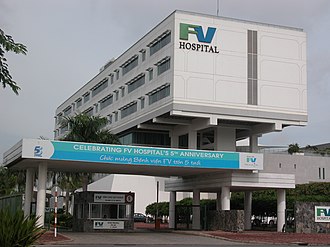 Franco-Vietnamese Hospital in District 7, Ho Chi Minh City.

![City International Hospital is an international hospital in Ho Chi Minh City and Vietnam[130]](https://en.wikipedia.org/wiki/File:City_International_Hospital_Vietnam.jpg)


Education
[edit]High schools
[edit]Notable high schools in the city include Lê Hồng Phong High School for the Gifted, Phổ Thông Năng Khiếu High School for the Gifted, Trần Đại Nghĩa High School for the Gifted, Nguyễn Thượng Hiền High School, Nguyễn Thị Minh Khai High School, Gia Định High School [vi], Lê Quý Đôn High School [vi], Marie Curie High School, Võ Thị Sáu High School, Trần Phú High School and others. Though the former schools are all public, private education is also available in Ho Chi Minh City. High school consists of grade 10–12 (sophomore, junior, and senior).[131]
List of public high schools (non-exhaustive)
[edit]- VNUHCM High School for the Gifted
- Lê Hồng Phong High School for the Gifted
- Trần Đại Nghĩa High School for the Gifted
- Nguyễn Thượng Hiền High School
- Nguyễn Thị Minh Khai High School
- Bùi Thị Xuân High School
- Phú Nhuận High School
- Trần Phú High School
- Bình Phú High School
- Gia Định High School [vi]
- Mạc Đĩnh Chi High School
- Lê Quý Đôn High School [vi]
- Nguyễn Du Secondary School
- Nguyễn Hữu Cầu High School
- Nguyễn Hữu Huân High School
- Marie Curie High School
- Võ Thị Sáu High School
- Võ Trường Toản High School
- Hùng Vương High School
- Chu Văn An High School
- Trưng Vương High School
- Lương Thế Vinh High School
- Trần Khai Nguyên High School
- Ten Lơ Man High School
- Nguyễn Trãi High School
- Nguyễn Khuyến High School
- Nguyễn Du High School
- Nguyễn Công Trứ High School
- Trần Hưng Đạo High School
- Nguyễn Chí Thanh High School
- Nguyễn Thái Bình High School
- Thủ Đức High School
- Nguyễn Văn Cừ High School
- Nguyễn Thị Diệu High School
- Ernst Thalmann High School
- Lawrence S. Ting Memorial School
Private high schools offering Vietnamese or dual foreign-Vietnamese curricula (non-exhaustive)
[edit]- Pennsylvania American International School
- Western Australian International School System
- APU International School
- Japanese International School
- Wellspring International Bilingual School Ho Chi Minh City
- Singapore International School
- Horizon International Bilingual School
- Vinschool
- EMASI International Bilingual School
- VStar School
- Horizon International Bilingual School
- Ngô Thời Nhiệm High School
- Nguyễn Khuyến High School
- Khai Trí High School
- Quang Trung Nguyễn Huệ High School
- Trí Đức High School
- Trương Vĩnh Ký High School
- Vinschool
- Hồng Hà Secondary-High School
- Tuệ Đức Pathway School
Private primary and secondary schools offering exclusively foreign curricula (non-exhaustive)
[edit]- ABC International School
- American International School, Saigon
- British International School Ho Chi Minh City
- British Vietnamese International School
- International School Ho Chi Minh City
- International School Ho Chi Minh City - American Academy
- Saigon South International School
- Australian International School, Vietnam
- European International School Ho Chi Minh City
- Canadian International School Vietnam
- International German School Ho Chi Minh City
- Korean International School, HCMC
- Japanese School in Ho Chi Minh City
- Lycée Français International Marguerite Duras
- Saigon South International School
- Taipei School in Ho Chi Minh City
- Renaissance International School Saigon
- Vietnam Finland International School
- International School of North America
Universities
[edit]
Higher education in Ho Chi Minh City is a burgeoning industry; the city boasts over 80 universities and colleges with a total of over 400,000 students.[72] Notable universities include Vietnam National University, with 50,000 students distributed among six schools; The University of Technology (Đại học Bách khoa, formerly Phú Thọ National Center of Technology); The University of Sciences (formerly Saigon College of Sciences); The University of Social Sciences and Humanities (formerly Saigon College of Letters); The International University; The University of Economics and Law; and the newly established University of Information Technology.
Some other important higher education establishments include University of Pedagogy, University of Economics, University of Architecture, Pham Ngoc Thach University of Medicine, Nong Lam University (formerly University of Agriculture, Forestry and Silviculture), University of Law, University of Technical Education, University of Banking, University of Industry, Open University,[132] University of Sports and Physical Education, University of Fine Arts, University of Culture, the Conservatory of Music, the Saigon Institute of Technology, Văn Lang University, Saigon University, and Hoa Sen University.
In addition to the above public universities, Ho Chi Minh City is also home to several private universities. One of the most notable is RMIT International University Vietnam, a campus of Australian public research RMIT University with an enrollment of about 6,000 students. Tuition at RMIT is about US$40,000 for an entire course of study.[133] Other private universities include The Saigon International University (or SIU) is another private university run by the Group of Asian International Education.[134] Enrollment at SIU averages about 12,000 students[135] Depending on the type of program, tuition at SIU costs US$5,000–6,000 per year.[136]
Tourism
[edit]
Tourist attractions in the city are mainly related to periods of French colonisation and the Vietnam War. The city's centre has some wide American-style boulevards and a few French colonial buildings. The majority of these tourist spots are located in District 1 and are a short distance from each other. The most prominent structures in the city centre are the Reunification Palace (Dinh Thống Nhất), City Hall (Ủy ban nhân dân Thành phố), Municipal Theatre (Nhà hát thành phố, also known as the Opera House), City Post Office (Bưu điện thành phố), State Bank Office (Ngân hàng Nhà nước), City People's Court (Tòa án nhân dân thành phố), and Notre-Dame Cathedral (Nhà thờ Đức Bà Sài Gòn), which was constructed between 1863 and 1880. Some of the historic hotels include the Hotel Majestic, dating from the French colonial era, and the Rex and Caravelle hotels, both of which are former hangouts for American officers and war correspondents in the 1960s & '70s.[137]
The city has various museums including the City Museum, Museum of History, the Revolutionary Museum, the Museum of south-eastern Armed Forces, the War Remnants Museum, the Museum of Southern Women, the Museum of Fine Arts, the Nhà Rồng Memorial House, and the Bến Dược Relic of Underground Tunnels. The Củ Chi tunnels are north-west of the city in Củ Chi District. The Saigon Zoo and Botanical Gardens, in District 1, dates from 1865. The Đầm Sen Tourist and Cultural Park, Suối Tiên Amusement and Culture Park, and Cần Giờ's Eco beach resort are three recreational sites inside the city which are popular with tourists. Aside from the Municipal Theatre, there are other places of entertainment such as the Bến Thành Theatre, Hòa Bình Theatre, and the Lan Anh Music Stage. The city is home to hundreds of cinemas and theatres, with cinema and drama theatre revenue accounting for 60–70% of Vietnam's total revenue in this industry.[citation needed] Unlike other theatrical organisations found in Vietnam's provinces and municipalities, residents of the city keep their theatres active without the support of subsidies from the Vietnamese government. The city is also home to most of the private film companies in Vietnam.[citation needed]
Like many of Vietnam's smaller cities, the city boasts a multitude of restaurants serving typical Vietnamese dishes such as phở or rice vermicelli. Backpacking travellers most often frequent the "Backpackers' Quarter" on Phạm Ngũ Lão Street and Bùi Viện Street, District 1.[138]
It was approximated that 4.3 million tourists visited Vietnam in 2007, of which 70 percent, approximately 3 million tourists, visited the city.[139] According to the most recent international tourist statistic, Ho Chi Minh City welcomed 6 million tourists in 2017.[140]
According to Mastercard's 2019 report, the city is also the country's second most visited city (18th in Asia Pacific), with 4.1 million overnight international visitors in 2018 (after Hanoi with 4.8 million visitors).[141]
In H12025, HCMC welcomed over 22.1 million visitors (3.8 million international and 18.3 million domestic), generating approximately ₫118 trillion (~US $4.6 billion), a +27.3% year-over-year growth.[142] Over the Tet 2025 holiday, the city led all Vietnamese provinces in tourism receipts with ~$303 million, up 17% from 2024.[143] In September 2025, HCMC is hosting ITE HCMC 2025 which focuses on sustainable tourism and trade networking and is the 19th of its kind.[144][145]
Culture
[edit].jpg)
Museums and art galleries
[edit]Due to its history, artworks have generally been inspired by both Western and Eastern styles. Famous locations for art in Ho Chi Minh City include Ho Chi Minh City Museum of Fine Arts, and various art galleries located on Nam Kỳ Khởi Nghĩa street, Trần Phú street, and Bùi Viện street.[146]
_(2).jpg)


Food and drink
[edit]Ho Chi Minh City cultivates a strong food and drink culture with lots of roadside restaurants, coffee shops, and food stalls where locals and tourists can enjoy local cuisine and beverages at low prices.[147] It is currently ranked in the top five best cities in the world for street food.[148]
Media
[edit]
The city's media is the most developed in the country. At present, there are seven daily newspapers: Sài Gòn Giải Phóng (Liberated Saigon), and its Vietnamese, investment and finance, sports, evening, and weekly editions; Tuổi Trẻ (Youth), the highest circulation newspaper in Vietnam; Thanh Niên (Young People), the second largest circulation in the south of Vietnam; Người Lao Động (Labourer); Thể Thao (Sports); Pháp Luật (Law); The Saigon Times Daily, an English-language newspaper; as well as more than 30 other newspapers and magazines. The city has hundreds of printing and publishing houses, many bookstores, and a widespread network of public and school libraries; the city's General Library houses over 1.5 million books. Once called THVN9, the locally based Ho Chi Minh City Television (HTV) is the first and the second largest television network in the nation, just behind the national Vietnam Television (VTV), broadcasting 24/7 on 7 different channels (using analog and digital technology). Vietnam Television also has a studio in the city which broadcast programmes on channel VTV9.[149] Many major international TV channels are provided through two cable networks (SCTV and HTVC), with over one million subscribers. The Voice of Ho Chi Minh City is the largest radio station in south Vietnam.[citation needed]
Internet coverage, especially through ADSL connections, is rapidly expanding, with over 2,200,000 subscribers and around 5.5 million frequent users. Internet service providers (ISPs) operating in Ho Chi Minh City include the Vietnam Data Communication Company (VDC), Corporation for Finance and Promoting Technology (FPT), Netnam Company, Saigon Post and Telecommunications Services Corporation (Saigon Postel Corporation, SPT) and Viettel Company. The city has more than two million fixed telephones and about fifteen million cellular phones (the latter growing annually by 20%). Mobile phone service is provided by a number of companies, including Viettel Mobile, MobiFone, VinaPhone, and Vietnam Mobile.
Sport
[edit]
As of 2005[update], Ho Chi Minh City was home to 91 football fields, 86 swimming pools, and 256 gyms.[150] The largest stadium in the city is the 15,000-seat Thống Nhất Stadium, located on Đào Duy Từ Street, in Ward 6 of District 10. The next largest is Military Region 7 Stadium, located near Tan Son Nhat Airport in Tân Bình district. The Military Region 7 Stadium was of the venues for the 2007 AFC Asian Cup finals. As well as being a sporting venue, it is also the site of a music school. Phú Thọ Racecourse, another notable sporting venue established during colonial times, is the only racetrack in Vietnam, however, due to poor maintenance, the facilities are not in good condition.[151] The city's Department of Physical Education and Sport also manages a number of clubs, including Phan Đình Phùng, Thanh Đa, and Yết Kiêu.
The city is home to a number of association football clubs. One of the city's largest clubs, Ho Chi Minh City F.C., is based at Thống Nhất Stadium, formerly as Cảng Sài Gòn, they were four-time champions of Vietnam's V.League 1 (in 1986, 1993–94, 1997, and 2001–02). Navibank Saigon F.C., founded as Quân Khu 4, were also based at Thống Nhất Stadium, emerged as champions of the First Division in the 2008 season, and were promoted to the V-League in 2009, the club has since been dissolved during a corruption scandal.[152] The city's police department also fielded a football team in the 1990s, Công An Thành Phố, which won the V-League championship in 1995, the club was dissolved in 2002 as the league become more professional. Since its inception in 2016, Sài Gòn F.C. competed in V.League 1, however, in 2022 they suffered relegation and will complete in V.League 2 in 2023.
In 2011, the city was awarded an expansion team for the ASEAN Basketball League.[153] Saigon Heat was the first ever international professional basketball team to represent Vietnam.[154] The team also plays in the domestic basketball league, the Vietnam Basketball Association, and have won the championship on three occasions (2019, 2020 and 2022).
In 2016, a second professional basketball team was created, Wings, playing in the domestic Vietnam Basketball Association.
The city hosts a number of international sport events throughout the year, such as the AFF Futsal Championship and the Vietnam Vertical Run. Several other sports are represented by teams in the city, such as Irish (Gaelic) Football, rugby, cricket,[155] volleyball, basketball, chess, athletics, and table tennis.[156]
International relations
[edit]Twin towns – sister cities
[edit]The city is twinned with:[157]
 Ahmadi Governorate, Kuwait (2010)
 Almaty, Kazakhstan (2011)
 Auvergne-Rhône-Alpes, France (1998)
 Bangkok, Thailand (2014)
 Champasak Province, Laos (2001)
 Busan, South Korea (1995)
 Guangdong Province, China (2009)
- Guangxi Zhuang Autonomous Region, China (2013)
 Leipzig, Germany (2021)[158]
- Lyon, France (1997)
 Seattle, United States (2023)
 Manila, Philippines (1994)
 Minsk, Belarus (2008)
 Moscow, Russia (2003)
- New York City, United States (2023)[159]
 Osaka Prefecture, Japan (2007)
 Phnom Penh, Cambodia (1999)
- Saint Petersburg, Russia (2005)
- San Francisco, United States (1995)
- Shandong Province, China (2013)
- Shanghai, China (1994)
 Sofia, Bulgaria (2015)
- Vientiane, Laos (2001)
- Vladivostok, Russia (2009)
 Yangon, Myanmar (2012)
- Zhejiang Province, China (2009)


Cooperation and friendship
[edit]In addition to its twin towns, the city is in cooperation with:[157]
 Barcelona, Spain (2009)
 Budapest, Hungary (2013)
- Daegu, South Korea (2015)
 Geneva, Switzerland (2007)
- Guangzhou, China (1996)
 Johannesburg, South Africa (2009)
 Košice, Slovakia (2016)[160]
- Moscow Oblast, Russia (2015)
 Northern Territory, Australia (2014)
- Osaka, Japan (2011)
- Queensland, Australia (2005)
- Seville, Spain (2009)
- Shenyang, China (1999)
- Shiga Prefecture, Japan (2014)
- Sverdlovsk Oblast, Russia (2000)
 Toronto, Canada (2006)
- Yokohama, Japan (2009)


See also
[edit]
Notes
[edit]- ^ Nominally and partially independent until 4 June 1954 as an associated state of France[9]
- ^ Vo, Nghia M., ed. (2009). The Viet Kieu in America: Personal Accounts of Postwar Immigrants from Vietnam. McFarland. p. 218. ISBN 978-0-7864-5490-7.
Saigon began as the Cham village of Baigaur, then became the Khmer Prey Nôkôr before being taken over by the Vietnamese and renamed Gia Dinh Thanh and then Saigon.
- ^ The text of the resolution is as follows:
"By the National Assembly of the Socialist Republic of Vietnam, 6th tenure, 1st session, for officially renaming Saigon-Gia Dinh City as Ho Chi Minh City.
The National Assembly of the Socialist Republic of Vietnam Considering the boundless love of the people of Saigon-Gia Dinh City for Chairman Ho Chi Minh and their wish for the city to be named after him;
Considering the long and difficult revolutionary struggle launched in Saigon-Gia Dinh City, with several glorious feats, deserves the honour of being named after Chairman Ho Chi Minh;
After discussing the suggestion of the Presidium of the National Assembly's meeting;(PNAM)
Decides to rename Saigon-Gia Dinh City as Ho Chi Minh City."[17] - ^ "The Khmer name for Saigon, by the way, is Prey Nokor; prey means forest, nokor home or city."[21]
- ^ "Un siècle plus tard (1773), la révolte des TÁYON (sic) [qu'éclata] tout, d'abord dans les montagnes de la province de Qui-Nhon, et s'étendit rapidement dans le sud, chassa de Bien-Hoa le mouvement commercial qu'y avaient attiré les Chinois. Ceux-ci abandonnèrent Cou-lao-pho, remontèrent de fleuve de Tan-Binh, et vinrent choisir la position actuele de CHOLEN. Cette création date d'environ 1778. Ils appelèrent leur nouvelle résidence TAI-NGON ou TIN-GAN. Le nom transformé par les Annamites en celui de SAIGON fut depuis appliqué à tort, par l'expédition française, au SAIGON actuel dont la dénomination locale est BEN-NGHE ou BEN-THANH."[22]
- ^ The text of the resolution is as follows:
"By the National Assembly of the Socialist Republic of Vietnam, 6th tenure, 1st session, for officially renaming Saigon-Gia Dinh City as Ho Chi Minh City.
The National Assembly of the Socialist Republic of Vietnam Considering the boundless love of the people of Saigon – Gia Dinh City for Chairman Ho Chi Minh and their wish for the city to be named after him;
Considering the long and difficult revolutionary struggle launched in Saigon–Gia Dinh City, with several glorious feats, deserves the honour of being named after Chairman Ho Chi Minh;
After discussing the suggestion of the Presidium of the National Assembly's meeting;
Decides to rename Saigon-Gia Dinh City as Ho Chi Minh City."[17]
References
[edit]- ^ Cherry, Haydon (2019). Down and Out in Saigon: Stories of the Poor in a Colonial City. Yale University Press. p. 29. ISBN 978-0-300-21825-1.
- ^ "Chi tiết 34 ĐƠN VỊ HÀNH CHÍNH CẤP TỈNH".
- ^ Biểu số 4.5: Hiện trạng sử dụng đất vùng Đông Nam Bộ năm 2022 [Table 4.5: Current land use status in the Southeast region in 2022] (PDF) (Decision 3048/QĐ-BTNMT) (in Vietnamese). Ministry of Natural Resources and Environment (Vietnam). 18 October 2023. – the data in the report are in hectares, rounded to integers
- ^ a b xaydungchinhsach.chinhphu.vn. "Chi tiết 34 ĐƠN VỊ HÀNH CHÍNH CẤP TỈNH từ 12/6/2025". xaydungchinhsach.chinhphu.vn (in Vietnamese). Archived from the original on 22 June 2025. Retrieved 25 June 2025.
- ^ "TelluBase—Viet Nam Fact Sheet" (PDF). Tellusant Public Service Series. Retrieved 31 July 2024.
- ^ "Human Development Index by province(*) by Cities, provincies and Year". General Statistics Office of Vietnam. Retrieved 28 September 2024.
- ^ Trang, Huyền (20 March 2023). "Đóng góp của các tỉnh, thành phố về một số chỉ tiêu chủ yếu". kinhtetrunguong.vn (in Vietnamese). Retrieved 7 January 2024.
- ^ Onishi, Tomoya. "Vietnam to boost Ho Chi Minh budget for first time in 18 years". Nikkei Asia. Retrieved 30 August 2022. (Subscription required.)
- ^ "Vietnam, indépendance, Digithèque MJP".
- ^ "Military land approved for new Tan Son Nhat airport terminal". VnExpress. Retrieved 30 August 2022.
- ^ "Three Vietnamese seaports among top 100 largest container ports worldwide". General Statistics Office of Vietnam. Retrieved 27 December 2023.
- ^ www.reseau-asie.com https://web.archive.org/web/20110715174952/http://www.reseau-asie.com/cgi-bin/prog/gateway.cgi?langue=fr&password=&email=&dir=myfile_colloque&type=jhg54gfd98gfd4fgd4gfdg&id=430&telecharge_now=1&file=a09dolinski_michel.pdf. Archived from the original (PDF) on 15 July 2011. Retrieved 30 May 2025.
{{cite web}}: Missing or empty|title=(help) - ^ Vo, Nghia M. (2011). Saigon: A History. McFarland. pp. 7–8. ISBN 978-0-7864-6466-1.
- ^ a b c Salkin, Robert M.; Ring, Trudy (1996). Schellinger, Paul E.; Salkin, Robert M. (eds.). Asia and Oceania. International Dictionary of Historic Places. Vol. 5. Taylor & Francis. pp. 353–354. ISBN 1-884964-04-4.
- ^ "Comprehensive Map of Vietnam's Provinces". World Digital Library. UNESCO. 1890. Archived from the original on 30 June 2011. Retrieved 13 April 2011.
- ^ Trần Hoàng Vũ (2024). "Gia Định Thành trước cơn bão dữ".
- ^ a b "From Saigon to Ho Chi Minh City". People's Committee of Ho Chi Minh City. Archived from the original on 7 February 2011. Retrieved 15 June 2010.
- ^ 梁 Lương, 竹潭 Trúc Đàm (1908). "南國地輿教科書 Nam quốc địa dư giáo khoa thư". Nom Foundation.
- ^ Vo 2011, p. 9
- ^ Ky, Pétrus (1885). "Souvenirs historiques sur Saigon et ses environs" (PDF). Excursions et Reconnaissance (in French). Vol. X. Saigon: Imprimerie Coloniale. Archived (PDF) from the original on 20 May 2021. Retrieved 20 May 2021.
- ^ Norodom Sihanouk (1980). War and hope: the case for Cambodia. Pantheon Books. p. 54. ISBN 0-394-51115-8.
- ^ Francis Garnier, quoted in: Hồng Sến Vương, Q. Thắng Nguyễn (2002). Tuyển tập Vương Hồng Sến. Nhà xuất bản Văn học. Archived from the original on 5 May 2010. Retrieved 9 September 2017.
- ^ "Historic Figures: Hồ Chí Minh (1890–1969)". BBC. Archived from the original on 22 January 2010. Retrieved 1 June 2010.
- ^ Sinha, Sayoni (4 July 2019). "Craft brews and skyline views the ultimate Ho Chi Minh City itinerary". National Geographic. Archived from the original on 5 July 2019. Retrieved 23 November 2019.
- ^ a b c d Corfield, Justin (2014). Historical Dictionary of Ho Chi Minh City. Anthem Press. p. xvii. ISBN 978-1-78308-333-6. Archived from the original on 28 October 2018. Retrieved 27 October 2018.
- ^ Vo 2011, pp. 8, 12
- ^ Song, Jeong Nam, Sự mở rộng lãnh thổ Đại Việt dưới thời Hậu Lê và tính chất, Korean University of Foreign Studies, Seoul, 2010, p.22
- ^ "Chúa Nguyễn cử thống suất Nguyễn Hữu Cảnh vào Nam kinh lược". HCM CityWeb (in Vietnamese). Archived from the original on 18 May 2007. Retrieved 19 May 2021.
- ^ Harms, Erik (2011). Saigon's Edge: On the Margins of Ho Chi Minh City. Minnesota: University of Minnesota Press. p. 11. ISBN 978-0-8166-5605-9.
- ^ a b Song, Jeong Nam, Sự mở rộng lãnh thổ Đại Việt dưới thời Hậu Lê và tính chất, Korean University of Foreign Studies, Seoul, 2010, p.23
- ^ Vo 2011, p. 36
- ^ McLeod, Mark W. (1991). The Vietnamese Response to French Intervention, 1862–1874. New York: Praeger. p. 10. ISBN 978-0-275-93562-7.
- ^ a b Vo 2011, p. 56
- ^ Corfield 2014, p. xix
- ^ Vo 2011, pp. 75, 85–86
- ^ Corfield 2014, pp. xix−xx
- ^ Vo 2011, p. 82
- ^ Bogle, James E. (January 1972). Dialectics of Urban Proposals for the Saigon Metropolitan Area (PDF). Ministry of Public Works, Republic of Vietnam; United States Agency for International Development. p. 11. Archived from the original (PDF) on 20 May 2021. Retrieved 20 May 2021.
- ^ Vo 2011, pp. 1, 77
- ^ Corfield 2014, p. xxi
- ^ a b Banens, Maks; Bassino, Jean-Pascal; Egretaud, Eric (1998). Estimating population and labour force in Vietnam under French rule (1900–1954). Montpellier: Paul Valéry University. Archived from the original on 3 April 2012. Retrieved 20 May 2021.
- ^ Taylor, K. W. (2013). A History of the Vietnamese. Cambridge University Press. p. 547. ISBN 978-0-521-87586-8.
- ^ a b Vo 2011, p. 130
- ^ a b c d e f Tucker, Spencer C., ed. (2011). "Saigon". The Encyclopedia of the Vietnam War: A Political, Social, and Military History. Vol. III (2nd ed.). California: ABC-CLIO. pp. 1010–1011. ISBN 978-1-85109-960-3.
- ^ a b c d "Sài Gòn dưới thời Mỹ Ngụy". HCM CityWeb (in Vietnamese). Archived from the original on 18 May 2007. Retrieved 19 May 2021.
- ^ a b c d "Lịch sử vùng đất" (in Vietnamese). Ho Chi Minh City Cooperative Alliance. Archived from the original on 7 September 2005. Retrieved 22 May 2021.
- ^ Bogle 1972, p. 14
- ^ Bogle 1972, p. 13
- ^ Bogle 1972, p. 31
- ^ Vo 2011, pp. 129–130
- ^ Woollacott, Martin (21 April 2015). "Forty years on from the fall of Saigon: witnessing the end of the Vietnam war". The Guardian. Archived from the original on 1 May 2017. Retrieved 14 December 2016.
- ^ Đoàn Loan; Viết Tuân (9 December 2020). "Thành lập thành phố Thủ Đức". VnExpress (in Vietnamese). Archived from the original on 9 December 2020. Retrieved 22 May 2021.
- ^ "Fifteen years on from the horrors of catastrophic blaze that rocked Saigon – VnExpress International". VnExpress International – Latest news, business, travel and analysis from Vietnam.
- ^ Truong, Truong Hoang; Thao, Truong Thanh; Tung, Son Thanh (2017). Housing and Transportation in Vietnam's Ho Chi Minh City (PDF). Hanoi: Friedrich Ebert Foundation. p. 2. Archived (PDF) from the original on 22 May 2021. Retrieved 22 May 2021.
- ^ "Cost of Living City Ranking 2024". www.mercer.com. Retrieved 8 July 2025.
- ^ "World Cities 2024". GaWC. Retrieved 8 July 2025.
- ^ "Cổng thông tin điện tử Bộ Kế hoạch và Đầu tư". mpi.gov.vn. Archived from the original on 16 May 2021. Retrieved 16 May 2021.
Độ cao trung bình so với mặt nước biển: nội thành là 5 m, ngoại thành là 16 m.
- ^ Murray, N.J.; Clemens, R.S.; Phinn, S.R.; Possingham, H.P.; Fuller, R.A. (2014). "Tracking the rapid loss of tidal wetlands in the Yellow Sea" (PDF). Frontiers in Ecology and the Environment. 12 (5): 267–272. Bibcode:2014FrEE...12..267M. doi:10.1890/130260. Archived (PDF) from the original on 7 December 2021. Retrieved 21 August 2021.
- ^ "Flood management in Ho Chi Minh City, Vietnam". royalhaskoningdhv.com. Archived from the original on 20 September 2020. Retrieved 18 June 2020.
- ^ Vnexpress. "Saigon braces for more record tides this year – VnExpress International". VnExpress International – Latest news, business, travel and analysis from Vietnam. Archived from the original on 4 June 2020. Retrieved 18 June 2020.
- ^ "Can coastal cities turn the tide on climate change flooding risk?". mckinsey.com. Archived from the original on 16 June 2020. Retrieved 18 June 2020.
- ^ a b "Vietnam Building Code Natural Physical & Climatic Data for Construction" (PDF) (in Vietnamese). Vietnam Institute for Building Science and Technology. Archived from the original (PDF) on 22 July 2018. Retrieved 23 July 2018.
- ^ a b "World Weather Information Service – Ho Chi Minh City". World Meteorological Organization. Archived from the original on 29 July 2013. Retrieved 5 September 2012.
- ^ a b c d e f g "Viet Nam: Ha Noi and Ho Chi Minh City Power Grid Development Sector Project" (PDF). Asian Development Bank. Archived from the original (PDF) on 23 July 2018. Retrieved 27 January 2015.
- ^ "Resolution No. 1685/NQ-UBTVQH15 on the Arrangement of Commune-Level Administrative Units in Ho Chi Minh City in 2025". xaydungchinhsach.chinhphu.vn. 20 June 2025.
- ^ 01.04.1999
01.10.2004
01.04.2009
01.04.2019 - ^ TỔNG CỤC THỐNG KÊ Archived 3 October 2018 at the Wayback Machine __gso.gov.vn
- ^ Tổng điều tra dân số và nhà ở năm 2009 Archived 10 October 2018 at the Wayback Machine __gso.gov.vn
- ^ GENERAL STATISTICS OFFICE of VIET NAM Archived 27 September 2018 at the Wayback Machine __gso.gov.vn
- ^ "Report on Results of the 2019 Census". General Statistics Office of Vietnam. Archived (PDF) from the original on 9 May 2020. Retrieved 1 May 2020.
- ^ "Ho Chi Minh City Population 2025". worldpopulationreview.com. Retrieved 8 July 2025.
- ^ a b c d "Statistical office in Ho Chi Minh City". Pso.hochiminhcity.gov.vn. Archived from the original on 3 April 2010. Retrieved 3 April 2010.
- ^ "General Statistics Office of Vietnam". Gso.gov.vn. Archived from the original on 16 July 2011. Retrieved 4 October 2010.
- ^ a b "Tong Cuc Thong Ke". Gso.gov.vn. Archived from the original on 4 April 2013. Retrieved 22 April 2013.
- ^ "Báo cáo sơ bộ Tổng điều tra Dân số và nhà ở 2019" [General statistics for Population and households investigation 2019] (in Vietnamese). General Statistics Office of Vietnam. Archived from the original on 13 November 2019. Retrieved 20 March 2020.
- ^ Vnexpress. "Guess how many people are jamming into Saigon? Hint: It's as bad as Tokyo – VnExpress International". VnExpress International – Latest news, business, travel and analysis from Vietnam. Archived from the original on 21 March 2018. Retrieved 21 March 2018.
- ^ Thảo Nguyên (17 August 2017). "Chủ tịch Nguyễn Thành Phong: Dự báo dân số Tp. Hồ Chí Minh đến năm 2025 là 10 triệu người nhưng nay đã đạt 13 triệu người (Chairman Nguyễn Thành Phong: The official population of Ho Chi Minh City is estimated to reach 10 million by 2025 but this number reached 13 million in 2017)". Trí thức trẻ. Archived from the original on 17 July 2018. Retrieved 17 July 2018.
- ^ "Quy hoạch xây dựng vùng Tp.HCM". VnEconomy. 25 April 2008. Archived from the original on 10 June 2008. Retrieved 18 June 2008.
- ^ "Menelusuri jejak keturunan Indonesia asal Bawean di Vietnam". www.bbc.com (in Indonesian). 2 August 2015. Retrieved 23 May 2023.
- ^ "Cục thống kê – Tóm tắt kết quả điều tra dân số". Pso.hochiminhcity.gov.vn. 4 January 2001. Archived from the original on 23 September 2010. Retrieved 4 October 2010.
- ^ THE 2009 VIETNAM POPULATION AND HOUSING CENSUS Tổng cục Thống kê Việt Nam. Table 7, §79.
- ^ Statistics in 2005 Archived 13 November 2007 at the Wayback Machine on the city's official website.
- ^ Ho Chi Minh City Economics Institute Archived 15 April 2008 at the Wayback Machine
- ^ Hana R. Alberts (21 December 2009). "Forbes profile of Vietnam". Forbes. Archived from the original on 14 May 2012. Retrieved 24 April 2012.
- ^ Hàn Ni, "TPHCM dẫn đầu thu hút vốn FDI vì biết cách bứt phá" Archived 15 April 2009 at the Wayback Machine. Sài Gòn giải phóng, 2007.
- ^ "TPHCM sau 1 năm gia nhập WTO – Vượt lên chính mình..." Archived 4 April 2008 at the Wayback Machine, Trung tâm thông tin thương mại.
- ^ Minh Anh. "Sài Gòn trong mắt bạn trẻ". TUOI TRE ONLINE (in Vietnamese). Archived from the original on 3 December 2020. Retrieved 17 March 2023.
- ^ "Ho Chi Minh City attracts record FDI in 2008". Archived from the original on 19 May 2009.
- ^ "10 điểm nổi bật trong tình hình kinh tế – xã hội TPHCM năm 2010". Bsc.com.vn. Archived from the original on 16 January 2013. Retrieved 24 April 2012.
- ^ VnExpress. "TP HCM đặt mục tiêu thu nhập bình quân 4.000 USD mỗi người". VnExpress. Archived from the original on 27 December 2012. Retrieved 5 January 2013.
- ^ "TÌNH HÌNH KINH TẾ XÃ HỘI Tháng 9 và 9 tháng năm 2013" [SOCIO-ECONOMIC SITUATION September and May 9, 2013] (in Vietnamese). Archived from the original on 22 October 2013. Retrieved 10 October 2013.
- ^ "GDP bình quân đầu người của TP Hồ Chí Minh đạt 5.131 USD – Hànộimới". Hanoimoi.com.vn. 23 November 2014. Archived from the original on 5 December 2014. Retrieved 29 May 2015.
- ^ etime.danviet.vn (16 October 2020). "GRDP bình quân đầu người TP. HCM năm 2020 ước đạt 6.328 USD". danviet.vn (in Vietnamese). Archived from the original on 10 February 2022. Retrieved 10 February 2022.
- ^ Mai, Ban (14 March 2021). "Vì sao Tp.HCM lỡ mục tiêu thu nhập đầu người 9.800 USD/năm?". Nhịp sống kinh tế Việt Nam & Thế giới (in Vietnamese).
- ^ Chỉ tiêu tổng hợp giai đoạn 2001–06 Archived 15 April 2009 at the Wayback Machine, Ho Chi Minh City government website. (Dead Link)
- ^ "Chinese state port operator's India and Vietnam acquisitions stall". Nikkei Asia. Archived from the original on 28 January 2021. Retrieved 30 January 2021.
- ^ "A primer on China's Belt and Road Initiative plans in South-east Asia". Archived from the original on 5 February 2021. Retrieved 30 January 2021.
- ^ Exchange rate from XE.com
- ^ "Chỉ số năng lực cạnh tranh cấp tỉnh (PCI)". pcivietnam.vn (in Vietnamese). Retrieved 24 August 2024.
- ^ the-shiv (13 August 2024). "Doing Business in Ho Chi Minh City, Vietnam 2024". the-shiv. Retrieved 24 August 2024.
- ^ "Tong Cuc Thong Ke". Gso.gov.vn. Archived from the original on 31 March 2012. Retrieved 24 April 2012.
- ^ "mofahcm" (in Vietnamese). mofahcm. Archived from the original on 31 January 2010. Retrieved 3 April 2010.
Số lượng khách quốc tế đến TPHCM đã đạt tới 3 triệu lượt người, tăng 14,6% so với năm 2006, chiếm 70% tổng lượng du khách đến VN... Lượng hàng hóa vận chuyển qua cảng đạt 50,5 triệu tấn...
- ^ "Charming French architecture in Saigon". Vietnam News Agency. 12 July 2019. Retrieved 30 August 2022.
- ^ "Cholon: A Little China in the heart of Saigon". French Academic Network for Asian Studies. Archived from the original on 15 June 2023. Retrieved 15 June 2023.
- ^ "How Vietnam Created Its Own Brand of Modernist Architecture". Saigoneer. Retrieved 15 June 2023.
- ^ "The Best Parks and Green Spaces in Ho Chi Minh City, Vietnam". Culture Trip. 26 February 2018. Retrieved 15 June 2023.
- ^ Vnexpress. "HCMC park gets land back from metro". VnExpress. Retrieved 15 June 2023.
- ^ Vnexpress. "Record revenues at Saigon Zoo after post-Covid reopening". VnExpress. Retrieved 15 June 2023.
- ^ Vnexpress. "HCMC's popular pedestrian street to get a green facelift". VnExpress. Retrieved 15 June 2023.
- ^ Vnexpress. "Saigon flower street all set to blossom for Tet". VnExpress. Retrieved 15 June 2023.
- ^ Vnexpress. "Foreigners a common sight again at Saigon tourist hotspots". VnExpress. Retrieved 15 June 2023.
- ^ "Guide To Ho Chi Minh City Nightlife 2023 | Sipping, Dancing & More – Vietnam Travel Blog". All About Vietnam Travel. 2 October 2023. Retrieved 5 October 2023.
- ^ M. Ha (13 October 2007). "Mở rộng sân bay Tân Sơn Nhất". BÁO SÀI GÒN GIẢI PHÓNG (in Vietnamese). Archived from the original on 24 February 2009. Retrieved 17 March 2023.
- ^ Two more Hanoi<>Saigon flights per day for Pacific Airlines on Vietnamnet.net, accessdate 11 November 2007, (in Vietnamese) [1] Archived 22 April 2009 at the Wayback Machine
- ^ "Airport Development News" (PDF). Archived from the original (PDF) on 8 October 2006. Retrieved 19 May 2008.
- ^ "Train from Ho Chi Minh City – Ticket fare and Schedule | Vietnam Railways". vietnam-railway.com. Archived from the original on 31 March 2016. Retrieved 31 January 2017.
- ^ a b "Print Version". .mt.gov.vn. 29 May 2008. Archived from the original on 1 April 2012. Retrieved 24 April 2012.
- ^ "City to expand waterway transport". Vietnam News Service. 19 April 2010. Archived from the original on 21 April 2010. Retrieved 3 October 2017.
- ^ VnExpress. "Saigon River bus not convenient enough to lure commuters – VnExpress International". VnExpress International – Latest news, business, travel and analysis from Vietnam. Retrieved 31 August 2022.
- ^ "'Finally, we made it!': Ho Chi Minh City celebrates first metro". CNA. Archived from the original on 22 December 2024. Retrieved 22 December 2024.
- ^ a b "Ho Chi Minh City Metro". Railway-technology.com. Archived from the original on 4 May 2010. Retrieved 4 April 2010.
- ^ Dinh Muoi. "HCMC's subway route No.2 approved". Thanh Nien. Archived from the original on 21 May 2010. Retrieved 29 April 2010.
- ^ VnExpress. "November auto sales achieve year record – VnExpress International". VnExpress International – Latest news, business, travel and analysis from Vietnam. Archived from the original on 16 December 2020. Retrieved 17 December 2020.
- ^ Hans-Heinrich Bass, Thanh Trung Nguyen (April 2013). "Imminent gridlocks". dandc.eu. Archived from the original on 5 November 2013. Retrieved 7 May 2013.
- ^ "Dự án đường cao tốc TP.HCM – Trung Lương". Tedi.vn. Archived from the original on 6 May 2016. Retrieved 8 May 2016.
- ^ "Ngày 8/2 thông xe toàn cao tốc TP.HCM – Long Thành – Dầu Giây". VnExpress. Archived from the original on 8 May 2016. Retrieved 8 May 2016.
- ^ "International Hospitals and Clinics in Saigon – A Short Guide for Expats". Urban Sesame. 2 August 2022. Retrieved 15 August 2022.
- ^ World Association of Eye Hospitals (30 October 2023). "New members of the WAEH!". World Association of Eye Hospitals.
- ^ Hospital Management Asia (28 May 2025). "Vietnam's healthcare boom: Why global investors are eyeing a slice of the pie". thospitalmanagementasia.com. Retrieved 30 May 2025.
- ^ Travel & Leisure. "8 of the Cheapest Countries to Retire Around the World". travelandleisure.com. Retrieved 30 October 2024.
- ^ "High School Education system". Archived from the original on 28 April 2018.
- ^ "Ho Chi Minh City Open University". Ou.edu.vn. Archived from the original on 13 August 2004. Retrieved 3 April 2010.
- ^ "RMIT University website". Rmit.edu.vn. Archived from the original on 1 May 2012. Retrieved 24 April 2012.
- ^ "Saigon International University". siu.edu.vn. Archived from the original on 3 March 2013. Retrieved 2 March 2013.
- ^ "SIU Group of Asian International Education". siu.edu.vn. Archived from the original on 7 March 2013. Retrieved 2 March 2013.
- ^ "Schedule of Course Fees". siu.edu.vn. Archived from the original on 29 October 2008. Retrieved 2 March 2013.
- ^ In 2014, tourism revenue has hit VND 78.7 trillion (US$3.7 billion), up to 4 percent compared to the same period in 2013.
- ^ "Ho Chi Minh City backpackers' town – Tuoi Tre News". Tuoi Tre News. Archived from the original on 8 August 2016. Retrieved 23 June 2016.
- ^ [2] Archived 4 April 2008 at the Wayback Machine
- ^ TITC. "HCM City welcomes six millionth int'l visitor in 2017". Tổng cục Du lịch Việt Nam.
- ^ Vnexpress. "Mastercard lists Hanoi, HCMC among top 20 Asia-Pacific travel destinations". VNExpress. Archived from the original on 22 October 2019. Retrieved 13 November 2019.
- ^ "Ho Chi Minh City draws over 22 million visitors in first half of 2025". VOV.VN. 4 July 2025. Retrieved 8 July 2025.
- ^ "Vietnam's Tourism Boom During Tet 2025: Key Insights". Vietnam Briefing News. 3 February 2025. Retrieved 8 July 2025.
- ^ itehcmc (12 April 2025). "MEDIA BRIEFING ITE HCMC 2025 "SUSTAINABLE TOURISM, VIBRANT EXPERIENCES" AND VIET NAM INTERNATIONAL SOURCING & HO CHI MINH CITY EXPORT FORUM 2025". ITE HCMC. Retrieved 8 July 2025.
- ^ itehcmc (18 June 2025). "THE 19TH ITE HCMC IN 2025 AND SUSTAINABLE TOURISM". ITE HCMC. Retrieved 8 July 2025.
- ^ Kalmusky, Katie (20 May 2020). "The 6 Best Art Galleries in Ho Chi Minh City, Vietnam". Culture Trip. Retrieved 10 December 2022.
- ^ Guide, City Pass. "City Pass Guide". Why Is Food So Cheap in Vietnam?. Archived from the original on 4 May 2021. Retrieved 17 December 2020.
- ^ VnExpress. "Saigon among top five global cities for street food: survey – VnExpress International". VnExpress International – Latest news, business, travel and analysis from Vietnam. Archived from the original on 22 January 2021. Retrieved 17 December 2020.
- ^ "VTV9 and the journey to the audience's hearts". VTV.vn. 7 September 2017.
- ^ Exercise and sports Archived 30 December 2009 at the Wayback Machine. PSO Ho Chi Minh City.
- ^ "Cảnh xuống cấp tại nhà thi đấu hiện đại bậc nhất ở TP.HCM". ZingNews.vn. 25 July 2022.
- ^ ONLINE, TUOI TRE (29 October 2012). "Chính thức xóa sổ CLB Navibank Sài Gòn". TUOI TRE ONLINE.
- ^ "ASEAN Basketball League website". Aseanbasketballleague.com. 22 October 2011. Archived from the original on 27 December 2011. Retrieved 24 April 2012.
- ^ "SSA Saigon Heat Joins the AirAsia ASEAN Basketball League". ABL News. 20 October 2011. Archived from the original on 27 December 2011.
- ^ "Saigon Sports Clubs and Activities – with Men's and Women's Teams". Urbansesame.com. 15 March 2022. Retrieved 15 August 2022.
- ^ "Sports Clubs & Associations – Ho Chi Minh City Business Directory – Angloinfo". Angloinfo Ho Chi Minh City. Archived from the original on 16 May 2021. Retrieved 30 March 2021.
- ^ a b "Danh sách địa phương nước ngoài kết nghĩa với TpHCM" (in Vietnamese). Sở ngoại vụ Thành phố Hồ Chí Minh. Archived from the original on 7 June 2021. Retrieved 25 July 2021.
- ^ "Ho-Chi-Minh-Stadt". Stadt Leipzig. Archived from the original on 6 March 2023. Retrieved 16 April 2022.
- ^ "HCM City, New York establish sister city relationship". Government of Vietnam. 23 September 2023. Retrieved 24 September 2023.
- ^ "Partnerské mestá mesta Košice" (in Slovak). Košice. Archived from the original on 13 June 2021. Retrieved 25 July 2021.
Further reading
[edit]- Fleming, Tom (2021). "Hồ Chí Minh City". Việt Nam (PDF) (Report). Cultural Cities Profile East Asia. Hà Nội: British Council Vietnam. pp. 160–198. Archived (PDF) from the original on 28 April 2024. Retrieved 19 April 2025.
External links
[edit] Definitions from Wiktionary
 Media from Commons
 News from Wikinews
 Quotations from Wikiquote
 Texts from Wikisource
 Textbooks from Wikibooks
 Resources from Wikiversity
 Travel information from Wikivoyage


- Official website (in Vietnamese and English) (archived 18 February 2010)
- Ho Chi Minh City People's Council (archived 26 October 2015)
 Geographic data related to Ho Chi Minh City at OpenStreetMap

Places adjacent to Ho Chi Minh City | |
|---|---|


| |||||||||||||||||||||||||||||||||||||||||

| International | |
|---|---|
| National | |
| Geographic | |
| Other | |

Ho Chi Minh City
View on GrokipediaEtymology
Name Origins and Historical Designations
The territory comprising modern Ho Chi Minh City originated as a Khmer trading post known as Prey Nokor during the Khmer Empire's control over southern Vietnam, with the name translating to "forest city" or "forest kingdom" in Khmer—"prey" signifying forest and "nokor" derived from the Sanskrit term nagara for city or realm.[6][7] This designation persisted until the late 17th century, when Vietnamese forces under the Nguyễn lords conquered the area. In 1698, Nguyễn Hữu Cảnh, a Vietnamese military leader, reorganized the region into the administrative province of Gia Định, marking the formal incorporation into Vietnamese territory and shifting from Khmer to Vietnamese governance.[8][9] Gia Định served as the official provincial name, encompassing the urban core that would later develop into Saigon, and reflected the area's status as a frontier settlement under the Nguyễn dynasty. The name Sài Gòn, referring specifically to the city, entered Vietnamese records around 1776, with etymological theories attributing it to local vegetation—potentially combining "sài" (a type of firewood plant or kapok) and "gòn" (cotton or another shrub)—or to a corruption of the Chinese phrase "Tây Cống," interpreted as "tribute from the west" in reference to regional tribute practices.[10][9][7] Alternative hypotheses link it to Khmer influences or the nearby Chinese district of Chợ Lớn, originally called Tai-Ngon meaning "embankment," though these remain speculative without definitive archaeological corroboration.[3] Under French colonial administration, following the capture of the citadel in 1859 during the Cochinchina Campaign, the name was standardized in romanized form as Saigon, which became the official designation for the burgeoning capital of French Cochinchina by 1867.[8][11] This period solidified Saigon's identity as a key port and administrative hub, distinct from the broader Gia Định province, until the mid-20th century.[12]Political Renaming and Symbolism
Following the fall of Saigon to North Vietnamese forces on April 30, 1975, the city came under the control of the communist Provisional Revolutionary Government of the Republic of South Vietnam, which initially designated it as Sài Gòn–Gia Định to incorporate surrounding areas. On July 2, 1976, as part of the formal unification of North and South Vietnam into the Socialist Republic of Vietnam, the National Assembly decreed the official renaming to Thành phố Hồ Chí Minh (Ho Chi Minh City), honoring the late communist leader Hồ Chí Minh, who had died on September 2, 1969.[13] This act coincided with the broader restructuring of provincial boundaries, elevating the metropolitan area to provincial status while symbolically linking it to the revolutionary narrative.[14] The renaming carried explicit political symbolism, representing the triumph of communist forces over the U.S.-backed Republic of Vietnam and erasing associations with French colonial rule and southern capitalist governance, under which Saigon had served as the national capital since 1954. By invoking Hồ Chí Minh—the figurehead of Vietnamese communism who proclaimed independence from Japan and France in 1945—the new name aimed to unify national identity under Marxist-Leninist ideology and perpetuate his status as a symbol of anti-imperialist struggle, despite his limited direct involvement in southern urban affairs.[15] Vietnamese communist authorities framed it as commemorating southern sacrifices in the "liberation" effort, though this narrative overlooked the coerced nature of the change amid post-war reeducation campaigns and population displacements.[16] In practice, the name shift underscored ongoing divisions: imposed top-down without southern referendum, it provoked resentment among residents who viewed Saigon as a cultural and economic hub distinct from northern Hanoi. Many locals and the overseas Vietnamese diaspora persist in using "Saigon" to affirm pre-1975 heritage and reject communist legitimacy, with the dual nomenclature reflecting unresolved civil war legacies rather than full ideological assimilation. Official Vietnamese media upholds the Ho Chi Minh City designation to reinforce state unity, but informal usage of Saigon endures, as evidenced by its appearance in business names, music, and expatriate communities.[12][16]History
Pre-Colonial and Early Vietnamese Rule
The territory of present-day Ho Chi Minh City originated as Prey Nokor, a Khmer settlement under the Khmer Empire, deriving from Khmer terms "prey" for forest and "nokor" for city, reflecting its forested environs and modest scale as a trading outpost and fishing village.[6][17] In 1623, Khmer king Chey Chettha II permitted Vietnamese migrants, fleeing internal conflicts, to establish a customs post at Prey Nokor, initiating gradual Vietnamese influx amid the Khmer Empire's weakening grip on the Mekong Delta.[18] This paved the way for Vietnamese southward expansion, known as Nam tiến, culminating in the late 17th century when Nguyễn lords asserted dominance over the region, displacing Khmer authority through military campaigns and settlement.[18] In 1698, Nguyễn Hữu Cảnh, a commander under Lord Nguyễn Phúc Chu, formalized Vietnamese control by organizing the area into Gia Định prefecture, subdividing it into Phước Long and Tân Bình districts, with Sài Gòn (Saigon) designated as the administrative hub; he constructed fortifications, including a citadel, to secure the frontier against remnants of Khmer and other regional powers.[19][20] Under early Vietnamese rule, Sài Gòn evolved from a frontier garrison into a burgeoning port, fostering rice cultivation, riverine trade via the Saigon River, and immigration that swelled the population to tens of thousands by the mid-18th century, though it remained vulnerable to Siamese incursions and internal Nguyễn-Trịnh rivalries.[20] Following Nguyễn Ánh's unification victory in 1802 as Emperor Gia Long, Gia Định was elevated to provincial status within the Nguyễn dynasty, with enhanced irrigation works and a reinforced citadel underscoring its strategic role in consolidating southern territories against external threats.[19] ![Map of Gia Định in 1815][float-right] This era marked the transition from Khmer peripheral outpost to Vietnamese core settlement, driven by demographic pressures, agricultural expansion, and militarized administration rather than mere cultural assimilation.[18][20]French Colonial Development and Infrastructure
Following the French capture of Saigon Citadel on February 17, 1859, by Franco-Spanish forces, colonial administrators initiated systematic urban planning to transform the former Vietnamese fortress into a modern administrative and commercial hub modeled after European cities.[21] This involved expanding the city from its pre-colonial confines to approximately ten times its original size by incorporating surrounding marshlands and rural areas into a grid-based layout with wide, tree-lined boulevards such as Boulevard Norodom (now Lê Lợi Street) and public squares.[22] The Treaty of Saigon, signed on June 5, 1862, formalized French control over southern Vietnam (Cochinchina) and mandated the opening of ports to international trade, prompting immediate infrastructure investments to support export-oriented agriculture like rice and rubber. Dragon Wharf, the city's first commercial port facility on the Saigon River, was constructed between 1862 and 1863 to handle increased maritime traffic.[23] Railway development began with the inauguration of the Saigon–Mỹ Tho line on July 20, 1885, spanning 70 kilometers and marking the inaugural railway in French Indochina, designed to connect the port to inland rice-producing regions in the Mekong Delta for efficient resource extraction.[24] This narrow-gauge (meter) line facilitated the transport of agricultural goods to Saigon for export, integrating the delta's economy into global markets under colonial oversight. Subsequent extensions formed part of the broader North–South railway, with construction starting in 1899 from Saigon northward, though full completion to Hanoi took until 1936; these networks were built largely using corvée labor, requiring Vietnamese males to provide up to 30 days of unpaid work annually on public works. [25] Port enhancements elevated Saigon's maritime capacity, positioning it as the sixth-busiest port in the French Empire by 1937, handling substantial volumes of exports that underscored the colony's role in metropolitan France's imperial economy. Road networks complemented rail by linking urban centers to plantations and rural suppliers, with paved boulevards and bridges replacing earlier rudimentary paths to accommodate motor vehicles introduced in the early 20th century. Administrative buildings, including the Saigon City Hall (constructed 1898–1909) and the Municipal Theater (completed 1900), symbolized French architectural imposition while serving governance and cultural functions for the European settler community of several thousand.[26] [23] These developments prioritized colonial extraction and expatriate comfort, yielding measurable economic growth—such as rice exports rising from negligible pre-1859 levels to millions of tons annually by the 1930s—but at the cost of resource outflows to France and limited local technological transfer.[27]Japanese Occupation and Post-WWII Transition
Japanese forces occupied southern French Indochina, including Saigon, in July 1941, with troops entering the city on September 15, 1941, as part of a broader strategy to secure bases against Allied powers and China.[28][29] Approximately 140,000 Japanese soldiers were deployed across the region, including Saigon, though Vichy French colonial administration remained nominally in place until 1945, facilitating Japanese economic extraction of resources like rice and rubber.[30] This dual control led to tensions, as Japanese authorities imposed forced labor and requisitioned food supplies, contributing to shortages in urban centers like Saigon amid wartime disruptions.[28] On March 9, 1945, Japanese forces executed a coup d'état across Indochina, overthrowing French authorities in Saigon by arresting Governor-General Admiral Jean Decoux and key officials at his palace, driven by fears of French alignment with advancing Allies.[31][32] This shift dismantled French administrative structures, installing Japanese military governance and puppet Vietnamese organizations, while exacerbating local unrest through direct exploitation and propaganda efforts to promote anti-colonial sentiments.[28] Following Japan's surrender on August 15, 1945, a power vacuum emerged in Saigon, where communist-led Viet Minh forces, weaker in the south than in Hanoi, attempted uprisings as part of the broader August Revolution but faced fragmented opposition from groups like Cao Dai and Hoa Hao sects.[33] Japanese troops, still armed and present, initially maintained order and suppressed some local seizures of power, delaying Viet Minh control in the city.[33] British forces under Operation Masterdom arrived in Saigon on September 12, 1945, comprising Indian and British units led by General Douglas Gracey, tasked with disarming Japanese personnel per Potsdam Conference agreements designating southern Indochina as the British zone.[34] Gracey prioritized Allied objectives by rearming French colonial troops and facilitating their return, clashing with Viet Minh militants; on September 23, 1945, French forces, supported by British, reoccupied key sites in Saigon, sparking street fighting and raids that killed or arrested numerous Viet Minh members.[34][33] This transition solidified French reassertion in the south, setting the stage for the First Indochina War, as British withdrawals by early 1946 left French authorities dominant in Saigon amid ongoing insurgencies.[34]Independence Movements and National Division
Following the Japanese surrender on August 15, 1945, the Viet Minh, a communist-dominated front led by Ho Chi Minh, launched uprisings across Vietnam as part of the August Revolution, aiming to overthrow colonial and imperial rule. In Saigon, these efforts culminated in a large rally on August 22 at Tu Do Stadium (now Thong Nhat Stadium), where participants proclaimed the seizure of power from Japanese and French authorities, establishing a provisional Committee for the People's Administration of South Vietnam. However, local Viet Minh control proved short-lived, as French colonial forces, bolstered by British troops under Operation Masterdom to accept Japanese capitulation, launched attacks on September 22, raiding strongholds and arresting or killing numerous members, followed by a coup that overthrew the Saigon administration by September 23. French General Philippe Leclerc arrived soon after with reinforcements, reasserting colonial authority and imposing martial law on September 21 amid clashes that killed hundreds, including Vietnamese civilians and former Japanese prisoners used as auxiliaries.[33][35][36] The reimposition of French control in Saigon sparked the First Indochina War (1946–1954), during which the city functioned as the primary hub for French military operations and administration in southern Vietnam, relatively insulated from northern Viet Minh strongholds but subject to urban unrest, supply disruptions, and sporadic guerrilla actions by southern communists. Independence aspirations in the south diverged sharply from the north's Viet Minh model; while sharing anti-colonial sentiments, southern nationalists—often comprising urban elites, Catholics, and non-communist groups—viewed the Viet Minh's Marxist-Leninist agenda as a threat to private property, religion, and cultural traditions, leading many to collaborate with French forces or form rival organizations like the Cao Dai and Hoa Hao sects, which controlled rural enclaves and resisted both French and Viet Minh dominance. In 1949, France granted limited autonomy to the State of Vietnam under former emperor Bảo Đại, positioning Saigon as its de facto capital and framing it as a non-communist alternative to Ho Chi Minh's Democratic Republic of Vietnam in the north, though this entity remained dependent on French military protection and funding.[37][38][39] The war's climax at the Battle of Dien Bien Phu in May 1954, where Viet Minh forces defeated the French garrison after a 56-day siege involving over 50,000 troops and extensive artillery, prompted the Geneva Conference (April–July 1954), which produced accords partitioning Vietnam temporarily at the 17th parallel to facilitate ceasefires and civilian repatriation, with approximately 800,000 northerners—many Catholics and anti-communists—fleeing south to Saigon and surrounding areas by early 1955. Saigon, as the administrative center south of the demarcation line, became the seat of the State of Vietnam, which refused to endorse the accords due to provisions for nationwide elections in 1956 that southern leaders anticipated would favor the more organized Viet Minh; under Prime Minister Ngo Dinh Diem, who consolidated power via a referendum in October 1955 ousting Bảo Đại, the Republic of Vietnam was proclaimed with Saigon as capital, rejecting unification and establishing a separate anti-communist state backed by U.S. aid starting at $100 million annually. This division, intended as provisional, solidified into de facto national separation, reflecting southern priorities of preserving non-communist governance over immediate reunification under Hanoi’s control, amid ongoing Viet Minh infiltration and internal southern instability.[37][40][41]Vietnam War: Southern Perspectives and Conflict Dynamics
Southern Vietnamese, particularly in urban centers like Saigon, predominantly perceived the Vietnam War as a defensive effort against northern communist aggression rather than a domestic civil conflict. This viewpoint framed the conflict as an external invasion by the Democratic Republic of Vietnam (North Vietnam), supported by the National Liberation Front's (Viet Cong) insurgency in the South, with northern regulars infiltrating via the Ho Chi Minh Trail.[42][43] Leaders and civilians in the Republic of Vietnam (RVN) emphasized anti-communist motivations rooted in opposition to totalitarian ideology, including fears of mass executions and land reforms that had killed tens of thousands in the North during the 1950s.[44][45] Saigon, as the RVN capital, became a nexus of political stability and economic activity amid the war, with its population swelling from approximately 1.5 million in the early 1960s to around 3 million by the early 1970s due to rural refugees fleeing Viet Cong control and U.S. bombing campaigns. The influx, combined with U.S. military spending, fostered urban prosperity, including expanded commerce, infrastructure, and a vibrant service sector, though marred by inflation, black markets, and social issues like prostitution.[46] Southern perspectives often highlighted these benefits of U.S. alliance, viewing American involvement as essential to countering northern expansionism, with many residents expressing gratitude for the relative freedoms and economic opportunities unavailable under communist rule.[47] Conflict dynamics in the South blended guerrilla warfare by southern-based Viet Cong units with large-scale conventional assaults by North Vietnamese Army (NVA) forces, challenging RVN control over rural areas while sparing urban Saigon from sustained occupation until 1975. The Army of the Republic of Vietnam (ARVN), peaking at over 1 million personnel including about 287,000 combat troops by 1972, conducted pacification operations like the Phoenix Program to dismantle Viet Cong infrastructure, achieving mixed success amid corruption and desertions.[48] A pivotal event was the 1968 Tet Offensive, where Viet Cong and NVA forces launched coordinated attacks on Saigon and other cities on January 30, infiltrating key sites like the U.S. Embassy but suffering heavy losses—estimated at 30,000 to 40,000 killed—before being repelled by ARVN and U.S. forces within weeks, marking a tactical victory that bolstered southern morale despite eroding U.S. public support.[49][50] From southern viewpoints, ARVN effectiveness improved under Vietnamization after 1969, with units holding ground against the 1972 Easter Offensive until U.S. air intervention, though post-Paris Accords withdrawal of American aid in 1973-1975 exposed vulnerabilities to NVA's final conventional invasion. Oral histories from RVN veterans reveal a commitment to national survival, often portraying the war as a fight for democratic aspirations against northern dictatorship, countering narratives that dismissed southern agency as mere puppetry.[51][52] Urban Saigonese civilians, less sympathetic to Viet Cong ideology, supported government efforts through conscription compliance and intelligence provision, reflecting a causal divide where northern coercion contrasted with southern preferences for non-communist governance.[53]Fall of Saigon and Immediate Post-War Repercussions
North Vietnamese forces, advancing rapidly after the collapse of South Vietnamese defenses in the Central Highlands and Hue, encircled Saigon by April 16, 1975, prompting chaotic evacuations and the resignation of President Nguyen Van Thieu on April 21.[54] On April 29-30, Operation Frequent Wind, the largest helicopter evacuation in history, airlifted approximately 7,000 individuals—including U.S. personnel, diplomats, and select South Vietnamese allies—from rooftops and the U.S. Embassy to offshore ships, marking the abrupt end of American presence.[55] [56] By April 30, North Vietnamese tanks breached the gates of the Independence Palace, where South Vietnamese President Duong Van Minh, who had assumed office on April 28, offered unconditional surrender, effectively concluding the Vietnam War with minimal urban combat casualties in Saigon itself.[54] [57] The Provisional Revolutionary Government of the Republic of South Vietnam immediately assumed control, initiating a transitional administration that dismantled Republic of Vietnam institutions.[15] Saigon was formally renamed Ho Chi Minh City on July 2, 1976, via a National Assembly decision honoring the late North Vietnamese leader Ho Chi Minh, who died in 1969, as part of broader unification efforts under the Socialist Republic of Vietnam proclaimed on July 2, 1976.[7] This renaming symbolized the ideological triumph of communism but masked initial administrative disarray, including the seizure of private enterprises and land reforms that disrupted the city's market-driven economy.[58] Post-war repercussions included mass reeducation programs targeting former South Vietnamese military personnel, officials, and intellectuals, with an estimated 1 to 2.5 million individuals detained in remote camps involving forced labor and ideological indoctrination, contributing to significant human costs amid reports of harsh conditions and deaths numbering in the tens of thousands.[59] Economic policies of nationalization and collectivization, imposed without adaptation to southern commercial structures, led to hyperinflation exceeding 700% by 1978, widespread shortages, and a sharp decline in urban living standards, exacerbating famine risks already present from wartime disruptions.[58] Political repression prompted a refugee exodus, with over 800,000 "boat people"—primarily ethnic Chinese merchants and anti-communist dissidents—fleeing by sea from 1975 onward, facing high mortality from piracy and storms, as Southeast Asian nations initially refused landings.[59] [60] These outflows, peaking at 100,000 departures monthly by 1979, reflected causal links between communist consolidation policies and mass displacement, straining international resettlement systems.[59]Communist Governance: Stagnation and Reeducation Policies
Following the fall of Saigon on April 30, 1975, communist authorities in the newly renamed Ho Chi Minh City initiated widespread reeducation campaigns targeting former Republic of Vietnam officials, military personnel, intellectuals, and business owners perceived as threats to the regime.[61] These programs involved mass internments in remote camps, where detainees—estimated in the hundreds of thousands from southern urban centers like Saigon—underwent indefinite detention without formal charges or trials, often enduring forced labor in agriculture, jungle clearance, and infrastructure projects under harsh conditions including malnutrition and disease.[62][63] Conditions in these facilities, numbering around 90 to 100 across Vietnam, frequently led to high mortality rates, with survivors reporting psychological and physical tolls from isolation and ideological indoctrination sessions lasting years or even over a decade for some.[64][65] Parallel to reeducation efforts, economic governance emphasized rapid nationalization and collectivization, confiscating private enterprises in Ho Chi Minh City and redirecting resources northward, which dismantled the city's pre-war commercial vitality.[66] By 1976-1977, state takeovers affected thousands of businesses, including those in the ethnic Chinese-dominated Cholon district, turning it into a near-deserted area with shuttered markets and abandoned warehouses until partial reforms in the mid-1980s.[67] These policies eliminated private incentives, disrupted supply chains, and imposed rationing, resulting in chronic shortages of rice, fuel, clothing, and consumer goods throughout the late 1970s, exacerbating urban hunger in a city whose population had swelled with refugees.[68] The command economy's rigid central planning fostered stagnation, with agricultural and industrial output stagnating due to failed collectivization drives that ignored local knowledge and productivity signals.[69] By the early 1980s, hyperinflation compounded these issues, reaching rates over 700% annually amid fiscal deficits and monetary expansion, while production incentives remained suppressed, leading to widespread black markets and emigration waves from the city.[70][71] In Ho Chi Minh City, these measures contrasted sharply with its prior role as a dynamic trade hub, prioritizing ideological conformity over economic pragmatism until the 1986 Doi Moi shift.[72]Doi Moi Reforms and Economic Liberalization
The Đổi Mới reforms, formally adopted at the Communist Party of Vietnam's 6th National Congress in December 1986, initiated a transition from rigid central planning to a "socialist-oriented market economy," incorporating elements of private ownership, price deregulation, and incentives for foreign direct investment (FDI).[73] These measures addressed chronic shortages, hyperinflation exceeding 700% in 1986, and agricultural stagnation by allowing household farming contracts and enterprise autonomy.[73] In Ho Chi Minh City, previously burdened by post-war collectivization and reeducation policies, the reforms unlocked latent commercial potential rooted in the city's pre-1975 trading heritage, positioning it as Vietnam's primary engine for liberalization.[74] Ho Chi Minh City's municipal authorities rapidly implemented Đổi Mới directives, establishing the Tan Thuan Export Processing Zone in District 7 in 1991 as Vietnam's inaugural economic zone, which attracted garment, electronics, and food processing industries oriented toward export markets.[75] The 1987 Foreign Investment Law, enacted shortly after Đổi Mới, enabled joint ventures and 100% foreign-owned enterprises, channeling FDI into the southern region; by 1996, 52.8% of national FDI commitments—totaling billions in registered capital—flowed to southern provinces dominated by Ho Chi Minh City.[76] This influx supported infrastructure upgrades, including port expansions at Cat Lai and factory clusters, transforming the city from a subdued administrative center into a manufacturing and services hub with annual GRDP growth averaging over 8% in the 1990s.[75] By the early 2000s, liberalization effects compounded: Ho Chi Minh City's private sector expanded under the 1999 Enterprise Law, which simplified business registration and spurred small-to-medium enterprises in retail, real estate, and technology.[74] The city's GRDP reached approximately VND 1,371 trillion (USD 59.5 billion) in 2022, comprising 22% of Vietnam's total GDP and underscoring its outsized role in national exports, which hit USD 70 billion annually by 2025.[77] FDI continued to prioritize Ho Chi Minh City, accounting for roughly 20-25% of Vietnam's inflows in recent decades, with investments in high-tech parks like Saigon Hi-Tech Park drawing semiconductor and software firms.[78][79] Despite successes, Đổi Mới's implementation in Ho Chi Minh City revealed tensions between state oversight and market dynamics; while official accounts credit party-led renovation for poverty reduction from 58% nationally in 1993 to under 5% by 2020, analysts note that informal markets and individual initiatives predated 1986, suggesting reforms ratified rather than originated grassroots entrepreneurship.[73][74] Urban challenges emerged, including income disparities and land disputes from rapid industrialization, yet the city's GRDP per capita surpassed USD 6,000 by 2022, far exceeding rural averages and fueling Vietnam's integration into global supply chains.[77]Geography
Physical Location and Urban Layout
Ho Chi Minh City lies in southern Vietnam at coordinates 10.8231° N, 106.6297° E, positioned along the Saigon River at its confluence with the Đồng Nai River, roughly 80 kilometers inland from the South China Sea.[80][81] This strategic riverine location facilitated historical trade and continues to influence logistics and flood dynamics.[1] The municipality spans 2,095 square kilometers, encompassing flat alluvial plains with an average elevation of 19 meters above sea level, rendering much of the terrain low-lying and prone to seasonal inundation from river overflows.[82][1] Urban development radiates from a compact core in the southwest, bounded by waterways that historically delineated settlement patterns and modern infrastructure corridors. Ho Chi Minh City's urban layout integrates a dense inner city with expansive peri-urban fringes, divided administratively into 16 urban districts, Thu Đức City (established in 2021 by merging former Districts 2, 9, and Thủ Đức), and five rural districts.[83][84] District 1 forms the central business district, characterized by high-rise clusters, colonial-era orthogonal grids, and radial boulevards converging on landmarks such as the former Hôtel de Ville.[83] Encircling inner districts like 3, 5, 10, and Bình Thạnh exhibit mixed residential-commercial zoning with narrower streets and markets, transitioning outward to suburban sprawl in districts like Bình Chánh and Củ Chi, where agricultural land abuts industrial parks and new housing estates.[84] The 2021–2040 master plan delineates six functional zones to guide expansion: a preserved central zone for heritage and commerce; an eastern high-tech axis in Thu Đức City; northern and western residential-industrial belts; and southern-swampy areas targeted for reclamation and logistics hubs, connected by ring roads and elevated expressways to mitigate congestion in the radial-dominated core.[85] Canals and the Saigon River segment the layout into semi-autonomous wedges, with bridges and tunnels enabling cross-water connectivity, though informal settlements persist along waterways due to historical migration patterns.[1]Topography, Rivers, and Land Reclamation
Ho Chi Minh City occupies a low-lying alluvial plain at the confluence of the Saigon and Dong Nai rivers in southeastern Vietnam, forming part of the Mekong River Delta's eastern fringe.[86] The terrain is predominantly flat, with elevations averaging around 8 meters above sea level and rarely exceeding 10 meters in urban areas.[87] This gentle topography results from sedimentary deposits accumulated over millennia, creating fertile but flood-prone soils across the city's 2,095 square kilometers.[88] The Saigon River serves as the city's principal waterway, originating at an elevation of 150 meters in Binh Phuoc Province's Loc Ninh District and flowing southward for approximately 140 kilometers before merging with the Dong Nai River near the urban core.[89] The Dong Nai River, stretching about 300 miles from the central highlands, joins the Saigon to form a vital estuarine system that facilitates navigation, irrigation, and sediment transport into the delta.[86] Additional rivers and canals, including the Nha Be, Long Tau, and Soai Rap, traverse the periphery, contributing to a dense network of waterways that historically shaped settlement patterns and continue to influence drainage and commerce.[88] Land reclamation efforts address the city's constrained land supply amid rapid urbanization, particularly in coastal districts like Can Gio. In January 2025, authorities approved a detailed zoning plan for the Can Gio Coastal Urban Area, encompassing 2,870 hectares across four zones, with over 1,357 hectares dedicated to sea reclamation as a Group A project slated for 50-year operation.[90] Construction commenced on April 19, 2025, under Vingroup's Vinhomes Green Paradise initiative, aiming to create marine tourism and residential space through dredging and infill techniques.[91] These projects build on earlier canal infilling in central districts to expand habitable land, though they raise concerns over ecological disruption in mangrove ecosystems.[92]Climate and Environment
Tropical Monsoon Climate Patterns
Ho Chi Minh City experiences a tropical monsoon climate, classified as Aw under the Köppen-Geiger system, characterized by high temperatures year-round and distinct wet and dry seasons driven by the southwest monsoon.[93] The annual average temperature stands at 27.0 °C, with minimal seasonal variation due to the equatorial proximity and consistent solar insolation.[94] Temperatures remain elevated throughout the year, with average monthly highs ranging from 31.5 °C in December to 34.2 °C in April, and lows from 21.7 °C in December to 25.0 °C in May.[95] The dry season, from December to April, features the highest daytime temperatures, often exceeding 35 °C, while nighttime cooling provides limited relief.[96] Record highs have reached approximately 40 °C during heatwaves in the dry season, though such extremes are infrequent.[97] Precipitation totals average 1,909 mm annually, concentrated in the rainy season from May to November, which accounts for 80-85% of yearly rainfall due to monsoon inflows.[94][98] September is the wettest month, with averages of 165 mm, often falling in intense afternoon downpours lasting 1-3 hours on 20-25 days per month during peak periods.[95][99] The dry season sees minimal rain, with February averaging under 10 mm, enabling lower humidity but persistent warmth.[100] Relative humidity averages 80-90% year-round, exacerbating the heat index during both seasons, while winds are generally light at 5-10 km/h, occasionally strengthening with monsoon fronts.[95] These patterns result from the city's lowland position near the Mekong Delta, where orographic effects are absent, leading to uniform convective rainfall rather than prolonged frontal systems.[101]| Month | Avg High (°C) | Avg Low (°C) | Rainfall (mm) |
|---|---|---|---|
| Jan | 32.2 | 22.2 | 27 |
| Feb | 33.3 | 22.8 | 7 |
| Mar | 34.4 | 24.4 | 13 |
| Apr | 35.0 | 25.6 | 42 |
| May | 34.4 | 25.0 | 218 |
| Jun | 33.3 | 24.4 | 312 |
| Jul | 32.8 | 24.4 | 294 |
| Aug | 32.8 | 24.4 | 270 |
| Sep | 32.2 | 24.4 | 329 |
| Oct | 31.7 | 23.9 | 266 |
| Nov | 31.1 | 23.3 | 117 |
| Dec | 30.6 | 22.2 | 48 |
Flooding Risks and Climate Change Impacts
Ho Chi Minh City faces chronic flooding due to its low-lying topography in the Mekong Delta, where approximately 40% to 45% of the urban area lies less than one meter above sea level, exacerbating inundation from heavy monsoon rains, river overflows from the Saigon River, and tidal surges.[102] Land subsidence, primarily caused by excessive groundwater extraction for urban and industrial use, occurs at rates of 3.4 to 11.3 millimeters per year along the delta coastline, outpacing global sea-level rise by up to four times and amplifying relative water level increases locally.[103] In the city proper, subsidence rates currently exceed twice the approximate one centimeter per year of sea-level rise, leading to cracked infrastructure, sinking roads, and heightened vulnerability in districts like Binh Chanh and District 8.[104][105] Climate change contributes through projected sea-level rise, with about 60% of the city at a maximum elevation of 1.5 meters above mean sea level, making even modest increases—such as one meter by century's end under high-emission scenarios—capable of causing widespread deep inundation without accounting for subsidence or storm intensification.[106] Empirical assessments indicate that Vietnam's population exposure to a 25-year flood event currently affects 33% nationally, with projections rising to 38% to 46% under climate change scenarios, disproportionately impacting Ho Chi Minh City's slum areas and low-income districts due to inadequate drainage and upstream dam effects on river flows.[107] However, local analyses emphasize that subsidence and rapid urbanization, including impervious surface expansion reducing natural drainage, drive much of the increased flood frequency and duration more than isolated climate variables alone, with historical data showing nine extreme rainfall events (over 100 millimeters in three hours) between 1962 and 2001.[108] Economic impacts are severe, with chronic tidal and rainfall flooding estimated to cost the city 1.3 billion USD annually as of 2023, potentially escalating to 8.7 billion USD—or 3% of local GDP—by 2050 under combined subsidence and sea-level rise pressures, hitting least affluent areas hardest through property damage, disrupted transport, and health risks from contaminated water.[109] Studies project that deltaic megacities like Ho Chi Minh City could see severe inundation from relative sea-level changes, but causal factors such as groundwater depletion underscore the need to address anthropogenic subsidence over attributing risks solely to global temperature shifts.[110] Flood events have intensified post-urban boom, with social losses including displacement and infrastructure failures, though adaptation modeling suggests that managing local drivers like aquifer overuse could mitigate risks more effectively than sea walls alone in the near term.[111]Pollution and Urban Environmental Degradation
Ho Chi Minh City's rapid urbanization and industrialization have intensified pollution across air, water, and land, primarily driven by vehicular emissions, industrial discharges, and inadequate waste management. The city's population exceeding 9 million, coupled with over 8 million motor vehicles as of 2023, contributes to high anthropogenic emissions, while lax enforcement of environmental regulations exacerbates degradation. Empirical measurements indicate that these factors cause measurable health risks, including respiratory illnesses, and ecological damage, such as waterway eutrophication.[112][113] Air pollution, dominated by fine particulate matter (PM2.5), stems largely from transportation (34.7% of sources), secondary aerosols (37.8%), biomass burning (11.5%), and coal combustion (9.4%), as identified through positive matrix factorization modeling of monitoring data. The annual average PM2.5 concentration reached 20.9 µg/m³ in 2024, surpassing World Health Organization interim guidelines of 15 µg/m³, with episodic spikes during dry seasons linked to traffic congestion and construction dust. Localized hotspots in districts like District 5 arise from street vendors, incense burning at temples, and road commuting, elevating personal exposure levels by up to 28.9% from household incense alone. These pollutants correlate with increased respiratory health impacts, including higher incidences of asthma and cardiovascular disease among urban residents.[114][115][116][117] Water bodies, including the Saigon River and interconnected canals, suffer severe contamination from untreated domestic sewage, industrial effluents, and solid waste dumping. The Saigon River exhibits elevated ammonia, plastics, and heavy metals, with only about 14% of the city's 1.3 million cubic meters daily wastewater treated before discharge as of recent assessments. Urban canals like Vam Thuat, Kenh Te, and Nhieu Loc register Water Pollution Index (WPI) scores of 1.85–5.56, denoting severe pollution, with total coliforms and E. coli exceeding Vietnam's discharge limits by orders of magnitude; dissolved oxygen often approaches zero, yielding biochemical oxygen demand (BOD) and chemical oxygen demand (COD) levels up to 300 mg/L and 900 mg/L, respectively. Sediments accumulate toxic metals like arsenic, posing carcinogenic risks, though some canal quality improved marginally from 2021 to 2022 due to dredging efforts. These conditions foster algal blooms and biodiversity loss, while untreated discharges amplify flooding vulnerabilities by clogging waterways.[113][118][119][120][121] Solid waste mismanagement compounds land and waterway degradation, with the city generating over 9,000 tons of municipal solid waste daily, over 80% of which is landfilled nationally, leading to leachate contamination of groundwater and methane emissions. Plastic litter pervades rivers and canals, with open dumping and narrow collection routes in dense areas hindering recovery; industrial wastewater accounts for about 26% of river basin pollution. Urban sprawl has degraded peri-urban lands through informal settlements and unchecked development, reducing green spaces and intensifying heat islands that trap pollutants. Health impacts include vector-borne diseases from stagnant waste-impacted waters, while economic costs from pollution-related productivity losses run into billions annually.[122][123][124] Government initiatives, such as canal renovation projects and plans for two waste-to-energy incinerators by 2025, aim to mitigate these issues, yet implementation lags due to funding shortages and regulatory gaps under centralized oversight. The Ho Chi Minh City People's Committee has promoted plastic collection drives and drainage improvements, but reliance on landfills persists, with enforcement weakened by corruption and rapid growth outpacing infrastructure. International assessments note that without stricter source controls, pollution will worsen amid climate-exacerbated stressors like rising temperatures.[125][126][127][128]Government and Politics
Communist Party Dominance and Central Control
The governance of Ho Chi Minh City operates under the absolute authority of the Communist Party of Vietnam (CPV), which maintains a monopoly on political power as the sole ruling party in a unitary socialist state. The CPV's Ho Chi Minh City Committee functions as the supreme directing body, embedding party cells within all state organs to enforce ideological conformity and policy alignment with national directives. This structure subordinates local institutions—such as the People's Council, which nominally legislates, and the People's Committee, which executes administrative functions—to party resolutions, ensuring no independent decision-making occurs outside CPV oversight.[129][130] The Party Secretary of the Ho Chi Minh City Committee wields de facto executive primacy, outranking the Chairman of the People's Committee in influence over cadre appointments, resource allocation, and crisis response, with selections for top local posts requiring vetting and approval from the CPV Central Committee and Politburo in Hanoi. Central control extends through vertical command chains, where provincial-level party organs report directly to higher echelons, as evidenced by recent administrative consolidations that reduced HCMC's subordinate party organizations to 173, streamlining enforcement of nationwide reforms like agency mergers and anti-corruption drives.[131][132] This mechanism prevents deviations, such as unauthorized economic experiments, by tying local budgets and development plans—HCMC's 2025 growth target of 8.5% GDP expansion, for instance—to centrally mandated socialist objectives.[133] CPV dominance is reinforced by the prohibition of opposition parties and competitive multiparty elections, with political dissent curtailed via state security apparatus and media controls loyal to the party, resulting in no organized challenges to its rule since the 1975 reunification. As one of Vietnam's five centrally governed municipalities, HCMC exemplifies the CPV's nationwide ideological framework of Marxism-Leninism and Ho Chi Minh Thought, which prioritizes collective state goals over local autonomy, often manifesting in uniform implementation of policies like land use regulations and public security measures.[130][129] Reports from international observers note this system's efficiency in maintaining stability but highlight its rigidity, as local innovations require explicit central endorsement to avoid purges for ideological impurity.[134]Administrative Structure and Local Autonomy Limits
Ho Chi Minh City operates as one of Vietnam's five centrally governed municipalities with provincial-level status, directly subordinate to the national government in Hanoi.[135] Its administrative structure centers on the Ho Chi Minh City People's Council, a unicameral legislative body with 125 deputies responsible for electing the People's Committee and approving local budgets, and the executive Ho Chi Minh City People's Committee, chaired by the mayor.[136] The Communist Party of Vietnam's City Party Committee, led by its secretary, exerts de facto supreme authority, directing policy alignment with national directives and vetting key appointments.[129] As of July 1, 2025, national reforms established a two-tier local governance model nationwide, eliminating district-level intermediaries in Ho Chi Minh City and reorganizing it into 168 wards, communes, and townships directly under city administration.[137] [138] This streamlining aims to enhance efficiency by delegating more operational authority to the commune level while consolidating city-wide planning.[139] Prior to this, the city comprised 16 urban districts, five rural districts, and Thu Duc City, a merged entity formed in 2020.[140] Local autonomy faces inherent constraints within Vietnam's unitary socialist republic framework, where provincial-level units like Ho Chi Minh City must adhere to centrally mandated five-year socioeconomic plans, ideological guidelines from the Communist Party Politburo, and approvals for major infrastructure or fiscal decisions exceeding delegated thresholds.[129] Initiatives such as Resolution 98, implemented experimentally in Ho Chi Minh City since 2021, permit accelerated local approvals for investments and administrative innovations, yet require conformity to national laws and party oversight, limiting independent fiscal or regulatory divergence.[141] [142] Central intervention persists in sensitive domains like security, land allocation for state enterprises, and anti-corruption enforcement, underscoring the prioritization of national unity over unfettered local discretion.[143]Corruption Scandals and Governance Challenges
Ho Chi Minh City's governance has been marred by systemic corruption, particularly in land allocation, real estate development, and public asset management, where opaque processes enable bribery and favoritism toward connected elites in a state-dominated economy. Scandals often involve undervalued land transfers to private developers and illegal appropriations, exacerbating inequality and distorting urban planning. For instance, violations in the Thu Thiem new urban area project, a flagship redevelopment initiative, led to probes into irregular land pricing and compensation, implicating high-level officials in decisions made during the 2010s.[144][145] The Van Thinh Phat fraud case exemplifies the scale of corruption, with real estate tycoon Truong My Lan convicted in April 2024 of embezzling approximately $12.5 billion from Saigon Commercial Bank through shell companies and bribery of bank executives, causing losses exceeding $27 billion overall. The trial, held in Ho Chi Minh City, involved 85 defendants, including 15 former bank officials and three government figures, resulting in death sentences for Lan and several accomplices, alongside seizures of prime properties in Districts 1 and 3. This scandal, rooted in HCMC's property boom, highlighted collusion between business leaders and state entities, freezing parts of the local real estate market.[146][147] In response to such cases, the Communist Party of Vietnam's anti-corruption campaign, known as the "blazing furnace," prompted significant internal purges in Ho Chi Minh City. By December 2024, the city expelled 112 Party members for misconduct tied to scandals involving groups like Van Thinh Phat, AIC Corporation, and Thuan An Group, with 505 total members disciplined across inspections focusing on land, construction, and public investments. Former HCMC Party Secretary Le Thanh Hai, who served from 2010 to 2015, faced recommended discipline in May 2024 for links to Van Thinh Phat and Thu Thiem irregularities, reflecting the campaign's reach into past leadership despite prior sanctions.[148][144] Governance challenges persist amid central oversight, which constrains local decision-making and fosters bureaucratic delays in a rapidly urbanizing metropolis of over 10 million residents. The city's designation as a "megacity" on July 1, 2025, expanded its administrative boundaries but strained lower-level communes with shortages in staffing, regulatory coordination, and infrastructure management, particularly for drainage, green spaces, and lighting. Regional coordination in the metropolitan area remains inefficient, hampered by mandatory rather than voluntary inter-locality cooperation, slowing responses to urban pressures like flooding and expansion. While digital transformation initiatives aim to modernize administration, entrenched central-local tensions and the anti-corruption drive's emphasis on punishment over systemic reforms—potentially enabling selective prosecutions—undermine accountability and innovation.[149][143][150][151][152]Demographics
Population Dynamics and Rural-Urban Migration
Ho Chi Minh City's registered population stood at 9,521,886 as of April 1, 2024, according to mid-term census data from Vietnam's General Statistics Office, though estimates including unregistered migrants place the figure closer to 9.8 million in 2025.[153][154] The city has experienced a 2.6% annual growth rate in recent years, driven primarily by net in-migration rather than natural increase, with the latter declining due to Vietnam's overall fertility rate drop to below replacement levels.[154] Historically, the population expanded from approximately 2.56 million in 1989 to 3.95 million by 1999 at an average annual rate of 4%, accelerating post-Doi Moi economic reforms that spurred industrialization and job creation in urban centers.[155] Rural-urban migration accounts for the majority of this growth, with the city absorbing 200,000 to 400,000 net migrants annually in recent decades, predominantly from the Mekong Delta and Central Highlands regions where agricultural stagnation and limited non-farm opportunities prevail.[156] Economic pull factors dominate, including access to manufacturing, construction, and service sector jobs, with 36.8% of migrants citing employment opportunities as the primary driver; family reunification and higher wages in urban informal economies also contribute significantly.[157][158] Push factors from rural areas encompass household-level vulnerabilities such as larger family sizes, inadequate education of household heads, unreliable water sources, electricity shortages, and climate variability like erratic rainfall and rising temperatures, which exacerbate agricultural risks.[159] Net migration rates remain positive at around 116 per 1,000 residents, far outpacing Hanoi, reflecting HCMC's role as Vietnam's economic hub where peri-urban industrial zones amplify labor demand.[160] This influx has elevated Vietnam's urbanization rate, with HCMC's metropolitan area embodying the national shift from 19% urban in 1989 to over 40% by 2024, though unregistered migrants—often young, low-skilled workers—create a "floating population" that strains housing, sanitation, and public services without proportional fiscal contributions.[161] Migration patterns show temporary and circular flows, with many retaining rural ties for remittances or fallback agriculture, but prolonged stays lead to informal settlements on city peripheries, underscoring causal links between uneven regional development and unchecked urban expansion.[162] Government efforts to manage inflows, such as household registration (hộ khẩu) restrictions, have limited efficacy, as economic incentives override administrative barriers, perpetuating high-density living and vulnerability to economic downturns.[163]| Year | Estimated Population | Annual Growth Rate (%) | Primary Driver |
|---|---|---|---|
| 1950 | 1,213,220 | - | Post-colonial consolidation[154] |
| 1989 | 2,563,621 | - | Pre-reform baseline[155] |
| 1999 | 3,950,264 | 4.0 | Early Doi Moi migration[155] |
| 2024 | 9,521,886 (registered) | 2.6 | Net in-migration[153][154] |
| 2025 | ~9,816,000 (est.) | 2.6 | Continued rural inflows[154] |
Ethnic Groups and Minority Integration
Ho Chi Minh City is ethnically dominated by the Kinh majority, who comprise roughly 86-90% of the population, reflecting broader national patterns where Kinh form the core of urban centers due to historical migration and assimilation pressures. The 2019 national census, with city-specific breakdowns, indicates that non-Kinh groups total under 15%, concentrated in commercial and historical enclaves like Chợ Lớn for the Hoa Chinese. This composition stems from colonial-era Chinese immigration for trade and post-war Kinh influx from rural areas, altering pre-1975 ratios where Chinese exceeded 10% in Saigon.[164] The largest minority is the Hoa (ethnic Chinese), numbering approximately 382,825 individuals or 4.25% of the city's roughly 9 million residents as of late 2010s data, primarily in Districts 5 and 6.[165] Hoa communities maintain distinct cultural practices, including Teochew and Cantonese dialects alongside Vietnamese fluency, and dominate sectors like retail and manufacturing, controlling an outsized share of private commerce relative to population size—estimated at over 40% in some analyses—due to intergenerational business networks rather than state favoritism.[166] Post-1975 policies, including nationalization and 1978-1979 expulsions amid Sino-Vietnamese tensions, reduced their numbers from over 1 million nationally to current levels, fostering partial assimilation but lingering wariness; recent economic liberalization has enabled recovery without formal quotas.[164] Smaller groups include Khmer Krom (around 50,000, or 0.5-1%), concentrated in southern districts with ties to Mekong Delta origins, and Cham (under 10,000, or 0.1%), mostly Muslim adherents in scattered urban pockets practicing Islam amid Kinh surroundings.[153][167] Khmer maintain Theravada Buddhist temples and agricultural remittances, while Cham preserve Hindu-Muslim syncretism, with communities in An Giang extending to HCMC via trade; both groups exhibit higher poverty rates than Kinh averages, linked to lower urbanization skills rather than overt exclusion.[168] Integration occurs via mandatory Vietnamese education and urban employment, with the Communist Party's framework prohibiting discrimination under Article 5 of the 2013 Constitution, though enforcement relies on local cadres often favoring Kinh networks.[169] City policies since 2024 include tuition exemptions, housing subsidies, and cultural preservation grants for minorities, targeting Khmer and Cham to reduce disparities; for instance, HCMC allocated funds for ethnic schools and festivals in 2024.[170] Yet, societal biases persist, including stereotypes of Hoa as economic opportunists and occasional Khmer-Cham marginalization in hiring, exacerbated by national security laws viewing ethnic ties (e.g., to China or Cambodia) suspiciously, though no widespread pogroms have occurred since the 1980s.[171] Empirical outcomes show minorities achieving higher intermarriage rates in HCMC (over 20% for Hoa) than rural areas, driven by economic incentives, but cultural dilution remains a causal pressure from state secularism and market assimilation.[172]| Ethnic Group | Approximate Population (Recent Estimates) | Percentage of HCMC Total | Primary Districts/Notes |
|---|---|---|---|
| Kinh | 8.0-8.5 million | 86-90% | Citywide; dominant in administration and services. |
| Hoa (Chinese) | 382,825 | 4.25% | Chợ Lớn area; business-focused.[165] |
| Khmer | ~50,000 | 0.5-1% | Southern outskirts; agrarian ties.[153] |
| Cham | <10,000 | <0.1% | Scattered; Muslim/Hindu practices.[167] |
| Others (Tày, etc.) | ~20,000-30,000 | <0.5% | Migrants; minimal urban footprint.[153] |
Religious Composition and State Restrictions
Ho Chi Minh City's religious composition reflects Vietnam's broader syncretic traditions, with a substantial non-religious segment amid diverse affiliations. Approximately 34% of the population identifies with no formal religion, while Roman Catholics account for around 12%, a proportion elevated by historical French colonial evangelization in southern Vietnam. Buddhism, often blended with folk ancestor worship and animist practices, predominates among adherents, though exact figures vary due to underreporting of informal beliefs; nationally, Buddhists comprise 13.3% of the population, with similar patterns in urban centers like Ho Chi Minh City. Smaller groups include Cao Đài (1.5-3% nationally), Hòa Hảo (1.5-4%), Protestants (about 1%), Muslims (0.1%, concentrated among Cham minorities), and negligible Hindu communities.[154][173] The Vietnamese government's atheist framework, enshrined in the Communist Party's ideology, imposes comprehensive restrictions on religious expression throughout the country, including Ho Chi Minh City. All religious organizations must register under state oversight via bodies like the Government Committee for Religious Affairs, with unregistered "house churches" or independent groups subject to surveillance, fines, arrests, and forced dissolution for alleged national security threats. The 2018 Law on Belief and Religion mandates prior approval for activities, clergy appointments, and publications, effectively subordinating faiths to party control; Decree 95/2024 further requires financial disclosures and empowers local officials to halt gatherings. In Ho Chi Minh City, enforcement has included raids on Protestant assemblies and monitoring of Buddhist temples, as documented in annual reports, contrasting official claims of constitutional freedoms.[173][174][175] These controls stem from the regime's prioritization of ideological uniformity, viewing autonomous religion as a vector for dissent or foreign interference, a stance reinforced by historical suspicions post-colonial era. While recognized groups like the state-sanctioned Buddhist Church operate pagodas and cathedrals—such as the iconic Notre-Dame Basilica—deviations prompt intervention; for instance, ethnic minority Christian leaders in southern urban areas have faced imprisonment for evangelism without permits. Independent assessments highlight systemic coercion, including coerced renunciations of faith among detained believers, underscoring the gap between legal provisions and practical implementation.[176][173]Economy
Growth Trajectory and GDP Contributions
Ho Chi Minh City's economic growth accelerated following Vietnam's Đổi Mới market reforms launched in 1986, which shifted the country from a command economy to one incorporating private enterprise and foreign investment, positioning the city as the epicenter of commercial activity and industrial expansion.[177] Urban output in Ho Chi Minh City surged significantly in the decades after these reforms, outpacing agricultural gains nationwide and establishing it as Vietnam's leading producer of goods and services.[177] The city's gross regional domestic product (GRDP) has demonstrated robust recovery and expansion in recent years. In 2023, GRDP growth reached 5.8%, reflecting post-pandemic stabilization amid global supply chain disruptions.[178] This improved to an estimated 7.17% in 2024, driven by rebounds in manufacturing and services, with total GRDP nearing planned targets and budget revenues exceeding 500 trillion VND.[179][178] Early 2025 data indicate continued momentum, with first-quarter GRDP growth surpassing 7.5%, supporting annual targets of 8-8.5%.[180][181] Looking ahead, city planners aim for 10-11% annual GRDP growth through the 2025-2030 period to elevate per capita GRDP further.[182] Ho Chi Minh City accounts for the largest share of Vietnam's national GDP, consistently leading provincial outputs and contributing substantially to the country's overall economic performance.[5] In 2024, its GRDP underpinned Vietnam's national growth of approximately 7.1%, with the city's per capita income reaching nearly $7,800 USD, projected to rise to $8,500 USD by year-end. According to the General Statistics Office (GSO) Vietnam Household Living Standards Survey, the average monthly per capita income in Ho Chi Minh City was 6.357 million VND in 2020, 6.008 million VND in 2021, 6.39 million VND in 2022, and 6.516 million VND in 2023. Data for 2024 is not yet available from official GSO sources.[183][184][185] This dominance stems from structural shifts, such as the decline of agriculture's GRDP share from 0.73% in 2015 to 0.52% in 2023, alongside expansions in industry and services.[5]| Year | GRDP Growth Rate (%) | Key Notes |
|---|---|---|
| 2023 | 5.8 | Post-COVID recovery baseline[178] |
| 2024 | 7.17 (est.) | Manufacturing and services rebound; revenues >500 trillion VND[179][178] |
| 2025 (target) | 8-8.5 | Aimed at sustaining momentum into 2025-2030 period[181][182] |
Dominant Sectors: Manufacturing, Services, and Emerging Tech
Ho Chi Minh City's economy is dominated by the services sector, which accounted for 63.5% of the city's gross regional domestic product (GRDP) in 2022, driven by retail, finance, and tourism.[77] In recent years, services have continued to lead growth, expanding by 8.6% and comprising 61% of overall GRDP increase as of October 2025.[186] Retail and wholesale trade benefit from the city's role as Vietnam's commercial hub, while finance and banking concentrate in District 1, supported by institutions like Vietcombank and foreign banks. Tourism, a key subsector, draws millions annually to sites like the Saigon Opera House, contributing indirectly through hospitality and transport, though national tourism data indicate a 6-8% GDP share with HCMC as the primary urban beneficiary.[187] Manufacturing forms the second-largest sector, representing 30.5% of GRDP in 2022, with concentrations in electronics, textiles, garments, footwear, and food processing across industrial zones like Tan Thuan and Binh Chanh.[77] The city hosts facilities for multinational firms such as Samsung and Intel, focusing on assembly and components for export; Vietnam's electronics exports reached $126.5 billion in 2023, with HCMC's proximity to ports facilitating a significant portion.[188] Textiles and garments added $40.3 billion nationally in 2023, underscoring labor-intensive production reliant on the city's migrant workforce.[189] Despite growth, the sector faces challenges from global supply chain shifts and rising wages, prompting a transition toward higher-value activities in areas like the Saigon Hi-Tech Park, which attracted $10.1 billion in FDI by November 2023 for hi-tech manufacturing.[190] Emerging technology sectors, including IT services, software development, and startups, are rapidly expanding within the services framework, positioning HCMC as Vietnam's innovation epicenter. The city's startup ecosystem, valued at $7.4 billion as of August 2025, ranks third in Southeast Asia and hosts over 2,000 tech firms, with funding exceeding $1.8 billion.[191][192] Key players focus on fintech (e.g., Momo), e-commerce (e.g., Tiki), and AI applications, supported by government initiatives like the August 2025 inauguration of a startup hub aiming for 5,000 innovative ventures by 2030.[193][194] Globally, HCMC ranks 111th in startup ecosystems per the 2024 Startup Genome Report, bolstered by a young, tech-savvy population and policies attracting FDI in digital infrastructure.[195] This growth reflects causal drivers like post-Doi Moi liberalization and foreign investment, though it remains nascent compared to manufacturing's scale.Foreign Direct Investment and Market Reforms
Vietnam's Đổi Mới reforms, initiated at the Sixth National Congress of the Communist Party in December 1986, marked a pivotal shift from a centrally planned economy to a socialist-oriented market economy, emphasizing private enterprise, foreign investment, and integration into global trade.[196] In Ho Chi Minh City, these reforms catalyzed rapid commercialization, transforming the city from a war-ravaged hub into Vietnam's primary engine of export-oriented growth by dismantling state monopolies and legalizing private businesses.[75] The policy's emphasis on attracting foreign capital led to the establishment of special economic zones and incentives like tax holidays, positioning Ho Chi Minh City as a focal point for manufacturing and services due to its infrastructure and labor pool.[197] Foreign direct investment (FDI) inflows into Ho Chi Minh City surged following Đổi Mới, with the city consistently ranking among Vietnam's top recipients. In 2024, the city attracted approximately 2.2 billion USD in FDI capital.[198] By the first seven months of 2025, FDI reached nearly 6.2 billion USD, reflecting a 45% year-on-year increase driven by high-tech projects and regional administrative mergers that streamlined approvals.[199] [79] The city targets 7 billion USD in FDI for the full year 2025, focusing on sectors like electronics, textiles, and processing industries, which dominate inflows alongside real estate and logistics.[199] Manufacturing has historically captured the largest share, benefiting from low labor costs and proximity to ports, though services and high-value tech are gaining traction amid global supply chain shifts.[200] Despite these advances, persistent bureaucratic hurdles and corruption impede FDI efficiency in Ho Chi Minh City. Regulatory opacity, including overlapping approvals from multiple agencies and state-owned enterprise dominance in key sectors, often delays projects and raises unofficial costs.[201] Vietnam's anti-corruption campaign, intensified since 2016 under directives like "blazing furnace," has exposed graft in local governance but also introduced uncertainty, as high-profile prosecutions of officials have slowed decision-making without fully eradicating bribery demands from investors.[202] [203] In Ho Chi Minh City, where state control limits land access and contract enforcement, these issues exacerbate investor wariness, contributing to Vietnam's middling rankings in ease-of-doing-business metrics despite reform rhetoric.[201] Ongoing efforts to digitize approvals and reduce red tape aim to mitigate these barriers, but entrenched incentives for rent-seeking persist, constraining the city's potential to fully capitalize on Đổi Mới's legacy.[204]Inequality, Informal Economy, and Structural Barriers
Ho Chi Minh City's official poverty rate declined to 0.5% in 2022 from 1.45% in 2016, reflecting targeted urban welfare programs and economic expansion, yet this metric masks deeper wealth concentration in the city's core districts.[77] The surrounding Southeast region, dominated by Ho Chi Minh City, records Vietnam's highest average monthly incomes, exacerbating intra-urban divides where affluent areas like District 1 contrast sharply with peripheral migrant settlements.[205] National Gini coefficients, hovering at 0.37 in 2023 and 0.372 in 2024, indicate moderate inequality by regional standards, but city-specific data reveal rising poverty segregation, with low average rates (around 1.8%) belied by spatial clustering of deprivation in informal outskirts.[205][206][207] The informal economy sustains much of Ho Chi Minh City's labor force, comprising an estimated 60-70% of employment akin to national figures of 63.5% in 2025 and 68.5% in 2021, primarily through street vending, unregistered services, and small-scale manufacturing.[208][209] These workers, often rural migrants, generate vital economic activity but operate without contracts, social insurance, or legal recourse, heightening vulnerability to shocks like the COVID-19 downturns that displaced millions temporarily.[208] Over 70% of the broader workforce lacks formal training, perpetuating low-wage cycles in sectors like retail and construction, where informal operations evade taxes yet fuel urban dynamism.[210] Structural barriers entrench these disparities, including the hộ khẩu registration system that denies full-city residency to migrants, restricting access to subsidized education, healthcare, and formal employment quotas. Bureaucratic red tape and corruption scandals hinder small business formalization, while state dominance in key sectors limits private credit for informal entrepreneurs, with industrial inequalities favoring export zones over local upskilling.[211] Rapid, unplanned urbanization amplifies these issues, as infrastructure lags behind influxes, stranding unskilled workers in low-mobility traps despite trade-driven growth opportunities.[212][213] Empirical analyses attribute stagnant intergenerational mobility to such factors, where rural-origin families in the city face persistent skill mismatches and capital exclusion.Infrastructure and Transport
Urban Architecture: Colonial Legacy vs. Modern Skyscrapers
Ho Chi Minh City's urban architecture prominently features remnants of French colonial rule, concentrated in District 1, where structures embody Beaux-Arts and neoclassical styles adapted for tropical climates with features like wide verandas and louvered shutters. The Saigon Opera House, constructed between 1898 and 1900 under the design of French architects Eugène Ferret and Charles Bourgois, mirrors Paris's Petit Palais and served as a cultural hub during the colonial era.[23] Similarly, the Notre-Dame Cathedral Basilica of Saigon, built from 1877 to 1880 using materials imported from France, exemplifies Gothic Revival influences with its red bricks and twin bell towers completed in 1911.[214] The Ho Chi Minh City People's Committee Building, erected between 1898 and 1908, draws inspiration from Paris's Hôtel de Ville, featuring ornate facades and manicured gardens that underscore administrative grandeur.[215] In contrast, modern skyscrapers have proliferated since Vietnam's Đổi Mới economic reforms of 1986, symbolizing rapid urbanization and foreign investment-driven growth, often in newer districts like District 2 and Thủ Thiêm. Landmark 81, completed in 2018 and standing at 461 meters with 81 floors, represents the tallest structure in Vietnam and Southeast Asia's second-tallest as of 2025, integrating residential, commercial, and hospitality functions within the Vinhomes Central Park complex.[216] The Bitexco Financial Tower, finished in 2010 at 262 meters, adopts a distinctive lotus-inspired helix design to evoke national symbolism while accommodating offices and observation decks.[217] These high-rises, enabled by relaxed height regulations and steel-frame construction techniques, have reshaped the skyline, with over 100 buildings exceeding 100 meters by 2025, reflecting GDP growth averaging 7% annually in the post-reform period.[218] The juxtaposition of colonial low-rise elegance and modern verticality highlights tensions in urban development, where economic pressures have led to the demolition of numerous heritage shophouses and villas since the 1990s to accommodate high-density projects. Preservation efforts, including designations for landmarks like the Opera House, coexist with unchecked razing, as seen in the loss of modernist and colonial-era structures amid a construction boom that added dozens of towers between 2010 and 2020.[219] [220] This dynamic underscores causal trade-offs: while skyscrapers boost capacity for a population surpassing 9 million, they erode tangible links to colonial history, prompting debates on sustainable heritage policies amid unchecked land value escalation.[221]Public Transportation Networks and Metro Development
Ho Chi Minh City's public transportation primarily relies on an extensive bus network operated by the Ho Chi Minh City Transport Corporation, comprising over 140 routes that link central districts to suburban areas, including connections to Thu Duc City.[222] Despite this coverage, bus usage remains marginal, accounting for only about 4% of daily trips citywide, overshadowed by private motorcycles that dominate with an 80% modal share.[223] [224] Low ridership stems from factors including inconsistent schedules, overcrowding during peak hours, and competition from informal ride-hailing services, though fares remain affordable at around 7,000-9,000 VND (approximately 0.28-0.36 USD) per trip.[225] Efforts to enhance bus integration include dedicated feeder lines for emerging rail systems and pilot bus rapid transit (BRT) corridors, such as the proposed Vo Van Kiet to Mai Chi Tho route, intended to prioritize buses on exclusive lanes for faster service.[226] However, BRT implementation has faced delays, with initial plans for a 23 km Saigon BRT Line 1 along key boulevards postponed beyond original 2022 targets due to funding and infrastructure challenges; recent proposals explore elevated BRT structures to circumvent ground-level congestion.[227] These initiatives aim to boost capacity to handle up to 28,300 passengers daily on select corridors but have yet to achieve operational scale.[228] Metro development represents a pivotal shift, with Line 1 (Ben Thanh-Suoi Tien), a 19.7 km elevated and underground route, commencing operations on December 22, 2024, after years of construction delays.[229] The line, featuring 14 stations, initially offered free rides for 30 days to encourage adoption and has since integrated with 17 connecting bus routes (numbered 153-169) from District 1 to Thu Duc City.[230] Ridership has surpassed projections, averaging 52,300 passengers daily over the first seven months through July 2025—300% above early forecasts—and reaching 10 million total passengers in six months, driven by reliable service intervals of 2-5 minutes during peaks.[229] [231] Future expansion includes groundbreaking for Metro Line 2's Ben Thanh-Tham Luong segment (11 km) in December 2025, part of a broader network plan for seven lines totaling 355 km by 2035, with construction on nine additional lines slated to begin in late 2027.[232] [233] These projects, funded partly through international loans like those from Japan for Line 1, target alleviation of chronic traffic strain but contend with cost overruns and land acquisition hurdles, potentially serving up to 1.5 million daily passengers on mature lines by 2060.[234] [235] Overall, while metro rollout signals modernization, systemic reliance on private vehicles persists, necessitating integrated pricing and enforcement to elevate public transport's viability.[236]Road Traffic Congestion and Private Mobility Issues
Ho Chi Minh City faces chronic road traffic congestion driven by explosive growth in private vehicle ownership amid limited infrastructure capacity. As of 2024, the city registered 9,506,751 vehicles, comprising 8,491,895 motorbikes and 1,014,856 cars, reflecting a vehicle density that overwhelms the road network designed for far lower volumes.[237] This fleet expansion, tied to rising incomes and urbanization, has seen motorbikes—preferred for their low cost, maneuverability in narrow alleys, and suitability for short urban trips—dominate private mobility, accounting for over 95% of passenger transport modes in the city.[238] Congestion metrics underscore the severity: the TomTom Traffic Index for 2024 reported an average congestion level of 51%, with drivers losing 96 hours per year to peak-period delays, equivalent to four full days of idling.[239] Travel times for a typical 10 km trip averaged 30 minutes 14 seconds in free-flow conditions but extended significantly during rush hours, reaching 38 minutes 3 seconds in the morning peak at speeds of 15.8 km/h.[239] These delays stem causally from private vehicle proliferation outpacing road expansions and public transit alternatives, as economic liberalization since the 1990s has boosted affordability of two-wheelers without commensurate investments in mass transit until recent metro projects.[240] Private mobility issues compound the problem, with motorbikes enabling flexible but hazardous navigation through congested arteries, often resulting in chaotic weaving and frequent minor collisions. High accident rates highlight safety risks: between January and October 2024, HCMC logged 1,230 road accidents, causing 380 deaths and 768 injuries, many involving motorcyclists due to lax helmet compliance and speeding.[241] Car ownership, though growing slower, exacerbates gridlock in central districts via bulkier profiles and parking shortages, while ride-hailing services like Grab amplify motorbike volumes during peaks.[242] Debates persist on culpability, with some attributing jams more to cars' space inefficiency than sheer motorbike numbers, yet empirical vehicle counts confirm two-wheelers as the primary congestion driver given their saturation.[242] Beyond delays, these dynamics impose economic costs through lost productivity—estimated indirectly via time metrics—and environmental burdens from exhaust emissions, though official data understate severity due to monitoring gaps. Policy responses, including vehicle quotas and anti-congestion fees, have yielded limited results, as private mobility remains entrenched without scalable alternatives fully online.[243]Air, Rail, and Water Transport Hubs
Tan Son Nhat International Airport serves as the primary aviation hub for Ho Chi Minh City, accommodating both domestic and international flights.[244] The airport's Terminal 3, dedicated primarily to domestic operations, became operational in phases leading up to 2025, boosting annual passenger capacity to approximately 20 million at that terminal alone, with the overall facility reaching around 50 million passengers per year.[245] In 2024, Vietnam's Airports Corporation handled 109 million passengers across its network, with Tan Son Nhat bearing the brunt of Ho Chi Minh City's traffic amid ongoing congestion issues that have prompted plans for relocation to the new Long Thanh International Airport by 2026.[246] Saigon Railway Station, located in District 3, functions as the southern terminus of Vietnam's North-South Railway line, facilitating connections to central and northern provinces including long-distance routes to Hanoi.[247] The station handles passenger and freight services on the 1,726-kilometer mainline, though travel times remain lengthy—such as over 30 hours for the Hanoi-Ho Chi Minh City journey—due to outdated infrastructure, with high-speed rail proposals under discussion to reduce this to about six hours.[248] Daily operations include multiple trains departing for regional destinations, supporting both commuter and intercity travel, though integration with urban transit like the metro remains limited.[249] Ho Chi Minh City's water transport infrastructure centers on the Saigon River port system, with Saigon Port and Cat Lai Terminal as key facilities handling the bulk of maritime and inland waterway cargo.[250] In 2024, Saigon Port processed a record 9.3 million tonnes of cargo, surpassing its annual target by 3%, while the broader system, including Cat Lai—which managed 4.46 million TEUs—supports Vietnam's export-driven economy through containerized goods and bulk shipments.[251][252] Inland river routes connect to the Mekong Delta, facilitating over 173,000 vessel passages annually in the area, though bottlenecks from shallow drafts and urban encroachment constrain deeper-water access for larger vessels.[253] Expansion plans aim to add 41-44 new terminals by 2030 to accommodate projected cargo growth to 228-253 million tonnes.[254]Social Issues and Challenges
Housing Shortages and Slum Proliferation
Ho Chi Minh City's housing shortage stems primarily from sustained rural-to-urban migration, which has accelerated population growth to over 9 million residents as of recent estimates, outpacing formal housing development. Annual net migration inflows, driven by economic opportunities in manufacturing and services, add hundreds of thousands of low-income workers, exacerbating demand for affordable units in central districts.[255] In the first half of 2024, new apartment supply in the city dropped sharply to just 1,700 units, a decline from prior years amid regulatory hurdles and land constraints, leaving a gap estimated at over 200,000 units needed annually to meet basic needs.[256] By early 2025, supply remained constrained, with only 350 condominium units and 58 ready-built houses launched, while prices in key areas surged up to 40% in 2024, pricing out low-income households whose median incomes afford less than 10% of available stock.[257][258] Affordable housing, defined as units under $120,000, now comprises only 15% of the market, projected to fall to 5% by 2028 due to rising land costs and developer focus on luxury segments.[259] This deficit has fueled slum proliferation, with informal settlements housing a significant portion of migrants in substandard conditions. As of 2004 data, approximately 15% of the city's housing stock consisted of slums or squatter areas, a figure that has likely persisted or grown amid unchecked expansion along canals and riversides.[260] District 8 alone accounts for nearly 50% of HCMC's slums, where multi-story illegal structures built from scrap materials lack basic sanitation, with majorities without toilets and prone to flooding, contributing to public health risks from untreated sewage discharge into waterways.[261] Slum dwellers, often rural migrants in informal jobs, face intergenerational poverty traps, with youth more likely to remain in low-wage sectors compared to non-slum peers, compounded by poor governance in land allocation and urban planning.[262] Living conditions include overcrowding, psychological distress prevalence exceeding 20% in surveyed groups, and vulnerability to eviction during sporadic clearance drives, though state-sponsored upgrading programs have had limited scale due to funding shortfalls.[260][263] Despite national policies aiming for slum reduction, migration-fueled growth continues to overwhelm supply, sustaining these settlements as a de facto response to formal market failures.[264]Crime Rates, Public Safety, and Petty Corruption
Ho Chi Minh City's crime index stood at 50.7 as of mid-2025 according to Numbeo, a crowd-sourced database reflecting user perceptions, classifying it as moderate overall with higher concerns for property crimes such as vandalism and theft (58.64) and drug-related issues (52.36).[265] The city ranks 137th globally in Numbeo's mid-year 2025 crime rankings, indicating levels comparable to many mid-sized urban centers but elevated relative to rural Vietnam.[266] Official reports from 2024 highlight a sharp increase in serious offenses, including brutal murders, sophisticated drug trafficking, and high-stakes corruption cases, amid Vietnam's national trend of murders reaching a recent peak in 2023.[267][268] Public safety remains relatively high for a densely populated metropolis, with Numbeo data showing low to moderate risks for violent crimes like assault (44.98) and a safety index of 49.3, positioning Ho Chi Minh City as the 14th safest tourist destination in Southeast Asia per 2024-2025 assessments.[265][269] The U.S. Embassy rates crime as high in the city, primarily due to opportunistic thefts targeting foreigners in crowded areas like markets and tourist districts, though violent incidents against visitors are rare.[270] Local authorities have implemented AI-driven surveillance and enhanced patrols since October 2025 to bolster tourist safety, addressing vulnerabilities in high-traffic zones.[271] Perceptions of increasing crime over the past five years (59.55 on Numbeo) correlate with urban density and migration strains, though underreporting in official statistics—common in Vietnam's controlled reporting environment—may obscure full extents.[265] Petty corruption, particularly bribery involving traffic police and low-level officials, permeates daily interactions in Ho Chi Minh City, often normalized as a "cost of doing business" due to low public sector salaries incentivizing small payments for routine services like license renewals or traffic stops.[272] Surveys indicate Vietnam's bribery rates to key institutions remain among the highest regionally, with practices described as blatant and sophisticated, including demands for unofficial fees to expedite administrative processes.[273] In Ho Chi Minh City, anecdotal and investigative reports detail routine shakedowns by police for minor infractions, such as improper parking or documentation lapses, exacerbating inefficiencies in governance.[274] While Vietnam's 2018 anti-corruption law criminalizes such acts, enforcement focuses more on high-level scandals than grassroots extortion, perpetuating a cycle where citizens and businesses factor in these payments.[272] This petty graft, intertwined with broader systemic issues, undermines public trust and economic formality, though official narratives emphasize anti-corruption drives targeting larger networks.[275]Human Rights: Dissent Suppression and Protest Crackdowns
The Vietnamese authorities in Ho Chi Minh City routinely employ provisions of the penal code, such as Article 117 on "propaganda against the Socialist Republic of Vietnam," to prosecute individuals for dissent expressed through protests, social media posts, or activism, resulting in lengthy prison terms that effectively silence critics.[276] [277] This enforcement has intensified in recent years, with police targeting not only organized activists but also ordinary citizens voicing complaints about policies, as documented in operations ahead of key Communist Party events.[278] [279] Protests in Ho Chi Minh City, often sparked by land disputes, environmental concerns, or opposition to perceived Chinese influence, face swift crackdowns involving dispersal by security forces and mass arrests. In June 2018, demonstrations against proposed special economic zones—viewed as concessions to China—escalated in the city, prompting authorities to deploy riot police, leading to violent clashes and over 100 detentions nationwide, many originating from Ho Chi Minh City gatherings.[280] [281] Earlier, in 2014, anti-China protests over oil rig disputes in the South China Sea drew thousands to streets in Ho Chi Minh City, where riot squads used batons and arrests to quell assemblies, amid a broader pattern of suppressing over 250 protest events from 2010 to 2015.[282] [283] Arrests of bloggers, labor activists, and religious figures underscore targeted suppression of online and organized dissent in the city. In March 2024, labor activist Nguyen Anh Tuan was last seen publicly in Ho Chi Minh City before his detention on charges related to union activities.[284] November 2024 saw the arrest of pro-democracy member Tran Khac Duc by city police, while in January 2025, 71-year-old Protestant pastor Nguyen Manh Hung was detained for alleged anti-state propagation.[285] [286] Nationwide, authorities recorded at least 32 new political arrests in 2023, with Ho Chi Minh City as a primary site due to its concentration of dissidents, extending to social media users criticized for state-bashing posts.[287] [288] These measures, including preemptive summons and convictions under national security pretexts, have created a chilling effect on public assembly, with reports of over three decades of systemic repression against peaceful movements on issues from religious freedom to land rights, primarily through Ho Chi Minh City's security apparatus.[289] [290] In 2025, a fresh wave of detentions targeted activists ahead of the Communist Party's national congress, reinforcing one-party dominance by labeling dissent as criminality.[291]Culture and Society
Traditional Festivals and Modern Cultural Shifts
Ho Chi Minh City's traditional festivals are rooted in Vietnamese lunar calendar observances and Confucian-Buddhist influences, with Tet Nguyen Dan serving as the preeminent event. Celebrated annually from the first day of the lunar new year—typically late January or early February—and extending officially for seven days, Tet involves widespread family reunions, house cleanings symbolizing renewal, and offerings to ancestors through rituals at home altars or pagodas. In the city, public elements include bustling flower markets such as the one on Nguyen Hue Boulevard, where vendors sell peach blossoms and kumquat trees as prosperity symbols, alongside lion dances and firecrackers in designated areas despite partial bans implemented since 1995 for safety reasons.[292][293][294] The Mid-Autumn Festival, held on the 15th day of the eighth lunar month (around September or October), emphasizes children's folklore with lantern processions, mooncake distributions representing family unity, and lion dance performances, particularly vibrant in the Chợ Lớn district's Chinese-Vietnamese communities. Other observances include Vu Lan (15th day of the seventh lunar month), focused on filial piety and honoring the deceased through temple releases of lanterns and charitable acts, though these draw smaller urban crowds compared to Tet. These festivals maintain communal ties amid the city's density of over 9 million residents, with participation reinforced by state media promotion as cultural heritage.[295][296] Post-1975 reunification and especially following the 1986 Doi Moi economic reforms, Ho Chi Minh City has undergone rapid urbanization, transforming it into Vietnam's commercial epicenter with GDP growth averaging 7-8% annually through the 2010s, fostering a youth-driven culture blending Confucian traditions with global consumerism. Traditional festivals persist but exhibit adaptations: Tet preparations now incorporate commercial tourism, with hotels reporting occupancy spikes of 20-30% and markets shifting toward imported goods, while urban work pressures—evident in the city's 40-hour standard workweek—have shortened family rituals for many professionals.[297][298][299] Among younger demographics, comprising over 60% under age 35, exposure to international media via smartphones—penetration exceeding 70% by 2020—has popularized hybrid celebrations, such as Tet parties with electronic music or Mid-Autumn events featuring K-pop influences, correlating with surveys indicating declining interest in purely ritualistic aspects among urban millennials. Urban expansion has also marginalized some ethnic minority practices, as seen in broader Vietnamese trends where modernization reduces festival depth in favor of economic pursuits, though state policies preserve core events through designated heritage status. This evolution reflects causal pressures from market integration and migration, prioritizing productivity over extended observances without eradicating their social function.[300][301][298] Scenes of children, typically boys and girls aged 5-8, playing together in the small backyards or courtyards of narrow tube houses represent everyday family life in residential areas. These innocent, playful interactions on sunny days include simple outdoor games such as chasing, ball games, or imaginative activities, set against the backdrop of tropical sunshine and urban architecture.Culinary Traditions and Street Food Economy
Ho Chi Minh City's culinary traditions reflect the southern Vietnamese style, characterized by sweeter flavors, abundant use of fresh herbs like dill and sawtooth coriander, and ingredients from the Mekong Delta such as coconut milk and tropical fruits, distinguishing it from the lighter, dill-free northern variants.[302][303] This regional cuisine emphasizes balance among five tastes—sweet, sour, salty, bitter, and umami—using fresh produce, rice as the staple, and minimal oil or dairy, with fish sauce (nước mắm) as a foundational condiment.[304] Historical influences include Chinese immigration via Chợ Lớn (Cholon) district, introducing noodle soups like hủ tiếu, and French colonial rule from 1859 to 1954, which adapted baguettes into bánh mì sandwiches and incorporated pâté and butter.[305][306] Iconic dishes exemplify these traditions: cơm tấm, broken rice served with grilled pork ribs (sườn nướng), fried egg, and pickled vegetables, originated post-World War II from surplus rice mills; bánh xèo, crispy turmeric-infused rice pancakes filled with shrimp, pork, bean sprouts, and herbs, wrapped in rice paper; and bún thịt nướng, cold rice vermicelli with grilled pork, peanuts, and fish sauce dressing.[307][308] Bánh mì, a fusion baguette filled with meats, pickled carrots, cilantro, and chili, became widespread after French bakeries trained local vendors in the early 20th century.[305] These preparations prioritize simplicity and portability, rooted in agrarian lifestyles and wartime adaptations for quick, nutrient-dense meals.[309] The street food economy thrives on this heritage, with vendors operating from mobile carts, alleyways, and markets, serving affordable portions that sustain daily life and attract tourists. In Ho Chi Minh City, sidewalk businesses including street food stalls contribute 11 to 13% of the city's GDP as of 2021, employing hundreds of thousands in the informal sector despite regulatory pressures for urban order.[310] This vending generates income for low-skilled workers, recirculates funds locally, and preserves culinary techniques passed through families, though vendors face vulnerabilities like typhoons, heatwaves, and periodic crackdowns.[311][312] Street food's resilience was evident during the COVID-19 pandemic, where vendors adapted via delivery despite lockdowns, underscoring its role in food security for urban poor.[313] Economically, it bolsters tourism, with districts like District 1 hosting clusters of stalls offering phở (beef noodle soup, adapted southerner-style with more herbs) and bò né (sizzling beef with eggs), drawing millions annually.[314][307]Media Landscape: State Censorship and Digital Adaptation
The media environment in Ho Chi Minh City operates under the stringent oversight of Vietnam's Communist Party, which maintains monopoly control over all major outlets, including print, broadcast, and online platforms, ensuring alignment with state ideology and prohibiting criticism of the government.[315] Laws such as the 2018 Cybersecurity Law and Press Law mandate content removal for material deemed to undermine national security or propagate "wrong views," with systematic censorship enforced through pre-publication reviews and post-facto deletions.[316] In Ho Chi Minh City, as Vietnam's largest urban center and economic hub, local outlets like Tuoi Tre and Thanh Nien newspapers—formally state-affiliated—focus on economic development and party achievements while avoiding sensitive political topics, reflecting the party's strategy to channel public discourse toward approved narratives.[317] Suppression of independent journalism remains pervasive, with authorities in Ho Chi Minh City and nationwide arresting reporters and bloggers for online dissent; for instance, prominent journalist Pham Doan Trang was detained in the city in October 2020 for her work with independent outlets like Luat Khoa Magazine, remaining imprisoned as of October 2025 on charges of "propaganda against the state."[318] Recent cases include the February 2025 sentencing of Huy Duc to 30 months in prison for Facebook posts critiquing government policies, and the October 2025 arrest of Huynh Ngoc Tuan in Dak Lak province (with ties to southern networks) for anti-state content.[319] [320] Vietnam's ranking of 174th out of 180 in the 2024 Reporters Without Borders World Press Freedom Index underscores this, as the regime jails dozens annually to deter challenges to its authority, prioritizing regime stability over open information flow.[321] Digital adaptation has proliferated amid these controls, with Vietnam's internet penetration exceeding 70% by 2024 and Ho Chi Minh City boasting over 8 million users engaging social platforms like Facebook (76.95 million national users), Zalo, and TikTok for news and commerce, despite periodic blocks and forced content moderation.[322] The government compels global firms—Meta, YouTube, TikTok—to comply with over 90% of takedown requests in 2025, turning them into de facto censorship tools, while banning apps like Telegram and Reddit, prompting widespread VPN adoption to access uncensored content.[323] [324] In the city, state media outlets have digitized operations, launching podcasts, 360-degree videos, and apps to reach younger audiences, but independent digital ventures face shutdowns or arrests, limiting innovation to party-sanctioned channels.[325] Freedom House rated Vietnam "Not Free" on the internet in 2024, citing such adaptations as extensions of control rather than liberalization, with users navigating a landscape where utility drives usage but surveillance and self-censorship constrain expression.[316]Education
Primary and Secondary School Systems
Primary education in Ho Chi Minh City spans five years, from grades 1 to 5, and is compulsory for children aged 6 to 10 as part of Vietnam's national system managed by the Ministry of Education and Training.[326] Enrollment rates remain near universal, with gross primary enrollment exceeding 100% nationally in 2024 due to repeaters and over-age students, reflecting high attendance in urban areas like Ho Chi Minh City where access to public schools is widespread.[327] Public primary schools dominate, enrolling the vast majority of students, though private and semi-private options exist for affluent families seeking smaller classes and supplementary English instruction.[328] Secondary education follows, divided into lower secondary (grades 6-9, ages 11-14) and upper secondary (grades 10-12, ages 15-17), with lower secondary also compulsory. National net enrollment for lower secondary stands at 95.6%, while upper secondary reaches 79.9%, with Ho Chi Minh City's rates likely higher given its urban infrastructure, though public upper secondary quotas were reduced to 71,000 students for the 2024-2025 academic year amid capacity constraints.[329][330] The curriculum emphasizes rote memorization, mathematics, and sciences, preparing students for high-stakes national exams that determine university access, but faces criticism for limiting critical thinking and creativity.[328] Ho Chi Minh City's schools grapple with chronic overcrowding, driven by rural-to-urban migration, resulting in classes of 45 to 70 students, which hampers individualized instruction and exacerbates teacher shortages—over 6,000 educators needed citywide as of September 2025 for its 2.6 million students.[331][332][333] Public teacher quality varies, with many relying on traditional lecture methods amid limited professional development, though recent reforms under Resolution 71 aim to modernize curricula, integrate AI literacy, and mandate English from grade 1 starting in the near term to enhance competitiveness.[334][335] Private schools, numbering dozens in the city including international ones, offer alternatives with class sizes under 30, bilingual programs, and Western-style pedagogy, primarily serving expatriates and local elites but comprising a small fraction of total enrollment.[336][328] Overall literacy among those aged 15 and above exceeds 96% nationally, supporting Vietnam's strong foundational skills evidenced in past PISA performances, though urban-rural disparities persist and Ho Chi Minh City's system strains under demographic pressures without proportional infrastructure investment.[337][338]Higher Education Institutions and Vocational Training
Ho Chi Minh City serves as Vietnam's primary hub for higher education, hosting over 80 universities and colleges that collectively enroll approximately 500,000–600,000 students up to 2023, representing a significant portion of Vietnam's total higher education enrollment of around 2 million students nationwide. The sector emphasizes technical, economic, and scientific disciplines to support industrialization, with public institutions dominating under Ministry of Education and Training oversight. Enrollment has grown rapidly since economic reforms, driven by urban youth migration and government investment, but challenges include overcrowding and limited research output compared to global standards.[339] Prominent public universities include Vietnam National University Ho Chi Minh City (VNU-HCM), established in 1995 as a multidisciplinary flagship with approximately 61,500 full-time students across member institutions like the University of Science and International University; it ranks 801-850 globally in QS assessments for research and employability.[340] [341] Ho Chi Minh City University of Technology (HCMUT), founded in 1957 and part of VNU-HCM, focuses on engineering and technology, leading local rankings in citations and innovation metrics as of 2025.[342] The University of Economics Ho Chi Minh City (UEH), dating to 1976, specializes in business and finance, with strong regional ties evidenced by its top placements in Vietnam-specific economic education evaluations.[343] Private entities like Ton Duc Thang University, operational since 2007, have risen in global lists, ranking second nationally in US News metrics for scholarly impact despite origins in applied sciences.[344] International collaborations, such as Fulbright programs, supplement curricula, though state censorship limits certain social science topics.[345] Vocational training complements higher education by addressing skill gaps in manufacturing and services, with over 100 centers training around 200,000 learners annually in Ho Chi Minh City. Key public facilities include Ho Chi Minh City Vocational College, a priority institution under city investment since the 1990s, offering diplomas in mechanics, IT, and food technology to prepare workers for export-oriented industries.[346] German-Vietnamese dual models via AHK Vietnam provide certified programs in engineering and logistics, emphasizing practical apprenticeships to align with FDI-driven demands, with certifications from the German Chamber of Industry and Commerce.[347] Enrollment from Southeast Asia has surged post-2020, attracting students to cost-effective programs in tourism and mechanics, reflecting Vietnam's integration into regional supply chains.[348] Government policies prioritize vocational expansion to reduce youth unemployment, which hovered at 7% in urban areas in 2023, though quality assurance remains inconsistent due to variable instructor qualifications.[339]Healthcare
Public Health Infrastructure and Access Disparities
Ho Chi Minh City's public health infrastructure centers on a network of over 100 hospitals and hundreds of clinics, with major facilities like Cho Ray Hospital and the Ho Chi Minh City Hospital of Tropical Diseases serving as key hubs for general and specialized care. Public institutions predominate, accounting for the bulk of inpatient capacity, though private hospitals have expanded rapidly, comprising about 23% of Vietnam's total hospitals nationally as of late 2024, with HCMC hosting a disproportionate share due to its status as the southern region's medical epicenter. Hospital bed density in urban Vietnam, including HCMC, lags behind national targets of 33 beds per 10,000 people by 2025, with public facilities strained by high patient volumes—often exceeding capacity by factors of two to three in emergency and outpatient departments. Government health expenditure, at approximately 4.6% of national GDP in 2022 or USD 18.5 billion, disproportionately benefits urban centers like HCMC through provincial-level investments, yet per capita spending remains low at around USD 200 annually, limiting equipment upgrades and staffing in public wards.[349][350][351] Access disparities manifest starkly between socioeconomic groups and facility types, with public hospitals providing subsidized care to over 80% of residents but plagued by overcrowding, extended wait times averaging several hours for non-emergencies, and shortages of specialized personnel, prompting many middle-class patients to bypass them for private alternatives. Private facilities, which hold only 8% of national bed capacity as of 2024 but offer shorter queues, modern diagnostics, and English-speaking staff, cater primarily to those affording out-of-pocket costs or supplemental insurance, leaving the urban poor—estimated at 5-10% of HCMC's 9 million residents—dependent on under-resourced public options where informal "envelope" payments for priority service are common. Rural-to-urban migrants, numbering over 2 million in HCMC and often unregistered for social health insurance covering 90% of costs for locals, face heightened barriers including discriminatory treatment at facilities and exclusion from commune-level preventive services, resulting in delayed care and higher unmet needs compared to native urbanites. These inequities persist despite national equity gains from 2010-2020, as poverty correlates strongly with utilization gaps in urban settings, where migrants reside in substandard housing lacking basic sanitation that amplifies health risks.[349][352][351][353][354]| Aspect | Public Facilities | Private Facilities |
|---|---|---|
| Primary Users | Low-income, uninsured, migrants (affordable but subsidized fees often USD 5-20 per visit) | Affluent, insured urbanites (fees 5-10x higher, with advanced tech) |
| Capacity Challenges | Overcrowding (patient-to-bed ratios >2:1); staff shortages in specialties | Limited beds (8% national share); rapid expansion via foreign investment |
| Access Barriers | Long waits, informal bribes, language issues for non-Vietnamese speakers | Cost prohibitive for poor; uneven geographic distribution favoring District 1 |
| Quality Indicators | Basic care adequate for routine needs but outdated equipment | Superior outcomes in elective procedures; attracts medical tourism |
Disease Prevalence and Response to Pandemics
Ho Chi Minh City experiences a high burden of infectious diseases due to its dense urban population, tropical climate, and socioeconomic factors facilitating vector-borne and respiratory transmission. Dengue fever remains endemic, with outbreaks peaking during rainy seasons; in week 33 of 2025 (August 11–17), the city reported 2,517 new cases, a 38% increase from the prior week, contributing to national surges driven by Aedes mosquito proliferation in stagnant water sources. Tuberculosis (TB) clusters prominently in central districts, with spatial analyses identifying hotspots where incidence rates exceed national averages; approximately 81% of cases occur in urban residents, predominantly males aged around 45, and multidrug-resistant strains affect 4.1% of new patients citywide. Other notable infections include hand, foot, and mouth disease, which rose 40% week-over-week to 916 cases by May 2025, alongside persistent risks of leptospirosis from contaminated freshwater and low measles seroprevalence in western districts, prompting outbreak alerts.[356][357][358] The city's response to pandemics draws on Vietnam's centralized health system, emphasizing rapid containment informed by prior experiences like SARS. During the COVID-19 outbreak, Ho Chi Minh City implemented stringent measures starting in early 2020, including aggressive contact tracing, mandatory quarantines, and border closures that initially suppressed transmission to near-zero cases until mid-2021. A Delta variant surge in July 2021 led to the city's largest wave, with over 300,000 cases by September; authorities enforced a full lockdown from August 23 to September 6, 2021, restricting movement to essential activities and deploying military-assisted testing and food distribution, which reduced daily cases from peaks exceeding 10,000. Vaccination campaigns accelerated from July 2021, prioritizing high-risk groups and achieving over 90% coverage among adults by late 2022, though supply delays and variant pressures prolonged restrictions.[359][360][361] These responses yielded mixed outcomes: early interventions prevented widespread mortality, with Vietnam reporting fewer than 50,000 total deaths nationally by 2023 despite its population density, but prolonged lockdowns in Ho Chi Minh City exacerbated economic disruptions and supply chain strains, particularly for informal workers. For endemic threats like dengue, annual campaigns involve mosquito eradication drives and community surveillance, yet case numbers persist at 100,000 nationally yearly, underscoring challenges in vector control amid urbanization. TB management relies on directly observed therapy and screening yields of 0.4% in high-risk groups, though multidrug resistance complicates treatment success rates below 70% in retreated patients. Ongoing enhancements include technology-aided surveillance and international partnerships for vaccine equity, as seen in 2025 alerts intensifying monitoring amid global resurgence concerns.[362][363][364]Tourism and International Relations
Key Tourist Attractions and Economic Impact
Ho Chi Minh City's key tourist attractions primarily consist of colonial-era landmarks, war-related sites, and vibrant markets that highlight its historical and cultural transitions. The Notre-Dame Cathedral Basilica of Saigon, constructed between 1877 and 1883 using materials imported from France, serves as a prominent symbol of French colonial architecture and attracts visitors for its red-brick facade and twin bell towers.[365] The Saigon Opera House, built in 1900 in the Renaissance style inspired by Paris's Petit Palais, hosts performances and draws crowds to District 1's cultural district.[365] The Independence Palace, originally the Norodom Palace completed in 1873 and later repurposed as the Presidential Palace, marks the site where North Vietnamese tanks breached its gates on April 30, 1975, ending the Vietnam War; guided tours reveal preserved rooms and bunkers.[366] Other major draws include the War Remnants Museum, opened in 1975, which displays military artifacts, photographs, and aircraft from the Vietnam War era, emphasizing perspectives on the conflict's impacts.[367] The Cu Chi Tunnels, located about 70 kilometers northwest of the city center, comprise an extensive underground network expanded during the 1960s for guerrilla warfare, allowing tourists to crawl through sections and learn about Viet Cong strategies.[368] Ben Thanh Market, established in the 17th century and rebuilt in 1912, functions as a bustling hub for bargaining over textiles, spices, and street food, encapsulating local commerce.[369] Tourism exerts substantial economic influence on Ho Chi Minh City, generating revenue through visitor spending on accommodations, dining, and excursions. In the first nine months of 2025, the city accommodated nearly 5.8 million international arrivals and 29 million domestic tourists, underscoring its role as Vietnam's primary entry point.[370] For the first half of 2025 alone, total visitor numbers exceeded 22.1 million, yielding approximately VND 118 trillion (US$4.6 billion) in tourism-related revenue, which supports sectors like hospitality and transport.[371] This influx sustains an estimated hundreds of thousands of jobs, with attractions like the Cu Chi Tunnels and War Remnants Museum contributing directly via entrance fees—typically VND 40,000 to 200,000 per site—and ancillary services, though overtourism strains urban infrastructure.[368] Nationally, tourism's GDP share approached 6.4% by 2024, with Ho Chi Minh City accounting for over 40% of Vietnam's international arrivals, amplifying local multipliers in retail and real estate.[372]Sister Cities and Diplomatic Partnerships
Ho Chi Minh City has forged sister city and friendship city relationships with various international municipalities to advance economic collaboration, cultural exchanges, tourism promotion, and knowledge sharing in urban planning and technology. These partnerships, often formalized through memoranda of understanding or official agreements, facilitate joint business forums, student exchanges, and infrastructure projects, reflecting Vietnam's post-Đổi Mới emphasis on global integration.[373] Notable sister city ties include Busan, South Korea, established on November 3, 1995, which has supported trade delegations and industrial cooperation in sectors like logistics and manufacturing.[374] New York City, United States, formalized its twinning relationship on September 23, 2023, via a memorandum signed by HCMC Chairman Phan Văn Mãi and New York Mayor Eric Adams, targeting advancements in finance, innovation, and cultural programs.[375][376] Leipzig, Germany, entered a partnership approved by its city council on July 21, 2021, yielding initiatives in education, healthcare, and sustainable development, including recent high-level visits in 2025 to deepen economic ties.[377][378] Friendship city arrangements extend to Shanghai, China, designated on May 14, 1994, fostering investments in real estate, electronics, and port management, with annual trade volumes exceeding billions in USD.[379] These pacts align with HCMC's role as Vietnam's economic hub, where partnerships prioritize tangible outcomes like foreign direct investment inflows, reported at over $10 billion annually in recent years from partner nations.[373]| Partner City | Country | Establishment Date | Key Focus Areas |
|---|---|---|---|
| Busan | South Korea | November 3, 1995 | Trade, logistics, manufacturing[374] |
| Shanghai | China | May 14, 1994 | Investment, electronics, ports[379] |
| New York City | United States | September 23, 2023 | Finance, innovation, culture[375] |
| Leipzig | Germany | July 21, 2021 | Education, healthcare, sustainability[377] |