


Community hub
Recent from talks
Contribute something to knowledge base
Content stats: 0 posts, 0 articles, 1 media, 0 notes
Members stats: 0 subscribers, 0 contributors, 0 moderators, 0 supporters
Subscribers
Supporters
Contributors
Moderators
Hub AI
Vigna subterranea AI simulator
(@Vigna subterranea_simulator)
Hub AI
Vigna subterranea AI simulator
(@Vigna subterranea_simulator)
Vigna subterranea
Vigna subterranea (common names: Bambara groundnut, Bambara nut, Bambara bean, manicongo, Congo goober, earth pea, ground-bean, or hog-peanut) is a member of the family Fabaceae. Its name is derived from the Bambara ethnic group. It reproduces via geocarpy, ripening its pods underground, much like the peanut (also called a groundnut).
The plant originated in West Africa. As a food and source of income, the Bambara groundnut is considered to be the third most important leguminous crop in those African countries where it is grown, after peanut and cowpea. The crop is mainly cultivated, sold and processed by women, and is, thus, particularly valuable for female subsistence farmers.
Bambara groundnut represents the third most important grain legume in semi-arid Africa. It is resistant to high temperatures and is suitable for marginal soils where other leguminous crops cannot be grown. It is a low-impact crop. The entire plant is known for soil improvement because of nitrogen fixation.
The pods can be eaten fresh or boiled after drying, and can be ground either fresh or dry to make puddings.
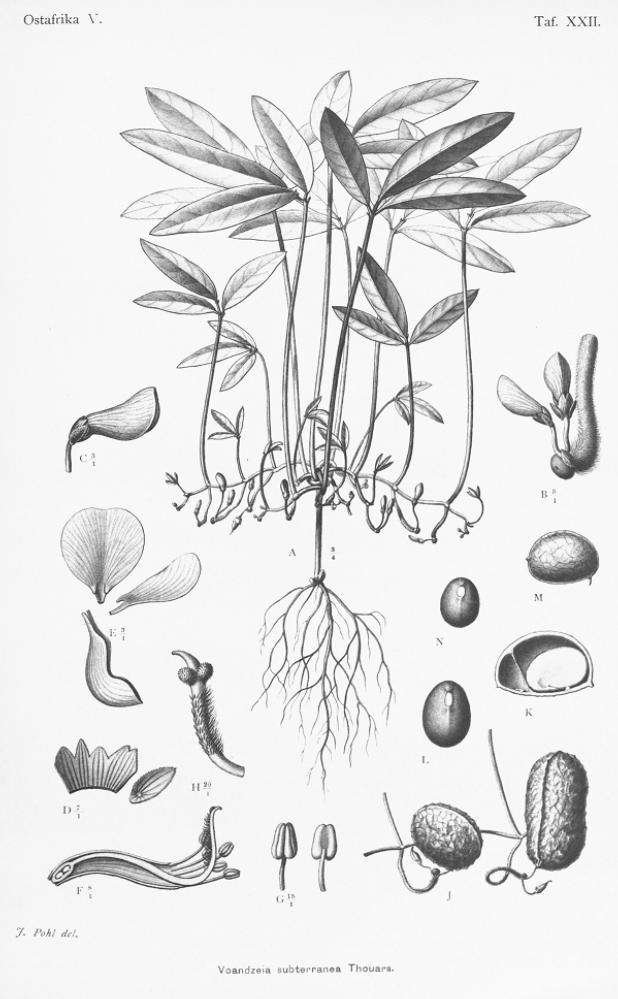
Bambara groundnut is a herbaceous, intermediate, annual plant, with creeping stems at ground level. It is a small legume plant that grows to a height of 0.25–0.37 metres (10 in – 1 ft 2+1⁄2 in) with compound leaves of three leaflets having stipules about 3 mm long. The flowers have a tube calyx about 1 mm long and 5 lobes about 1 mm long as well as a whitish yellow corolla, 4–7 mm long. The fruit is an indehiscent pod almost globose about 2.5 cm in diameter. The plant generally looks like bunched leaves arising from branched stems, which form a crown on the soil surface.
Bambara groundnut is considered as a fast-growing crop. The growth cycle is between (min-max) 90–170 days and under optimal conditions the cycle is about 120–150 days to pod maturity. Flowers appear 40–60 days after planting. After pollination, the pod reaches maturity, and during another 55 days, the seeds fully develop, producing again every 30 days.
Generative reproduction is for the Bambara groundnut autogamous, (self-fertilization), and (self-pollinating). After self-fertilization, pale yellow flowers are borne on the freely growing branching stems; these stems then grow downwards into the soil, taking the developing seed within the pods, which makes breeding and development of new cultivars for the traits of interest difficult. The seeds will form pods encasing seeds just below the soil. The pods are round, wrinkled and each contains one or two seeds that are round, smooth and very hard when dried.The seeds may be cream colored, brown, red, mottled or black eyed and their size is about 8.5–15 mm × 6.5–10 mm × 5.5–9 mm.
Several factors are essential for promoting cross-pollination in Bambara and these include a proper nursery habitat, short day lengths (<12h), an average temperature of 26 °C, which is necessary for optimum flowering and pod formation and a relative humidity of 90%. The strict photoperiod requirement of Bambara groundnut also limits its productivity in countries further away from the equator. In some accessions, long days (>12h) negatively affect pod-setting, resulting in crop failure.
Vigna subterranea
Vigna subterranea (common names: Bambara groundnut, Bambara nut, Bambara bean, manicongo, Congo goober, earth pea, ground-bean, or hog-peanut) is a member of the family Fabaceae. Its name is derived from the Bambara ethnic group. It reproduces via geocarpy, ripening its pods underground, much like the peanut (also called a groundnut).
The plant originated in West Africa. As a food and source of income, the Bambara groundnut is considered to be the third most important leguminous crop in those African countries where it is grown, after peanut and cowpea. The crop is mainly cultivated, sold and processed by women, and is, thus, particularly valuable for female subsistence farmers.
Bambara groundnut represents the third most important grain legume in semi-arid Africa. It is resistant to high temperatures and is suitable for marginal soils where other leguminous crops cannot be grown. It is a low-impact crop. The entire plant is known for soil improvement because of nitrogen fixation.
The pods can be eaten fresh or boiled after drying, and can be ground either fresh or dry to make puddings.
Bambara groundnut is a herbaceous, intermediate, annual plant, with creeping stems at ground level. It is a small legume plant that grows to a height of 0.25–0.37 metres (10 in – 1 ft 2+1⁄2 in) with compound leaves of three leaflets having stipules about 3 mm long. The flowers have a tube calyx about 1 mm long and 5 lobes about 1 mm long as well as a whitish yellow corolla, 4–7 mm long. The fruit is an indehiscent pod almost globose about 2.5 cm in diameter. The plant generally looks like bunched leaves arising from branched stems, which form a crown on the soil surface.
Bambara groundnut is considered as a fast-growing crop. The growth cycle is between (min-max) 90–170 days and under optimal conditions the cycle is about 120–150 days to pod maturity. Flowers appear 40–60 days after planting. After pollination, the pod reaches maturity, and during another 55 days, the seeds fully develop, producing again every 30 days.
Generative reproduction is for the Bambara groundnut autogamous, (self-fertilization), and (self-pollinating). After self-fertilization, pale yellow flowers are borne on the freely growing branching stems; these stems then grow downwards into the soil, taking the developing seed within the pods, which makes breeding and development of new cultivars for the traits of interest difficult. The seeds will form pods encasing seeds just below the soil. The pods are round, wrinkled and each contains one or two seeds that are round, smooth and very hard when dried.The seeds may be cream colored, brown, red, mottled or black eyed and their size is about 8.5–15 mm × 6.5–10 mm × 5.5–9 mm.
Several factors are essential for promoting cross-pollination in Bambara and these include a proper nursery habitat, short day lengths (<12h), an average temperature of 26 °C, which is necessary for optimum flowering and pod formation and a relative humidity of 90%. The strict photoperiod requirement of Bambara groundnut also limits its productivity in countries further away from the equator. In some accessions, long days (>12h) negatively affect pod-setting, resulting in crop failure.
Recent media
Recent media