



Community hub
Recent from talks
Knowledge base stats:
Talk channels stats:
Members stats:
Viking Age arms and armour
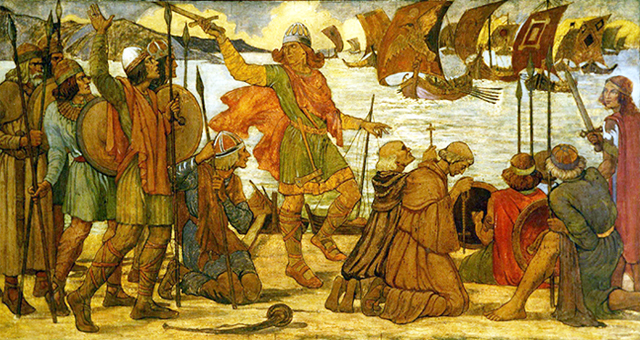
Knowledge about military technology of the Viking Age (late 8th to mid-11th century Europe) is based on relatively sparse archaeological finds, pictorial representations, and to some extent on the accounts in the Norse sagas and laws recorded in the 12th–14th centuries. According to custom, all free Norse men were required to own weapons, and permitted to carry them at all times. Indeed, the Hávamál, purported to be sage advice given by Odin, states "Don't leave your weapons lying about behind your back in a field; you never know when you may need all of sudden your spear."
As war was the most prestigious activity in Viking Age Scandinavia, beautifully finished weapons were an important way for a warrior to display his wealth and status. A wealthy Viking would likely have a complete ensemble of a spear, a wooden shield, and either a battle axe or a sword. Battle axes were considered the "normal weapon" for middle class Vikings. Swords were normally reserved for the upper class and nobles due to their then prohibitive cost.[better source needed] Much poetry was associated with Viking weapons. The richest might have a helmet and mail armour; these are thought to have been limited to the nobility and their professional warriors (retainers). Several layers of thick woollen clothing may have been used by poorer warriors. The average farmer was likely limited to a spear, shield, and perhaps a common axe or large knife (seax). Some would also bring their hunting bows (mostly long bows or flat bows) to use in the opening stages of battle.
Two distinct classes of knives were in use by Vikings. The more common one was a rather plain, single edge knife of normal construction, called a knifr. These are found in most graves, being the only weapon allowed for all, even slaves. Smaller versions served as the everyday utility tool, while longer versions were likely meant for hunting or combat or both. Weapon knives sometimes had ornamental inlays on the blade. The construction was similar to traditional Scandinavian knives. The tang ran through a more or less cylindrical handle, the blade was straight with the edge sweeping upward at the tip to meet the back of the blade in a point. The knife apparently played an important role for all Scandinavians. This is evidenced by the large number of knives found in burial sites of not just the men, but the women and the children too.
The other type was the seax. The type associated with Vikings is the so-called broken-back style seax. It was usually a bit heavier than a regular knife and served as a machete- or falchion-like arm. A wealthier man might own a larger seax, some being effectively swords. With the single edge and heavy blade, this somewhat crude weapon was relatively simple to use and produce, compared to the regular sword. A rather long tang is fitted to many examples, indicating that they may have had a longer handle for two-handed use. The smaller knife-like seaxes were likely within the fabrication ability of a common blacksmith.
The seax was in widespread use among the migration period Germanic tribes, and is even eponymous of the Saxons. It appears in Scandinavia from the 4th century, and shows a pattern of distribution from the lower Elbe (the Irminones) to Anglo-Saxon England. While its popularity on the continent declines with the end of the migration period, it remained in the British Isles where it was taken up by the Vikings. The large, sword-like seaxes are primarily found in connection with Viking settlements in England and Ireland, but do not appear very commonly in Scandinavia.
The Viking Age sword was for single-handed use to be combined with a shield, with a double edged blade length of up to 90 cm (35 in). Its shape was still very much based on the Roman spatha with a tight grip, long deep fuller and no pronounced cross-guard. It was not exclusive to the Vikings, but rather was used throughout Europe.
Swords were very costly to make, and a sign of high status. Many were rarely used and some swords found in graves were probably not sturdy enough for battle or raiding, and instead were likely decorative items. Like Roman spathae, they were worn in leather-bound wooden scabbards suspended from a strap across the right shoulder.[citation needed] Early blades were pattern welded, a technique in which strips of wrought iron and mild steel were twisted and forged together, with the addition of a hardened edge. Later blades of homogeneous steel, imported probably from the Rhineland, many bearing inlaid makers' marks and inscriptions, such as Ingelrii or Vlfberht. Local craftsmen often added their own elaborately decorated hilts, and many swords were given names, such as Leg-biter and Gold-hilt. The sword grip was usually made of an organic material, such as wood, horn, or antler (which does not often survive for archaeological uncovering), and may well have been wound around with textile.
Owning a sword was a matter of high honour. Persons of status might own ornately decorated swords with silver accents and inlays. Most Viking warriors would own a sword as one raid was usually enough to afford a good blade. Most freemen would own a sword with goðar, jarls and sometimes richer freemen owning much more ornately decorated swords. The poor farmers would use an axe or spear instead but after a couple of raids they would then have enough to buy a sword. One sword mentioned in the Laxdæla saga was valued at half a crown, which would correspond to the value of 16 milk-cows. Constructing such weapons was a highly specialized endeavour and many sword-blades were imported from foreign lands, such as the Rhineland. Swords could take up to a month to forge and were of such high value that they were passed on from generation to generation. Often, the older the sword, the more valuable it became.
Hub AI
Viking Age arms and armour AI simulator
(@Viking Age arms and armour_simulator)
Viking Age arms and armour
Knowledge about military technology of the Viking Age (late 8th to mid-11th century Europe) is based on relatively sparse archaeological finds, pictorial representations, and to some extent on the accounts in the Norse sagas and laws recorded in the 12th–14th centuries. According to custom, all free Norse men were required to own weapons, and permitted to carry them at all times. Indeed, the Hávamál, purported to be sage advice given by Odin, states "Don't leave your weapons lying about behind your back in a field; you never know when you may need all of sudden your spear."
As war was the most prestigious activity in Viking Age Scandinavia, beautifully finished weapons were an important way for a warrior to display his wealth and status. A wealthy Viking would likely have a complete ensemble of a spear, a wooden shield, and either a battle axe or a sword. Battle axes were considered the "normal weapon" for middle class Vikings. Swords were normally reserved for the upper class and nobles due to their then prohibitive cost.[better source needed] Much poetry was associated with Viking weapons. The richest might have a helmet and mail armour; these are thought to have been limited to the nobility and their professional warriors (retainers). Several layers of thick woollen clothing may have been used by poorer warriors. The average farmer was likely limited to a spear, shield, and perhaps a common axe or large knife (seax). Some would also bring their hunting bows (mostly long bows or flat bows) to use in the opening stages of battle.
Two distinct classes of knives were in use by Vikings. The more common one was a rather plain, single edge knife of normal construction, called a knifr. These are found in most graves, being the only weapon allowed for all, even slaves. Smaller versions served as the everyday utility tool, while longer versions were likely meant for hunting or combat or both. Weapon knives sometimes had ornamental inlays on the blade. The construction was similar to traditional Scandinavian knives. The tang ran through a more or less cylindrical handle, the blade was straight with the edge sweeping upward at the tip to meet the back of the blade in a point. The knife apparently played an important role for all Scandinavians. This is evidenced by the large number of knives found in burial sites of not just the men, but the women and the children too.
The other type was the seax. The type associated with Vikings is the so-called broken-back style seax. It was usually a bit heavier than a regular knife and served as a machete- or falchion-like arm. A wealthier man might own a larger seax, some being effectively swords. With the single edge and heavy blade, this somewhat crude weapon was relatively simple to use and produce, compared to the regular sword. A rather long tang is fitted to many examples, indicating that they may have had a longer handle for two-handed use. The smaller knife-like seaxes were likely within the fabrication ability of a common blacksmith.
The seax was in widespread use among the migration period Germanic tribes, and is even eponymous of the Saxons. It appears in Scandinavia from the 4th century, and shows a pattern of distribution from the lower Elbe (the Irminones) to Anglo-Saxon England. While its popularity on the continent declines with the end of the migration period, it remained in the British Isles where it was taken up by the Vikings. The large, sword-like seaxes are primarily found in connection with Viking settlements in England and Ireland, but do not appear very commonly in Scandinavia.
The Viking Age sword was for single-handed use to be combined with a shield, with a double edged blade length of up to 90 cm (35 in). Its shape was still very much based on the Roman spatha with a tight grip, long deep fuller and no pronounced cross-guard. It was not exclusive to the Vikings, but rather was used throughout Europe.
Swords were very costly to make, and a sign of high status. Many were rarely used and some swords found in graves were probably not sturdy enough for battle or raiding, and instead were likely decorative items. Like Roman spathae, they were worn in leather-bound wooden scabbards suspended from a strap across the right shoulder.[citation needed] Early blades were pattern welded, a technique in which strips of wrought iron and mild steel were twisted and forged together, with the addition of a hardened edge. Later blades of homogeneous steel, imported probably from the Rhineland, many bearing inlaid makers' marks and inscriptions, such as Ingelrii or Vlfberht. Local craftsmen often added their own elaborately decorated hilts, and many swords were given names, such as Leg-biter and Gold-hilt. The sword grip was usually made of an organic material, such as wood, horn, or antler (which does not often survive for archaeological uncovering), and may well have been wound around with textile.
Owning a sword was a matter of high honour. Persons of status might own ornately decorated swords with silver accents and inlays. Most Viking warriors would own a sword as one raid was usually enough to afford a good blade. Most freemen would own a sword with goðar, jarls and sometimes richer freemen owning much more ornately decorated swords. The poor farmers would use an axe or spear instead but after a couple of raids they would then have enough to buy a sword. One sword mentioned in the Laxdæla saga was valued at half a crown, which would correspond to the value of 16 milk-cows. Constructing such weapons was a highly specialized endeavour and many sword-blades were imported from foreign lands, such as the Rhineland. Swords could take up to a month to forge and were of such high value that they were passed on from generation to generation. Often, the older the sword, the more valuable it became.