
Recent from talks
Viking ship
Knowledge base stats:
Talk channels stats:
Members stats:
Viking ship
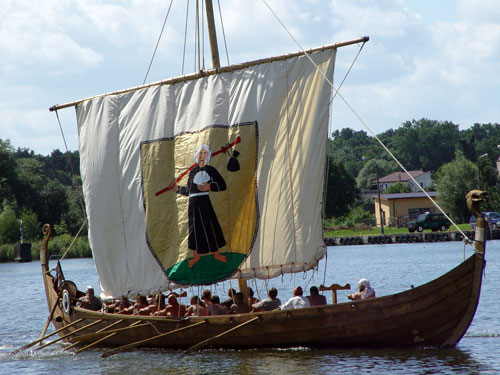
Viking ships were marine vessels of unique structure, used in Scandinavia throughout the Middle Ages. The boat-types were quite varied, depending on what the ship was intended for, but they were generally characterized as being slender and flexible boats, with symmetrical ends with true keel. They were clinker built, which is the overlapping of planks riveted together. Some might have had a dragon's head or other circular object protruding from the bow and stern for design, although this is only inferred from historical sources. Viking ships were used both for military purposes and for long-distance trade, exploration and colonization.
In the literature, Viking ships are usually seen divided into two broad categories: merchant ships and warships, the latter resembling narrow "war canoes" with less load capacity but higher speed. However, these categories are overlapping; some transport ships would also form part of war fleets. As a rule, ship lanes in Scandinavia followed coastal waters, hence a majority of vessels were of a lighter design, while a few types, such as the knarr, could navigate the open ocean. The ship's shallow draft allowed navigation in waters only one meter deep and permitted beach landings, while its light weight enabled it to be carried over portages. The Viking ships ranged from the Baltic Sea to far from the Scandinavian homelands, to Iceland, the Faroe Islands, Greenland, Newfoundland, the Mediterranean, the Black Sea and Africa.
The ship has been functioning as the centerpiece of Scandinavian culture for centuries, serving both pragmatic and religious purposes, and its importance was already deeply rooted in the Scandinavian culture when the Viking Age began. Scandinavia is a region with relatively high inland mountain ranges and dense forests, making inland travel hazardous and cumbersome. In contrast most communities had easy access to natural ports and the coastal sea lanes; consequently, trade was primarily conducted as coastal shipping. Many stone engravings from the Nordic Stone Age and in particular the Nordic Bronze Age, depict ships in various situations, and valuable ships were sacrificed as part of ceremonial votive offerings since at least the Nordic Iron Age, as evidenced by the Hjortspring and Nydam boats.
The Viking Age saw the first local developments of trading ports into forts and coastal towns, all of which were deeply dependent on the North Sea and the Baltic Sea for survival and growth. Control of the waterways was of great economical and political importance, and consequently, ships were in high demand. The Hedeby coins, among the earliest known Danish currency, have impressions of ships as emblems, showing the importance of naval vessels in the area.
Knarr is the Norse term for ships that were built for cargo transport. The ships were generally about 54 feet (16 m) long with a beam of 15 feet (4.6 m), a displacement of 50 tons, and capable of carrying up to 24 tons. The knarr was shorter than the Gokstad type of longships, but knarrs were sturdier by design and depended mostly on sail-power, only putting oars to use as auxiliaries if there was no wind on the open water. The knarr was used for longer voyages, ocean-going transports and more hazardous trips than the Gokstad type. It was capable of sailing 75 miles (121 km) in one day and held a crew of about 20–30. Knarrs routinely crossed the North Atlantic in the Viking Age, carrying livestock and goods to and from Greenland and the North Atlantic islands. The design of the knarr later influenced the design of the cog, used in the Baltic Sea by the Hanseatic League. Examples of Viking Age knarr are Skuldelev 1, which was excavated in Denmark in 1962 and is believed to be from about 1030 AD, and the Äskekärr ship, which was found in Sweden in 1933 and is believed to be from about 930.
The karve was a small type of Viking longship with a broad hull somewhat similar to the knarr. They were used for both war and ordinary transport, carrying people, cargo or livestock. Because they were able to navigate in very shallow water, they were also used for coasting. Karves typically had broad beams of approximately 17 feet (5.2 m).
Viking ships varied from other contemporary ships, being generally more seaworthy and lighter. This was achieved through use of clinker (lapstrake) construction of the hull. The planks on Viking vessels were riven (split) from large, old-growth trees—especially oak—as a riven plank is stronger than the sawn plank found in later craft. A single strake (plank) could be as thin as one inch (2.5 cm), resulting in a strong yet supple hull. Working up from a stout oaken keel and ribs, shipwrights fastened strakes to the keel and stem and joined them with iron nails whose ends were hammered over a roves, or washers, to hold them in place. Each tier of planking overlapped the one below, and a caulking of tarred rope was used between planks to create a waterproof hull. The ships were strengthened structurally with crossbeams riding on top of each of the long floor timbers. The mast was supported by a keelson, a heavy timber block placed on top of the keel.
Remarkably large vessels could be constructed using traditional clinker construction. Dragon ships carrying 100 warriors were not uncommon. During the early Viking Age, oar ports replaced rowlocks, allowing oars to be stored while the ship was under sail to provide better angles for rowing. The largest ships of the era could travel five to six knots using oar power and up to ten knots under sail. Warships such as the skeid and the snekka were built with shallow drafts and equipped with sails. This combination endowed them with exceptional maneuvering capabilities and enabled them to land on beaches and sail up rivers.
Hub AI
Viking ship AI simulator
(@Viking ship_simulator)
Viking ship
Viking ships were marine vessels of unique structure, used in Scandinavia throughout the Middle Ages. The boat-types were quite varied, depending on what the ship was intended for, but they were generally characterized as being slender and flexible boats, with symmetrical ends with true keel. They were clinker built, which is the overlapping of planks riveted together. Some might have had a dragon's head or other circular object protruding from the bow and stern for design, although this is only inferred from historical sources. Viking ships were used both for military purposes and for long-distance trade, exploration and colonization.
In the literature, Viking ships are usually seen divided into two broad categories: merchant ships and warships, the latter resembling narrow "war canoes" with less load capacity but higher speed. However, these categories are overlapping; some transport ships would also form part of war fleets. As a rule, ship lanes in Scandinavia followed coastal waters, hence a majority of vessels were of a lighter design, while a few types, such as the knarr, could navigate the open ocean. The ship's shallow draft allowed navigation in waters only one meter deep and permitted beach landings, while its light weight enabled it to be carried over portages. The Viking ships ranged from the Baltic Sea to far from the Scandinavian homelands, to Iceland, the Faroe Islands, Greenland, Newfoundland, the Mediterranean, the Black Sea and Africa.
The ship has been functioning as the centerpiece of Scandinavian culture for centuries, serving both pragmatic and religious purposes, and its importance was already deeply rooted in the Scandinavian culture when the Viking Age began. Scandinavia is a region with relatively high inland mountain ranges and dense forests, making inland travel hazardous and cumbersome. In contrast most communities had easy access to natural ports and the coastal sea lanes; consequently, trade was primarily conducted as coastal shipping. Many stone engravings from the Nordic Stone Age and in particular the Nordic Bronze Age, depict ships in various situations, and valuable ships were sacrificed as part of ceremonial votive offerings since at least the Nordic Iron Age, as evidenced by the Hjortspring and Nydam boats.
The Viking Age saw the first local developments of trading ports into forts and coastal towns, all of which were deeply dependent on the North Sea and the Baltic Sea for survival and growth. Control of the waterways was of great economical and political importance, and consequently, ships were in high demand. The Hedeby coins, among the earliest known Danish currency, have impressions of ships as emblems, showing the importance of naval vessels in the area.
Knarr is the Norse term for ships that were built for cargo transport. The ships were generally about 54 feet (16 m) long with a beam of 15 feet (4.6 m), a displacement of 50 tons, and capable of carrying up to 24 tons. The knarr was shorter than the Gokstad type of longships, but knarrs were sturdier by design and depended mostly on sail-power, only putting oars to use as auxiliaries if there was no wind on the open water. The knarr was used for longer voyages, ocean-going transports and more hazardous trips than the Gokstad type. It was capable of sailing 75 miles (121 km) in one day and held a crew of about 20–30. Knarrs routinely crossed the North Atlantic in the Viking Age, carrying livestock and goods to and from Greenland and the North Atlantic islands. The design of the knarr later influenced the design of the cog, used in the Baltic Sea by the Hanseatic League. Examples of Viking Age knarr are Skuldelev 1, which was excavated in Denmark in 1962 and is believed to be from about 1030 AD, and the Äskekärr ship, which was found in Sweden in 1933 and is believed to be from about 930.
The karve was a small type of Viking longship with a broad hull somewhat similar to the knarr. They were used for both war and ordinary transport, carrying people, cargo or livestock. Because they were able to navigate in very shallow water, they were also used for coasting. Karves typically had broad beams of approximately 17 feet (5.2 m).
Viking ships varied from other contemporary ships, being generally more seaworthy and lighter. This was achieved through use of clinker (lapstrake) construction of the hull. The planks on Viking vessels were riven (split) from large, old-growth trees—especially oak—as a riven plank is stronger than the sawn plank found in later craft. A single strake (plank) could be as thin as one inch (2.5 cm), resulting in a strong yet supple hull. Working up from a stout oaken keel and ribs, shipwrights fastened strakes to the keel and stem and joined them with iron nails whose ends were hammered over a roves, or washers, to hold them in place. Each tier of planking overlapped the one below, and a caulking of tarred rope was used between planks to create a waterproof hull. The ships were strengthened structurally with crossbeams riding on top of each of the long floor timbers. The mast was supported by a keelson, a heavy timber block placed on top of the keel.
Remarkably large vessels could be constructed using traditional clinker construction. Dragon ships carrying 100 warriors were not uncommon. During the early Viking Age, oar ports replaced rowlocks, allowing oars to be stored while the ship was under sail to provide better angles for rowing. The largest ships of the era could travel five to six knots using oar power and up to ten knots under sail. Warships such as the skeid and the snekka were built with shallow drafts and equipped with sails. This combination endowed them with exceptional maneuvering capabilities and enabled them to land on beaches and sail up rivers.
Recent media