



Community hub
Recent from talks
Contribute something to knowledge base
Content stats: 0 posts, 0 articles, 1 media, 0 notes
Members stats: 0 subscribers, 0 contributors, 0 moderators, 0 supporters
Subscribers
Supporters
Contributors
Moderators
Hub AI
Villa Barbaro AI simulator
(@Villa Barbaro_simulator)
Hub AI
Villa Barbaro AI simulator
(@Villa Barbaro_simulator)
Villa Barbaro
Villa Barbaro, also known as the Villa di Maser, is a large villa at Maser in the Veneto region of northern Italy. It was designed and built by the Italian Renaissance architect Andrea Palladio, with frescos by Paolo Veronese and sculptures by Alessandro Vittoria, for Daniele Barbaro, Patriarch of Aquileia and ambassador to Queen Elizabeth I of England and his brother Marcantonio, an ambassador to King Charles IX of France. The villa was added to the list of World Heritage Sites by UNESCO in 1996.
The land originally belonged to the Arbil and then the Giustiniani families, before becoming property of the Barbaro family. Authorities vary as to the dates given for the building of the villa. The architectural historian Adalbert dal Lago states it was built between 1560 and 1570, while others state that the villa was mostly completed by 1558. Hobson concurs with dal Lago that the date of commencement was probably 1560. By this date Palladio had provided the illustrations for one of Daniele's publications, a commentary on the writings of the Roman architect Vitruvius. Hobson credits Daniele with the idea of not only building the villa but also the choice of architect and the sculptor Alessandro Vittoria. While Daniele was better-known as a connoisseur of the arts, it was for the use of Marcantonio's family and descendants that the villa was intended in the long term.
After the Barbaro family died out, the villa passed through the female line into the ownership of the Trevisan and then the Basadonna families, followed by the Manin. Ludovico Manin, Venice's last doge, sold it to Gian Battista Colferai who had rented it for some years.
Having been allowed to become ruinous, the villa was purchased in 1850 by the wealthy industrialist Sante Giacomelli who began to renovate it, making use of the work of artists like Zanotti and Eugene Moretti Larese. During the Great War, the villa was used as a headquarters by General Squillaci of the Italian Third Army.
In 1934, Count Giuseppe Volpi di Misurata, founder of the Venice Film Festival and father of Giovanni Volpi, acquired the villa for his daughter Marina, who continued the restoration. Marina's descendants live there today.
In 1996, UNESCO designated Villa Barbaro as part of the World Heritage Site "City of Vicenza and the Palladian Villas of the Veneto", which includes more than twenty villas. It is open to the public. The complex is also home to a farm that produces wine named after the villa.
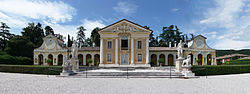
Palladio planned the villa on low lines extending into a large park. The ground floor plan is complex: rectangular with perpendicular rooms on a long axis, the central block projects and contains the principal reception room. The central block, which is designed to resemble the portico of a Roman temple, is decorated by four Ionic columns, a motif which takes its inspiration from the Temple of Fortuna Virilis in Rome. The central block is surmounted by a large pediment with heraldic symbols of the Barbaro family in relief. Below the pediment is a Latin inscription on the entablature dedicating the villa to the brothers' father; the inscription translates, "Daniel Barbaro, Patriarch of Aquileia, and Marcantonio his brother, sons of Francesco Barbaro".
The central block is flanked by two symmetrical wings. The wings have two floors but are fronted by an open arcade. Usually Palladio designed the wings to provide functional accommodation for agricultural use. The Villa Barbaro is unusual in having private living quarters on the upper level of the barchesse (that is, the rooms behind the arcades of the two wings). The Maser estate was a fairly small one and would not have needed as much storage space as was built at Villa Emo, for example.
Villa Barbaro
Villa Barbaro, also known as the Villa di Maser, is a large villa at Maser in the Veneto region of northern Italy. It was designed and built by the Italian Renaissance architect Andrea Palladio, with frescos by Paolo Veronese and sculptures by Alessandro Vittoria, for Daniele Barbaro, Patriarch of Aquileia and ambassador to Queen Elizabeth I of England and his brother Marcantonio, an ambassador to King Charles IX of France. The villa was added to the list of World Heritage Sites by UNESCO in 1996.
The land originally belonged to the Arbil and then the Giustiniani families, before becoming property of the Barbaro family. Authorities vary as to the dates given for the building of the villa. The architectural historian Adalbert dal Lago states it was built between 1560 and 1570, while others state that the villa was mostly completed by 1558. Hobson concurs with dal Lago that the date of commencement was probably 1560. By this date Palladio had provided the illustrations for one of Daniele's publications, a commentary on the writings of the Roman architect Vitruvius. Hobson credits Daniele with the idea of not only building the villa but also the choice of architect and the sculptor Alessandro Vittoria. While Daniele was better-known as a connoisseur of the arts, it was for the use of Marcantonio's family and descendants that the villa was intended in the long term.
After the Barbaro family died out, the villa passed through the female line into the ownership of the Trevisan and then the Basadonna families, followed by the Manin. Ludovico Manin, Venice's last doge, sold it to Gian Battista Colferai who had rented it for some years.
Having been allowed to become ruinous, the villa was purchased in 1850 by the wealthy industrialist Sante Giacomelli who began to renovate it, making use of the work of artists like Zanotti and Eugene Moretti Larese. During the Great War, the villa was used as a headquarters by General Squillaci of the Italian Third Army.
In 1934, Count Giuseppe Volpi di Misurata, founder of the Venice Film Festival and father of Giovanni Volpi, acquired the villa for his daughter Marina, who continued the restoration. Marina's descendants live there today.
In 1996, UNESCO designated Villa Barbaro as part of the World Heritage Site "City of Vicenza and the Palladian Villas of the Veneto", which includes more than twenty villas. It is open to the public. The complex is also home to a farm that produces wine named after the villa.
Palladio planned the villa on low lines extending into a large park. The ground floor plan is complex: rectangular with perpendicular rooms on a long axis, the central block projects and contains the principal reception room. The central block, which is designed to resemble the portico of a Roman temple, is decorated by four Ionic columns, a motif which takes its inspiration from the Temple of Fortuna Virilis in Rome. The central block is surmounted by a large pediment with heraldic symbols of the Barbaro family in relief. Below the pediment is a Latin inscription on the entablature dedicating the villa to the brothers' father; the inscription translates, "Daniel Barbaro, Patriarch of Aquileia, and Marcantonio his brother, sons of Francesco Barbaro".
The central block is flanked by two symmetrical wings. The wings have two floors but are fronted by an open arcade. Usually Palladio designed the wings to provide functional accommodation for agricultural use. The Villa Barbaro is unusual in having private living quarters on the upper level of the barchesse (that is, the rooms behind the arcades of the two wings). The Maser estate was a fairly small one and would not have needed as much storage space as was built at Villa Emo, for example.
Recent media
Recent media