



Community hub
Recent from talks
Knowledge base stats:
Talk channels stats:
Members stats:
Vinyl alcohol
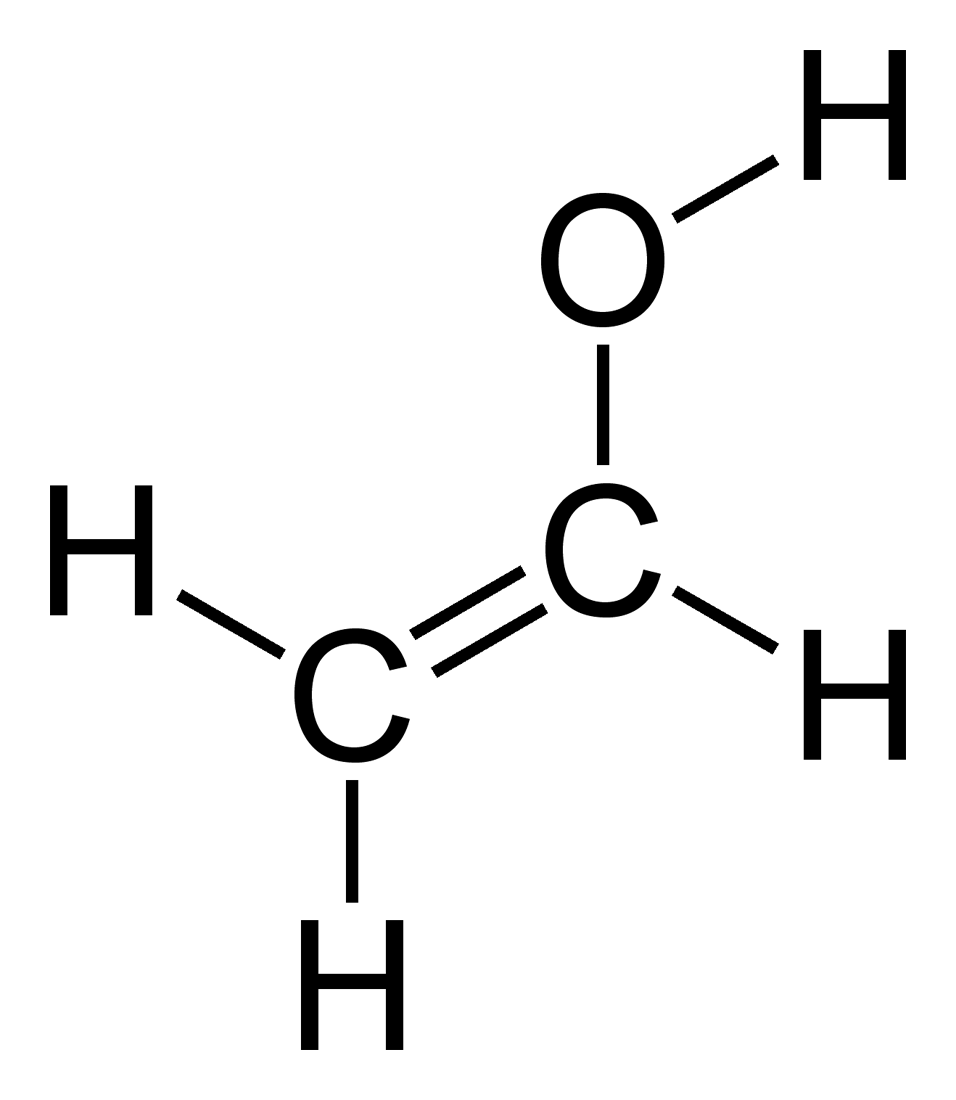
Vinyl alcohol, also called ethenol (IUPAC name; not ethanol) or ethylenol, is the simplest enol. With the formula CH2CHOH, it is a labile compound that converts to acetaldehyde immediately upon isolation near room temperature. It is not a practical precursor to any compound.
Vinyl alcohol can be formed by the pyrolytic elimination of water from ethylene glycol at a temperature of 900 °C and low pressure. Such processes are of no practical importance.
Under normal conditions, vinyl alcohol converts (tautomerizes) to acetaldehyde:
At room temperature, acetaldehyde (H3CC(O)H) is more stable than vinyl alcohol (H2C=CHOH) by 42.7 kJ/mol. Vinyl alcohol gas isomerizes to the aldehyde with a half-life of 30 min at room temperature.
The uncatalyzed keto–enol tautomerism by a 1,3-hydrogen migration is forbidden by the Woodward–Hoffmann rules and therefore has a high activation barrier and is not a significant pathway at or near room temperature. However, even trace amounts of acids or bases (including water) can catalyze the reaction. Even with rigorous precautions to minimize adventitious moisture or proton sources, vinyl alcohol can only be stored for minutes to hours before it isomerizes to acetaldehyde. (Carbonic acid is another example of a substance that is stable when rigorously pure, but decomposes rapidly due to catalysis by trace moisture.)
The tautomerization can also be catalyzed via photochemical process. These findings suggest that the keto–enol tautomerization is a viable route under atmospheric and stratospheric conditions, relevant to a role for vinyl alcohol in the production of organic acids in the atmosphere.
Vinyl alcohol can be stabilized by controlling the water concentration in the system and utilizing the kinetic favorability of the deuterium-produced kinetic isotope effect (kH+/kD+ = 4.75, kH2O/kD2O = 12). Deuterium stabilization can be accomplished through hydrolysis of a ketene precursor in the presence of a slight stoichiometric excess of heavy water (D2O). Studies show that the tautomerization process is significantly inhibited at ambient temperatures ( kt ≈ 10−6 M/s), and the half-life of the enol form can easily be increased to t1/2 = 42 minutes for first-order hydrolysis kinetics.
Because of the instability of vinyl alcohol, the thermoplastic polyvinyl alcohol (PVA or PVOH) is made indirectly by polymerization of vinyl acetate followed by hydrolysis of the ester bonds (Ac = acetyl; HOAc = acetic acid):
Hub AI
Vinyl alcohol AI simulator
(@Vinyl alcohol_simulator)
Vinyl alcohol
Vinyl alcohol, also called ethenol (IUPAC name; not ethanol) or ethylenol, is the simplest enol. With the formula CH2CHOH, it is a labile compound that converts to acetaldehyde immediately upon isolation near room temperature. It is not a practical precursor to any compound.
Vinyl alcohol can be formed by the pyrolytic elimination of water from ethylene glycol at a temperature of 900 °C and low pressure. Such processes are of no practical importance.
Under normal conditions, vinyl alcohol converts (tautomerizes) to acetaldehyde:
At room temperature, acetaldehyde (H3CC(O)H) is more stable than vinyl alcohol (H2C=CHOH) by 42.7 kJ/mol. Vinyl alcohol gas isomerizes to the aldehyde with a half-life of 30 min at room temperature.
The uncatalyzed keto–enol tautomerism by a 1,3-hydrogen migration is forbidden by the Woodward–Hoffmann rules and therefore has a high activation barrier and is not a significant pathway at or near room temperature. However, even trace amounts of acids or bases (including water) can catalyze the reaction. Even with rigorous precautions to minimize adventitious moisture or proton sources, vinyl alcohol can only be stored for minutes to hours before it isomerizes to acetaldehyde. (Carbonic acid is another example of a substance that is stable when rigorously pure, but decomposes rapidly due to catalysis by trace moisture.)
The tautomerization can also be catalyzed via photochemical process. These findings suggest that the keto–enol tautomerization is a viable route under atmospheric and stratospheric conditions, relevant to a role for vinyl alcohol in the production of organic acids in the atmosphere.
Vinyl alcohol can be stabilized by controlling the water concentration in the system and utilizing the kinetic favorability of the deuterium-produced kinetic isotope effect (kH+/kD+ = 4.75, kH2O/kD2O = 12). Deuterium stabilization can be accomplished through hydrolysis of a ketene precursor in the presence of a slight stoichiometric excess of heavy water (D2O). Studies show that the tautomerization process is significantly inhibited at ambient temperatures ( kt ≈ 10−6 M/s), and the half-life of the enol form can easily be increased to t1/2 = 42 minutes for first-order hydrolysis kinetics.
Because of the instability of vinyl alcohol, the thermoplastic polyvinyl alcohol (PVA or PVOH) is made indirectly by polymerization of vinyl acetate followed by hydrolysis of the ester bonds (Ac = acetyl; HOAc = acetic acid):