



Community hub
Recent from talks
Contribute something to knowledge base
Content stats: 0 posts, 0 articles, 1 media, 0 notes
Members stats: 0 subscribers, 0 contributors, 0 moderators, 0 supporters
Subscribers
Supporters
Contributors
Moderators
Hub AI
Multi-touch AI simulator
(@Multi-touch_simulator)
Hub AI
Multi-touch AI simulator
(@Multi-touch_simulator)
Multi-touch
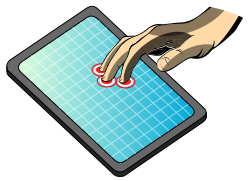
In computing, multi-touch is technology that enables a surface (a touchpad or touchscreen) to recognize the presence of more than one point of contact with the surface at the same time. The origins of multitouch began at CERN, MIT, University of Toronto, Carnegie Mellon University and Bell Labs in the 1970s. CERN started using multi-touch screens as early as 1976 for the controls of the Super Proton Synchrotron. Capacitive multi-touch displays were popularized by Apple's iPhone in 2007. Multi-touch may be used to implement additional functionality, such as pinch to zoom or to activate certain subroutines attached to predefined gestures using gesture recognition.
Several uses of the term multi-touch resulted from the quick developments in this field, and many companies using the term to market older technology which is called gesture-enhanced single-touch or several other terms by other companies and researchers. Several other similar or related terms attempt to differentiate between whether a device can exactly determine or only approximate the location of different points of contact to further differentiate between the various technological capabilities, but they are often used as synonyms in marketing.
Multi-touch is commonly implemented using capacitive sensing technology in mobile devices and smart devices. A capacitive touchscreen typically consists of a capacitive touch sensor, application-specific integrated circuit (ASIC) controller and digital signal processor (DSP) fabricated from CMOS (complementary metal–oxide–semiconductor) technology. A more recent alternative approach is optical touch technology, based on image sensor technology.
In computing, multi-touch is technology which enables a touchpad or touchscreen to recognize more than one or more than two points of contact with the surface. Apple popularized the term "multi-touch" in 2007 with which it implemented additional functionality, such as pinch to zoom or to activate certain subroutines attached to predefined gestures.
The two different uses of the term resulted from the quick developments in this field, and many companies using the term to market older technology which is called gesture-enhanced single-touch or several other terms by other companies and researchers. Several other similar or related terms attempt to differentiate between whether a device can exactly determine or only approximate the location of different points of contact to further differentiate between the various technological capabilities, but they are often used as synonyms in marketing.
The use of touchscreen technology predates both multi-touch technology and the personal computer. Early synthesizer and electronic instrument builders like Hugh Le Caine and Robert Moog experimented with using touch-sensitive capacitance sensors to control the sounds made by their instruments. IBM began building the first touch screens in the late 1960s. In 1972, Control Data released the PLATO IV computer, an infrared terminal used for educational purposes, which employed single-touch points in a 16×16 array user interface. These early touchscreens only registered one point of touch at a time. On-screen keyboards (a well-known feature today) were thus awkward to use, because key-rollover and holding down a shift key while typing another were not possible.
Exceptions to these were a "cross-wire" multi-touch reconfigurable touchscreen keyboard/display developed at the Massachusetts Institute of Technology in the early 1970s and the 16 button capacitive multi-touch screen developed at CERN in 1972 for the controls of the Super Proton Synchrotron that were under construction.
In 1976 a new x-y capacitive screen, based on the capacitance touch screens developed in 1972 by Danish electronics engineer Bent Stumpe, was developed at CERN. This technology, allowing an exact location of the different touch points, was used to develop a new type of human machine interface (HMI) for the control room of the Super Proton Synchrotron particle accelerator. In a handwritten note dated 11 March 1972, Stumpe presented his proposed solution – a capacitive touch screen with a fixed number of programmable buttons presented on a display. The screen was to consist of a set of capacitors etched into a film of copper on a sheet of glass, each capacitor being constructed so that a nearby flat conductor, such as the surface of a finger, would increase the capacitance by a significant amount. The capacitors were to consist of fine lines etched in copper on a sheet of glass – fine enough (80 μm) and sufficiently far apart (80 μm) to be invisible. In the final device, a simple lacquer coating prevented the fingers from actually touching the capacitors. In the same year, MIT described a keyboard with variable graphics capable of multi-touch detection.
Multi-touch
In computing, multi-touch is technology that enables a surface (a touchpad or touchscreen) to recognize the presence of more than one point of contact with the surface at the same time. The origins of multitouch began at CERN, MIT, University of Toronto, Carnegie Mellon University and Bell Labs in the 1970s. CERN started using multi-touch screens as early as 1976 for the controls of the Super Proton Synchrotron. Capacitive multi-touch displays were popularized by Apple's iPhone in 2007. Multi-touch may be used to implement additional functionality, such as pinch to zoom or to activate certain subroutines attached to predefined gestures using gesture recognition.
Several uses of the term multi-touch resulted from the quick developments in this field, and many companies using the term to market older technology which is called gesture-enhanced single-touch or several other terms by other companies and researchers. Several other similar or related terms attempt to differentiate between whether a device can exactly determine or only approximate the location of different points of contact to further differentiate between the various technological capabilities, but they are often used as synonyms in marketing.
Multi-touch is commonly implemented using capacitive sensing technology in mobile devices and smart devices. A capacitive touchscreen typically consists of a capacitive touch sensor, application-specific integrated circuit (ASIC) controller and digital signal processor (DSP) fabricated from CMOS (complementary metal–oxide–semiconductor) technology. A more recent alternative approach is optical touch technology, based on image sensor technology.
In computing, multi-touch is technology which enables a touchpad or touchscreen to recognize more than one or more than two points of contact with the surface. Apple popularized the term "multi-touch" in 2007 with which it implemented additional functionality, such as pinch to zoom or to activate certain subroutines attached to predefined gestures.
The two different uses of the term resulted from the quick developments in this field, and many companies using the term to market older technology which is called gesture-enhanced single-touch or several other terms by other companies and researchers. Several other similar or related terms attempt to differentiate between whether a device can exactly determine or only approximate the location of different points of contact to further differentiate between the various technological capabilities, but they are often used as synonyms in marketing.
The use of touchscreen technology predates both multi-touch technology and the personal computer. Early synthesizer and electronic instrument builders like Hugh Le Caine and Robert Moog experimented with using touch-sensitive capacitance sensors to control the sounds made by their instruments. IBM began building the first touch screens in the late 1960s. In 1972, Control Data released the PLATO IV computer, an infrared terminal used for educational purposes, which employed single-touch points in a 16×16 array user interface. These early touchscreens only registered one point of touch at a time. On-screen keyboards (a well-known feature today) were thus awkward to use, because key-rollover and holding down a shift key while typing another were not possible.
Exceptions to these were a "cross-wire" multi-touch reconfigurable touchscreen keyboard/display developed at the Massachusetts Institute of Technology in the early 1970s and the 16 button capacitive multi-touch screen developed at CERN in 1972 for the controls of the Super Proton Synchrotron that were under construction.
In 1976 a new x-y capacitive screen, based on the capacitance touch screens developed in 1972 by Danish electronics engineer Bent Stumpe, was developed at CERN. This technology, allowing an exact location of the different touch points, was used to develop a new type of human machine interface (HMI) for the control room of the Super Proton Synchrotron particle accelerator. In a handwritten note dated 11 March 1972, Stumpe presented his proposed solution – a capacitive touch screen with a fixed number of programmable buttons presented on a display. The screen was to consist of a set of capacitors etched into a film of copper on a sheet of glass, each capacitor being constructed so that a nearby flat conductor, such as the surface of a finger, would increase the capacitance by a significant amount. The capacitors were to consist of fine lines etched in copper on a sheet of glass – fine enough (80 μm) and sufficiently far apart (80 μm) to be invisible. In the final device, a simple lacquer coating prevented the fingers from actually touching the capacitors. In the same year, MIT described a keyboard with variable graphics capable of multi-touch detection.
Recent media
Recent media