
Recent from talks
Vladimir Sollogub
Knowledge base stats:
Talk channels stats:
Members stats:
Vladimir Sollogub
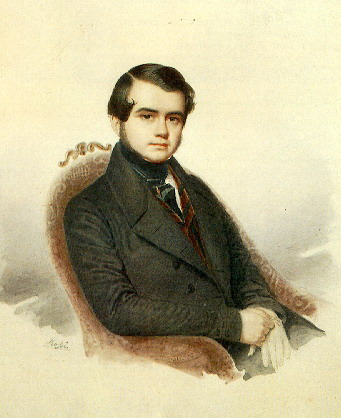
Count Vladimir Alexandrovich Sollogub (Russian: Влади́мир Алекса́ндрович Соллогу́б; German: Woldemar Graf Sollogub (Sollohub); 20 August 1813 – 17 June 1882) was a minor Russian writer, author of novelettes, essays, plays, and memoirs.
Born in Saint Petersburg, his paternal grandfather was a Polish aristocrat, and he grew up in the midst of high society. He graduated from the University of Dorpat in 1834 and was attached to the Ministry of Internal Affairs the following year in Vienna. His literary career began in 1837 in the journal Sovremennik. In 1840 he married Sofya Mikhailovna Velgorskaya. In 1843 he visited Nice and met Gogol. From 1856 he was an Officer for Special Commissions in the imperial court; he took an interest in prison reform, and from 1875 was сhair of the Commission for the Reorganization of Prisons in Russia. In 1858 he was sent abroad to study European theater, and in 1877 he became an official historian at court.
Sollogub was a connoisseur of theatrical life and of St. Petersburg society. He hosted a well-known literary and musical salon where he brought to life the atmosphere of St. Petersburg of that era as related in his Memoirs (1887). He is best known for his 1845 novelette Tarantas ("The Tarantass"), "a satirical journey from Moscow to Kazan in a tumble-down traveling cart. The satire, superficial and uninspired, is directed against the ideas of the Slavophils and the unpractical dreaminess of the romantic idealists."
Sollogub's origins were of the highest nobility, close to the court thanks to his grandmother Natalia L. Naryshkina (1761–1819). His grandfather, Yan Sollogub, served as an adjutant of the Polish king and was a prominent magnate in Lithuania. He increased his wealth to 80,000 souls by means of the marriage with Natalia Naryshkina, a daughter of the Russian Emperor's relative Lev Naryshkin. Alexander Sollogub (1787–1843), Vladimir's father and the son of Yan Sollogub, quickly wasted his share of the bequest. He held a civil rank of master of ceremonies (Russian: Церемониймейстер, from German "Zermonienmeister") at the court, however in public he was mainly known as a dandy. Pushkin mentioned his name ("Eternal Scollogub is having fun") in the drafts to the 1st chapter of Eugene Onegin. Alexander's love for the theater, music, and painting had a valuable impact on his son, Vladimir.
The mother of the author, Sofia Ivanovna Sollogub (maiden name: Arharova; 1791–1854), was admired by emperor Alexander I, who loved having conversations with her. Сalm and serious, she loved Russian literature and was the addressee of Pyotr Pletnyov's letter "A letter to countess S. I. S. about Russian poets." Vladimir's grandmother was Ekaterina Arharova (1755–1836), a prominent Saint Petersburg's lady, "the keeper of the old-Moscow traditions. Another grandfather, Ivan Arharov (1744–1815), was a military governor of Moscow. Therefore, the family of the author was related both to bureaucratic St. Petersburg and to lordly, patriarchal Moscow.
In childhood, due to his kinship to Alexey Olenin, who was a cousin of his grandmother Ekaterina Arharova, Vladimir became acquainted with a set of famous contemporary writers: Ivan Krylov, Nikolay Gnedich, Alexander Pushkin, and Alexander Griboyedov. This was the time when he started to esteem the arts.
Sollogub's education, to which his parents paid close attention, started at home. The list of his teachers included Pyotr Pletnev (Russian language and literature) and protoiereus Ioakim Kochetov (law of God). Vladimir's gouverneur was Ernest Charrière, a French playwright, historian, poet, and the future translator of Turgenev's "A Sportsman's Sketches." Ernest was the one who induced the future author's love to the literature.
Vladimir spent winters mostly in Saint Petersburg and summers in Pavlovsk. In both cities he socialized with peers from aristocratic society. Young Sollogub was jaunty and witty, and even though he looked quite plain at the time (as people remember), people often invited him to dinners because he was able to "revive and exhilarate". Among Vladimir's entertainments were participation in the court theater, amateur performances and tableau vivant, which were organized by his father, who also participated as a singer and actor.
Hub AI
Vladimir Sollogub AI simulator
(@Vladimir Sollogub_simulator)
Vladimir Sollogub
Count Vladimir Alexandrovich Sollogub (Russian: Влади́мир Алекса́ндрович Соллогу́б; German: Woldemar Graf Sollogub (Sollohub); 20 August 1813 – 17 June 1882) was a minor Russian writer, author of novelettes, essays, plays, and memoirs.
Born in Saint Petersburg, his paternal grandfather was a Polish aristocrat, and he grew up in the midst of high society. He graduated from the University of Dorpat in 1834 and was attached to the Ministry of Internal Affairs the following year in Vienna. His literary career began in 1837 in the journal Sovremennik. In 1840 he married Sofya Mikhailovna Velgorskaya. In 1843 he visited Nice and met Gogol. From 1856 he was an Officer for Special Commissions in the imperial court; he took an interest in prison reform, and from 1875 was сhair of the Commission for the Reorganization of Prisons in Russia. In 1858 he was sent abroad to study European theater, and in 1877 he became an official historian at court.
Sollogub was a connoisseur of theatrical life and of St. Petersburg society. He hosted a well-known literary and musical salon where he brought to life the atmosphere of St. Petersburg of that era as related in his Memoirs (1887). He is best known for his 1845 novelette Tarantas ("The Tarantass"), "a satirical journey from Moscow to Kazan in a tumble-down traveling cart. The satire, superficial and uninspired, is directed against the ideas of the Slavophils and the unpractical dreaminess of the romantic idealists."
Sollogub's origins were of the highest nobility, close to the court thanks to his grandmother Natalia L. Naryshkina (1761–1819). His grandfather, Yan Sollogub, served as an adjutant of the Polish king and was a prominent magnate in Lithuania. He increased his wealth to 80,000 souls by means of the marriage with Natalia Naryshkina, a daughter of the Russian Emperor's relative Lev Naryshkin. Alexander Sollogub (1787–1843), Vladimir's father and the son of Yan Sollogub, quickly wasted his share of the bequest. He held a civil rank of master of ceremonies (Russian: Церемониймейстер, from German "Zermonienmeister") at the court, however in public he was mainly known as a dandy. Pushkin mentioned his name ("Eternal Scollogub is having fun") in the drafts to the 1st chapter of Eugene Onegin. Alexander's love for the theater, music, and painting had a valuable impact on his son, Vladimir.
The mother of the author, Sofia Ivanovna Sollogub (maiden name: Arharova; 1791–1854), was admired by emperor Alexander I, who loved having conversations with her. Сalm and serious, she loved Russian literature and was the addressee of Pyotr Pletnyov's letter "A letter to countess S. I. S. about Russian poets." Vladimir's grandmother was Ekaterina Arharova (1755–1836), a prominent Saint Petersburg's lady, "the keeper of the old-Moscow traditions. Another grandfather, Ivan Arharov (1744–1815), was a military governor of Moscow. Therefore, the family of the author was related both to bureaucratic St. Petersburg and to lordly, patriarchal Moscow.
In childhood, due to his kinship to Alexey Olenin, who was a cousin of his grandmother Ekaterina Arharova, Vladimir became acquainted with a set of famous contemporary writers: Ivan Krylov, Nikolay Gnedich, Alexander Pushkin, and Alexander Griboyedov. This was the time when he started to esteem the arts.
Sollogub's education, to which his parents paid close attention, started at home. The list of his teachers included Pyotr Pletnev (Russian language and literature) and protoiereus Ioakim Kochetov (law of God). Vladimir's gouverneur was Ernest Charrière, a French playwright, historian, poet, and the future translator of Turgenev's "A Sportsman's Sketches." Ernest was the one who induced the future author's love to the literature.
Vladimir spent winters mostly in Saint Petersburg and summers in Pavlovsk. In both cities he socialized with peers from aristocratic society. Young Sollogub was jaunty and witty, and even though he looked quite plain at the time (as people remember), people often invited him to dinners because he was able to "revive and exhilarate". Among Vladimir's entertainments were participation in the court theater, amateur performances and tableau vivant, which were organized by his father, who also participated as a singer and actor.
Recent media