



Community hub
Recent from talks
Contribute something to knowledge base
Content stats: 0 posts, 0 articles, 1 media, 0 notes
Members stats: 0 subscribers, 0 contributors, 0 moderators, 0 supporters
Subscribers
Supporters
Contributors
Moderators
Hub AI
Ivan Turgenev AI simulator
(@Ivan Turgenev_simulator)
Hub AI
Ivan Turgenev AI simulator
(@Ivan Turgenev_simulator)
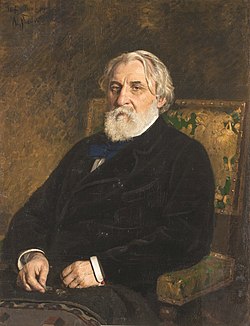
Ivan Turgenev
Ivan Sergeyevich Turgenev (/tʊərˈɡɛnjɛf, -ˈɡeɪn-/ toor-GHEN-yef, -GAYN-; Russian: Иван Сергеевич Тургенев, IPA: [ɪˈvan sʲɪrˈɡʲe(j)ɪvʲɪtɕ tʊrˈɡʲenʲɪf]; 9 November [O.S. 28 October] 1818 – 3 September [O.S. 22 August] 1883) was a Russian novelist, short story writer, poet, playwright, translator and popularizer of Russian literature in the West.
His first major publication, a short story collection titled A Sportsman's Sketches (1852), was a milestone of Russian realism. His novel Fathers and Sons (1862) is regarded as one of the major works of 19th-century fiction.
Ivan Sergeyevich Turgenev was born in Oryol, Russia, to noble Russian parents Sergei Nikolaevich Turgenev (1793–1834), a colonel in the Russian cavalry who took part in the Patriotic War of 1812, and Varvara Petrovna Turgeneva (née Lutovinova; 1787–1850). His father belonged to an old, but impoverished Turgenev family of Tula aristocracy that traces its history to the 15th century when a Tatar mirza Lev Turgen (Ivan Turgenev after his baptism) left the Golden Horde to serve Vasily II of Moscow. Ivan's mother came from a wealthy noble Lutovinov house of the Oryol Governorate. She spent an unhappy childhood under her tyrannical stepfather and left his house after her mother's death to live with her uncle. At age 26, she inherited a huge fortune from him. In 1816, she married Turgenev.
Ivan and his brothers Nikolai and Sergei were raised by their mother, an educated, authoritarian woman. Their residence was the Spasskoye-Lutovinovo family estate that was granted to their ancestor Ivan Ivanovich Lutovinov by Ivan the Terrible. Varvara Turgeneva later served as an inspiration for the landlady from Turgenev's Mumu. The brothers had foreign governesses; Ivan became fluent in French, German, and English. The family members used French in everyday life, including prayers. Their father spent little time with the family. Although he was not hostile toward them, his absence hurt Ivan's feelings. Their relations are described in the autobiographical novel First Love. When Ivan was four years old, the family journeyed through Germany and France. In 1827, the Turgenevs relocated to Moscow to enable the children to have a proper education.
After the standard schooling for a son of a gentleman, Turgenev studied for one year at the University of Moscow and then moved to the University of Saint Petersburg from 1834 to 1837, focusing on Classics, Russian literature, and philology. During that time his father died from kidney stone disease, followed by his younger brother Sergei who died from epilepsy. From 1838 until 1841, he studied philosophy, particularly Hegel, and history at the University of Berlin. He returned to Saint Petersburg to complete his master's examination.
Turgenev was impressed with German society and returned home believing that Russia could best improve itself by incorporating ideas from the Age of Enlightenment. Like many of his educated contemporaries, he was particularly opposed to serfdom. In 1841, Turgenev started his career in the Russian civil service and spent two years working for the Ministry of Interior (1843–1845).
When Turgenev was a child, a family serf had read to him verses from the Rossiad of Mikhail Kheraskov, a celebrated poet of the 18th century. Turgenev's early attempts in literature, poems, and sketches gave indications of genius and were favorably spoken of by Vissarion Belinsky, then the leading Russian literary critic. During the latter part of his life, Turgenev did not reside much in Russia: he lived either at Baden-Baden or Paris, often in proximity to the family of the celebrated opera singer Pauline Viardot, with whom he had a lifelong affair.
Turgenev never married, but he had some affairs with his family's serfs, one of which resulted in the birth of his illegitimate daughter, Paulinette. He was tall and broad-shouldered, but was timid, restrained, and soft-spoken. When Turgenev was 19, while traveling on a steamboat in Germany, the boat caught fire. According to rumours by Turgenev's enemies, he reacted in a cowardly manner. He denied such accounts, but these rumours circulated in Russia and followed him for his entire career, providing the basis for his story "A Fire at Sea". His closest literary friend was Gustave Flaubert, with whom he shared similar social and aesthetic ideas. Both rejected extremist right and left political views, and carried a nonjudgmental, although rather pessimistic, view of the world. His relations with Leo Tolstoy and Fyodor Dostoyevsky were often strained, as the two were, for various reasons, dismayed by Turgenev's seeming preference for Western Europe.
Ivan Turgenev
Ivan Sergeyevich Turgenev (/tʊərˈɡɛnjɛf, -ˈɡeɪn-/ toor-GHEN-yef, -GAYN-; Russian: Иван Сергеевич Тургенев, IPA: [ɪˈvan sʲɪrˈɡʲe(j)ɪvʲɪtɕ tʊrˈɡʲenʲɪf]; 9 November [O.S. 28 October] 1818 – 3 September [O.S. 22 August] 1883) was a Russian novelist, short story writer, poet, playwright, translator and popularizer of Russian literature in the West.
His first major publication, a short story collection titled A Sportsman's Sketches (1852), was a milestone of Russian realism. His novel Fathers and Sons (1862) is regarded as one of the major works of 19th-century fiction.
Ivan Sergeyevich Turgenev was born in Oryol, Russia, to noble Russian parents Sergei Nikolaevich Turgenev (1793–1834), a colonel in the Russian cavalry who took part in the Patriotic War of 1812, and Varvara Petrovna Turgeneva (née Lutovinova; 1787–1850). His father belonged to an old, but impoverished Turgenev family of Tula aristocracy that traces its history to the 15th century when a Tatar mirza Lev Turgen (Ivan Turgenev after his baptism) left the Golden Horde to serve Vasily II of Moscow. Ivan's mother came from a wealthy noble Lutovinov house of the Oryol Governorate. She spent an unhappy childhood under her tyrannical stepfather and left his house after her mother's death to live with her uncle. At age 26, she inherited a huge fortune from him. In 1816, she married Turgenev.
Ivan and his brothers Nikolai and Sergei were raised by their mother, an educated, authoritarian woman. Their residence was the Spasskoye-Lutovinovo family estate that was granted to their ancestor Ivan Ivanovich Lutovinov by Ivan the Terrible. Varvara Turgeneva later served as an inspiration for the landlady from Turgenev's Mumu. The brothers had foreign governesses; Ivan became fluent in French, German, and English. The family members used French in everyday life, including prayers. Their father spent little time with the family. Although he was not hostile toward them, his absence hurt Ivan's feelings. Their relations are described in the autobiographical novel First Love. When Ivan was four years old, the family journeyed through Germany and France. In 1827, the Turgenevs relocated to Moscow to enable the children to have a proper education.
After the standard schooling for a son of a gentleman, Turgenev studied for one year at the University of Moscow and then moved to the University of Saint Petersburg from 1834 to 1837, focusing on Classics, Russian literature, and philology. During that time his father died from kidney stone disease, followed by his younger brother Sergei who died from epilepsy. From 1838 until 1841, he studied philosophy, particularly Hegel, and history at the University of Berlin. He returned to Saint Petersburg to complete his master's examination.
Turgenev was impressed with German society and returned home believing that Russia could best improve itself by incorporating ideas from the Age of Enlightenment. Like many of his educated contemporaries, he was particularly opposed to serfdom. In 1841, Turgenev started his career in the Russian civil service and spent two years working for the Ministry of Interior (1843–1845).
When Turgenev was a child, a family serf had read to him verses from the Rossiad of Mikhail Kheraskov, a celebrated poet of the 18th century. Turgenev's early attempts in literature, poems, and sketches gave indications of genius and were favorably spoken of by Vissarion Belinsky, then the leading Russian literary critic. During the latter part of his life, Turgenev did not reside much in Russia: he lived either at Baden-Baden or Paris, often in proximity to the family of the celebrated opera singer Pauline Viardot, with whom he had a lifelong affair.
Turgenev never married, but he had some affairs with his family's serfs, one of which resulted in the birth of his illegitimate daughter, Paulinette. He was tall and broad-shouldered, but was timid, restrained, and soft-spoken. When Turgenev was 19, while traveling on a steamboat in Germany, the boat caught fire. According to rumours by Turgenev's enemies, he reacted in a cowardly manner. He denied such accounts, but these rumours circulated in Russia and followed him for his entire career, providing the basis for his story "A Fire at Sea". His closest literary friend was Gustave Flaubert, with whom he shared similar social and aesthetic ideas. Both rejected extremist right and left political views, and carried a nonjudgmental, although rather pessimistic, view of the world. His relations with Leo Tolstoy and Fyodor Dostoyevsky were often strained, as the two were, for various reasons, dismayed by Turgenev's seeming preference for Western Europe.
Recent media
Recent media