Hubbry Logo
Voltage dividerVoltage dividerMain
Open search
Voltage divider
Community hub
Voltage divider
logo
7 pages, 0 posts
0 subscribers
Be the first to start a discussion here.
Voltage divider
Voltage divider
from Wikipedia

In electronics, a voltage divider (also known as a potential divider) is a passive linear circuit that produces an output voltage (Vout) that is a fraction of its input voltage (Vin). Voltage division is the result of distributing the input voltage among the components of the divider. A simple example of a voltage divider is two resistors connected in series, with the input voltage applied across the resistor pair and the output voltage emerging from the connection between them.

Resistor voltage dividers are commonly used to create reference voltages, or to reduce the magnitude of a voltage so it can be measured, and may also be used as signal attenuators at low frequencies. For direct current and relatively low frequencies, a voltage divider may be sufficiently accurate if made only of resistors; where frequency response over a wide range is required (such as in an oscilloscope probe), a voltage divider may have capacitive elements added to compensate load capacitance. In electric power transmission, a capacitive voltage divider is used for measurement of high voltage.

General case

[edit]
Figure 1: A simple voltage divider

A voltage divider referenced to ground is created by connecting two electrical impedances in series, as shown in Figure 1. The input voltage is applied across the series impedances Z1 and Z2 and the output is the voltage across Z2. Z1 and Z2 may be composed of any combination of elements such as resistors, inductors and capacitors.

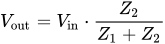
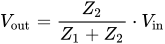
If the current in the output wire is zero then the relationship between the input voltage, Vin, and the output voltage, Vout, is:
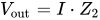
Proof (using Ohm's law):

The transfer function (also known as the divider's voltage ratio) of this circuit is:
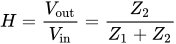
In general this transfer function is a complex, rational function of frequency.

Examples

[edit]

Resistive divider

[edit]
Figure 2: Simple resistive voltage divider

A resistive divider is the case where both impedances, Z1 and Z2, are purely resistive (Figure 2).

Substituting Z1 = R1 and Z2 = R2 into the previous expression gives:
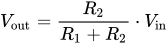
If R1 = R2 then
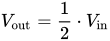
If Vout = 6 V and Vin = 9 V (both commonly used voltages), then:
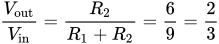
and by solving using algebra, R2 must be twice the value of R1.

To solve for R1:

To solve for R2:
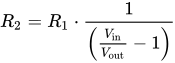
Any ratio Vout / Vin greater than 1 is not possible. That is, using resistors alone it is not possible to either invert the voltage or increase Vout above Vin.

Low-pass RC filter

[edit]
Figure 3: Resistor/capacitor voltage divider

Consider a divider consisting of a resistor and capacitor as shown in Figure 3.

Comparing with the general case, we see Z1 = R and Z2 is the impedance of the capacitor, given by
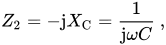
where XC is the reactance of the capacitor, C is the capacitance of the capacitor, j is the imaginary unit, and ω (omega) is the radian frequency of the input voltage.

This divider will then have the voltage ratio:
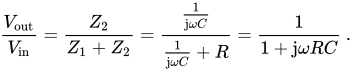
The product τ (tau) = RC is called the time constant of the circuit.

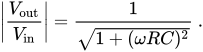
The ratio then depends on frequency, in this case decreasing as frequency increases. This circuit is, in fact, a basic (first-order) low-pass filter. The ratio contains an imaginary number, and actually contains both the amplitude and phase shift information of the filter. To extract just the amplitude ratio, calculate the magnitude of the ratio, that is:
Inductive divider

[edit]

Inductive dividers split AC input according to inductance:
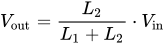
(with components in the same positions as Figure 2.)

The above equation is for non-interacting inductors; mutual inductance (as in an autotransformer) will alter the results.

Inductive dividers split AC input according to the reactance of the elements as for the resistive divider above.

Capacitive divider

[edit]

Capacitive dividers do not pass DC input.

For an AC input a simple capacitive equation is:

(with components in the same positions as Figure 2.)

Any leakage current in the capactive elements requires use of the generalized expression with two impedances. By selection of parallel R and C elements in the proper proportions, the same division ratio can be maintained over a useful range of frequencies. This is the principle applied in compensated oscilloscope probes to increase measurement bandwidth.

Loading effect

[edit]

The output voltage of a voltage divider will vary according to the electric current it is supplying to its external electrical load. The effective source impedance coming from a divider of Z1 and Z2, as above, will be Z1 in parallel with Z2 (sometimes written Z1 // Z2), that is: (Z1 Z2) / (Z1 + Z2) = HZ1.

To obtain a sufficiently stable output voltage, the output current must either be stable (and so be made part of the calculation of the potential divider values) or limited to an appropriately small percentage of the divider's input current. Load sensitivity can be decreased by reducing the impedance of both halves of the divider, though this increases the divider's quiescent input current and results in higher power consumption (and wasted heat) in the divider.[1] Voltage regulators are often used in lieu of passive voltage dividers when it is necessary to accommodate high or fluctuating load currents.

Applications

[edit]

Voltage dividers are used for adjusting the level of a signal, for bias of active devices in amplifiers, and for measurement of voltages. A Wheatstone bridge and a multimeter both include voltage dividers. A potentiometer is used as a variable voltage divider in the volume control of many radios.

Sensor measurement

[edit]

Voltage dividers can be used to allow a microcontroller to measure the resistance of a sensor.[2] The sensor is wired in series with a known resistance to form a voltage divider and a known voltage is applied across the divider. The microcontroller's analog-to-digital converter is connected to the center tap of the divider so that it can measure the tap voltage and, by using the measured voltage and the known resistance and voltage, compute the sensor resistance. This technique is commonly used to measure the resistance of temperature sensors such as thermistors and RTDs.

Another example that is commonly used involves a potentiometer (variable resistor) as one of the resistive elements. When the shaft of the potentiometer is rotated the resistance it produces either increases or decreases, the change in resistance corresponds to the angular change of the shaft. If coupled with a stable voltage reference, the output voltage can be fed into an analog-to-digital converter and a display can show the angle. Such circuits are commonly used in reading control knobs.

High voltage measurement

[edit]
High voltage (HV) resistor divider probe. The HV to be measured (Vin) is applied to the corona ball probe tip and ground is connected to the other end of the divider via the black cable. The divider output (Vout) appears on the connector adjacent to the cable.

A voltage divider can be used to scale down a very high voltage so that it can be measured by a volt meter. The high voltage is applied across the divider, and the divider output—which outputs a lower voltage that is within the meter's input range—is measured by the meter. High voltage resistor divider probes designed specifically for this purpose can be used to measure voltages up to 100 kV. Special high-voltage resistors are used in such probes as they must be able to tolerate high input voltages and, to produce accurate results, must have matched temperature coefficients and very low voltage coefficients. Capacitive divider probes are typically used for voltages above 100 kV, as the heat caused by power losses in resistor divider probes at such high voltages could be excessive.

Logic level shifting

[edit]

A voltage divider can be used as a crude logic level shifter to interface two circuits that use different operating voltages. For example, some logic circuits operate at 5 V whereas others operate at 3.3 V. Directly interfacing a 5 V logic output to a 3.3 V input may cause permanent damage to the 3.3 V circuit. In this case, a voltage divider with an output ratio of 3.3/5 might be used to reduce the 5 V signal to 3.3 V, to allow the circuits to interoperate without damaging the 3.3 V circuit. For this to be feasible, the 5 V source impedance and 3.3 V input impedance must be negligible, or they must be constant and the divider resistor values must account for their impedances. If the input impedance is capacitive, a purely resistive divider will limit the data rate. This can be roughly overcome by adding a capacitor in series with the top resistor, to make both legs of the divider capacitive as well as resistive.

See also

[edit]

References

[edit]
[edit]
Revisions and contributorsEdit on WikipediaRead on Wikipedia
from Grokipedia
A voltage divider is a fundamental passive linear circuit consisting of two or more resistors connected in series across an input voltage source, where the output voltage is taken across one or more of the resistors, resulting in a proportional fraction of the input voltage, applicable to both DC and AC inputs in resistive configurations. This configuration divides the total input voltage among the resistors based on their relative resistances, following the principle that the voltage drop across each resistor is directly proportional to its resistance value in a series circuit. The operation of a voltage divider relies on Kirchhoff's voltage law, which states that the sum of voltages across the series resistors equals the input voltage, and the current through all resistors is identical due to the series connection. For a basic two-resistor divider with input voltage VinV_{in}, resistor R1R_1 connected to the input, and R2R_2 connected to ground, the output voltage VoutV_{out} across R2R_2 is given by the formula Vout=Vin×R2R1+R2V_{out} = V_{in} \times \frac{R_2}{R_1 + R_2}. This equation, known as the voltage divider rule, derives from Ohm's law applied to the circuit, where the current I=VinR1+R2I = \frac{V_{in}}{R_1 + R_2}, and Vout=I×R2V_{out} = I \times R_2. In practice, the accuracy of the output can be affected by loading effects if the subsequent circuit draws significant current, as the effective resistance changes; high-impedance loads minimize this error. Voltage dividers are widely used in electronics for tasks such as generating reference voltages, biasing transistor circuits, and interfacing sensors that require voltage scaling. Common applications include adjustable voltage control via potentiometers, where a variable resistor replaces fixed ones to tune the output, and sensor circuits like thermistors or photoresistors paired with a fixed resistor to convert environmental changes into measurable voltage signals. They also serve in analog-to-digital converters, filters, and power supply regulation to provide stable intermediate voltages from a single source. Despite their simplicity, voltage dividers are essential building blocks in more complex systems, including operational amplifier configurations for gain setting and signal conditioning.

Fundamentals

Definition and Principle

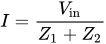
A voltage divider is a passive linear circuit consisting of two or more impedances connected in series across an input voltage source, which produces an output voltage across one or more of the impedances that is a fixed proportion of the input voltage. This division occurs as a direct consequence of Kirchhoff's voltage law (KVL), which states that the algebraic sum of all voltages around any closed loop in a circuit is zero. In a basic series configuration with two impedances, Z1Z_1 and Z2Z_2, the input voltage VinV_{in} is the sum of the voltage drops across each impedance, ensuring that the current through both is identical. The output voltage VoutV_{out} across Z2Z_2 can be derived from KVL and the definition of impedance. Since the current II is the same through both components, I=VinZ1+Z2I = \frac{V_{in}}{Z_1 + Z_2}. The voltage across Z2Z_2 is then Vout=IZ2=VinZ2Z1+Z2V_{out} = I Z_2 = V_{in} \frac{Z_2}{Z_1 + Z_2}. This general formula applies to both direct current (DC) and alternating current (AC) circuits, where impedances ZZ may include resistive, capacitive, or inductive elements. Under ideal conditions, the voltage divider assumes linear components that obey Ohm's law or its impedance generalizations, with no current drawn from the output (i.e., an infinite load impedance to prevent loading effects). Additionally, the analysis holds in steady-state conditions, such as constant DC or sinusoidal AC waveforms where transient effects have decayed. The concept of voltage division emerged from foundational circuit theory in the 19th century, building on early work in electromagnetism, and was formalized through Kirchhoff's circuit laws announced in 1845, which enabled systematic analysis of electrical networks. A common instantiation is the resistive voltage divider for DC applications, where impedances are purely resistive.

Resistive Voltage Divider

The resistive voltage divider employs two resistors in series to divide an input voltage proportionally based on their resistance values. This configuration is fundamental in circuits for generating a scaled output voltage from a higher input voltage. Consider a series circuit where resistor R1R_1 connects the input voltage VinV_{in} to the output node, and resistor R2R_2 connects the output node to ground, with the output voltage VoutV_{out} measured across R2R_2. The same current II flows through both resistors due to the series connection. To derive VoutV_{out}, apply Kirchhoff's Voltage Law (KVL) around the loop: Vin=VR1+VR2V_{in} = V_{R_1} + V_{R_2}, where VR1V_{R_1} and VR2V_{R_2} are the voltages across R1R_1 and R2R_2, respectively. By Ohm's law, VR1=IR1V_{R_1} = I R_1 and VR2=IR2V_{R_2} = I R_2. The total current is I=VinR1+R2I = \frac{V_{in}}{R_1 + R_2}, as the equivalent resistance is R1+R2R_1 + R_2. Substituting yields VR1=VinR1R1+R2V_{R_1} = V_{in} \frac{R_1}{R_1 + R_2} and VR2=VinR2R1+R2V_{R_2} = V_{in} \frac{R_2}{R_1 + R_2}. Thus, the output voltage is given by Vout=VinR2R1+R2.V_{out} = V_{in} \frac{R_2}{R_1 + R_2}. This equation, known as the voltage divider formula, directly follows from the application of Ohm's law and KVL to the series resistive network. The same voltage divider formula applies to purely resistive AC circuits in the time domain. For an input sinusoidal voltage vin(t)=Vmsin(ωt+ϕ)v_{in}(t) = V_m \sin(\omega t + \phi), the time-domain output voltage across R2R_2 is vout(t)=R2R1+R2Vmsin(ωt+ϕ).v_{out}(t) = \frac{R_2}{R_1 + R_2} V_m \sin(\omega t + \phi). Since the circuit is purely resistive, there is no phase shift or frequency-dependent attenuation beyond the constant division ratio, so the output is a scaled version of the input sinusoidal waveform with the same frequency ω\omega and phase ϕ\phi. For a numerical example, suppose R1=1kΩR_1 = 1 \, \mathrm{k}\Omega, R2=2kΩR_2 = 2 \, \mathrm{k}\Omega, and Vin=10VV_{in} = 10 \, \mathrm{V}. The output is Vout=10×21+2=6.67VV_{out} = 10 \times \frac{2}{1 + 2} = 6.67 \, \mathrm{V}. In this circuit, the voltage drop across R1R_1 is 3.33 V, and across R2R_2 is 6.67 V, confirming the proportional division. Power dissipation in the resistors must be considered to avoid overheating, as each resistor converts electrical energy to heat. The power in a resistor is P=V2RP = \frac{V^2}{R}, where VV is the voltage across it. For R1R_1, P1=(VinR1R1+R2)2R1P_1 = \frac{\left( V_{in} \frac{R_1}{R_1 + R_2} \right)^2}{R_1}; for R2R_2, P2=(VinR2R1+R2)2R2P_2 = \frac{\left( V_{in} \frac{R_2}{R_1 + R_2} \right)^2}{R_2}. Resistors should be rated to handle at least these values, typically with a margin for safety. In design, the resistor ratio R2R1+R2\frac{R_2}{R_1 + R_2} is selected to achieve the desired attenuation factor, with higher R1R_1 values reducing current draw but potentially increasing noise sensitivity in practice. Resistor tolerances affect accuracy; for instance, using 1% tolerance resistors limits the output error to approximately ±2% in a typical divider, as the relative errors add in the ratio. Standard E-series values (e.g., 1 kΩ, 2 kΩ) facilitate practical implementation while minimizing tolerance impacts.

Reactive and Frequency-Dependent Dividers

Capacitive Voltage Divider

A capacitive voltage divider consists of two or more capacitors connected in series across an AC input voltage source, producing an output voltage proportional to the capacitance ratio, similar to the resistive case but applicable only in steady-state AC conditions. The output voltage VoutV_{out} across the second capacitor C2C_2 is given by Vout=VinC1C1+C2,V_{out} = V_{in} \cdot \frac{C_1}{C_1 + C_2}, where C1C_1 is the capacitor connected between the input and output, and C2C_2 is the capacitor from the output to ground. This formula arises because the charge on series capacitors is the same, leading to voltage division inversely proportional to capacitance. The principle relies on capacitive reactance XC=12πfCX_C = \frac{1}{2\pi f C}, where ff is the frequency and CC is the capacitance, representing the opposition to AC current flow. For pure capacitors in series, the total reactance is the sum of individual reactances, but the voltage division ratio remains independent of frequency because both reactances scale inversely with ff in the same manner, preserving the proportion XC1XC1+XC2=C2C1+C2\frac{X_{C1}}{X_{C1} + X_{C2}} = \frac{C_2}{C_1 + C_2}. This frequency invariance holds under ideal conditions for sinusoidal AC signals, contrasting with DC where no division occurs. A rigorous derivation uses complex impedances, where the impedance of a capacitor is Z=1jωCZ = \frac{1}{j \omega C}, with ω=2πf\omega = 2\pi f and jj the imaginary unit. For two capacitors in series, the output voltage is VoutVin=Z2Z1+Z2=1jωC21jωC1+1jωC2=1C21C1+1C2=C1C1+C2.\frac{V_{out}}{V_{in}} = \frac{Z_2}{Z_1 + Z_2} = \frac{\frac{1}{j \omega C_2}}{\frac{1}{j \omega C_1} + \frac{1}{j \omega C_2}} = \frac{\frac{1}{C_2}}{\frac{1}{C_1} + \frac{1}{C_2}} = \frac{C_1}{C_1 + C_2}. The jωj \omega terms cancel, confirming the frequency-independent ratio for steady-state AC analysis. This approach treats the circuit as a generalized voltage divider using phasor methods. In AC circuits, capacitive voltage dividers serve as precursors to coupling networks, where they isolate signals while maintaining voltage scaling, or in basic filtering setups to attenuate specific frequencies before further processing. They are also employed in high-voltage measurement, such as scaling down transmission line potentials for metering without drawing significant current. Key limitations include inherent DC blocking, as capacitors prevent steady DC current flow, rendering the divider ineffective for DC inputs where the output would equal the input after charging. In real capacitors, leakage currents—small conductive paths through the dielectric—can introduce errors, particularly at low frequencies or high voltages, deviating from ideal behavior by allowing minor DC conduction.

Inductive Voltage Divider

An inductive voltage divider consists of two inductors connected in series across an input voltage, with the output taken across one of the inductors, primarily used for dividing AC voltages in applications requiring precise ratio control without significant power loss. Unlike resistive dividers, it leverages the inductive reactance of the components to achieve voltage division. The voltage division ratio is derived using the general impedance divider formula, where the impedance of each inductor is Z=jωLZ = j \omega L, with ω\omega as the angular frequency and LL as inductance. For inductors L1L_1 (from input to output) and L2L_2 (from output to ground), the output voltage VoutV_\text{out} across L2L_2 is given by: VoutVin=Z2Z1+Z2=jωL2jωL1+jωL2=L2L1+L2\frac{V_\text{out}}{V_\text{in}} = \frac{Z_2}{Z_1 + Z_2} = \frac{j \omega L_2}{j \omega L_1 + j \omega L_2} = \frac{L_2}{L_1 + L_2} This ratio is independent of frequency for ideal inductors, providing a constant division for AC signals above DC. At DC or very low frequencies approaching 0 Hz, inductors exhibit zero reactance and behave as short circuits, resulting in no voltage drop across either inductor and Vout=VinV_\text{out} = V_\text{in}, effectively providing no division. As frequency increases, the reactance dominates (assuming negligible parasitic resistance), and the ratio stabilizes at L2/(L1+L2)L_2 / (L_1 + L_2). In real inductors with series resistance R1R_1 and R2R_2, the low-frequency behavior follows a resistive division R2/(R1+R2)R_2 / (R_1 + R_2), transitioning to the inductive ratio at higher frequencies where ωLR\omega L \gg R. Practical implementations face challenges including large physical size and weight due to the need for substantial inductance, particularly at audio or power frequencies, limiting portability. Magnetic core saturation can occur under high currents or DC bias, distorting the linear response and ratio accuracy. Additionally, inductors generate electromagnetic interference (EMI) through magnetic fields, requiring shielding in sensitive environments, and are susceptible to external magnetic fields affecting performance. A representative example is a two-inductor circuit in RF applications, such as dividing signals in antenna matching networks, where high-frequency operation allows compact air-core inductors and maintains the constant ratio for efficient power transfer.

RC and RL Divider Configurations

RC and RL divider configurations combine resistive elements with reactive components (capacitors or inductors) to create frequency-dependent voltage dividers that function as first-order filters, providing controlled attenuation of signals based on frequency. These hybrid setups differ from pure resistive dividers by incorporating phase shifts and magnitude roll-off, making them essential for applications requiring selective frequency response, such as signal filtering in electronics. In an RC low-pass configuration, a resistor is placed in series with the input, followed by a capacitor connected to ground, with the output voltage taken across the capacitor. The transfer function is given by H(jω)=VoutVin=11+jωRC,H(j\omega) = \frac{V_{out}}{V_{in}} = \frac{1}{1 + j\omega RC}, where RR is the resistance and CC is the capacitance. The cutoff frequency, at which the magnitude response drops to 1/21/\sqrt{2}
Add your contribution
Related Hubs
User Avatar
No comments yet.